Torture and some salvation

Posted in Torture to Salvation on April 28th, 2011 by admin


Daniel Heyman‘s two part exhibition called

“Bearing Witnes” is at Linfield College in McMinnville Oregon and the White Box of the University of Oregon gives us unimaginable suffering and inhumanity in the first show depicting men recently released from Abu Ghraib, and some salvation in the second part about a program in Philadelphia for men released from prison who are being helped to reconnect to their children and their lives.

We know about Abu Ghraib, in media sound bites, and a few images, but Daniel has been face to face with men and women who have been subjected to the most unimaginable treatment that one person can perpetrate on another. He listened as they told in simple facts what had happened to them at the hands of the people in the prison. They had been released because it was found that they had done nothing at all.

As Brian Winkenweder, art historian at Linfield College,  stated in a conversation”The military machine does not work unless you are dehumanized” And he further pointed out that the people who were perpetrating the abuse were at the bottom of a huge chain of command.

It is wonderful that Heyman’s work affected Winkenweder as he is a specialist in the history of art criticism, a long way from torture in Iraq. It demonstrates the possibilities for political art that defies all restrictions.  Winkenweder calls Heyman a  teller of stories : I would counter with the idea that Heyman listens and records not stories, but brutal facts.

What we see, given that awareness of the monstrosity of the military machine, is that these innocent men were physically and emotionally violated in almost every way that is possible. It was lo tech, it was physical; it used  feces, urine, cold water, wet floors, wet mattresses, dogs, chains, beating, stress positions,  forced sex, raping of wives and daughter, raping of prisoners by both men and women, all of these acts are told by the recently released prisoners.

Heyman listened.

He wrote down what they said verbatim.

And he made portraits of the men. The gallery is a row of individual heads of men, they are dignified, and calm. It is hard to imagine surviving such abuse, but being able to at least say it must have provided some relief from the nightmare. The men are part of a class action suit against military contractors who were part of the abuse, you can’t sue the U.S. military.

In the second exhibition Heyman is listening to men who have also just come out of prison, in this case in the US. We learn not about their abuse in the prison, but the abusive circumstances of their lives, the rape of their very young mother, the murder of their very young father, their own efforts at bare survival; and then at the end we have an organization, the National Comprehensive Center for Fathers that has reached them and is offering some support.

Support for those who have been abused, who have lived at the bottom of our culture, with no resources, no opportunities. This is crucial. And Daniel in making these art works, these portrait galleries is giving us the faces and the circumstances of these individual men.

Each face is different, yellow, oranges, browns, blues, reds, and the color of face spills into changing colors of writing, the writing snakes around the head, waves in the space. The gouache colors are very strong.

Heyman listens, and the least we can do is listen also, challenging as it is to read these narratives.

I am a farmer. I was 22 at the time of the arrest. In the interrogation, I was forced on the ground, my hands tied to my feet behind my back. The interrogator hit me with his fists and kicked me with his boots. I vomited blood. For nine days I was not allowed to leave the cell  and use the bathroom …. 

My Mom was 17 . . . it was an accidental shooting, she was shot, felt a burning sensation and saw blood. She made it home, the cops came and beat her up. ... there was a long wait... she was paralyzed. She fought her way back. Later she participated in the Special Olympics


Tags: , , , , ,

Cultural Activism in a Time of Crisis, the exhibition

Posted in Uncategorized on April 25th, 2011 by admin

Entrance to the exhibition with Roger Shimomura visible opposite door

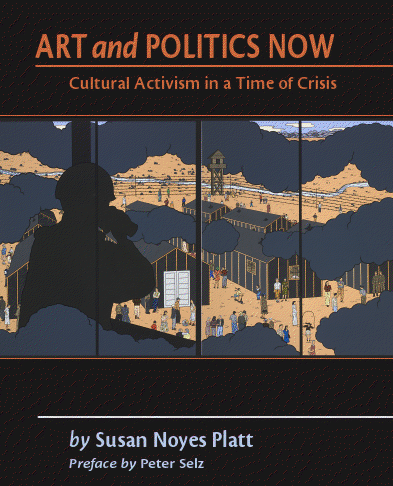
It is a time to return to blogging after the excitement of the book publication and the art exhibition. What better way than to analyze why the show “Cultural Activism in a Time of Crisis” is so exciting. As I have been giving people tours, I realized that all of these artists, whom I have been thinking about and writing about for several years for the book, are both deeply committed to social expressions and deeply committed to making strong art. Although I chose them to be in the book for that reason ( as well as the other 80 artists), seeing their work together in a fairly compact gallery space, where they speak loudly and clearly, each in a different medium and often on a different subject, underscores the power of their work. and the power of truly engaged artists to intervene in political discourses with new perspectives and new insights. In this time of perpetual visual imagery, visual artists are more important than ever to select and make more intense the subjects which we are all concerned about.

The installation, brilliantly resolved by Ken Matsudaira, the Director of the M. Rosetta Hunter Gallery at Seattle Central Community College, was very difficult because of the wide ranging aesthetics and topics, materials, and scale. We had glass, drawing, print making, paper, ceramic, painting, fabric, multi media installation and video. All of the work is on my website under www.artandpoliticsnow.com/exhibition. There are also installation shots on the website and a few pictures of the opening, and links to artists websites.

The topics addressed are maquiladora factories and their victimized workers, (Celia Munoz)  the unremembered Chinese railroad workers ( Zhi Lin), Abu Ghraib (Daniel Heyman, Selma Waldman, Deborah Lawrence), La Malinche with a new feminist perspectives (Cecilia Alvarez), civilian casualities in war (Gail Tremblay), appealing to peacemakers to prevent war ( Ellen Sollod), Chinese immigration (Flo Wong), Argentinian disappearances (Claudia Bernardi), racism (Marita Dingus), the oppressions of the separation wall between Palestine and Israel, (Larissa Sansour), the oppressions of  colonialism ( Maki Tamura) , the connection of past and present oppressions of native Americans in Alaska ( Tanis S’eiltin), the position of women in the midst of capitalist war(Deborah Lawrence),   South African violence (Kim Berman), and the pertinence of ancient Indian spirituality to our contemporary world (Lillian Pitt).

It is a big range, and each one includes unusual conceptualizations, rare insights, and new perspectives. This is political art at its best. It completely refutes the tired dismissals of shallow thinkers who seem to think that art that engages issues is somehow second to art that  is personal or is simply an assemblage of materials for their own sake. In fact those expressions are also political, in that the artists are choosing to deny that they live in a world with issues that are larger than they are, that affect them every day, that are part of who they are, even though they don’t know it. The artists in “Cultural Activism in a Time of Crisis” know these facts, they embrace not only who they are, but their place on the planet. That is the crucial act that all artists must follow today

At a recent “Conversation” sponsored by John Boylan, Seattle art critic, one participant, a young graduate student at the University of Washington, declared “there is no poetry in politics.” A young man who was attending and had just come from Wisconsin, said “Tell that to the people in Wisconsin.” In Wisconsin nobody is deluded into thinking that staring at their bellybutton is a way to stop the horrendous legislation that is being bullied through the state government. Being oblivious to the world means allowing the world to control you, more so every day. Exposure of wrongs and making visible those wrongs is what artists can do. The best ones are doing that.

Thousands of unions members protest budget cuts

When I went to Olympia to protest the budget cuts being perpetrated on the poorest, youngest, and sickest people of our state, at the expense of huge tax breaks for the wealthy, I saw some signs, some images, some log0s that were strong ( unfortunately I didn’t have a camera). The collective energy of 6000 union workers coming together was huge. But the most powerful moment for me was listening to the deep throbbing of a group of  Indian drummers. The use of art heightened the event immeasurably and connected the past and the future.

Indians in the Northwest are more and more frequently appearing at political events or just outdoor events, drumming, and reminding us of our spiritual roots, and the importance of fighting for the survival of the planet every day in some way that we can.

Tags: