The #Occupy Movement: Conversations

Posted in #Occupy movement, Uncategorized on November 19th, 2011 by admin

Waiting for Amtrak: the author in Penn Station, NYC

This blog marks my exciting experiences with  the early stages of the Occupy movement,  before the police in the service of the oligarchy started using pepper spray and obliteration tactics. You can see I look really happy here.  I was on the road lecturing on my book and I was able to visit five Occupy sites, each one has a different personality. Accidentally,  I missed the mass marches, and arrived at odd times of days, spending time talking to small groups of always extremely diverse individuals.   The spirit of the movement is certainly about conversation among people, among people in public, something that is unheard of in the U.S. for a long time. Although I am an ongoing activist, the amount of conversation I have had in all the Occupy sites with complete strangers from all walks of life,  is thrilling. That is one of the core signficant aspects of the movement. We are all so insulated in our corners of the world with our work, our families, our busy lives. Suddenly, “#Occupy ” allows us to break out of it and share common concerns.

We are joined together, we respect each other. The people united they cannot be defeated!

Seattle Occupy and AntiWar

The second experience for me was to feel the synergy among different causes. I have written already about Seattle and its intersections with various rallies that took place while the group was based in Westlake Park in downtown Seattle: anti war, anti police brutality, abolish Columbus Day, no genetically modified foods, and the list goes on.


In Des Moines Iowa I was there before and after a big march, the

Rainy Monday Morning Des Moines Occupy

people were friendly, and informed  about all sorts of different issues, from economic justice to lesbian and gay rights. They told me on a Monday morning, that most of them were at work.


Drummers at OWS

In NYC the energy center of the movement, I was overwhelmed by the  thrilling intersections of so many different people, their statements, their poetry, art, politics: support for political prisoners at the General Assembly, Tibet, brutality and illegal detention in Colombia, libraries, old, young, school children doing a project for social studies, the energies are many, stoic, resistant, calm, angry, it is an “Occupy” not an occupation an elderly black gentleman reminded me when I asked for directions in downtown NYC.

Pedal Power at OWS

Knitting for the Occupiers

SYNERGY

I am constantly amazed that people think that the Occupy movement has no demands. The demands are many and clear. I picked up the manifesto in NYC and it is a sweeping statement about all the ills perpetrated by corporations.  That is the right target and the right message, all messages, anti war, detention of immigrants, black sites, environment, all come to the same problem, the corporations  spending money for immoral purposes, making bombs, private prisons, surveillance.

So the conversations were real conversations.

Northhampton Mass Occupy

In Northhampton, Mass, there was not one, not two, but three different actions going on in the center of this small town, an Occupy, an anti war demonstration that has been there for years, and political signs for the upcoming election ( this was November 5).  The anti war protestors were at the center, the Occupy in a park not so visible, but there were anti war people included. Both included people of various ages, older, younger, children. And the Anti War people were handing out flyers about Occupy activities.

Hartford Conn Nov 8

In Hartford, in the middle of a sunny Tuesday morning, I dragged my suitcase up a muddy hill when I was changing buses, and talked with the people who were awake. They had just had a big march, but they were there and I cheered them on and was happy to meet them.

As a journalist and art critic, I have photographed as many signs as possible, recording the people’s poetry pouring out on these signs. In Seattle they were short and to the point, in NYC there were really long long essays on signs!

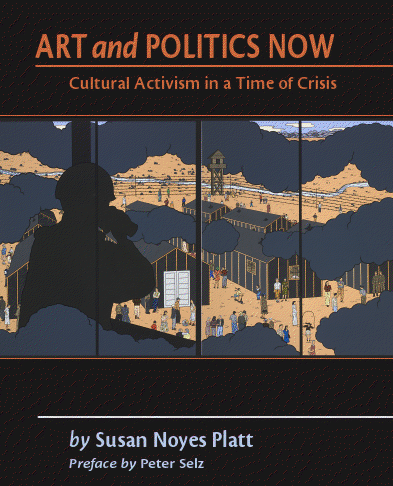
We also know that all the Occupy Sites have libraries. I have donated my book Art and Politics Now, Cultural Activism in a Time of Crisis to three of them.

#Occupy Wall Street

Statue participating in Occupy Wall Street

Occupy Wall Street Nov 2 9PM

Joshua Boulet Occupy Wall Street

This is a video of the poet Michael O’Brian reciting his amazing poems at OWS, Occupy Wall Street. It  has good footage giving a sense of the diversity of the activities going on there.   I have more photographs on my artandpoliticsnow flckr photostream and videos on my artandpoliticsnow YouTube channel:Drumming at Zuccotti Park NYC with other protestors

The videos include the flags waving, the sense of so many different people standing up for what they believe in.

Even the statues!

I didn’t photograph a union ironworker whose sign said he was employed and angry. When I talked to him he said he was actually lucky becuase he had work, but he was still pissed off.

This is a general shot of the encampment. And below is the work of Joshua Boulet, an artist drawing sketches at OWS. I really like his work. Buy some of it at his website.

So poets, musicians then and now, visual artists, and everybodyas a writer, artist, poet.  That is another signficance. Making signs is bringing out the creativity of every person and demonstrating the words and images are available as tools in changing the world.

As the Occupy movement is entering its new phase in mid November, it is important to hold on to the joyful connection and energy as well as the anger and discontent that is fueling this nationwide ongoing protest against the invasion of corporations into government. Here is a live stream to NYC.


Dorli Rainey

One of the most succinct statements of where the country is going was made by Dorli Rainey interviewed on Democracy Now after she was pepper sprayed on November 15.

She said in response to the Mayor’s apology to her

“ We spoke very briefly, and I told him that he is not in charge of what is going on, that our politicians really have lost control, and this sort of brutality is now endemic all over the United States and is being controlled by Homeland Security, by the FBI, and by the military against the war on terrorism. And it has nothing to do any longer with what individual mayors may want or not want to do.” This was reiterated in Oakland when bloggers pointed out that it was the retail oligarcy in downtown Oakland that put pressure on the Mayor there to eliminate the protestors.

The current horrifying sight of police in paramilitary gear spraying, beating up and arresting peaceful unarmed protestors is evidence of the fear that this movement has put in the elite. My image of the day is that all the police will suddenly realize that they are, indeed, also part of the 99 percent and take off all that gear and join us. The live stream today showed a police captain holding a sign ” police stop being mercenaries for the wealthy” !

I wonder if the copy of my book Art and Politics Now, Cultural Activism in a Time of Crisis that I donated to #Occupy Wall Street was trashed when the camp was destroyed or it was among the books that survived. In any case my spirit is there with the demonstrators


Tags: , , , , , ,

Sopheap Pich “Compound”

Posted in Sopheap Pich on November 12th, 2011 by admin


Sopheap Pich in front of part of his installation Compound

Sopheap Pich’s installation Compound at the Henry Art Gallery in Seattle is an oasis of peaceful structures that can evoke anything from bombs ( according to the artist) to fish traps, chicken coops, cages, high rises or fantasy playscapes (I thought of children crawling underneath and through these light weight structures.)

There is a lot of information about the  Sopheap Pich on the website of  Tyler Rollins because Sopheap is having a simultaneous one person show there. It features Morning Glory made of the same rattan and wire  as Compound. Morning Glories for the artist refer to a survival food in Cambodia during his childhood, when the Khmer Rouge controlled Cambodia.

Morning Glory courtesy of Tyler Rollins Fine Art

He escaped with his family to a refugee camp in 1979 and then to Massachusetts  in 1984. The story of the escape of many refugees with experiences in common with him is the subject of an astonishing play by Mark Jenkins, Red Earth Gold Gate Shadow Sky. The play is directed by Victor Pappas with all the actors Asian Americans, most of them Cambodian born and many who endured similar traumas as those presented in the play. There will be more performances next weekend at High Point Community Center in South Seattle.


The cast of Red Earth Gold Gate, Shadow Sky

The play is a reading and pantomine that includes Cambodian singing ( by a pop star in Cambodia) and Cambodian dancing ( by two young people), as a play within a play, performed at a refugee camp. The play begins with the American bombing of Cambodia (remember that in the winter of 1970) and it follows the disruption of one agricultural family to the city, back to the country side, taken by the Khmer Rouge in 1974, forced to produce food they could not eat for the Khmer Rouge, escape into the jungle, bare survival, escape to refugee camp in Thailand, several years of terrible treatment, sponsorship to US, placed in ghettoes here, gangs, difficulties ( Part II will treat the forced return of some of these people as a result of the new immigration laws, there is a photographic exhibition about some of them after they return to Cambodia that is devastating).  The period has been presented in the 1984  film by Dith Pran,  The Killing Fields and there are also books  with memories of other survivors. This production is a collaboration with Don Fels, Seattle based visual artist, Sopheap Pich who has created “visual framing” for the project, and others.

Sopheap Pich concept of repeated imprisonment

Sopheap Pich Model for set design of Red Earth...


Sopheap had many of these same experiences: like  so many other Cambodians he went through repeated traumas. In 2003 he returned voluntarily to Cambodia. He  found his current medium, the material that comes from his childhood as the son of rice farmers, the traps of fishing and of other agricultural implements.

It is a cheap material, he harvests the wood himself. His sculptures are made from the trees, split , boiled and shaped, the wood is made into a mesh with  fishing wire meticulously wound at hundreds of intersections – the wire made from metal recycled from left over war materials that were carted to Vietnam and then brought back as resusable materials. This detritus of war was the foundation of construction material until recently.

But now Cambodia is having a huge and ecologically destructive development surge, particularly around the capitol. Sopheap’s studio was on a lake, a cabin on stilts. The entire lake  is being destroyed for development, shown in a few photographs that accompany the sculpture.

Sopheap Pich Compound

“Compound” can be a prison or a fantasy city. It is  built out of the cheapest material, it can be an allegory of the new Cambodian economy, the new cities being built as most Cambodians still live on a dollar a day. They are a compound and an imprisonment, as well as a dream and a fantasy.  They invite you to enter but prevent you from doing so.

Sopheap has rearranged the bomb like shapes to be towers of this city, in previous installations they rested underneath the city. Bombs into towers, war into development, but development built on air with the work of the peasant. These simple structures suggest all of this, even as the artist has declared that they are abstract. He spoke of creating a peaceful environment in his studio, an oasis of calm with his team of workers as they build the rattan with its intersections connected by wire.

detail

Calm and peace. Coming out of the traumas of his past. It makes a lot of sense. In his previous work ( see the website above for his other work) he created organs, body parts out of rattan, he made reference to the war traumas more directly in his statements. Now he has moved to a less specific expresssion, and he specifically stated that he was not a political artist, no doubt coached by the international art scene that being “political” is not an accepatable concept. But abstract, allegorical, metaphorical though his work is, it is deeply political as well.

Peace is a political concept.

As part of the events in Seattle, Boreth Ly, a brilliant Cambodian academic based in Santa Cruz, discussed Sopheap’s work as well as that of other contemporary Cambodian artists, You Khin, Chakra Oeur, Sarith Peou, Aragna Ker and Seckon Leang with the theme of the trauma of memory and displacement, “home” and identity. Unfortuantely the nightmares of the past are still visited on the present, not only in their dreams, but also in present day Cambodia which is being destroyed by development. Cambodian American Aragna Ker’s image of a Superman Zarathustra provides one way forward!

Aragna Ker Supermanzarathustra


Tags: , , , , , , , , ,