Arpita Singh : Remembering – at the Serpentine Gallery, London

video still of Arpita Singh

Arpita Singh’s retrospective at the Serpentine Gallery in London gives us her career from the early 1970s to the present. It includes huge narrative oil paintings and small abstract watercolors.
I could feel the intensity in each work no matter what the style or size. Each viewer can find a different story here. I found a trajectory from calm but eccentric domesticity to political chaos.
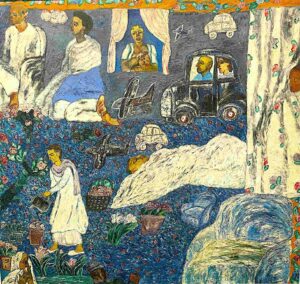
Munna Apa’s Garden 1989
As Munna Apa waters her garden, we see a dead man covered by a white sheet behind her and another figure fearfully peeking through a curtain on the right. Other people in the car and upper part of the painging seem oblivious, but in the center of the bottom we barely see a policeman- harbinger of things to come.
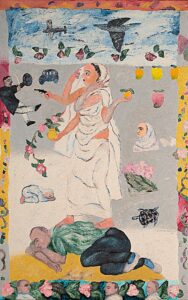 This painting “Devi Pistol Wali ” 1990 gives us a transition. A pistol in one hand and fruit in two others, this goddess is standing on a sleeping? man held up by three others. Small figures suggest a man with a sword, a car, a worshipping person, an airplane, a bird, and various other details.
The Devi ( Goddess) is dressed in white as a widow and pointing a gun at the small man with a sword? or just self protection.
It is easy to make a narrative out of these details
Only three years later she painted her iconic picture of her mother
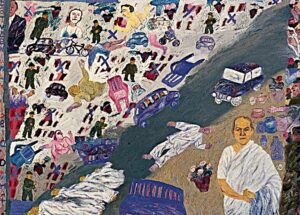
Following the destruction of the Babri Mosque in 1992, the mood of this painting is entirely different. Her mother stands stoic in the right hand corner, but there are dead people near her. Across a road is a lot of small figures : policemen, more dead people, chairs, cars and much more. So her mother stands against the chaos.
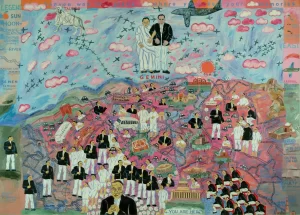
My lolliipop city: Gemini Rising 2005
this painting is hard to interpret. Gemini Rising suggests something positive as we see the couple in the sky, but the gathering crowd may point to something more ominous
Moving forward to increasing chaos
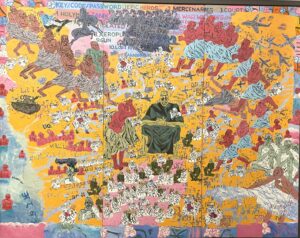
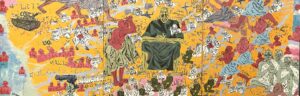 detail
Whatever is Here, 2006 has a somber praying figure in the center surrounded by white praying men, but above him are two groups of aggressive fighters in dark red and light brown with a cavalcade of gray horses between them. Some of the red men are spilling into the praying figures

Searching Sita through Torn Paper Strips, Paper Strips and Labels, 2015
Sita is the wife of Rama who is kidnapped by Ravana, King of Lanka. In this extraodinary painy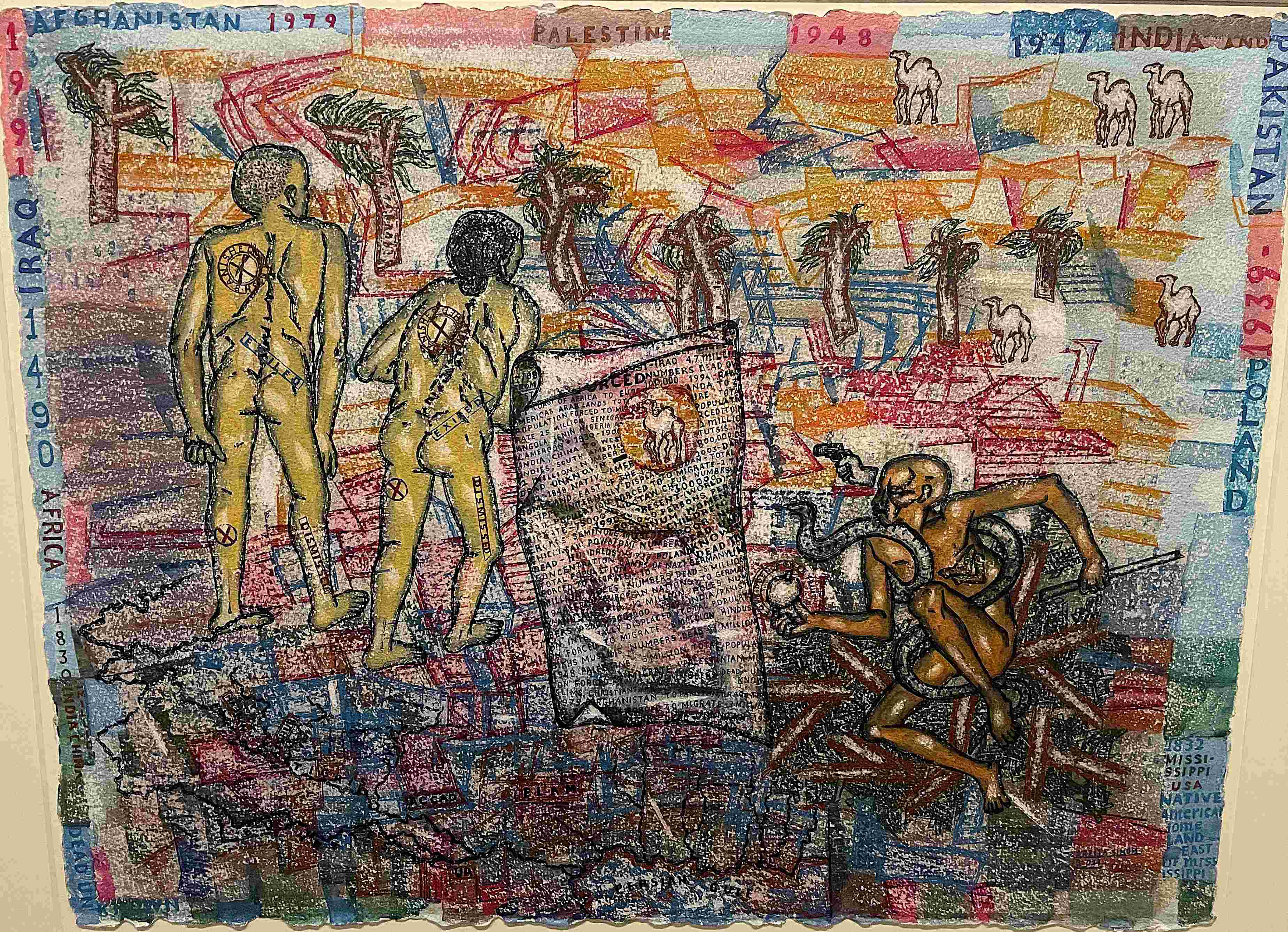 ing we see red deer in the center amidst a landscape of torn up letters. In the Ramayana golden deer distracted Rama as his wife was kidnapped.
Here we see an entire herd of red deer at the center
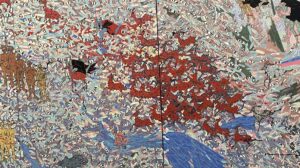
and a repeated image of capture with black covered people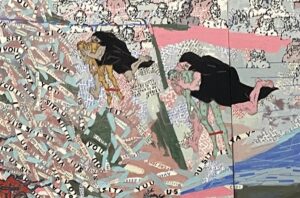
Also note the use of words in the backgoundL Sita repeated with other incomplete words


Homeward 2020

She has written boat over and over in a boat shaped white image
The date suggests wishful thinking in 2020, the year of the Covid shutdown, but this beautiful image is comforting if a little desolate
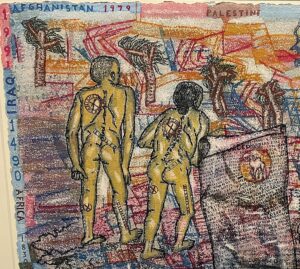
The Exile 2011 really states the deep problem: she names countries that led to refugees around the edge 1939 Poland 1947 India and Pakistan, 1948 Palestine,1979 Afghanistan , Iraq 1991, Africa 1990

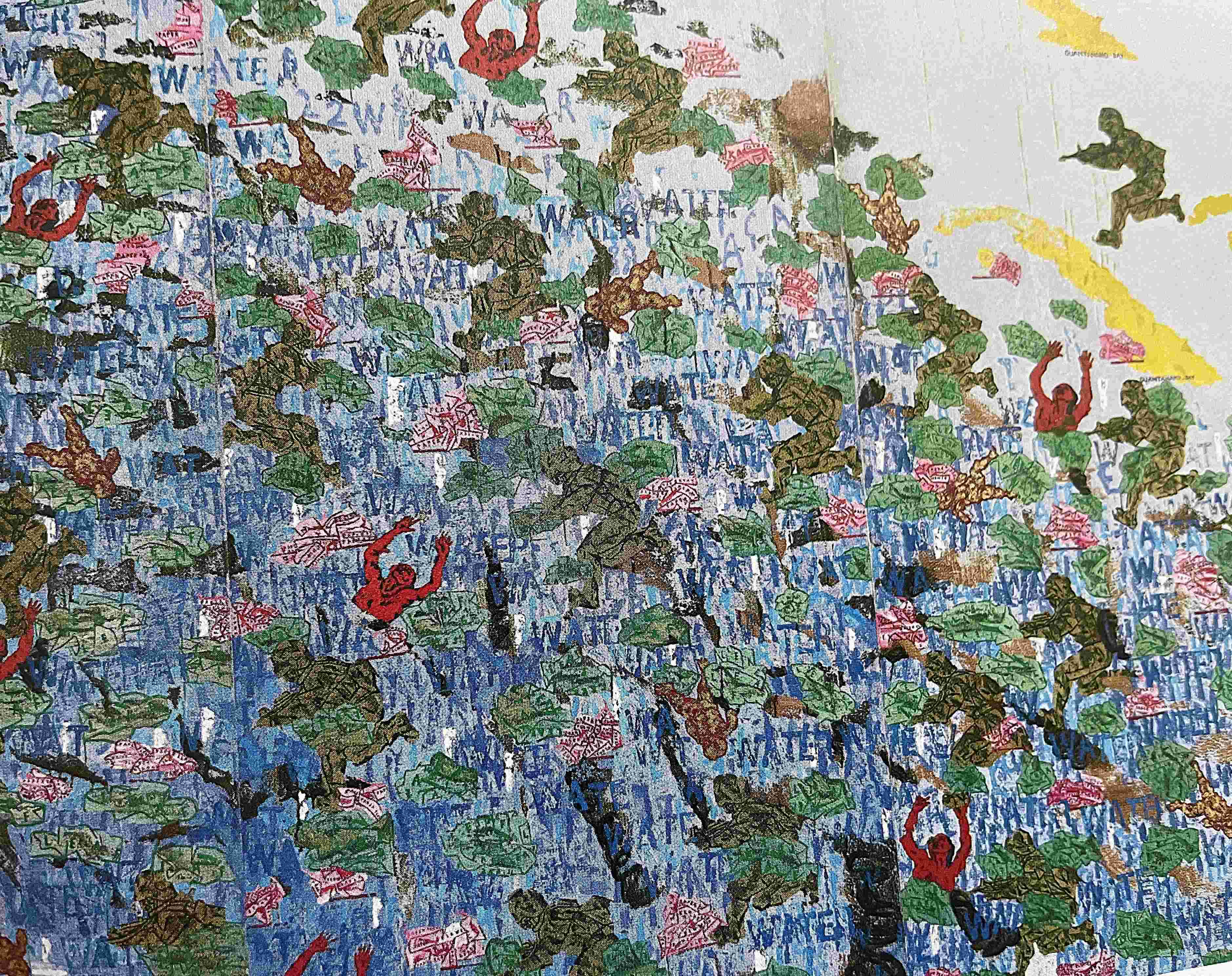
My Lily Pond 2009
This huge painting shows the soldiers overruning the water and a few desparate people raise thei hands as they drown.
What we see is an increasing move away from myth and towards reality. Although passages across the sea can be seen as allegorical, here the figures are very specific as is the writing.In the image of exile an even more heartfelt image suggests the tragedy of Forced departure. With the specific dates around the border we recognize that this is a global condition. I wonder if she is going to address the tragedy of Gaza.
Arpita Singh is a soothsayer and a truthteller embedded in complex and deeply felt images of our human condition.


This entry was posted on July 20, 2025 and is filed under art criticism, Art of Democracy, Uncategorized.