New books and an exhibition demonstrate Ruth Asawa’s extraordinary contributions to 20th century sculpture
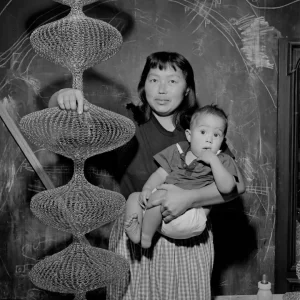
Installation view of Ruth Asawa: Retrospective at the San Francisco Museum of Modern Art, including a photograph of artist’s living room. Photo by Heinrich Kam.
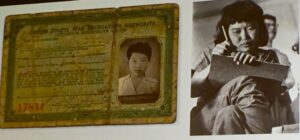
Ruth Asawa had an extraordinary childhood. In her early years she grew up on a farm with her immigrant parents, sharing in the hard work. That ethic of hard work stayed with her throughout her career as an artist. In April 1942, when she was sixteen, her family was sent to a detention camp, first the Santa Anita Assembly Center, then the Rohwer Relocation Camp in Arkansas. At the Santa Anita camp, she had the fortune of learning from three Asian American artists who worked for Walt Disney.
After she graduated from high school in the Rohwer camp in August 1943, Asawa was allowed to leave, provided she stayed away from the West Coast. She attended the Milwaukee State Teachers College and then the Black Mountain College in North Carolina, an experimental interdisciplinary arts school. It changed the course of her life.
These are some of the details with which Marilyn Chase begins her biography of Asawa, Everything She Touched: The Life ofRuth Asawa (2020).
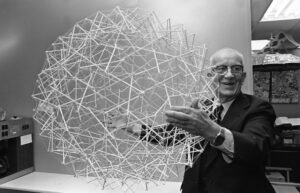
In a Philadelphia office, R. Buckminster Fuller holds up a tensegrity sphere one of his inventions thats inspired a space project April 18, 1979. Dr. Enrest Okress of the Franklin Center envisions the structure, made of rods and cables, as the basis for a Spherical Tensegrity Atmospheric Research Station Stars. A giant tensegrity sphere could be light and strong enough to support a floating space station a mile in diameter. (AP Photo/Bill Ingraham
Chase carefully describes Asawa’s unusual education at Black Mountain College, her study with the artist Josef Albers and the architect and philosopher Buckminster Fuller, as well as the courtship between her and the architect Alfred Lanier, her future husband. After completing her education, Asawa moved to San Francisco with Lanier to start her family and her career.
Chase’s book is an easy read. It includes a continuous narrative that focuses on Asawa’s professional activity and her personal life, much of it based on Asawa’s letters.
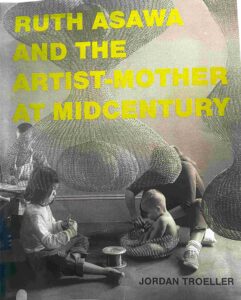
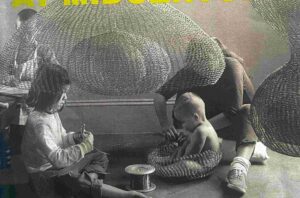
In her recent book Ruth Asawa and The Artist-Mother at Midcentury (2025), Jordan Troeller emphasizes the ways in which Asawa, together with other what she calls “artist-mothers,” managed to produce extraordinary art while they were raising children. Troeller’s method is to examine both motherhood and creativity together (she leads a research group on “The M/Other Project: Creativity, Procreation, and Contemporary Art,”). Asawa raised six children, defying the idea that having children prevents women from making creative art, Troeller argues. Various Asawa techniques such as weaving and knitting connect to female traditions, Troeller suggests, because they enable the artist to start and stop as is necessary to attend to children.
In actuality however, Asawa’s incorporation of her children into her art process might undermine that argument. Asawa’s work ethic and ability to embrace creativity as a generous gift meant that she worked almost nonstop, with her children helping as they grew older. Other chapters in Troeller’s book focus on flowers, folding, or pregnancy, to name only a few themes, integrating them with aspects of Asawa’s work.
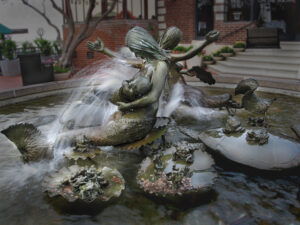
Asawa’s best known image of pregnancy is the “Andrea” cast bronze public sculpture in San Francisco. I found Troeller’s book a bit insistent in connecting everything to a feminist analysis. At the same time, it clearly demonstrates a feminist answer to patriarchal tropes and the traditional parameters of making art as a woman.
Installation view from Ruth Asawa: Retrospective at the San Francisco Museum of Modern Art Photo by Susan Platt.
As an art historian, I have to say that the large book accompanying Asawa’s major retrospective at the San Francisco Museum of Modern Art (SFMOMA) is comprehensive and invaluable. Edited by Janet Bishop, Ruth Asawa: Retrospective (2025) includes essay after essay on themes such as “From Tool to Ornament, Ruth’s Intricate Refusals,” and “What Cannot Be Produced Alone : Ruth Asawa’s Public Art.”
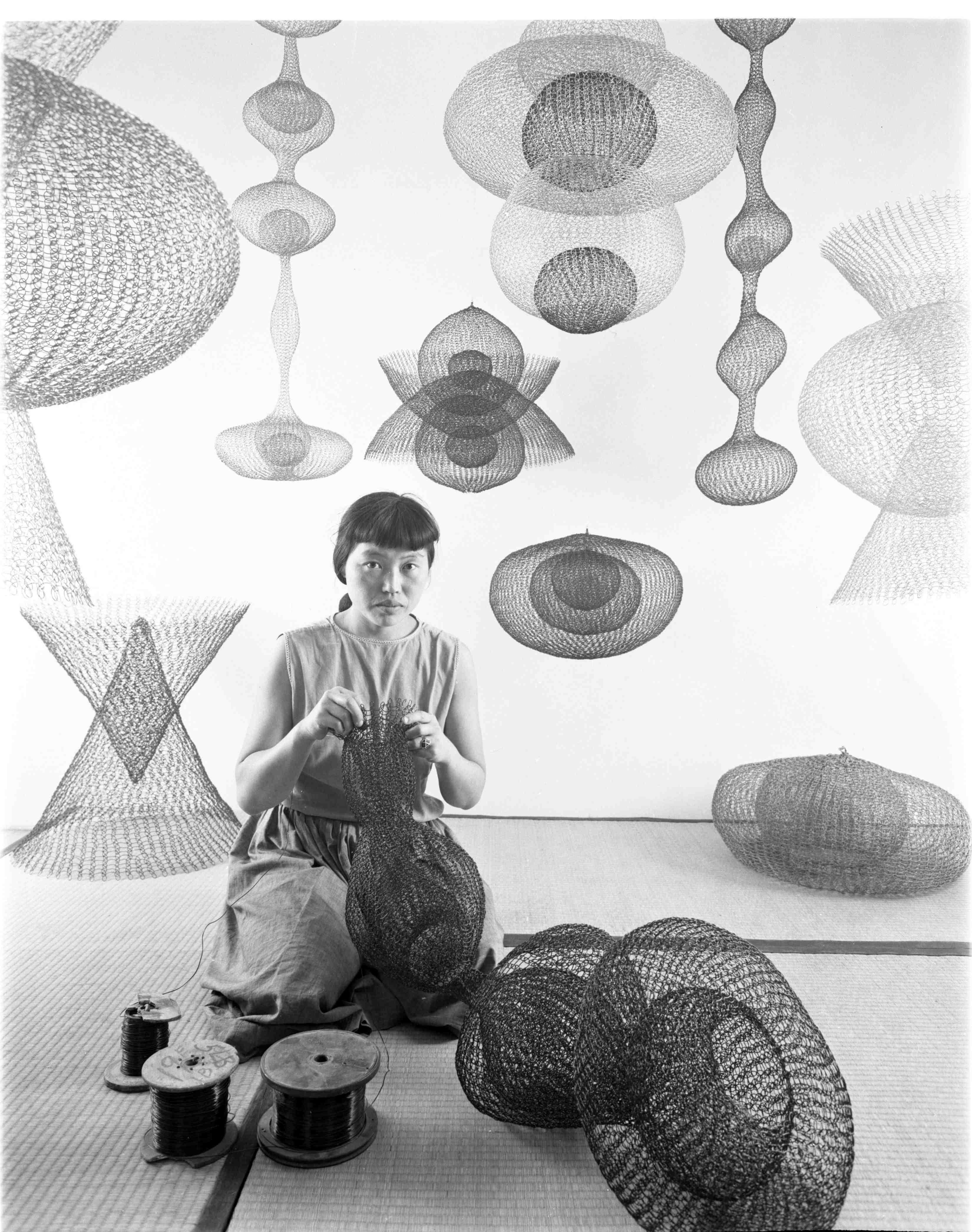
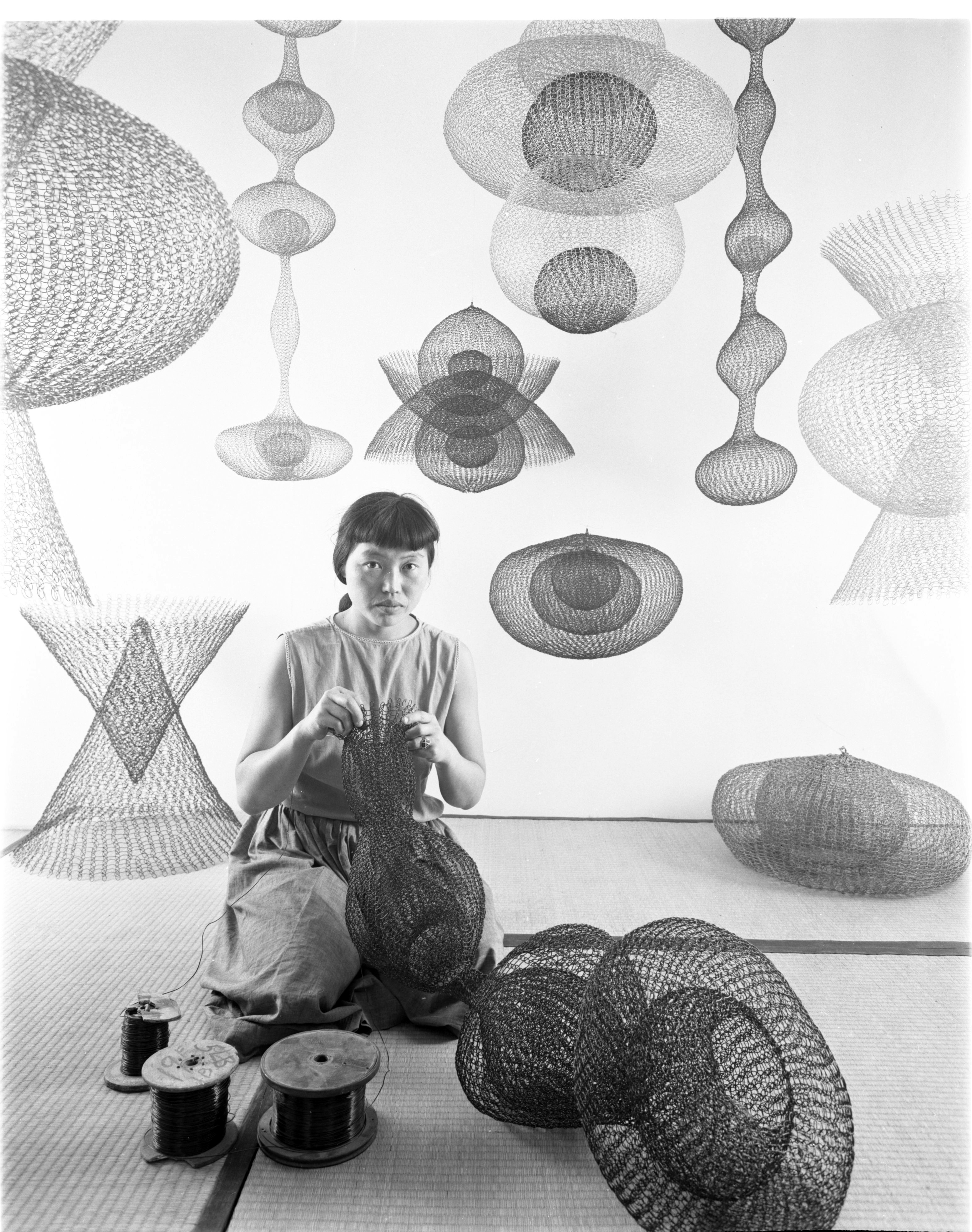
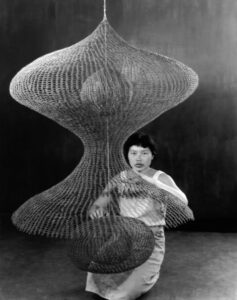
The SFMOMA exhibition itself follows all the stages of Asawa’s artistic career, from single woven-wire baskets to complex hanging sculptures enclosing one orb inside another. Then a new technique of tying wire, electroplating it, and much more. These dazzling hanging works are Asawa’s best known work. The complete discussion of her public art is also represented in the catalog and the exhibition, where we seestudies and photographs. The installation at the SFMOMA even includes a sample from Asawa’s garden.
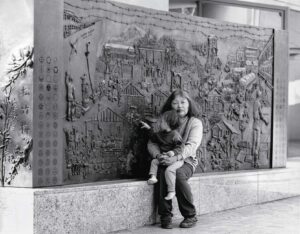
As we learn in this thorough study, Zen Buddhism was part of Asawa’s worldview, as well as nature itself. Her drawings of leaves and plants show her understanding of the intricacies of the natural world. In the chapter on public art, bronze casting is a major departure, as well as the scale of the works she took on, a huge low relief of the Japanese incarceration camps, a wall called San Francisco Fountain, with many small reliefs of life in San Francisco and many more.
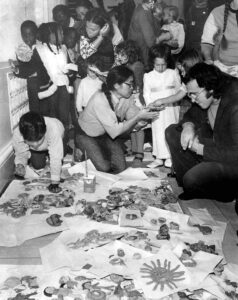
Asawa’s creativity also extended to schoolchildren, teaching them innovative ways to make art with materials such as milk cartons, and “bakers clay” (flour, salt and water). Asawa also engaged in civic affairs, founding an art school, now called the Ruth Asawa School of the Arts, and lobbying for more art education in the public schools.
The magnificent sculptures that Ruth Asawa created hang in space, and surround space. They embrace interior and exterior, the delicate and the strong, the idea of growth and the idea of stasis. It is hard to overstate her contribution: her wire-based art, at first seen as simply decorative, is now understood as major accomplishments of twentieth century sculpture.
This entry was posted on November 18, 2025 and is filed under Uncategorized.