Future Geographies at Vancouver Art Gallery
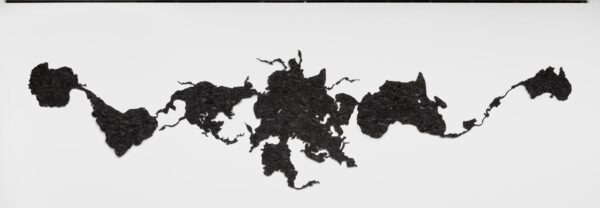
Teresita Fernandez Island Universe 2
This amazing exhbition at Vancouver Art gallery (BC) ( up until January 10) begins with this challenge and this image
“As new ecological realities reshape the planet, what role does art play?
Artists are not scientists, but they invite us to think differently and imagine new futures. Journalism too addresses the same territories. This exhibition offers no singular answer but rather a plurality of responses, from poetic to urgent.”
The exhibition had four themes; Consumed Earth , Living Knowledge, Material Memory, and Speculative Worlds
The art was more or less evenly divided but there was no sense of strong demarcations. Some of the artists were in more than one category.
The entire catalog for the exhibition is online at https://futuregeographies.nationalobserver.com/
This was addressing climate change by not using paper.
Included in the “catalog” are links to excellent videos about the individual artists. there seem to be many women of color, appropriate for an exhibition that was addressing the crises of the planet.
So each artist can be viewed often with in depth interviews or articles in The National Observer, an online climate magazine. So the only glitch was that several of the exhibits refer to articles in the magazine which we couldn’t read unless we subscribed to the magazine for $100 a year!
But this was part of the radicality of the exhbition that some of the exhibitors were actually climate journalists: Rory White, John Woodside, Cloe Logan, Natasha Bulowski, Jennifer Cole. Each of these writers were represented by a photograph of the issue they were addressing and a lead to their article in The Natioanl Observer
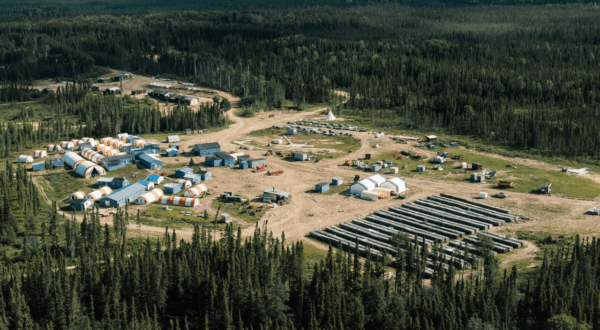
“Ontario First Nation battles Australian-owned company over Ring of Fire mine” by John Woodside
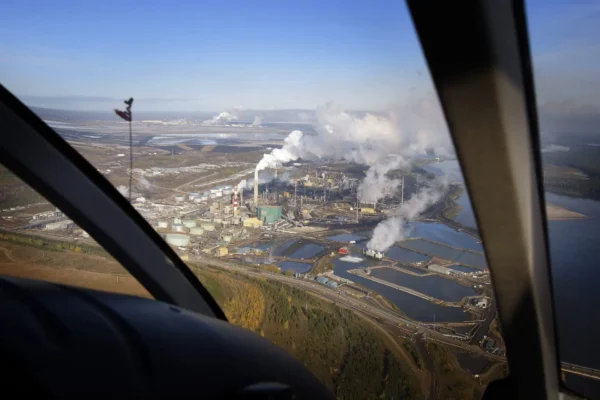
“World’s biggest carbon capture project could ‘essentially drain Alberta’, experts warn” By Darius Snieckus & Rory White
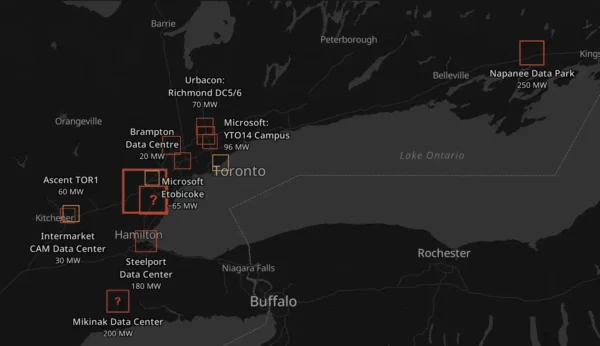
One data centre or one million homes? Mapping Ontario’s proposed hyperscaler boom
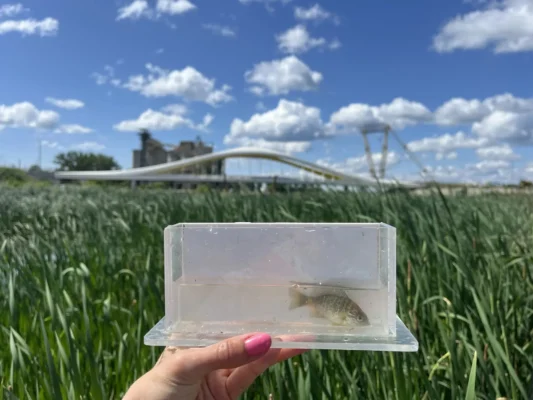
Fish are flooding back into Toronto’s Don River
By Cloe Logan
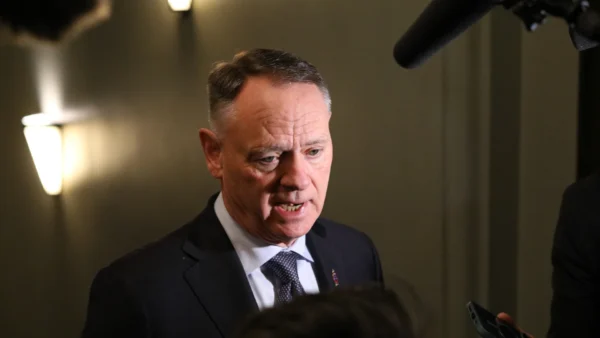
Critical minerals an ‘ace’ in Canada’s hand ahead of trade negotiations.
By Natasha Bulowski
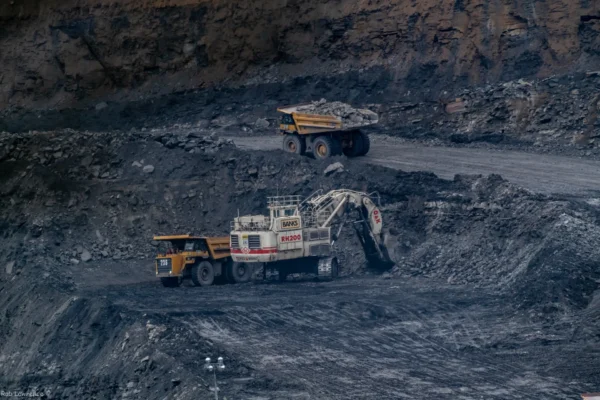
Massive mine expansion looms over calls to halt thermal coal exports
By Natasha Bulowski
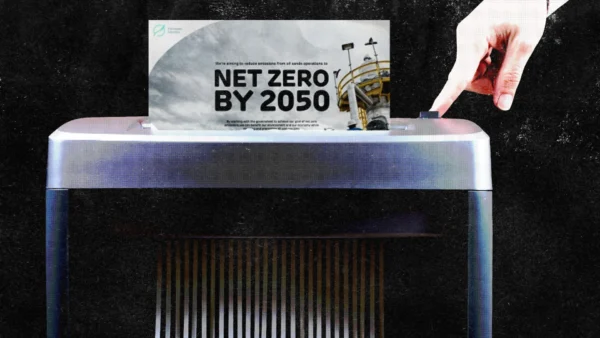
Unpacking Big Oil’s fierce pushback against new truth-in-advertising rules By John Woodside
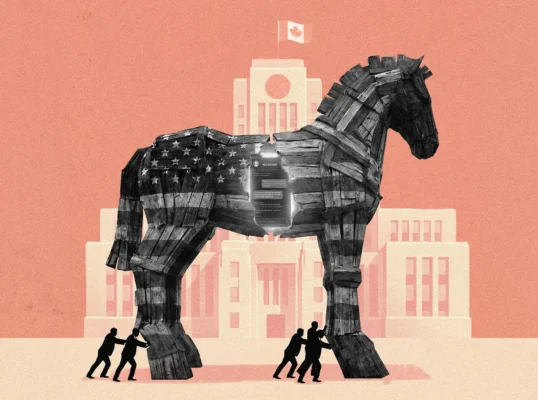
A US climate conspiracy has spread to Canada — and local politicians haven’t been warned
By Rory White
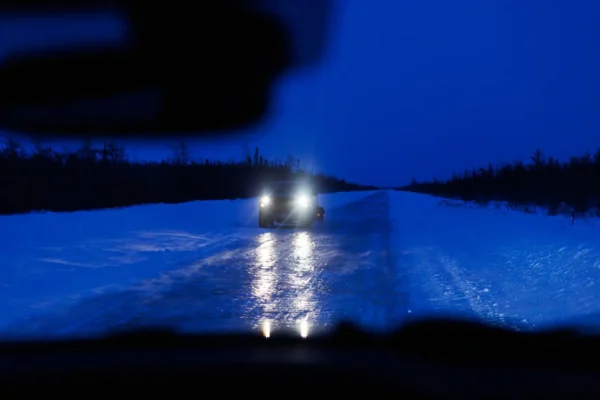
As ice road melts, a First Nation eyes solid ground
By Cloe Logan
this is only some of the articles. the combination of journalism and art was really effective. Clearly the imagery that went with the articles ranged from imaginary ( Trojan Horse) to docmentary.
These articles with their single photograph did not eclipse the art at all rather they expanded the breadth of the exhibition.
Theme 1 Consumed Earth
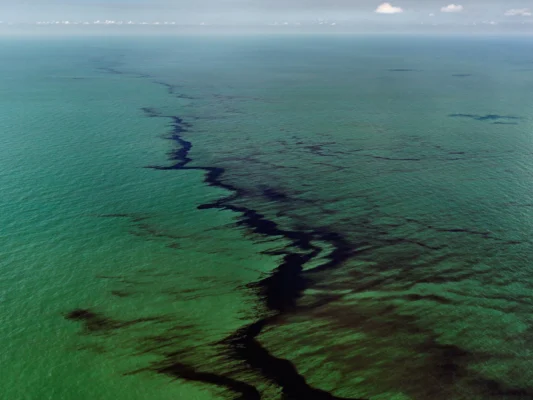
For Consumed Earth it is easy to have photographs, unfortunately. Edward Burtynsky, Oil Spill #10, Oil Slick, Gulf of Mexico, June 24 (2010)
Edward Burtynsky has been photographing the effects of industrial projects and thier impact on the land for decades. He was an obvious choice.
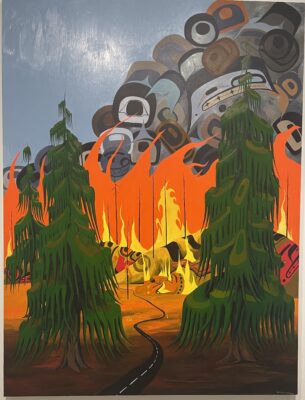
But my favorite work in Consumed Earth is by Lawrence Paul Yuxweluptun Lets’lo:tseltun,
The Impending Fire Storms (2024)
This incredible painting gives us the full flames of destruction with animals afire and other creatures and trees about to be devoured shortly. But the wall of fire also suggests that the creatures behind it are resisting.
“These paintings are history paintings, and when you look into these paintings, you are looking into a mirror. The environment, land title, being native in this country, it’s all there.”
—Lawrence Paul Yuxweluptun Lets’lo:tseltun
Another work about consumed earth by Liz Larner, Meerschaum Drift (Blue) (2020–21), created from plastic, also speaks direclty to us clearly ( plastic is a particular obsession of mine)
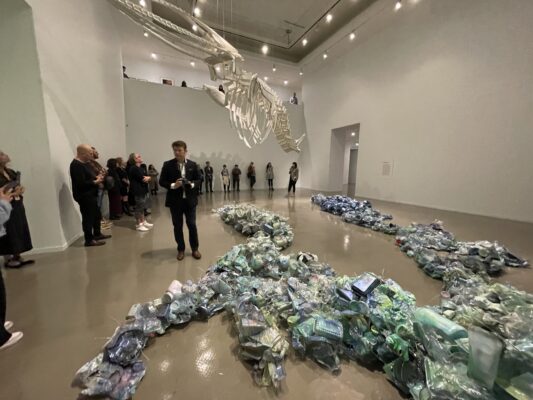
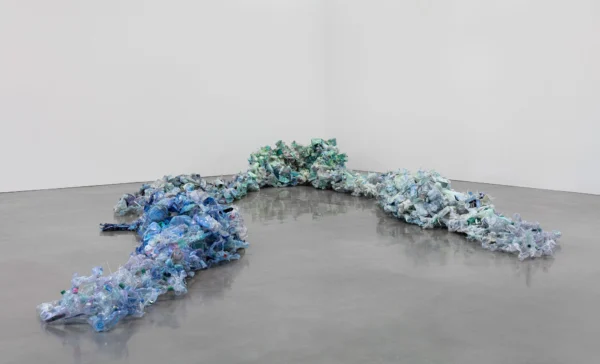
this sculpture made from plastic waste assumes a lovely wave like quality from afar.
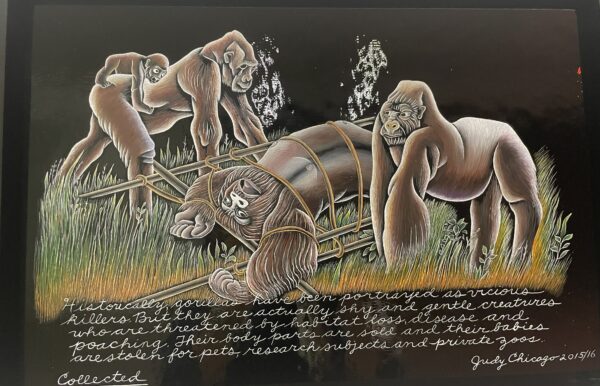
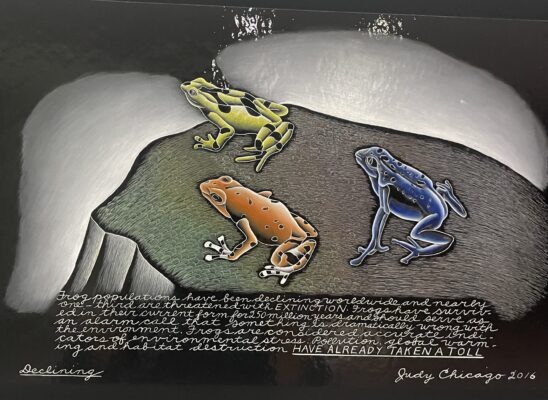
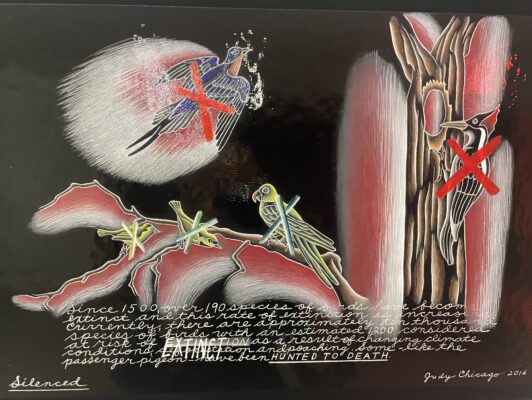
Judy Chicago ! is part of the consumed earth section with her multi part piece The End: A Meditation on Death and Extinction (2015–16). Here are three of them
Gorillas (Collected)
Frogs ( Disappearing) and Birds (Silenced)
John Akomfrah Vertical Sea ( three screens changing )
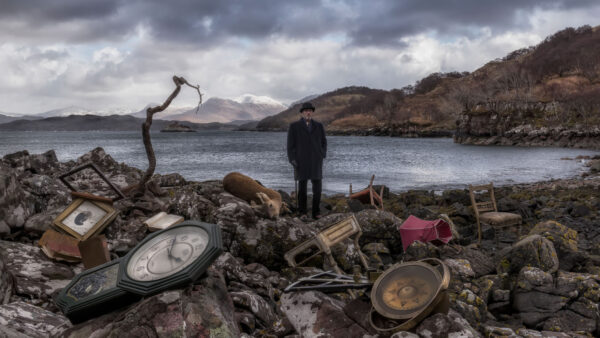

“The sea has its own independence, its own power and ontology, and it is ‘playing’ the space in which these dramas are unfolding…The sea is enormous, but it doesn’t care much who we are. It is not there to form a backdrop to our becoming or unbecoming.”
—John Akomfrah
Ths piece was shown a few years ago at the Seattle Art useum as part of an Akomfrah show that closed after one day because of the outbreak of Covid.
La Toya Ruby Frazier
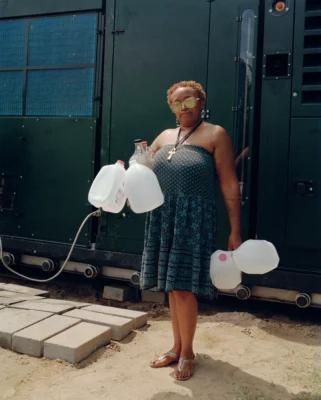
Also part of Consumed Earth La Toya Ruby Frazier
A Flint Community Member Holding Her Water Jugs at the Atmospheric Water Generator on North Saginaw Street Between East Marengo Avenue and East Pulaski Avenue, Flint, Michigan,
Frazier has been addressing the toxic effects of industry in Braddock Pa where she grew up and documentedher family there. In Flint there are huge toxic water problems.. She herself funded the water generator in the photo.
Also in the category of Consumed Earth
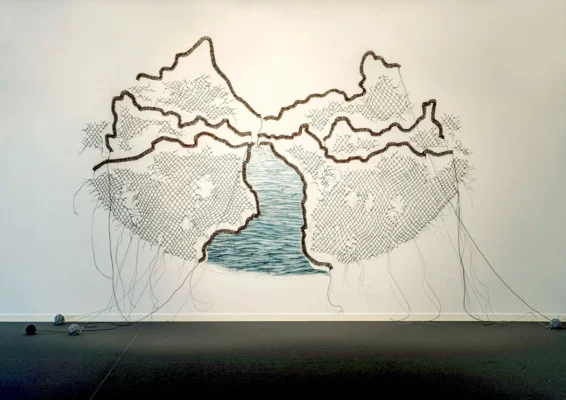
Reena Saini Kallat, River Drawing electric wires, nails and pigment
“Our connection to water lies both internally and externally, water being the origin of all known forms of life and our bodies primarily being composed of it.”
—Reena Saini Kallat
“River Drawing is an in-situ work that traces the borders of nations locked in conflict over shared river systems. Using electrical wires as a drawing tool, Reena Saini Kallat (b. 1973, Delhi, India) maps geopolitical boundaries that cut across waterways, revealing the tension between fluid natural forces and territorial claims. In her rendering, that typically separate seem to loosen and conjoin, echoing the flow of the river rather than the authority of the state.”
Living Knowledge
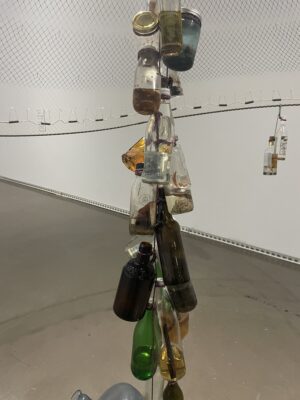
Carolun Cayceda’s fishng net To Drive Away Whiteness/Para alejar la blancura with detritus attachedis in the category living knowledge
“created from handmade fishing nets collected by Carolina Caycedo (b. 1978, London, United Kingdom) along river communities in Latin America affected by the privatization of those waterways.
Each Cosmotarraya is linked to specific people, rivers, traditions, and cultures, just as each net is linked to the individual who wove it. The resultant sculptures are talismanic embodiments of local resistance to corporate and governmental attempts to control the flow of water.”
—Carolina Caycedo
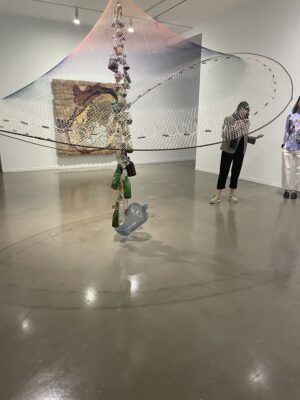
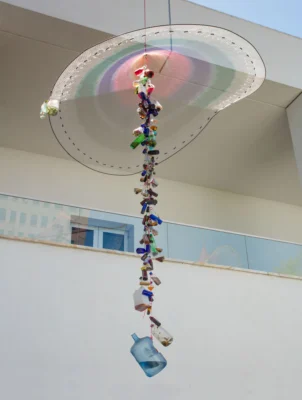
we see the toxic bottles in the river here, but the living knowledge has to do with the people who fish.
Also in Living Knowledge is Andrea Bowers
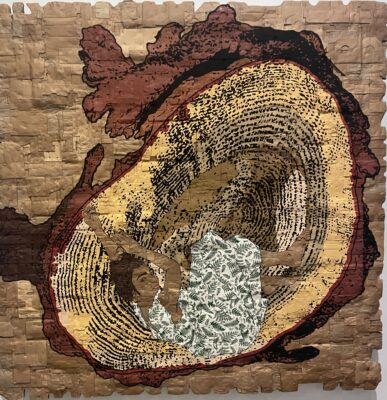
Andrea Bowers, Eco Grief Deforestation Series (Old Growth Stump 2) (2024)we see the stump with the artist crouched inside it.
“This work calls attention to old-growth forest logging practices in Northern California, where the stumps of 1,000- to 2,000-year-old trees exist as shadows of a once-thriving rain forest. Bowers was arrested in 2011 for tree-sitting in Arcadia, California.”
Bowers is intensely politically active and sees her art as embedded in activism.Cerainly this image of her inside a tree stump gives us a sense of the intensity.
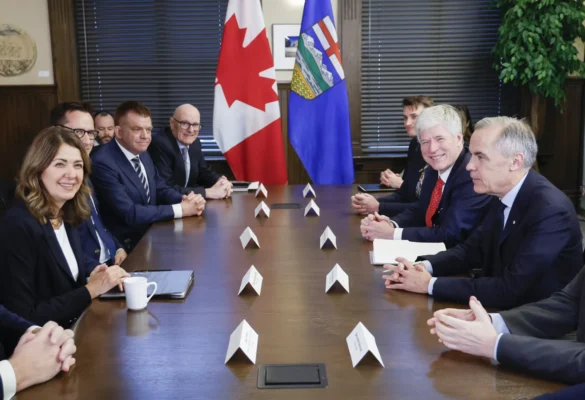
“Alberta gets its way in deal with Ottawa”
By John Woodside & Natasha Bulowski
is part of Living Knowledge
Is the phtograph is “art” ? but the comment as the lead of an article refers to a crucial issue highlighted by all these ridiculously smiling faces as they decide to tear the earth apart further Alberta of course is alreadynotorius for their exploitation of tar sands, and the horrendous environmental conditions that have resulted.
So against these clean orderly smiling faces is the ghastly polluton in Alberta.
In another version of Living Knowlege you can just see the human body under the ricks
The artist is buried under there
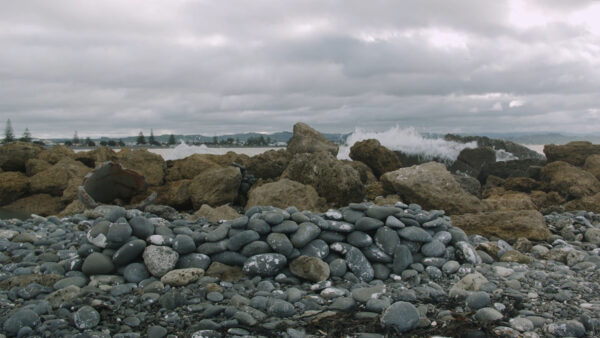
asinnajaq, Rock Piece (Ahuriri Edition) (2018)
This is a still from a video
“The weight of the stones as they pile on your body is an opportunity. . . I refuse to let the weight keep me down. Pushing myself up from the stones slowly and carefully. As I rise from underneath the weight of the stones the stones fall and slide away. It takes effort from the body and mind to be out from under the pressure of the stones but, as they fall, my body I must accept that I’m in a cycle.
—asinnajaq
What we heard was the rumbling of the rocks , but we never saw him emerge- this is certainly an example of living knowledge!
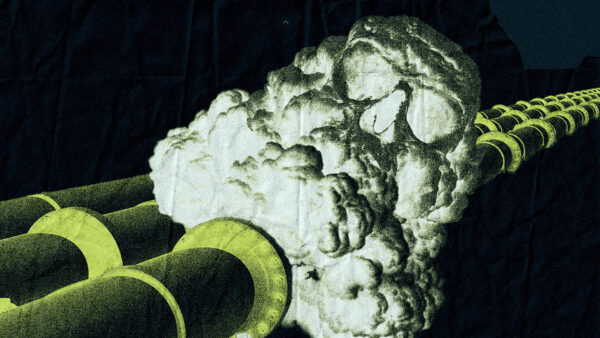
“Pathways Alliance’s flagship project looks like a big money loser
By John Woodside
Living Knowledge
This odd photograph is obviously constructed. I think it shows carbon exploding out of a pipe. The reference is to a carbon capture project and piping carbon to an underground stoage that is runnng way over budget.
Living Knowledge Teresita Fernandez’s work.
Teresita Fernández, Island Universe 2 (2023)
“I often use the word landscape because it’s a word that is perceived to be passive—as opposed to territory or country. But place is an entirely social construct, always attached to narratives of power and dominance. The places are named by the winners, by the oppressors. Maps are drawn up in the same way.”
—Teresita Fernández
The map of the world created in charcoal invokes the continents but they are all connected and recognizable even as they have been rearranged and reshaped.
Material Memory
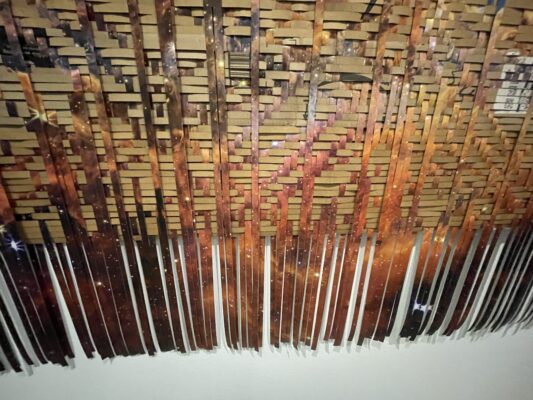
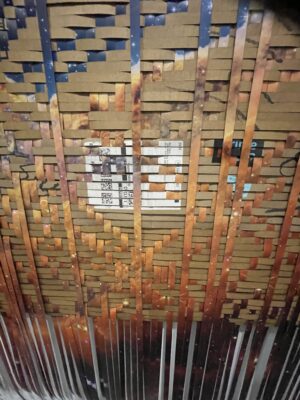
Clarissa Tossin, Future Geography: Cosmic Cliffs (2023)
This work which gives the show its title is emtirely made from Amazon boxes. It is a very amusing title and to put it in the category of material memory is also funny.
The piece, like so many of the works in the exhibition, looks like an attractive abstract work until the meanng of the title and material sink in.So our future is Amazon boxes, creating lanscapes of rubbish.
Also in Material Memory is this piece, which I found fascinating
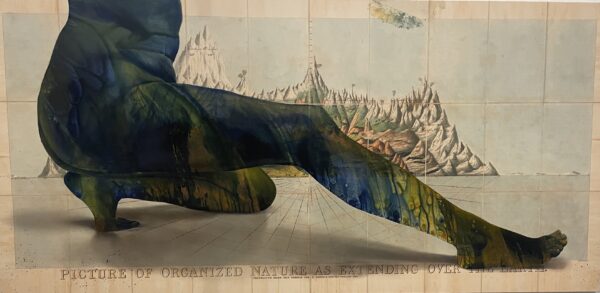
Firelei Báez, Unbound (one way ashore, a thousand channels), 2024
the large female figure in the foreground partially obscures
the print behind it which is identified as an “early nineteenth-century map—titled “Picture of Organized Nature as Extending over the Earth” and composed by British cartographer Charles Smith (1776–1854). Smith’s chart reflects the drive to categorize and contain the natural world, compressing the Earth’s oceans, polar ice, mountain ranges, flora and fauna into a single, totalizing image. ”
By placing a huge body in front of it, the artist contradicts and cancels that endeavor: the body is blue green, a marine color, her pose is temporary, about to go forward, so the overall effect is that we are with her as she balances on one knee.
Another example of Material Memory
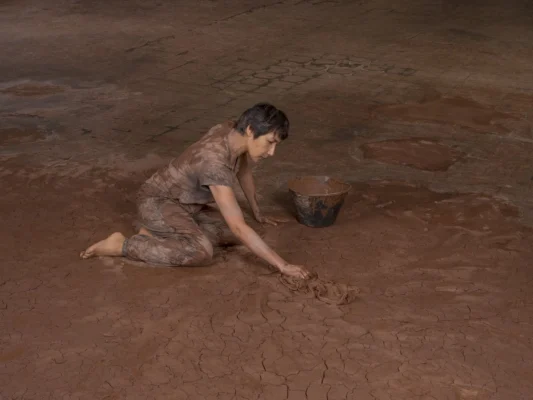
Rebecca Belmore, nindinawemaganidog (all my relations), keeper (2017)
This unassuming image is a recreation of performance art work. the actor ( artists sister) is cleaning a clay floor with a claysoaked rag.
the artist is Asishinaabe ( a group of indigneous peoples from various tribes) from the Great Lakes area. The idea is labor, especially women’s role in caring for the land.
Another favorite from Material Memory
Jean Shin’s Huddled Masses
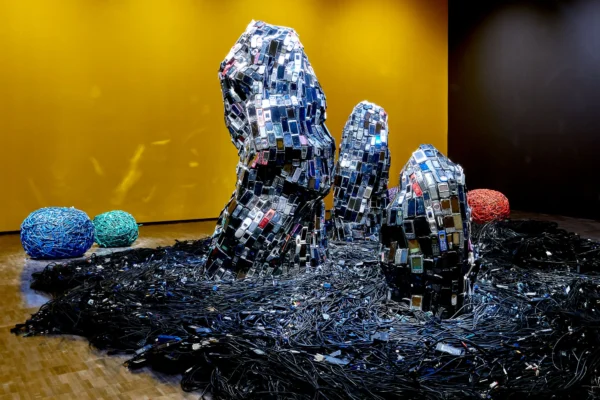
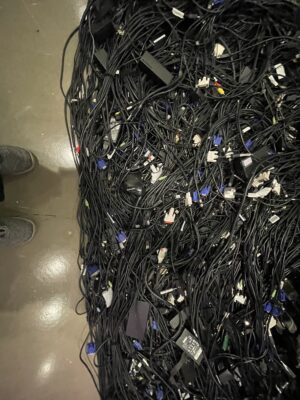
Guess what, they are all cell phones that have been discarded!
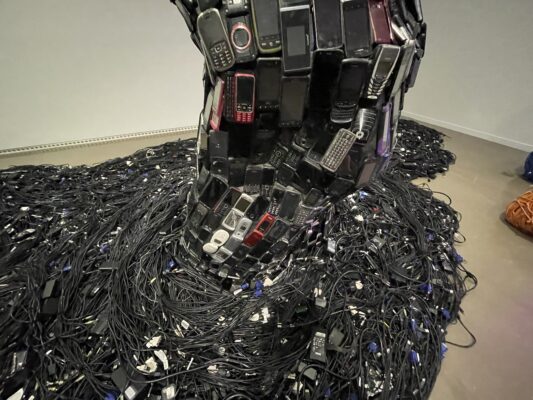 This really works as an indivual sculpture and a big comment.The Huddled Masses have also been referred to as Scholars Rocks!!
as in China.
The final category is Speculative Worlds.
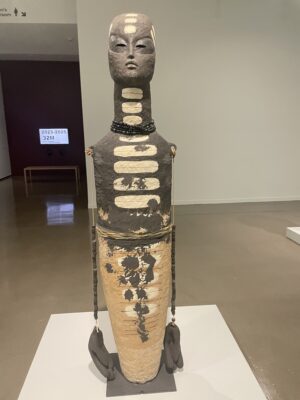
Rose B. Simpson Co Pilot A
Another work with clay and other sacred materials, this proud guardian figure is going to lead withut fear.
Rose Simpson is from the Santa Clara Pueblo. and she has transformed the traditons there. There is a long tradition of transforation among Pueblo women, her mother is Roxanne Swetzell
another well known artist.
Another Speculative Worlds
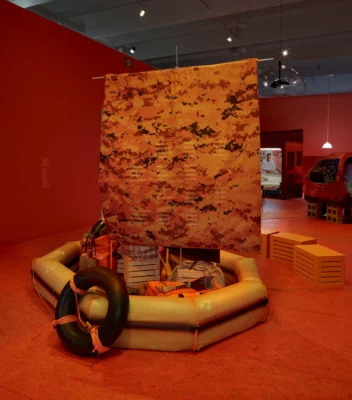
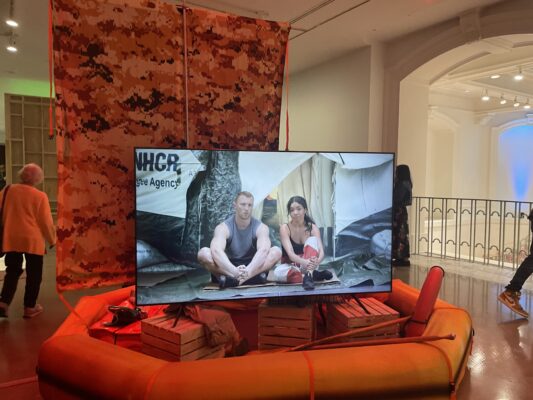
Josh Kline, Desperation (2024)
“Scientists and politicians do a very poor job of making people understand what sea level rise means for them. . . Art has the ability to place people inside a story and help them understand those connections emotionally.
—Josh Kline
we saw this piece with the video recounting two paople marroned without any place to go. The raft suggests the travel, the video gives us an imaginary situation of someone adrift on a raft, who have been turned back by immigration authorities. and are the victims of sea level rise ( two actors played the part).
Speculative worlds:
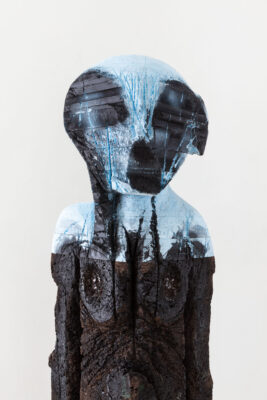
Huma Bhabha, Lifetime (2013)
“Monsters are beautiful to some of us, depending on how we were informed by different experiences in our upbringing. For me, I have always had a passion for extreme visual imagery which responds to the horror and science fiction films I have watched.”
—Huma Bhabha
By way of grand conclusion there was an installation ouside the four themes.
On another floor was this amazing full room installation
Sanctuary: the Ancient Forest Experience
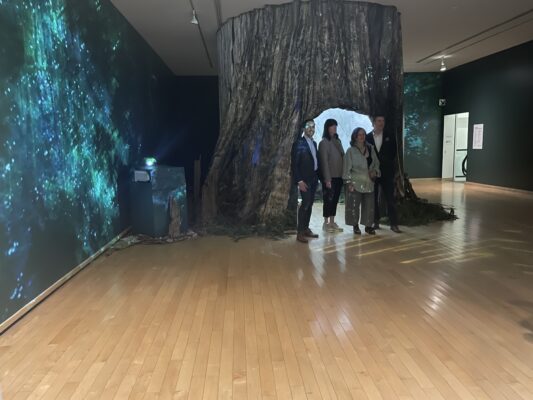
Curated by Dr.T’uy’t’anat Cease Wyss with filmakers Damien Gillis and Olivier Leroux
Inside the replica of the oldgrowth tree stump is a video that immerses us. the forest we see is on the Sunshine coast where some forests have survived since the last ice age, and others have been clear-cut.
In the video we see Dr.Wyss wandering through the forests and the clearcuts with the music of birds, and waterfalls as she narrates what she is harvesting in the way of small plants. Logging was stopped after a decade of activism in this foresst, but many other ancient forests still need protectiion
So what conclusion can I draw from the exhibition?
Future Geographies is amazing in its breadth and detail. It covered so many approaches to addressing climate change.
But of course there is so much more to say.
Zadie Smith in an article titled “Art for Our Sakes” in the New York Review of Books started with “why talk about arts and letters when people are being gunned down in the streets?”
She concluded “Such art is made by us and for us. It is for our sakes. Its power is not the kind ths president recognizes, but it has its own kind of force. It will outlast both him and his regime. It will outlast us all.”
Don’t miss it Future Geographies. Or at least access the online catalog with the artists interviews. We can all take some steps to save our precious planet.
This entry was posted on June 15, 2026 and is filed under climate chanage.