Contemporary Indigenous Art at the Frye Art Museum I: My Body is a Basket
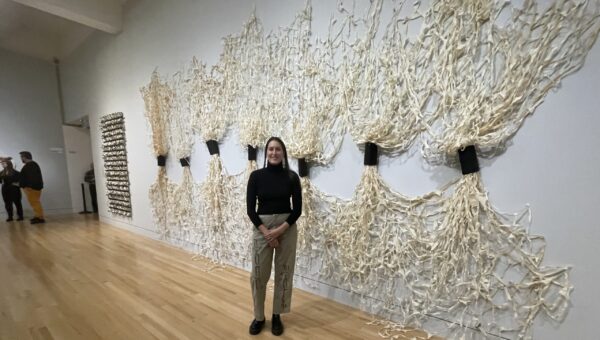
A fascinating exhibition has just opened at the Frye Art Museum in Seattle.
My Body is a Basket curated by Asia Tale (Cherokee Nation)
Here is the curator standing in front of Brenda Mallory’s (Cherokee Nation) Adaptive Connections (ᎠᎵᎪᏍᏒ ᎦᏁᏟᏴᏍᎬ), 2024.
This complex work could represent the nervous system or figures dancing or waving trees, or whatever you want it to represent.
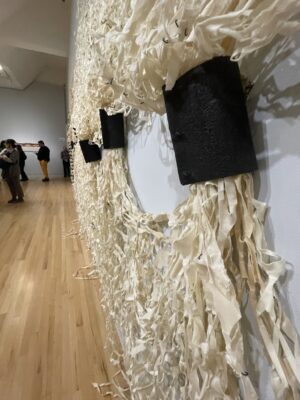
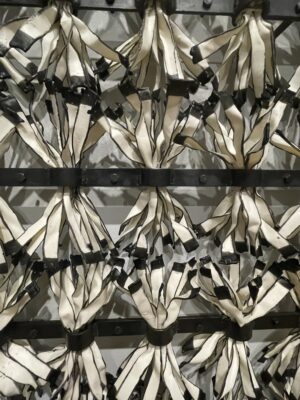
Here is a detail of the work that is made of waxed cloth and waxed felt, and nuts and bolts.We can feel the constraint in the black binding.”The impacts of humans within nature continues to be a core concept in her work and she models sustainability by repurposing found materials” In the case of this work she collecte scraps fom her business of developing reusable menstrual products.
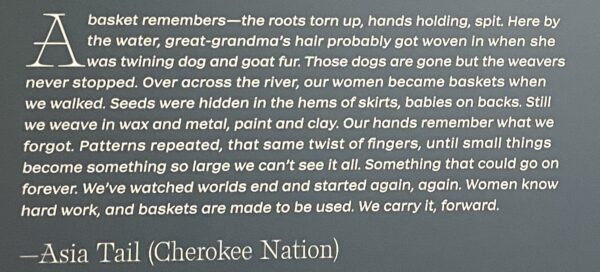 Explanation of the title
Three young Indigenous women, Sara Siestrem, Brenda Mallory and Danielle Morisette, all thought about weaving in different ways.
Brenda Mallory
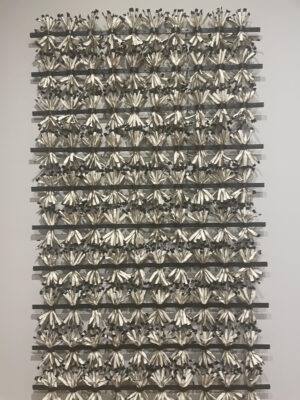
Making Time Waxed cloth, welded steel, nuts, bolts refers to her mother’s death at the age of ninety eight. “She always thought she would live to be a hundread years old. In honor of this idea, I calculated the number of lunar cycles she would have lived through if she made it to one hundred. Each of the small waxed strips represents one of those lunar cycles”
The work is incredibly labor intensive. We can imagine Brenda thinking about her mother as she put it together. Her mother is woven into the piece. Weaving then can cross the border of life and death, it can follow on over time, as tradtions are passed on and inherited.
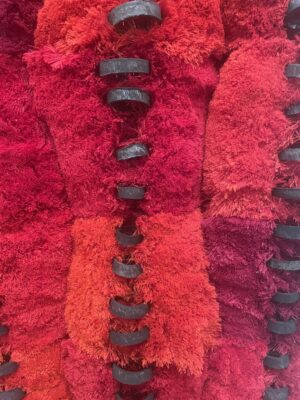
Proximate Parcels Waxed cloth, welded steel, nuts, bolts. The bolts are a spine, but they seem to wave back and forth a bit as well.The parcels are a reference to the allotments natives received, sometimes widely dispersed. The red suggests that it is soaked in blood perhaps. Her parents lost their allotment.
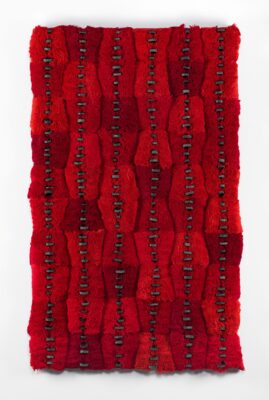
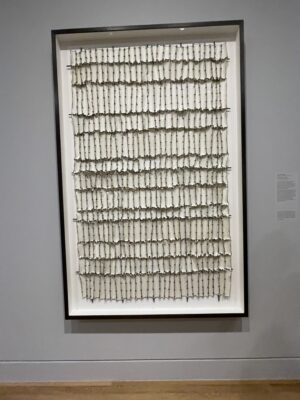
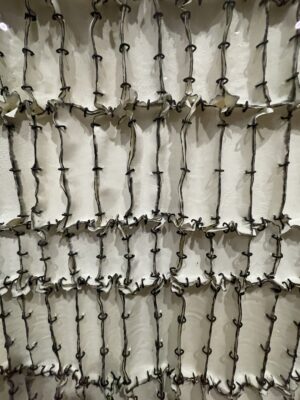
Thirteen Moons waxed cloth, hog rings, welded steel
refers to the Cherokee calender and the lunar cycle. The waxed fabric is translucent , severed, and sewn back together. Again an intense process, which absorbs the passage of time as the artist works on it.
To Carry an Ember Deconstructed thread spools , spool cores and paint on wooden panel
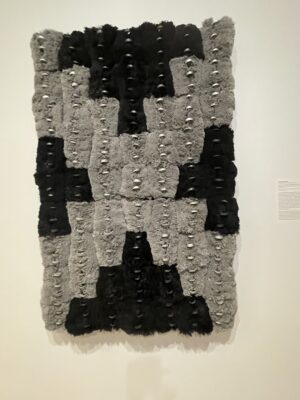
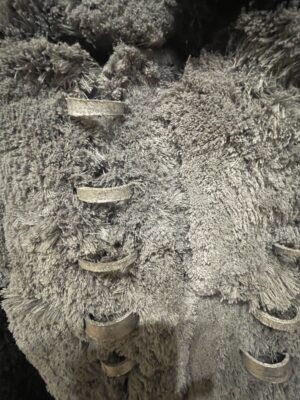
Each work refers to an episode in the artist’s life, or a myth.
In the case of this one it is a Cherokee Creation Story.” origin story of fire, “a small water spider spins a basket with the thread produced by her body to carry embers home on her back.”
The design is part of a pattern called Chief’s Daughter
These amazing works are each distinct and draw us in with their abstract patterns. But to each is attached a story or a myth that takes the physical material and lets it fly into our heads as something else. On the other hand these are meticulously created, hours of weaving in unusual materials. The continuation of the weaving tradition and its extension into our contemporary world gives us continuity with practices from thousands of years ago. Weaving with our hands, creating objects to use from materials that are both ancient and contemporary.
The second artist is Danielle Morsette (Suquamish) who wove blankets of traditional wool 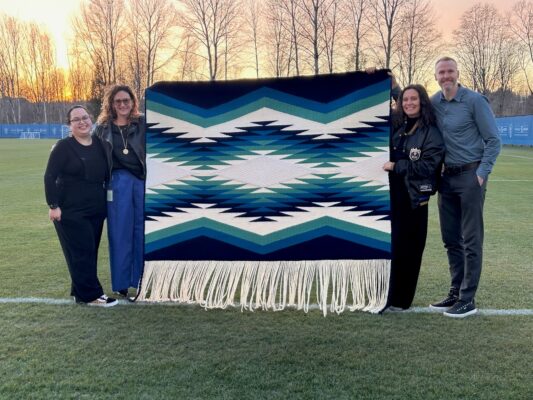
Spirit of the Salish Sea “I want to create something inspired by the water, by the colors, the patterns. It’s like the tides coming in and out. And I hope that people can see that story.” The artist is on the far left of the photograph.The colors inform the designs of the uniform worn by the Sounders. The blanket seems to undulate with the movement of the sea.
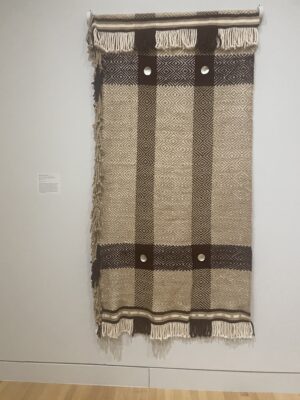
This is a wedding blanket for Ann and Jody Bromfield.
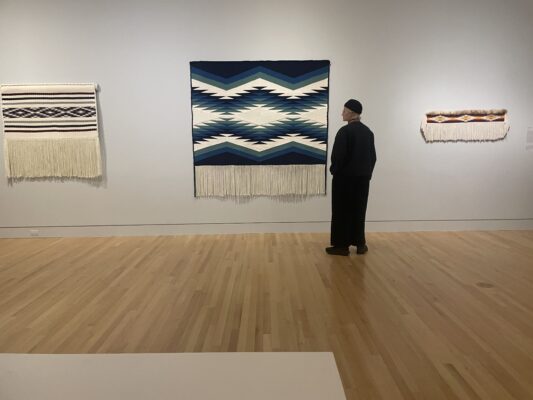
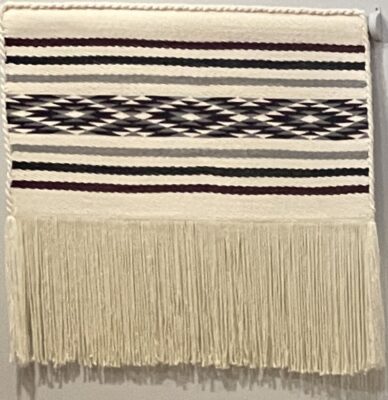
Awakened Spirit: Through Ancestral Teachings
” I am a reflection of my ancestors. It has been an absolute honor and privilege to act as a vessel, a conduit through which ancestral knowledge flows through my work”
Sunshine Weavings can protect the wearer and honor the viewer “Meaning ultimately emerges through layers : the artist personal experiences, her communitys visual vocabulary developed over generations and the associations each viewer brings to the work.”
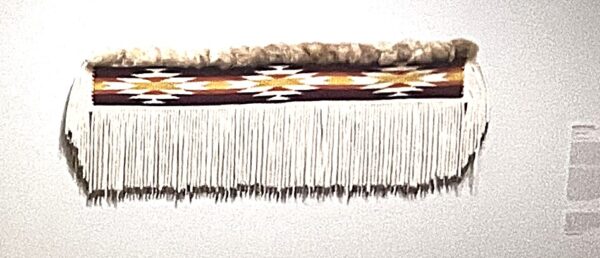 The weavings are the most recognizably “traditional” works in the exhibition, made of wool with abstract patterns, but the weaver takes her connections to her ancestora seriously and they are part of the weaving. The patterns are simple, the meaning is deep, as we think about the ancestors who preceded her and what they went through and how Danielle is a survivor of those years of removals, and boarding schools, and efforts to obliterate Native culture. Today we have a new generation of artists who honor, resurrect and transform those historieis, and they even include us in the proces, even as we are colonizers. They share their works and their ideas.
The third artist is Sara Siestreem dance apron acrylic grphite, color pencil, xerox transfer on panel board. Salmon and scallop patterns refer to tribal gathering rightsas well as destruction of traditional crops . You can also see large basket shapes and “both her joyful relations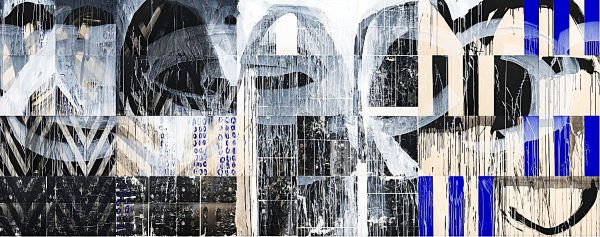 hip with these natural ecosystems and her sorrow at their destruction.”
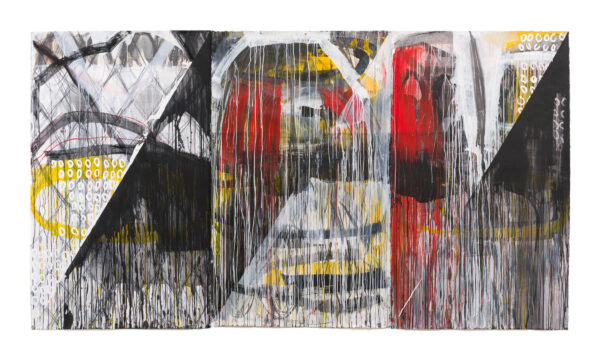
looking for the land///found the weather another large painting with layers of meaning,. “Abstraction leaves room for ancestors to collaborate in her practice”
Below are her own baskets some of which make direct references to the destruction of the enviornment. the upper right on the top shelf is titled “This one has to do with forest fires”
On the right of the bottom shelf science fiction crawdad trap
( we used to eat them from the stream”
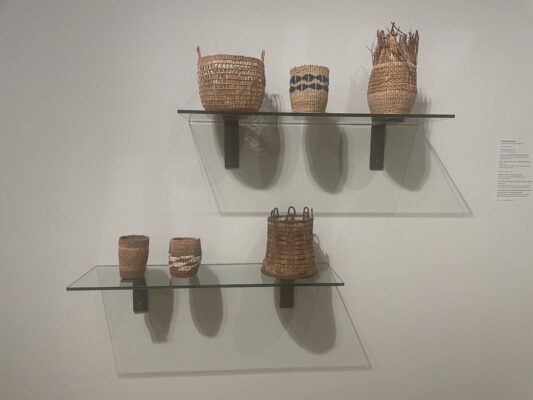
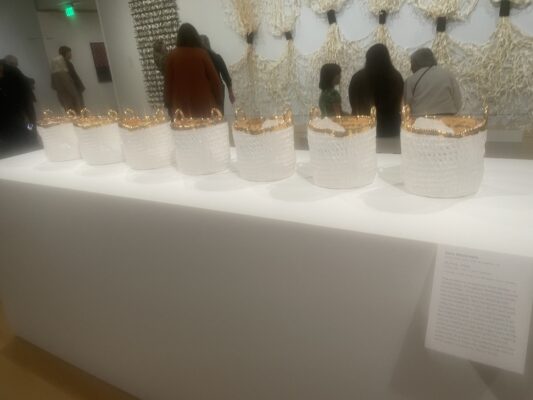 The variety in Sara Siestrem’s work is suggested here. Just above we see skyline baskets made of ceramic, with gold trim , to suggest snow covered mountains, and the white man’s coveting of native land and gold.
Above that are her own baskets made of spruce root and red cedar bark. The spruce root can no longer be collected without permission from the government, who “own ” the land. The artist decided with the current government she would gather her materials elsewhere.
Below is mnion(dozens of ways to say i love you) These are reimagined dance caps . The hats refer to ceremonies but stand on their own as sculptures “ready to uplift , protect amd defend the good.” Imagine the long beaded threads as sweeping around a dancer. 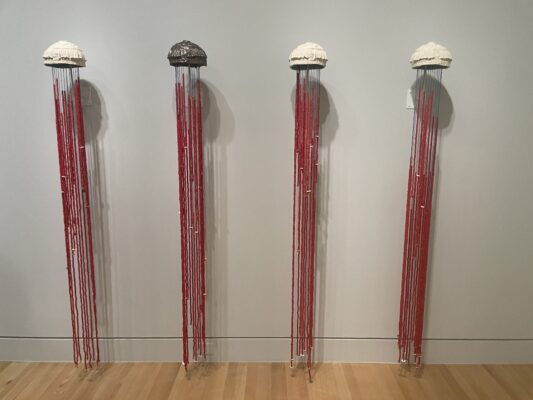 Sara Siestreem is not afraid to go in almost any direction with her work, in terms of medium and aesthetic, but it is bound together by her deep committment to her native heritage ( Hanis Coos) , and her connection to Coos Bay in Oregon and the ecological changes taking place there. All of these works incorporate references to traditional practices and incredible transformations. The bold reference to modernism in the large paintings is undercut by her references to weaving and shellfish that were traditionally collected.
This exhibition asserts that Native contemporary art is thriving and varied. Each of these artists is exploring with confidence. They are weaving together the past and the present and pointing to the future.
This entry was posted on November 9, 2026 and is filed under Uncategorized.