Marela Zacarias at Mad Art brings us the Temple of the Feathered Serpent in Xochicalco
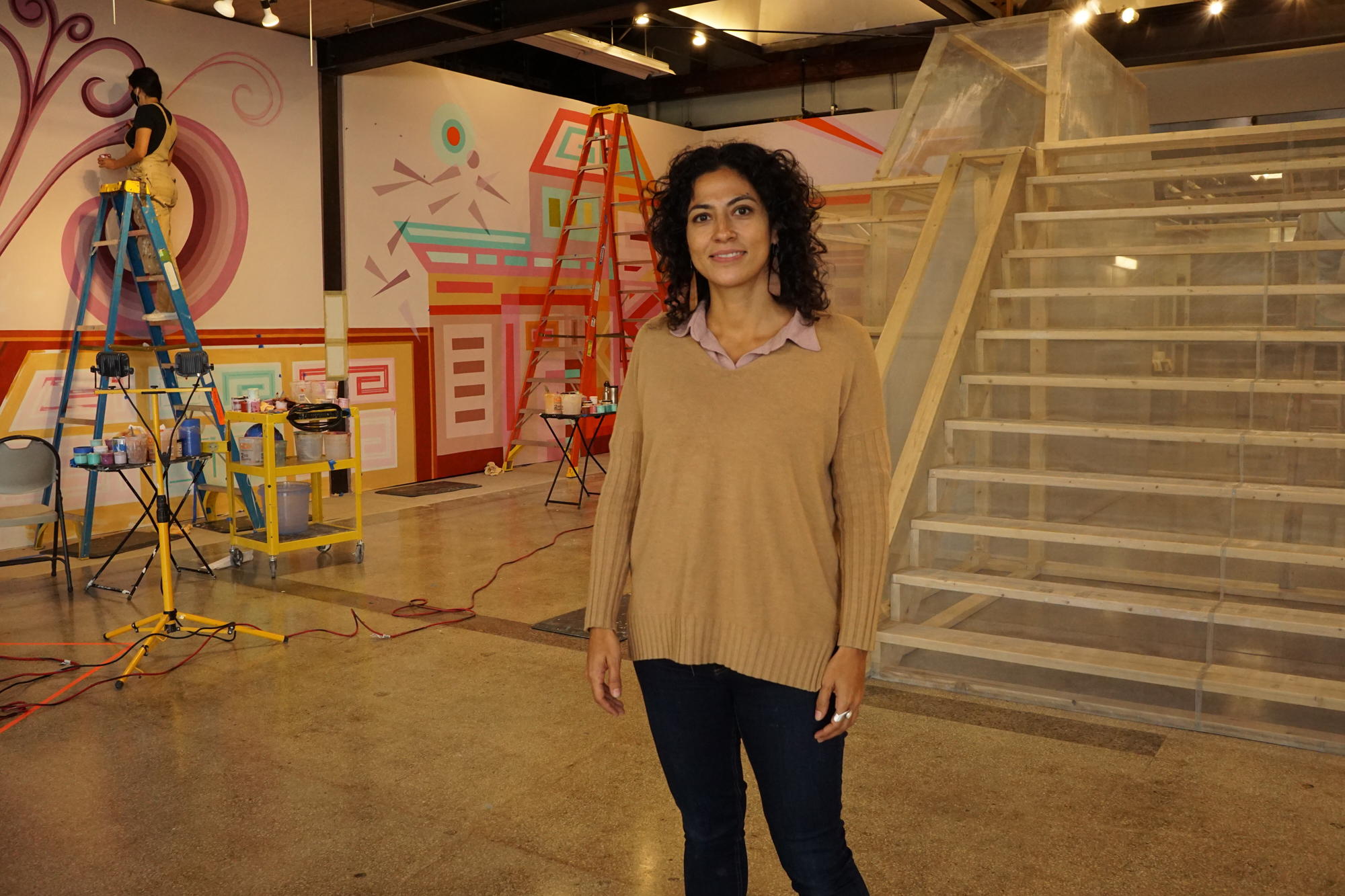
Marela Zacarías working on the installation Photo by Agueda Pacheco Flores/Crosscut
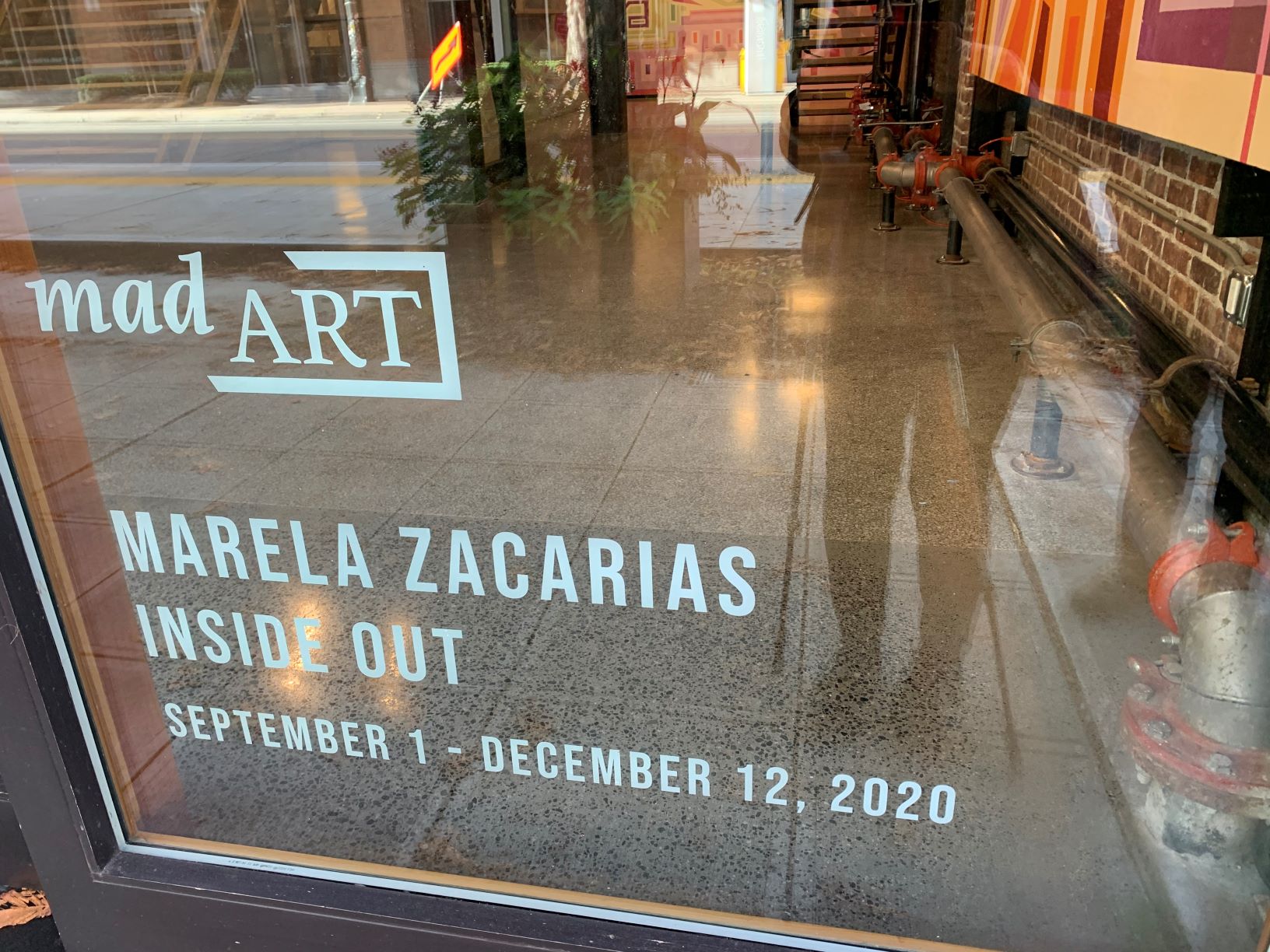
In case you are yearning for a trip to get away from our crazy election or now to celebrate it, go to Mad Art (325 Westlake Avenue N, open Thurs, Fri, Sat noon to 5 and by appointment necessary)
Marela Zacarías brings us the Temple of the Feathered Serpent in Xochicalco, a Mesoamerican site near where the artist grew up in Cuernavaca, Mexico. Made out of screening, it is an accurate but scaled down version of the pyramid.
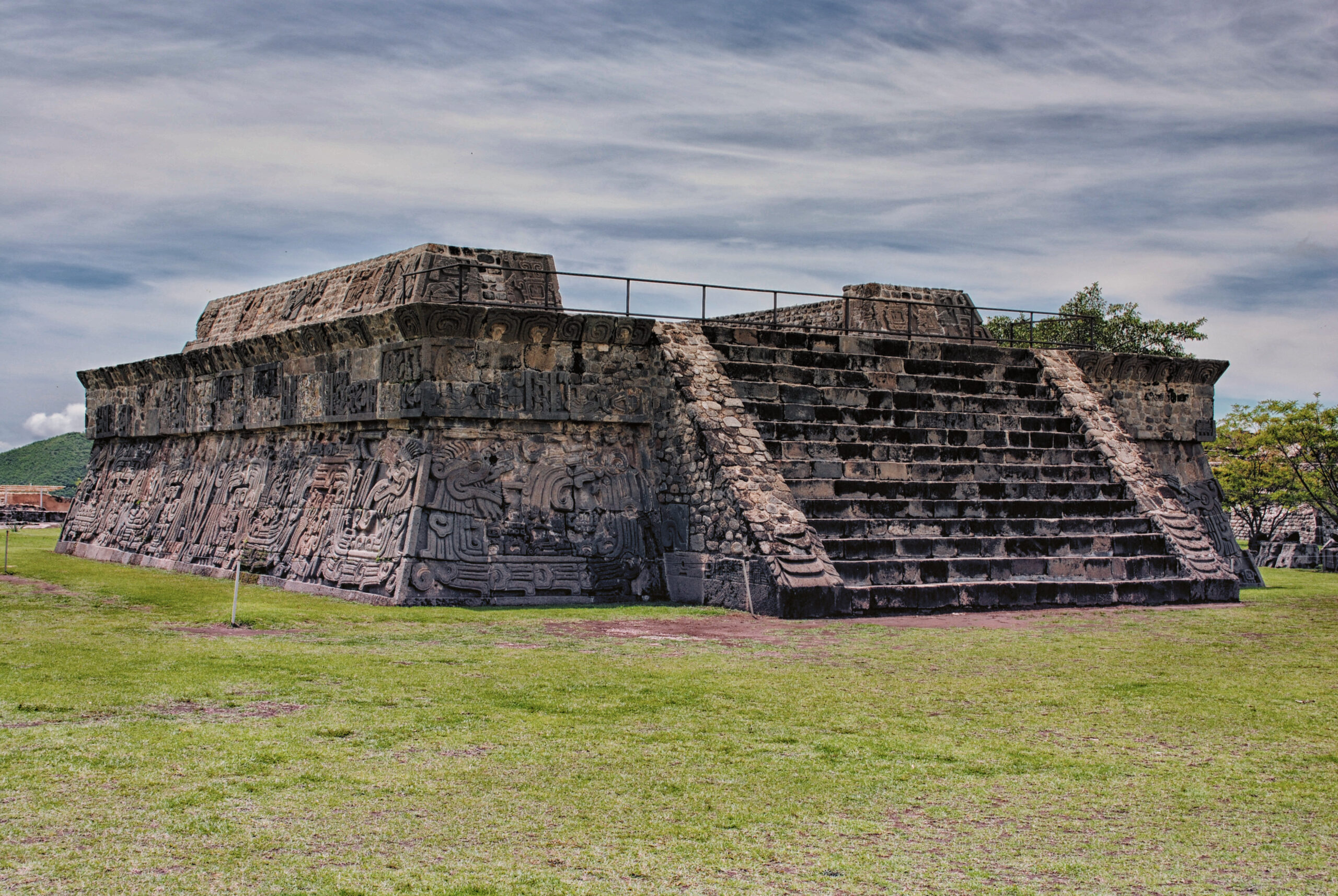
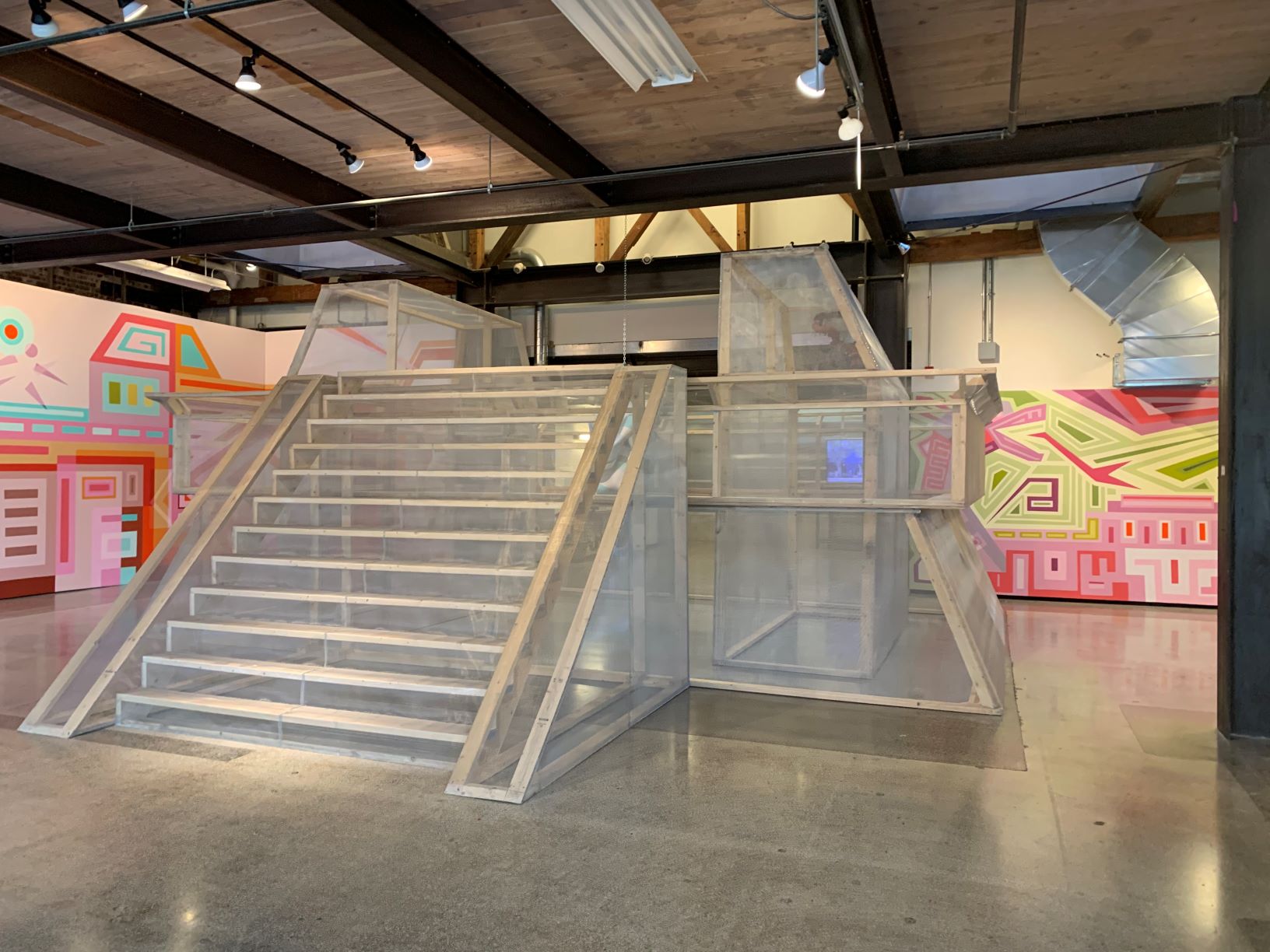
12 feet high and 22 feet by 25 feet at it widest
We see the building blocks of Mexican pyramids in the unusual shapes to the right of the stairs. Inside Out is the title of the exhibition, suggesting both the idea that she usually builds her sculpture from wire mesh and, to me, the feeling of the transparency of the pyramid as well as our current world which is being turned inside out.
Marela Zacarías was in Seattle working on a public art work for the new airport terminal. She then spent 8 weeks in a residency at Mad Art, ” a catalyst for new and unexpected artworks in Seattle”
Marela grew up going to archeological sites with her mother, an anthropologist, so the Mesoamerican sites are deeply embedded in her cultural identity.
According to Cross Cut author Agueda Pacheco Flores, Xochicalco is
“one of the only places where Aztec and Mayan shamans and leaders came together, perhaps to study the stars and determine the calendar. Aesthetic elements found on the site reflect art from both cultures, suggesting the two empires built the temple together before their eventual collapse.”
The artist sees a parallel between the collapsing of the Maya and Aztec empires and our current world.
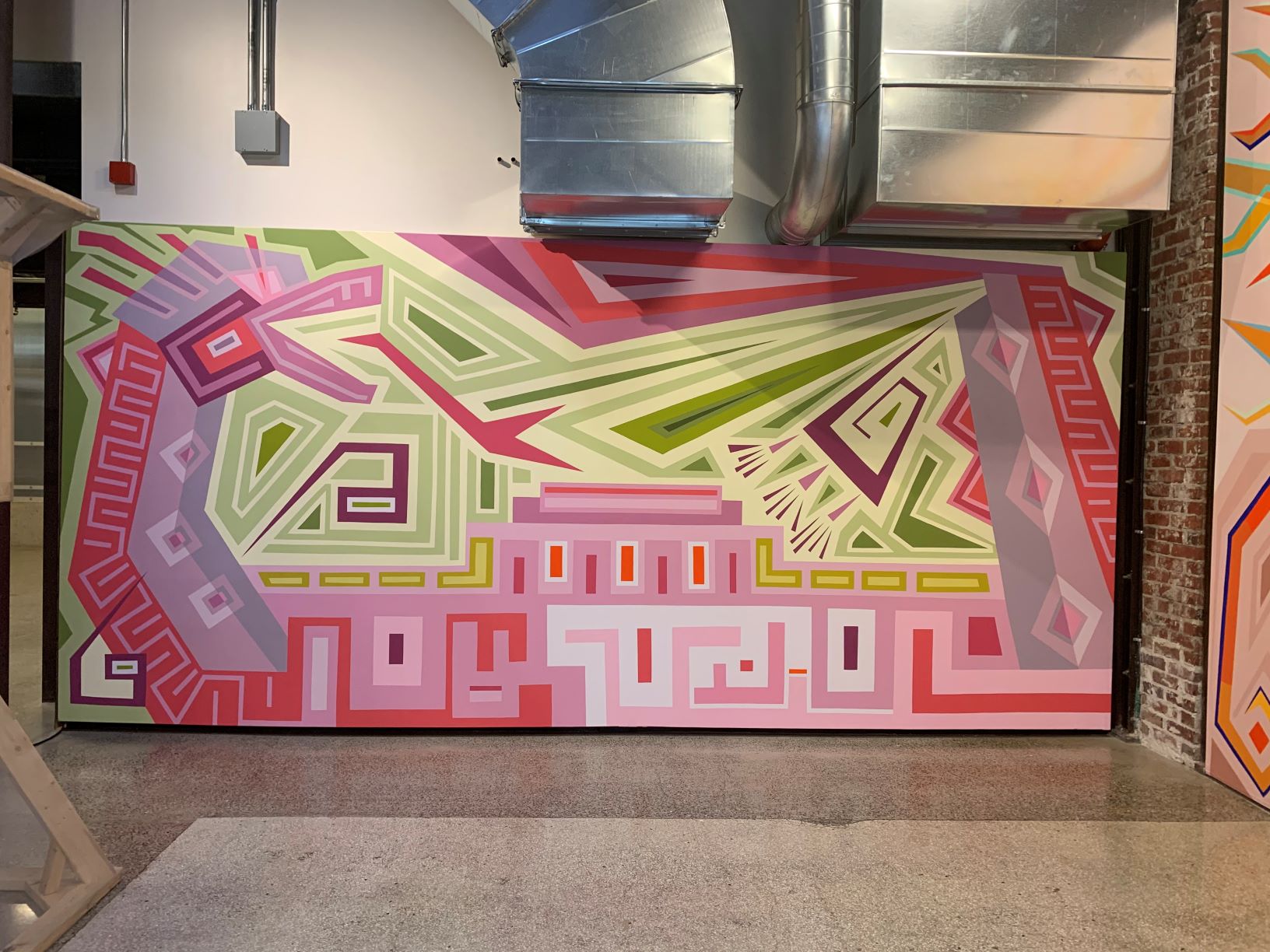
Before we look at what the artist has put at the center of the interior, let us make a tour of the murals on the walls around it. These are guaranteed to lift your spirits as you immerse yourselves in their stunning subtle purples, reds, pinks, aquas, reds, oranges and yellows.
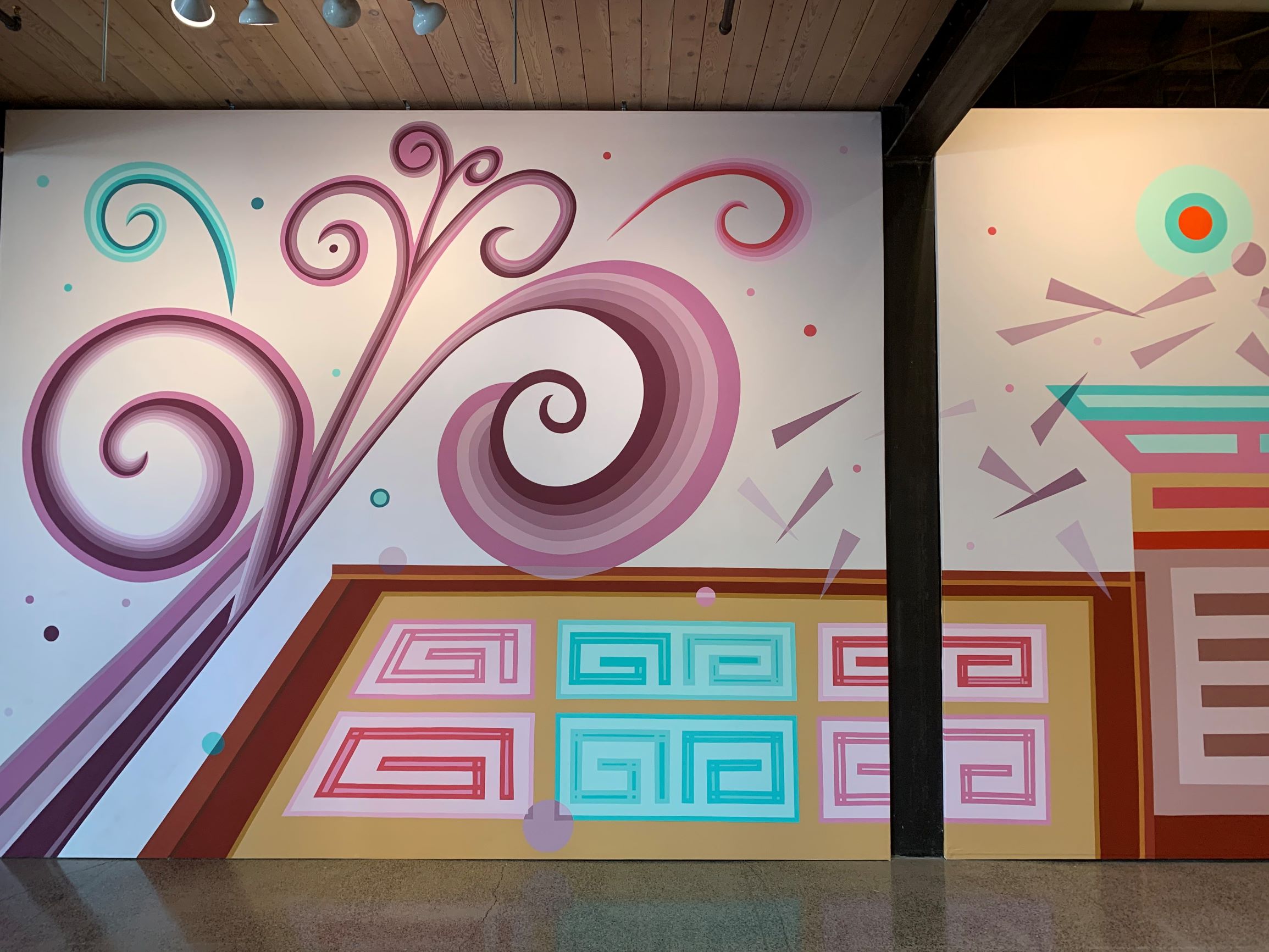
This burst of energy suggests a dramatic event, perhaps a volcano exploding. Look at the wedge shapes, which according to my friend Carolyn Tate, who knows all about Mesoamerican art, suggest the splintering of society. Underneath we recognize the familiar fret like decorations we see on Mexican pyramids.
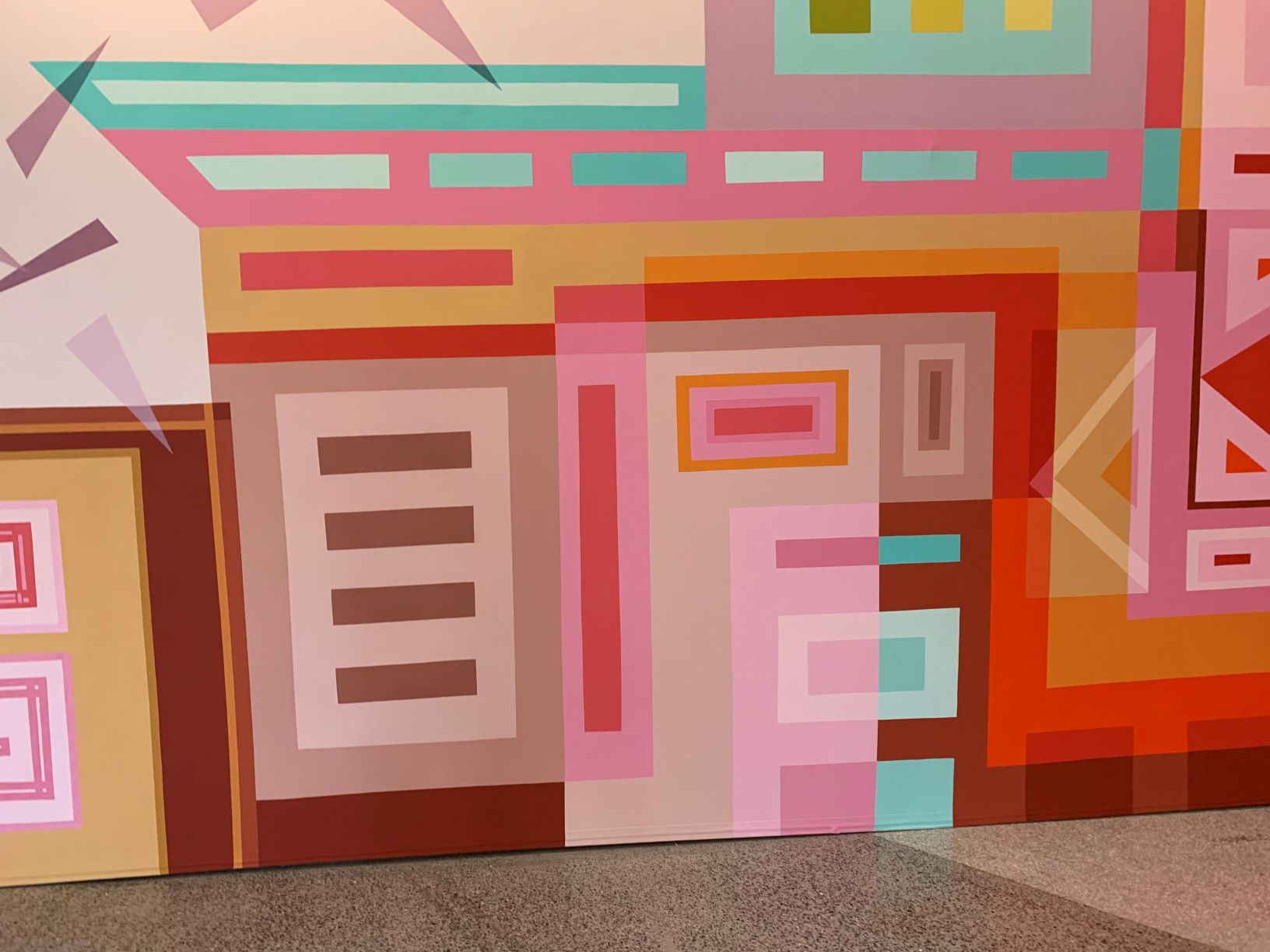
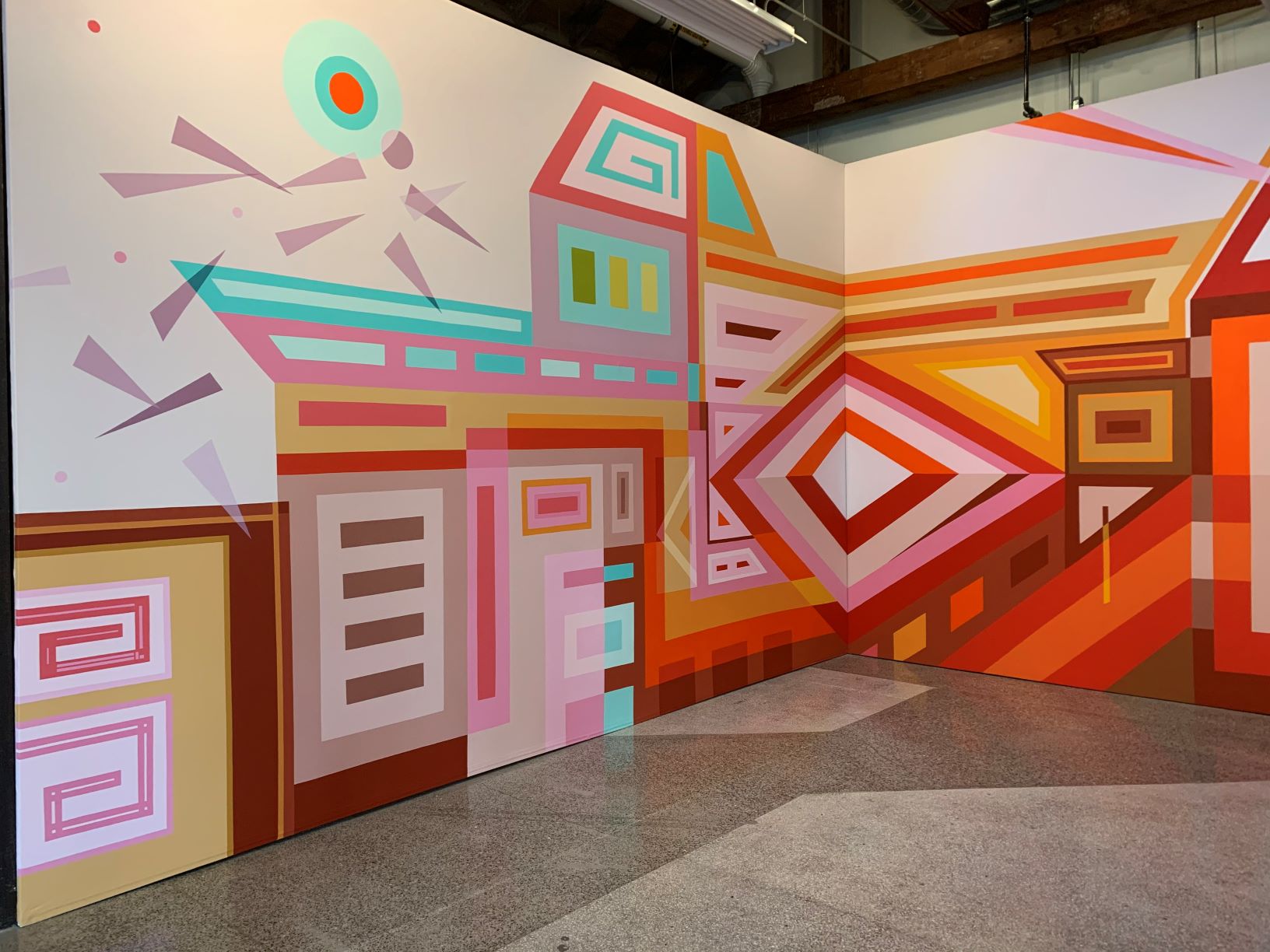
The next section suggests portals and entrances, especially the diamond shaped brilliant red shape in the corner. Then there are more portals. Above this is a light shaft going directly to the sky, which is part of the Mad Art gallery design, but Carolyn suggested we could be looking up from the underworld.
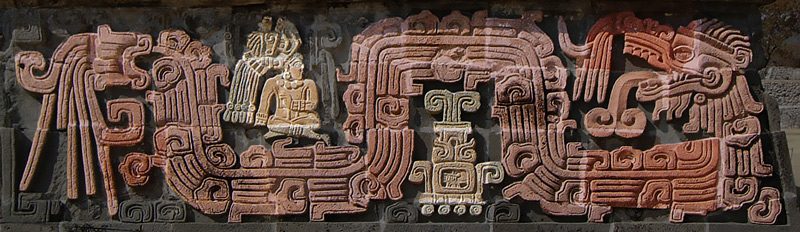
Next is the famous feathered serpent with its long tongue
Here is the serpent on the original pyramid. It is easy to see how much Marela has integrated her deep understanding of the serpent with her own aesthetics of color and abstraction.
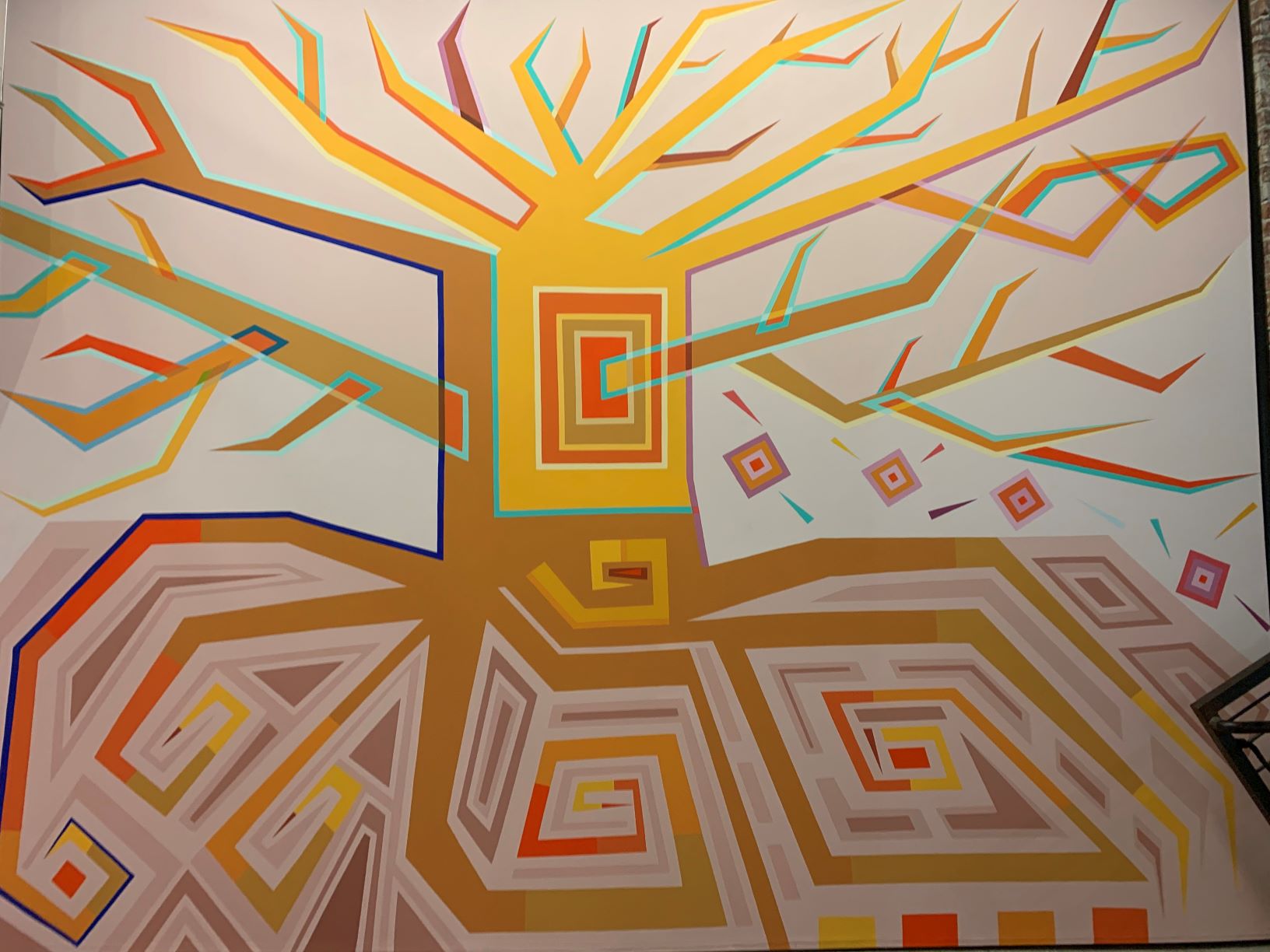
Around the corner is a glowing tree with roots reaching into the ground and labyrinthine spaces enclosed by its grasp.
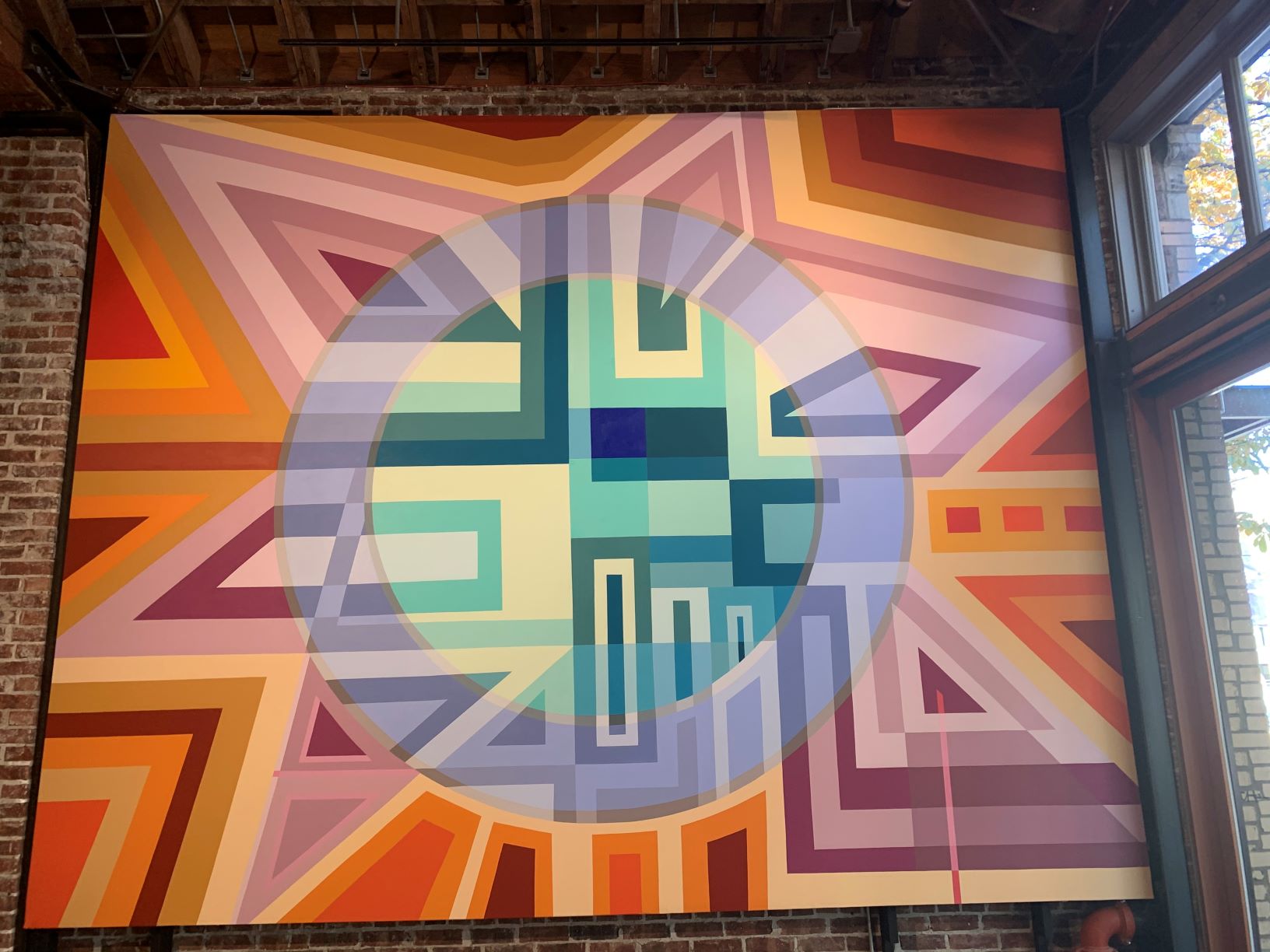
Finally we have a circular form collecting energies, perhaps a shield, a disc, a planet, a metaphor of unity.
But then we turn back to explore the pyramid again and we see a strange shape hanging there, it is a plaster serpent wrapped around a tire. It represents Cihuacoatl, dedicated to the mythological Aztec goddess known for providing women with strength during childbirth.
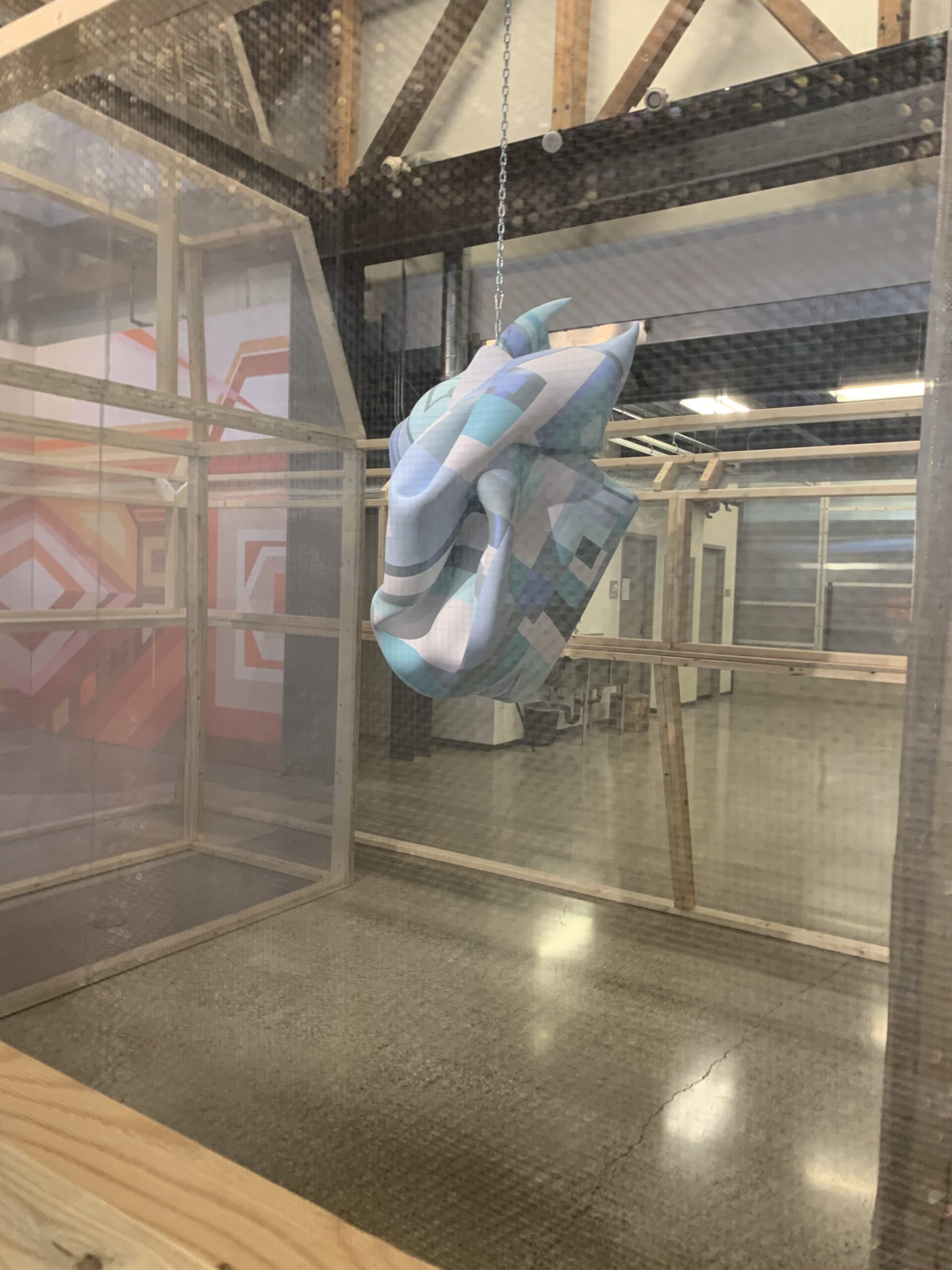
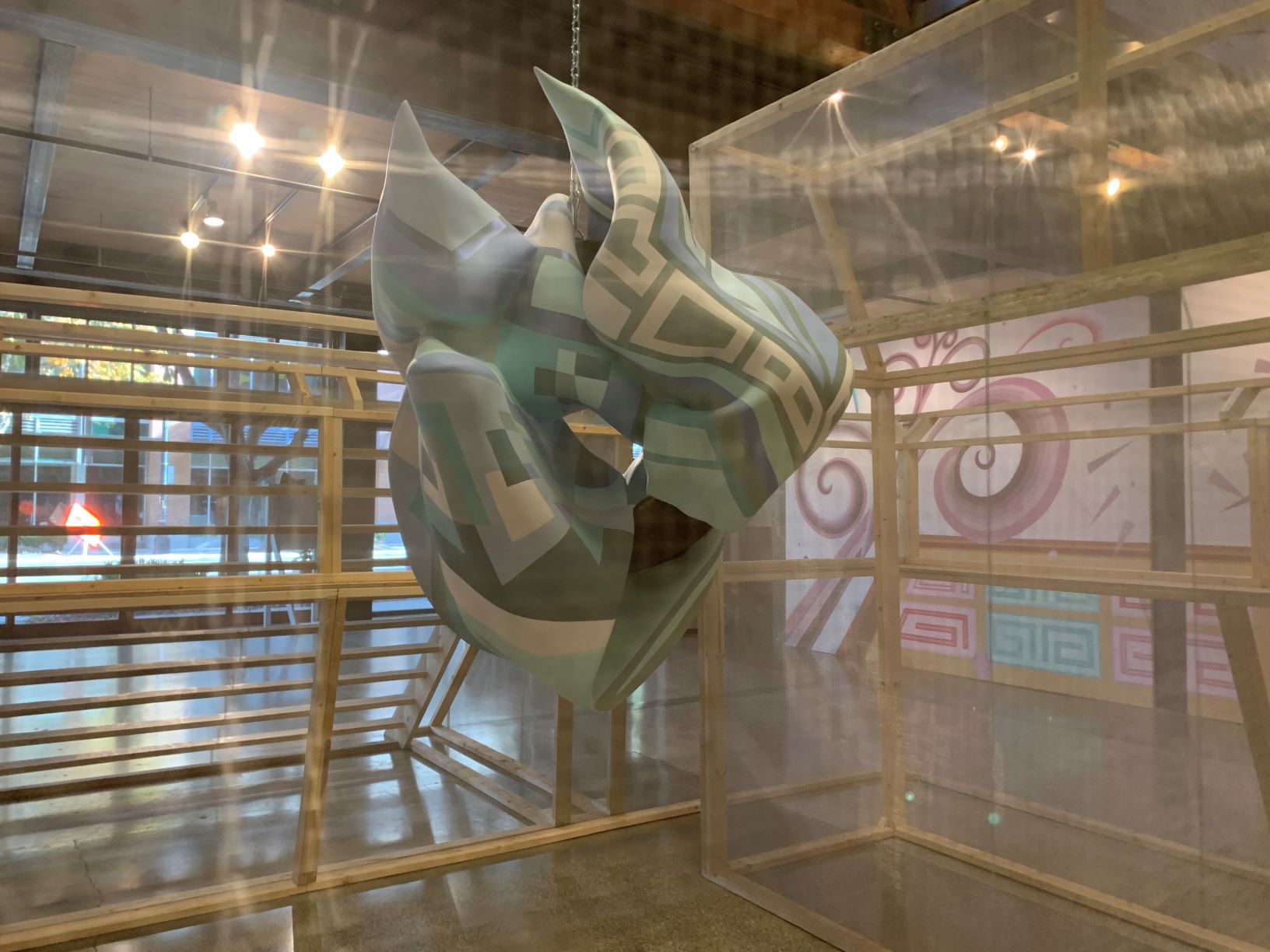
The artist said about the central image “I wanted to dedicate my temple to the resilience inherent in being a woman, the creative power, but also how we’re warriors with this energy that helps us. Not only childbirth, but I think of the women who are separated from their children at the border, of women who are going through a war, women who are single moms and finding food for their kids. I mean there’s just so much resilience that is called from us.”
This entry was posted on November 6, 2020 and is filed under Art and Activism, Art and Politics Now, Contemporary Art, Feminism, Uncategorized.
Na Chainkua Reindorf
Peli: You don’t play games with danger
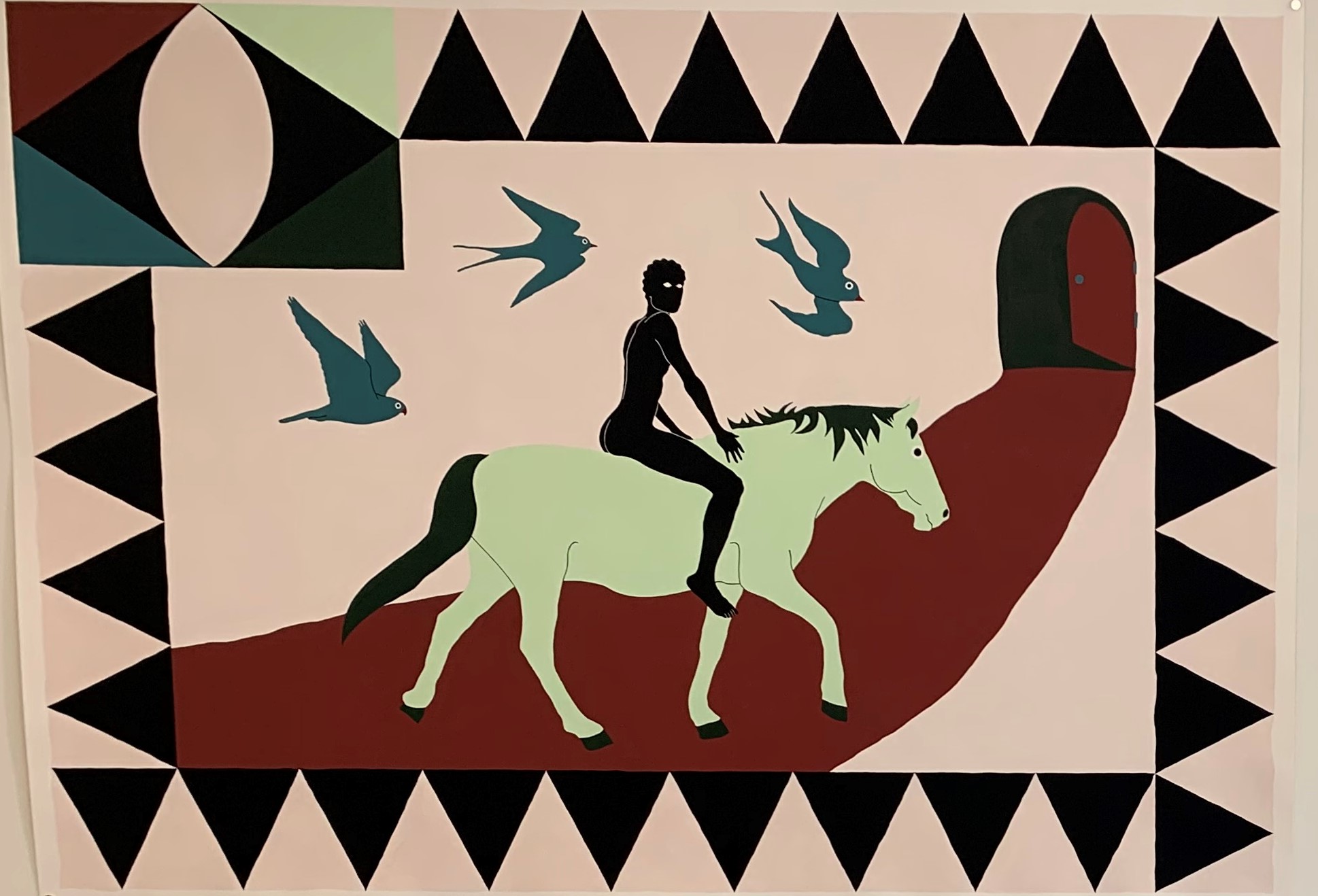
Bomi: Only the free can enter an unknown door without fear
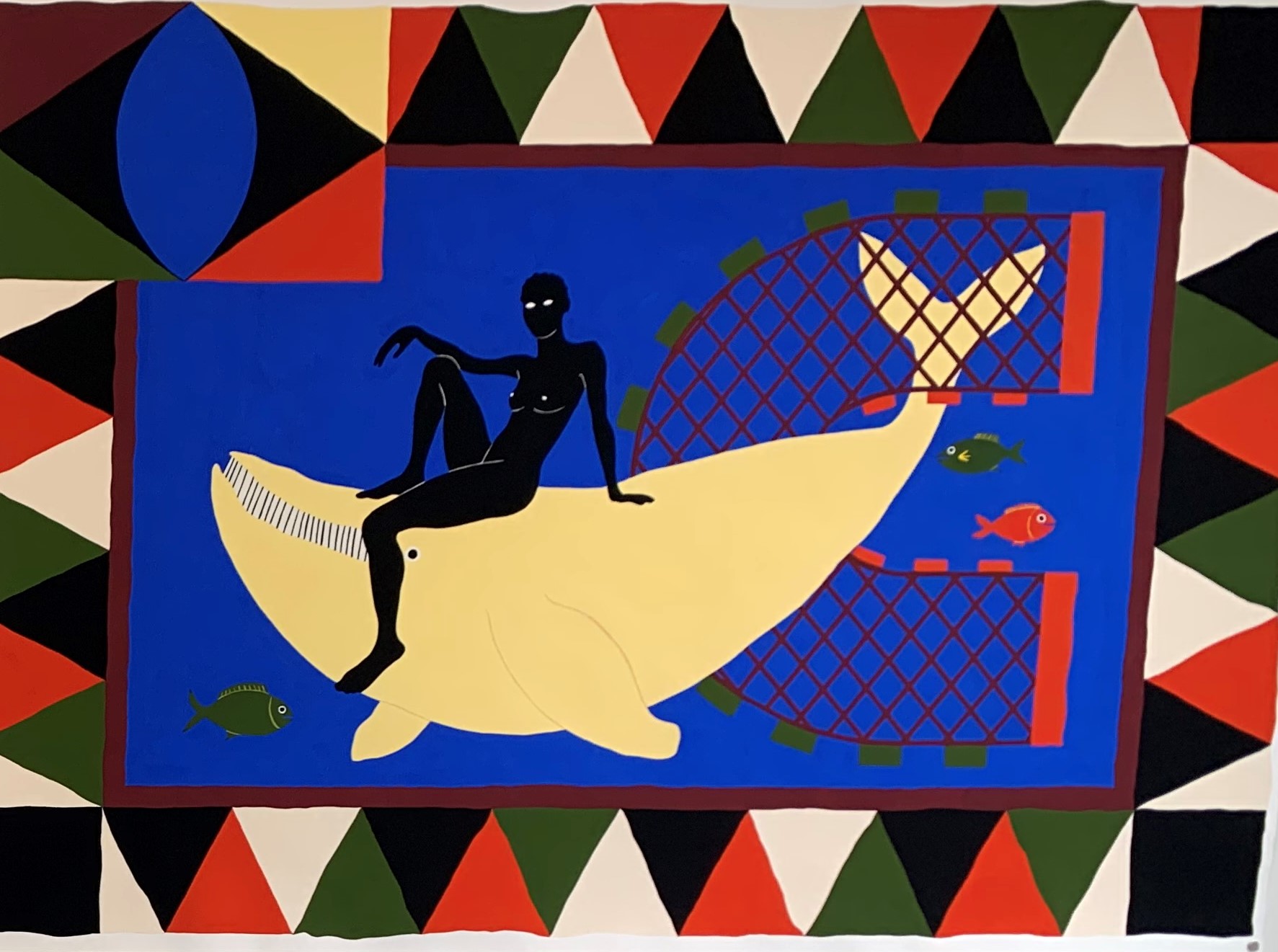
Lara The whale cannot be caught with a fishing net
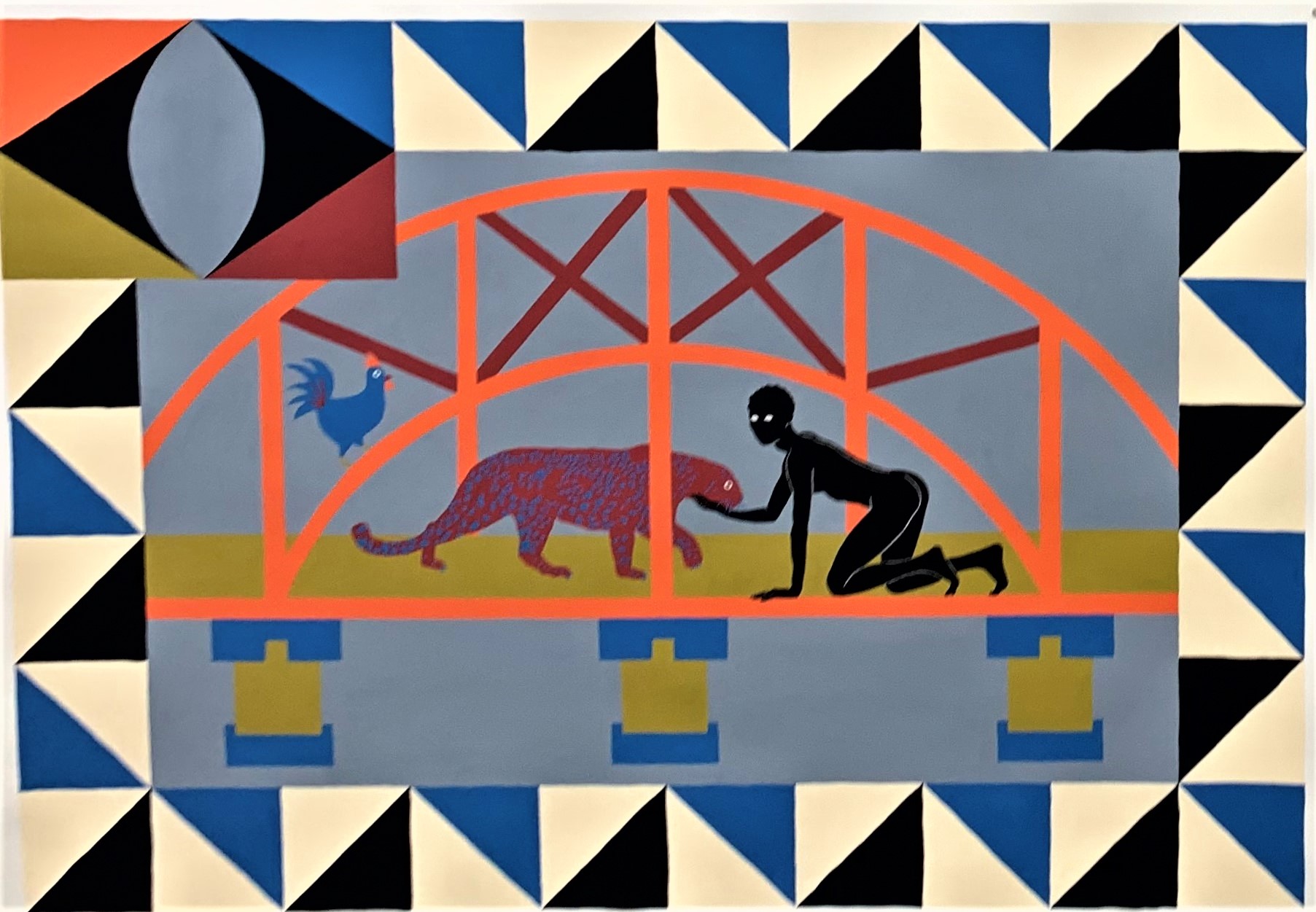
Evor: Only feed a beast with your hand when you don’t fear losing it
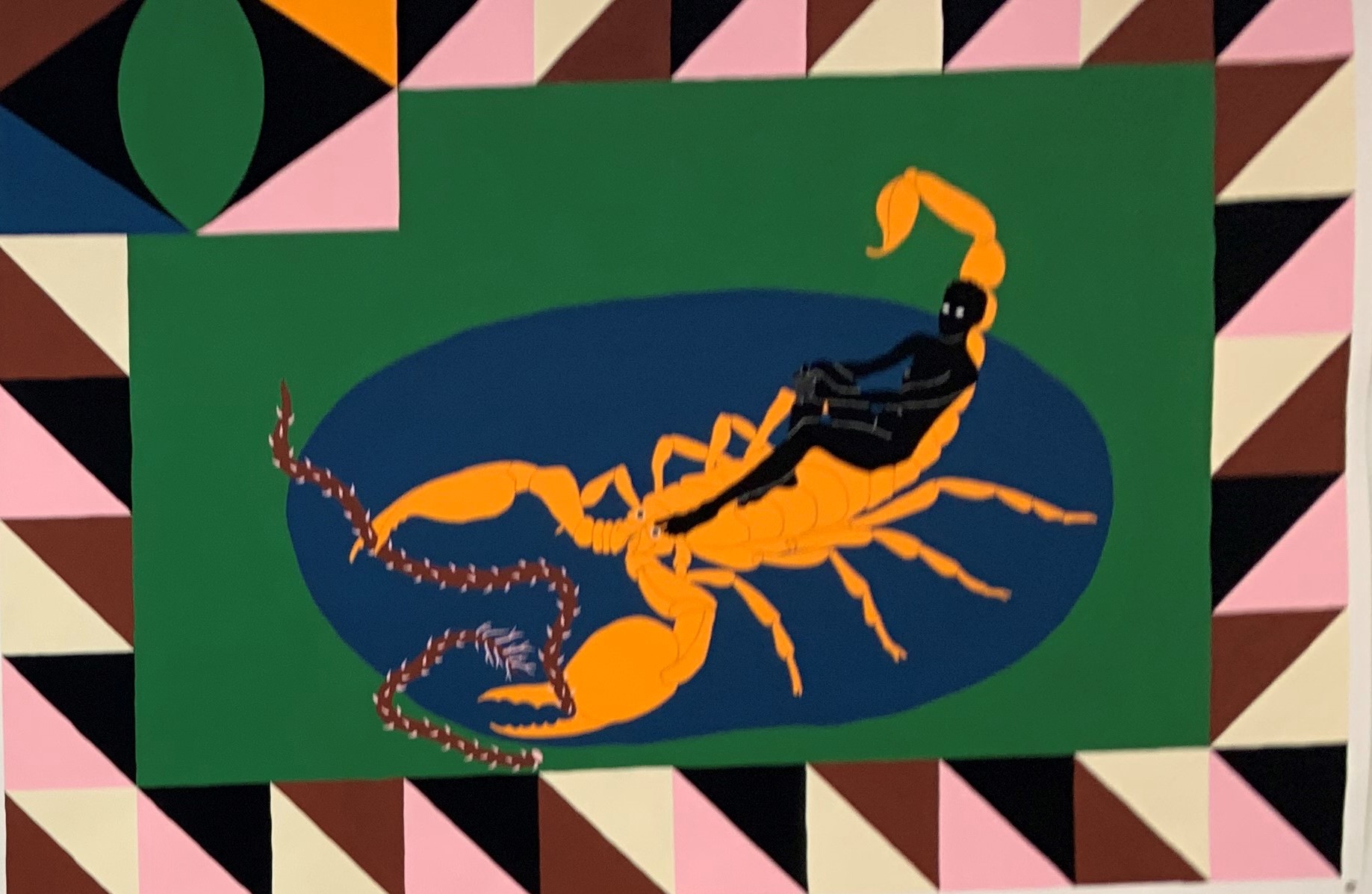
Nyeti Being a good friend of the scorpion does not mean you cannot be stung
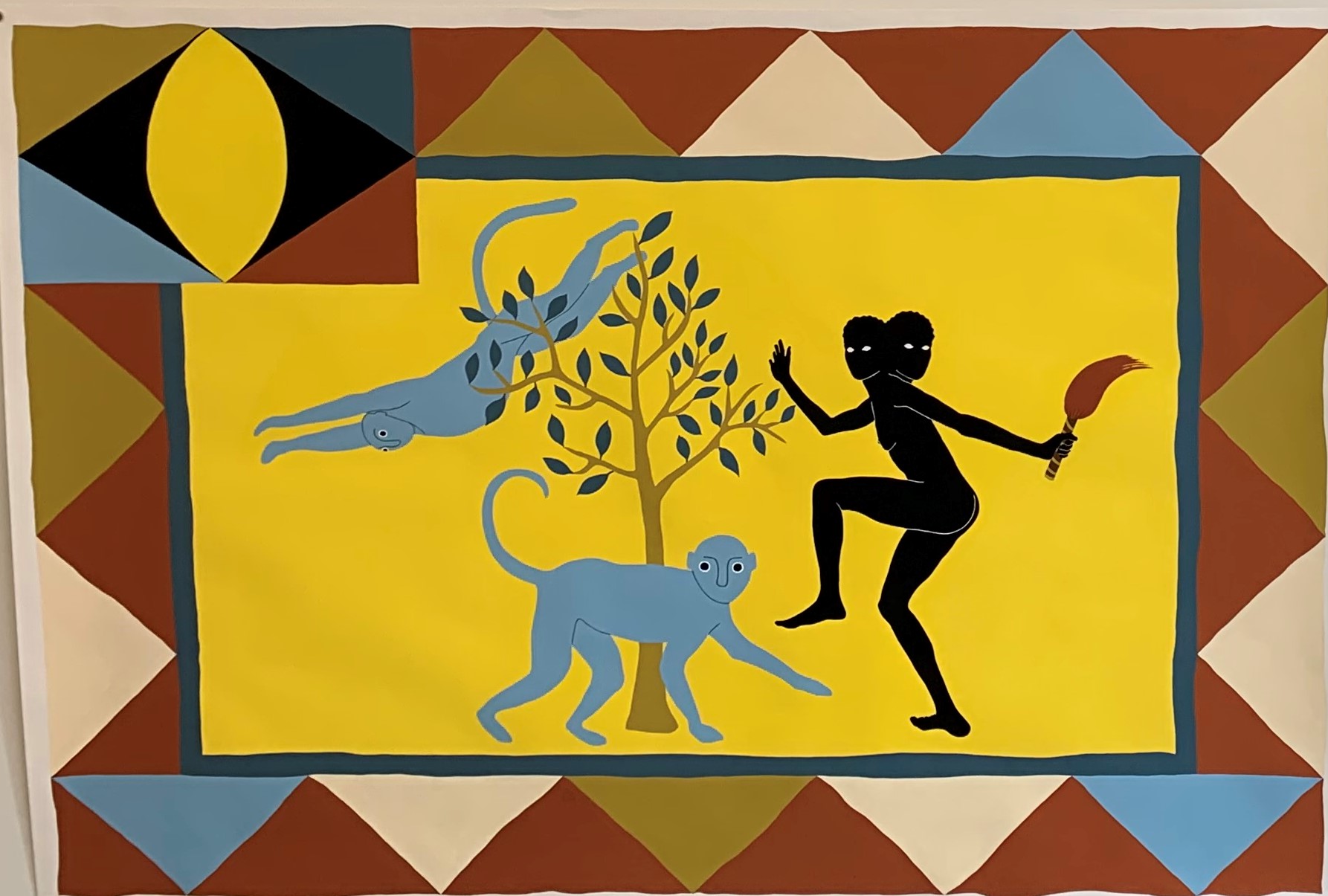
Tokpe: If you don’t want the monkey tail to touch you don’t attend the monkey dance
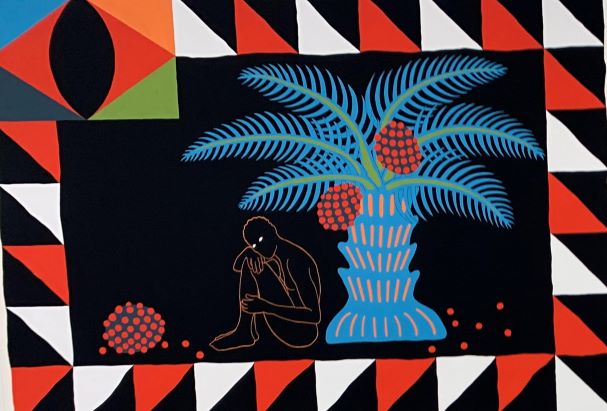
Gedu: The Palm Tree protects its fruits till they ripen
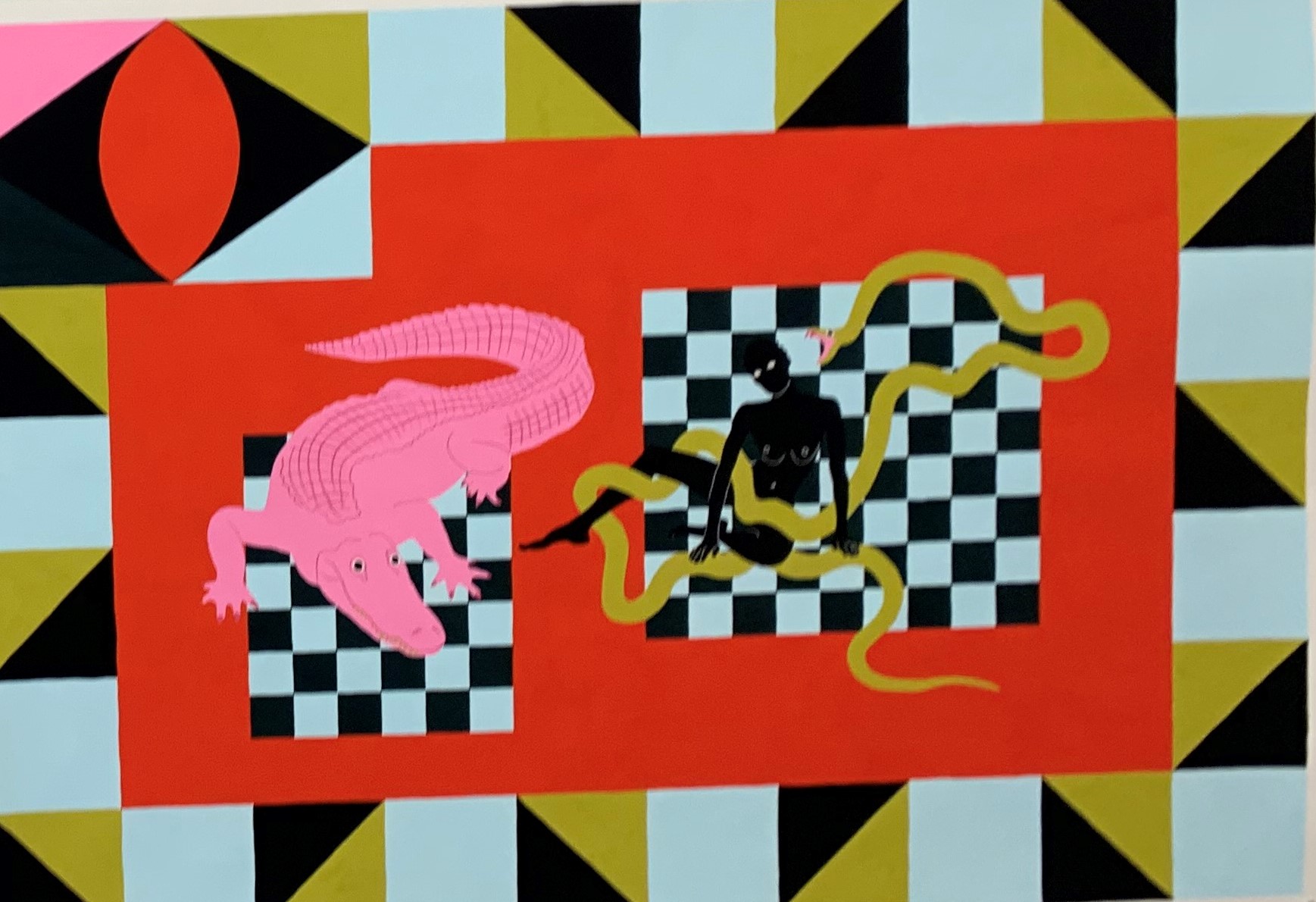
Ghanian artist Na Chainkua Reindorf is showing at the Specialist Gallery (until November 21, by appointment) a series of seven stunning works, with the title “Come, Let Me Spoil Your Things” The artist is inviting us to meet members of an imaginary secret society. This is the first phase of a long term project.
” this series of works introduces the seven original members of the Mawu Nyonu, a mythological women’s masquerade secret society believed to exist in parts of West Africa today.”
The seven masquerade characters “serve as mediums through which actions can be performed and in some cases transformations can take place”
Masquerading can ” explore ways of being that could be considered radical or unacceptable . . . they inhabit a world where women can explore their deepest, darkest and often radical desires through the art of masquerade, without fear of repercussion or judgment.
According to the artist
“The Mawu Nyonu (roughly translated as ‘god-woman’) are believed to have formed as a direct result of the 19th century disbandment of the Dahomey Amazons, an all-female military regiment active in what is now present day Benin.
Each painting in “Come, Let Me Spoil Your Things” takes the form of a flag, introducing each of the Mawu Nyonu characters, who forge the basis of their own unique masquerade. Reindorf’s carefully rendered gouache works are inspired by appliqué flags and banners from both the Asafo militarized states in Ghana and the former kingdom of Dahomey, Benin.
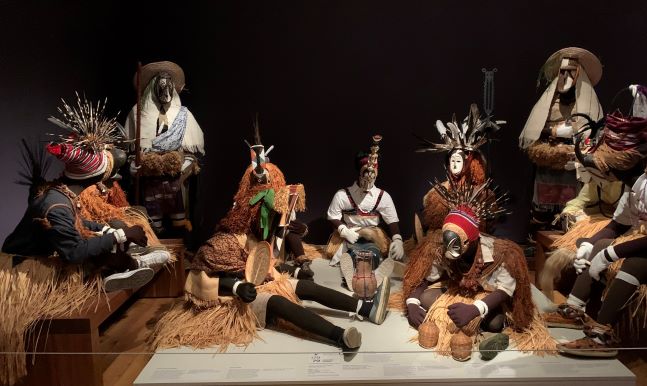
Okumpka Masquerade Players “The Pot of Foolishness” Chukwu Okoro masks, Sam Irem costume elements , assembly Eze Anamelechi
By coincidence I visited a masquerade installation at the Seattle Art Museum today as well.
“Ridiculous mistakes don’t hide in Okumpka plays. Instead an open pot is carried into view by a masked spirit who announces his name and offers a speech or song that explains why he is the most foolish man of all. Often his boast isn’t immediately accepted and he is urged to defend his claim, thereby revealing more of his blunders. Others continue to vie for this title and confess to their own stupid actions. Leaders ultimately decide who deserves to be known as the most foolish, an honor that conveys pride in facing one’s own folly. ”
As we approach Hallowe’en, as well as universally participate in masking to stay well, these are provocative exhibitions to think about. What does a masquerade mean, in these two cases they imply moral lessons, and deep feelings. What do we mean by it here in the US in November 2020 when we can no longer recognize even people we know, are we all transformed in this strange present into disguise, giving us the opportunity to explore our inner selves? To think about our relationship to nature, to other human beings, to the future and to the past?
This entry was posted on October 25, 2020 and is filed under Art and Activism, Art and Ecology, Art and Politics Now, Uncategorized, Women Artists.
Women’s Suffrage and Women’s Suffering
The Center on Contemporary Art (COCA) WHAT STORY WOULD THE UNINTENDED BENEFICIARIES TELL (WSWUBT), which closes in two days, is a wonderful small selection of artists addressing the suffrage amendment and who was left out. The artists include Carletta Carrington Wilson with a selection from her incredible Letter to a Laundress series that I have written about before.
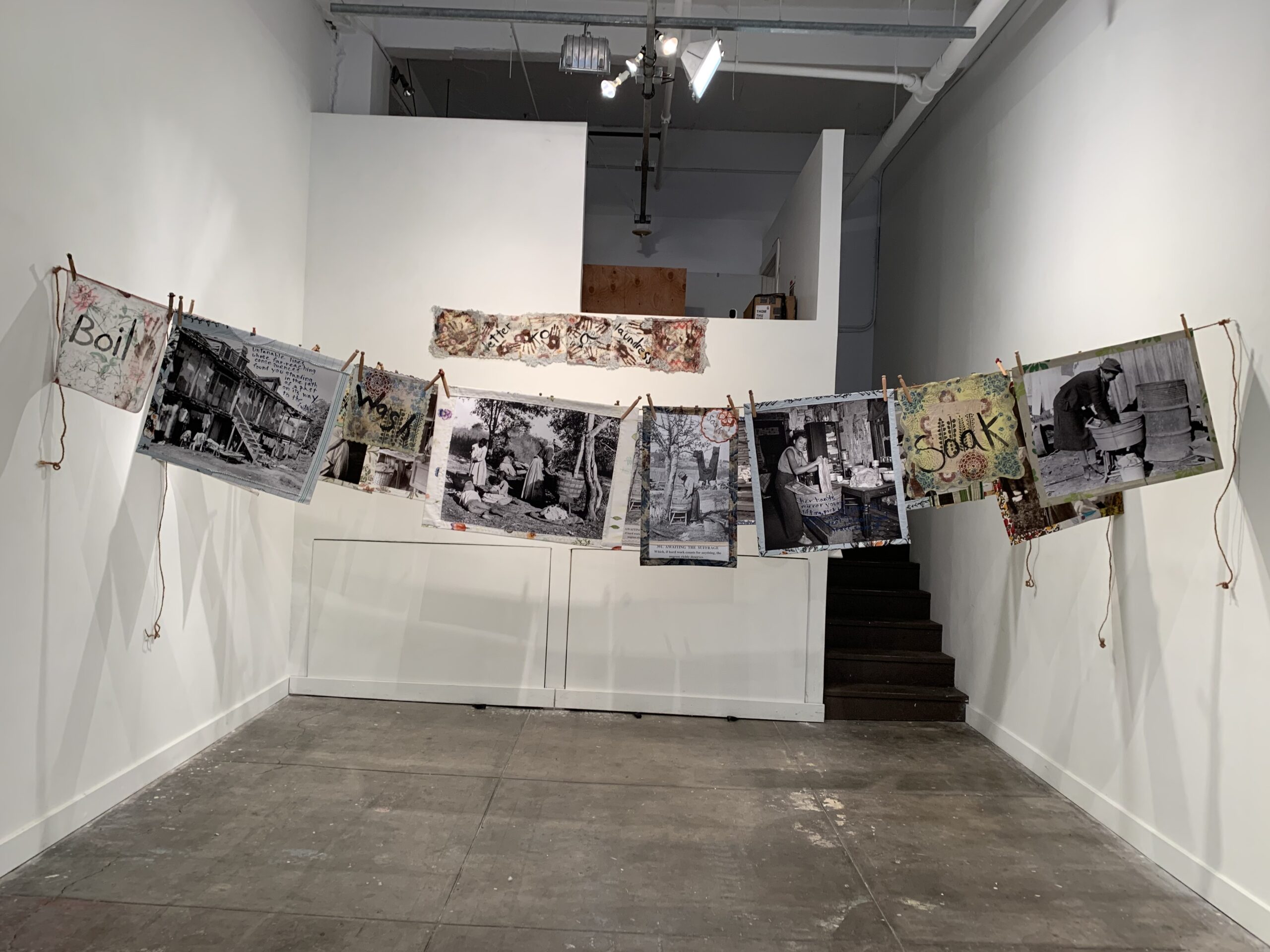
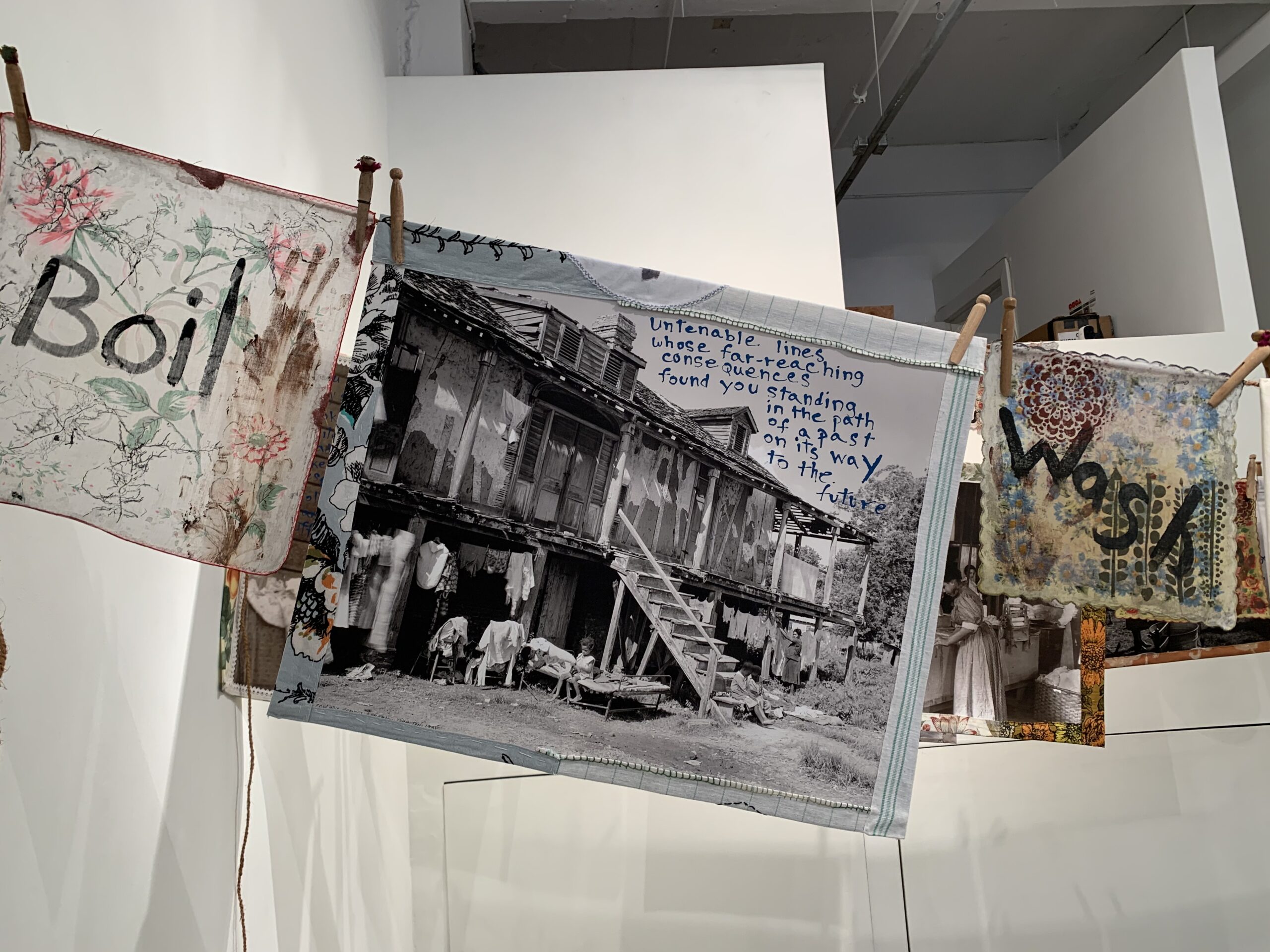
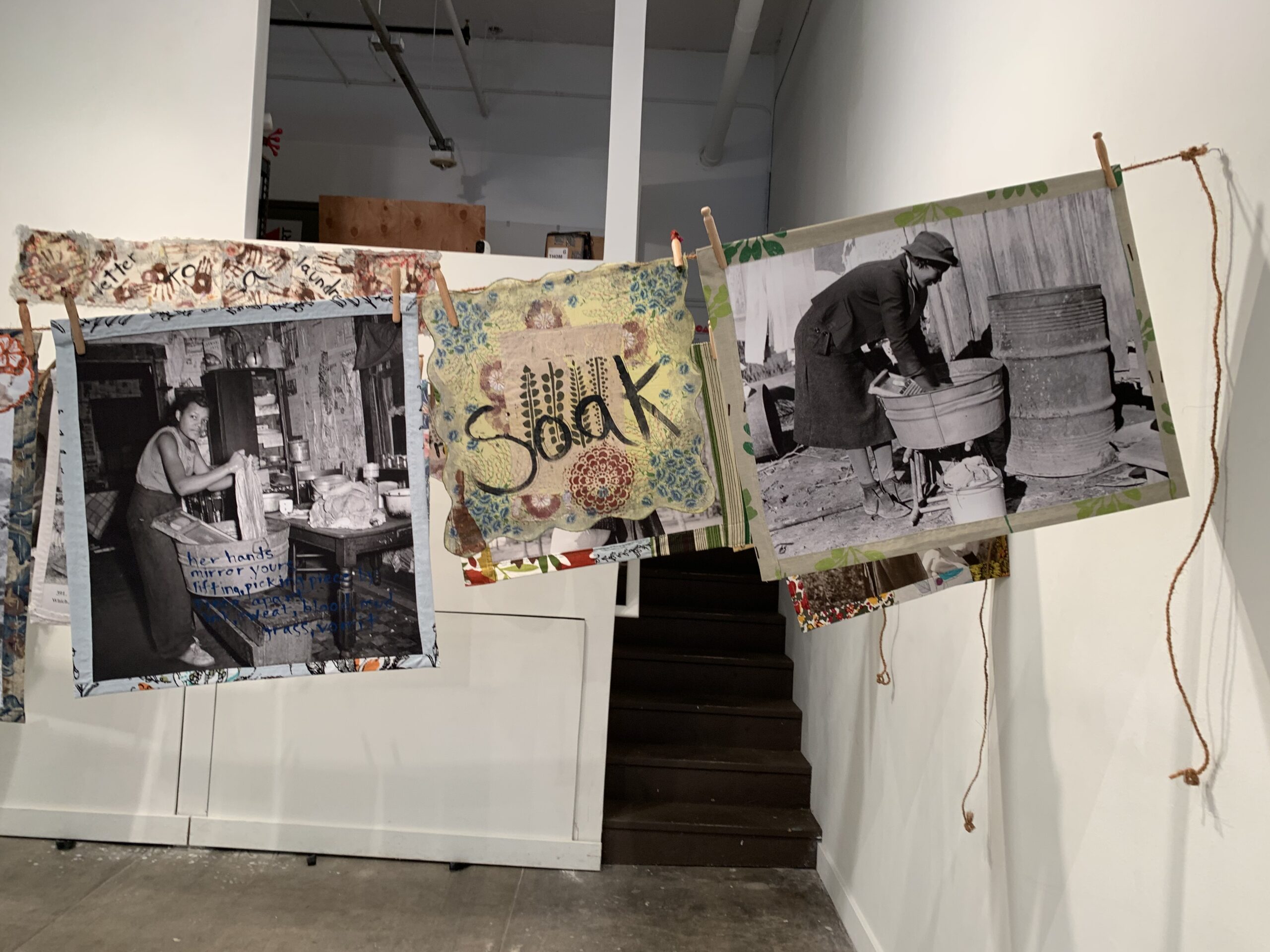
Carletta was stunned to discover that one of the archival photographs from the 1930s WPA photographers project had a caption directly referring to black women being left out of suffrage. Carletta added this image three times to her original series.
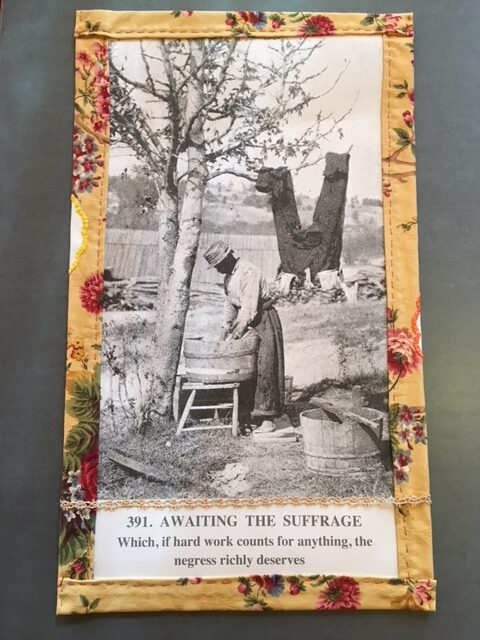
And note the background of the photograph with the upside down pants. Each verb in this series has a step in the laundry process, which we don’t even know about any more with our washing machines. Each step, as the artist hangs it on the washing line across the gallery suggests another meaning. In her installation Carletta had ten steps “Wash Soak Starch Wring Boil Pin Rub Scrub Hang Press.”
The other artists at COCA are less familiar to me, but together make a compelling statement.
This is Charlie Carlos Palmer directly referring to slavery in his powerful paintings that imitate the language of run away slaves and auctions. Look closely at the details!
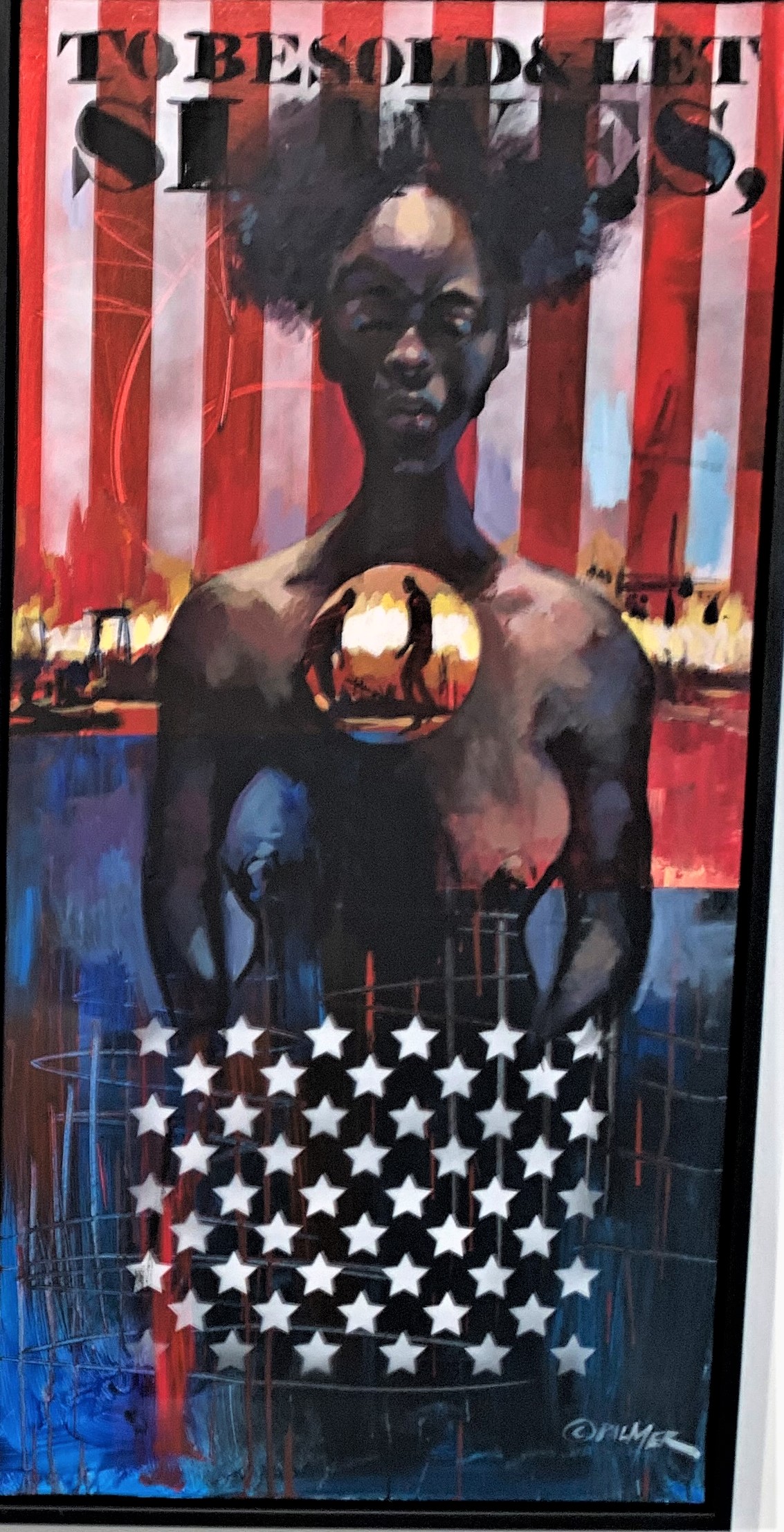
Hollow I 2020 Acrylic on Canvas 48 x 24″
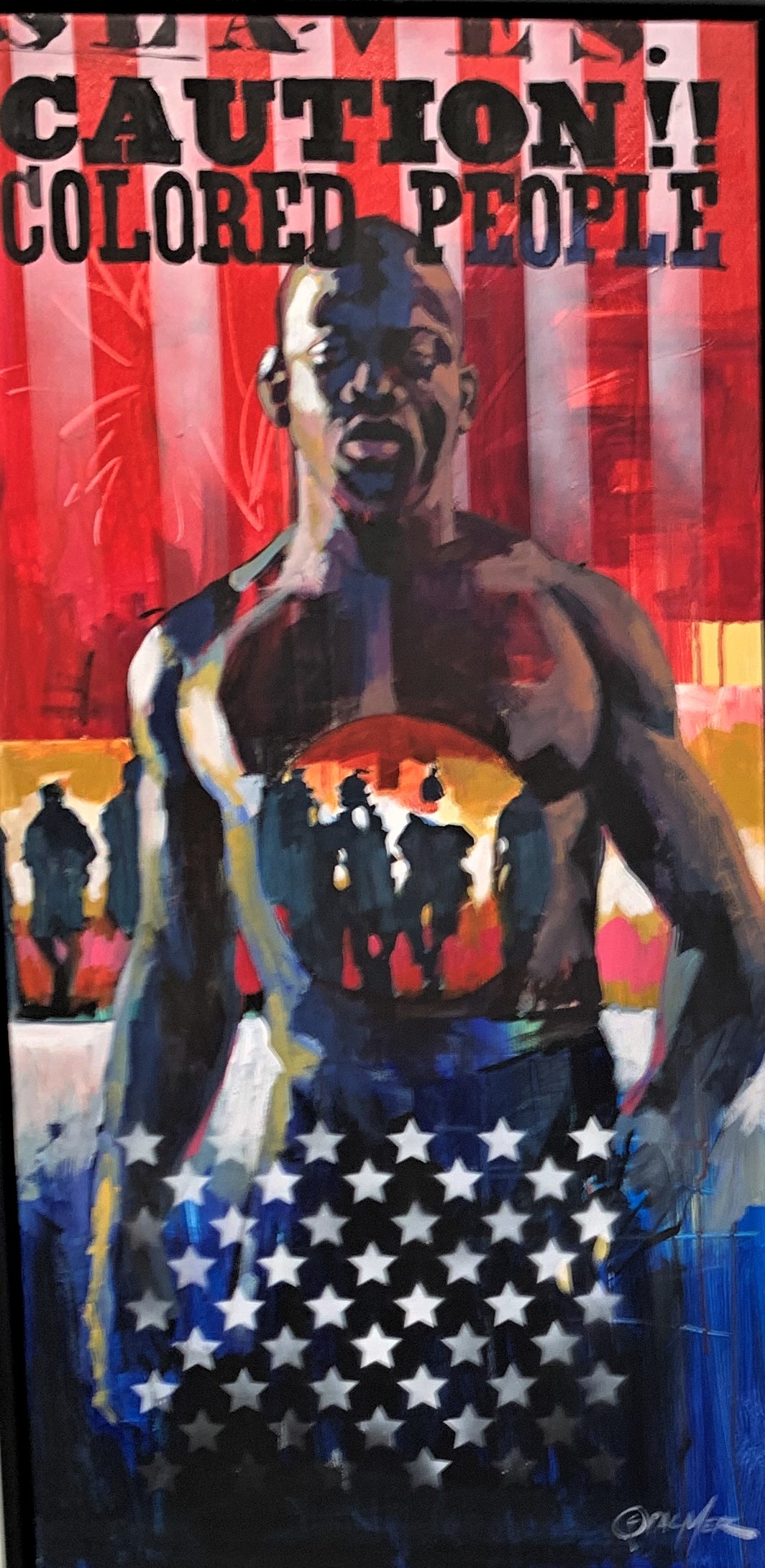
Hollow II 2020 Acrylic on Canvas 48 x 24″
We have Bonnie Parker
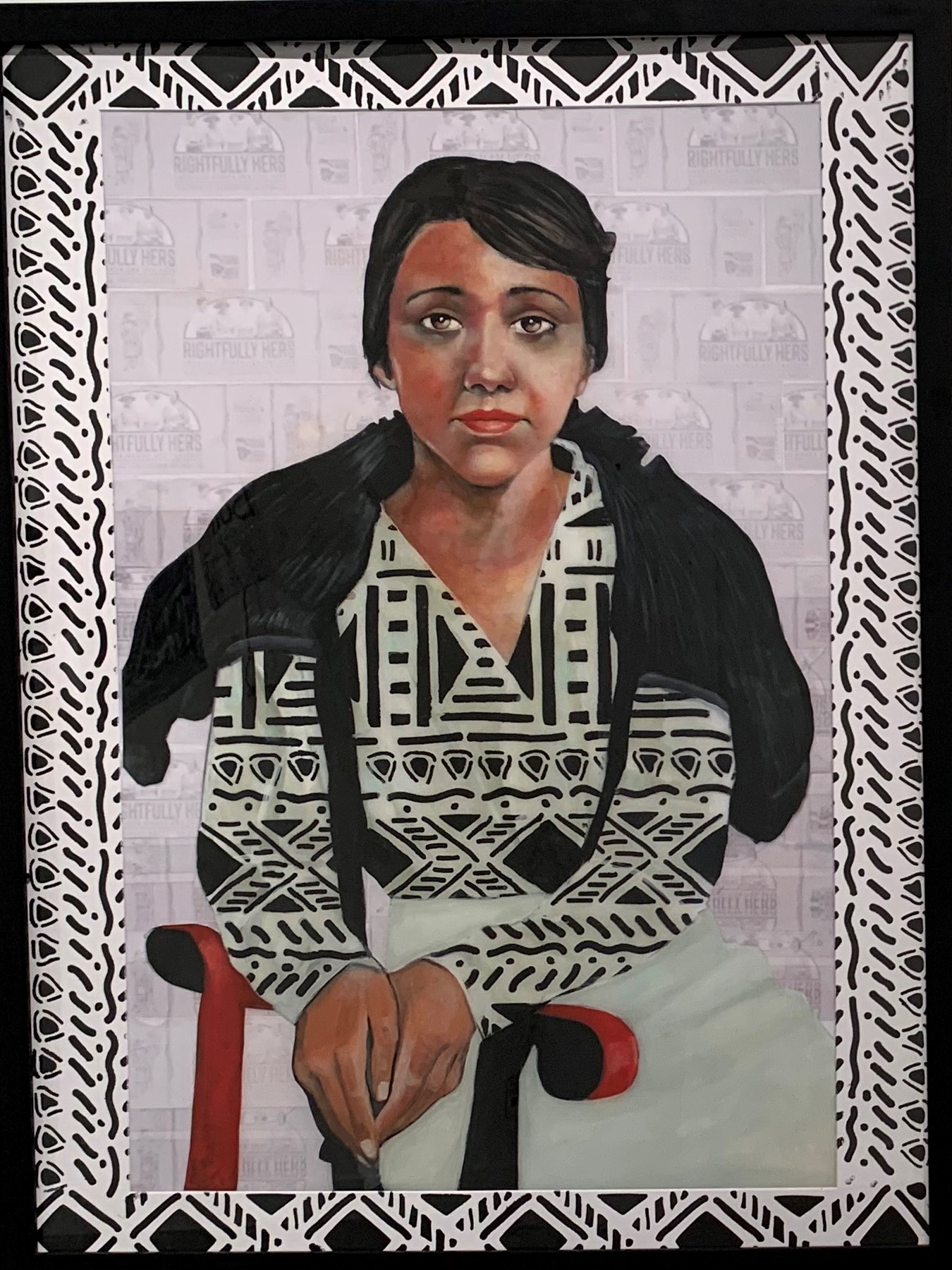
Left Out of the Conversation 2020 acrylic on yupo paper 30 x 40″
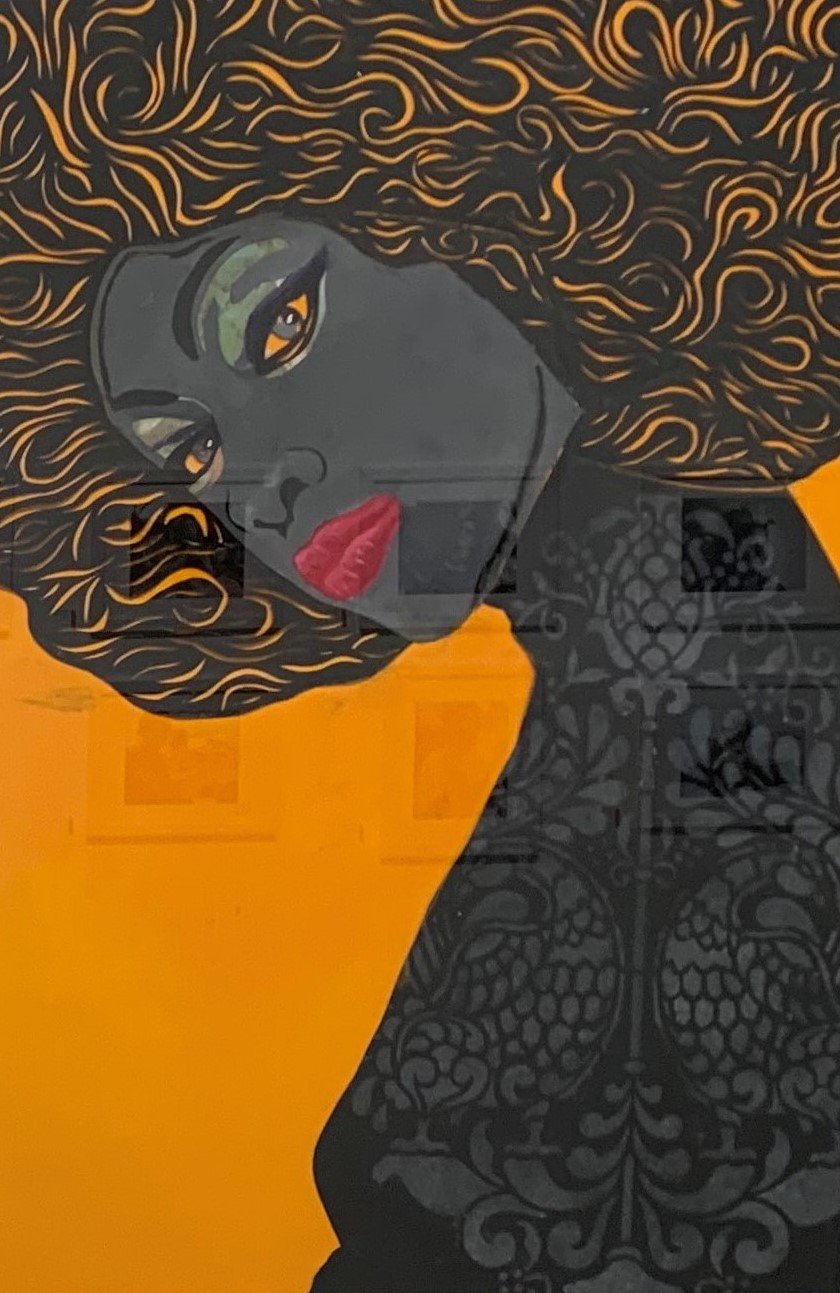
Legacy, 2020 printer ink on yupo paper 30 x 40″
with her compelling portraits of black women.
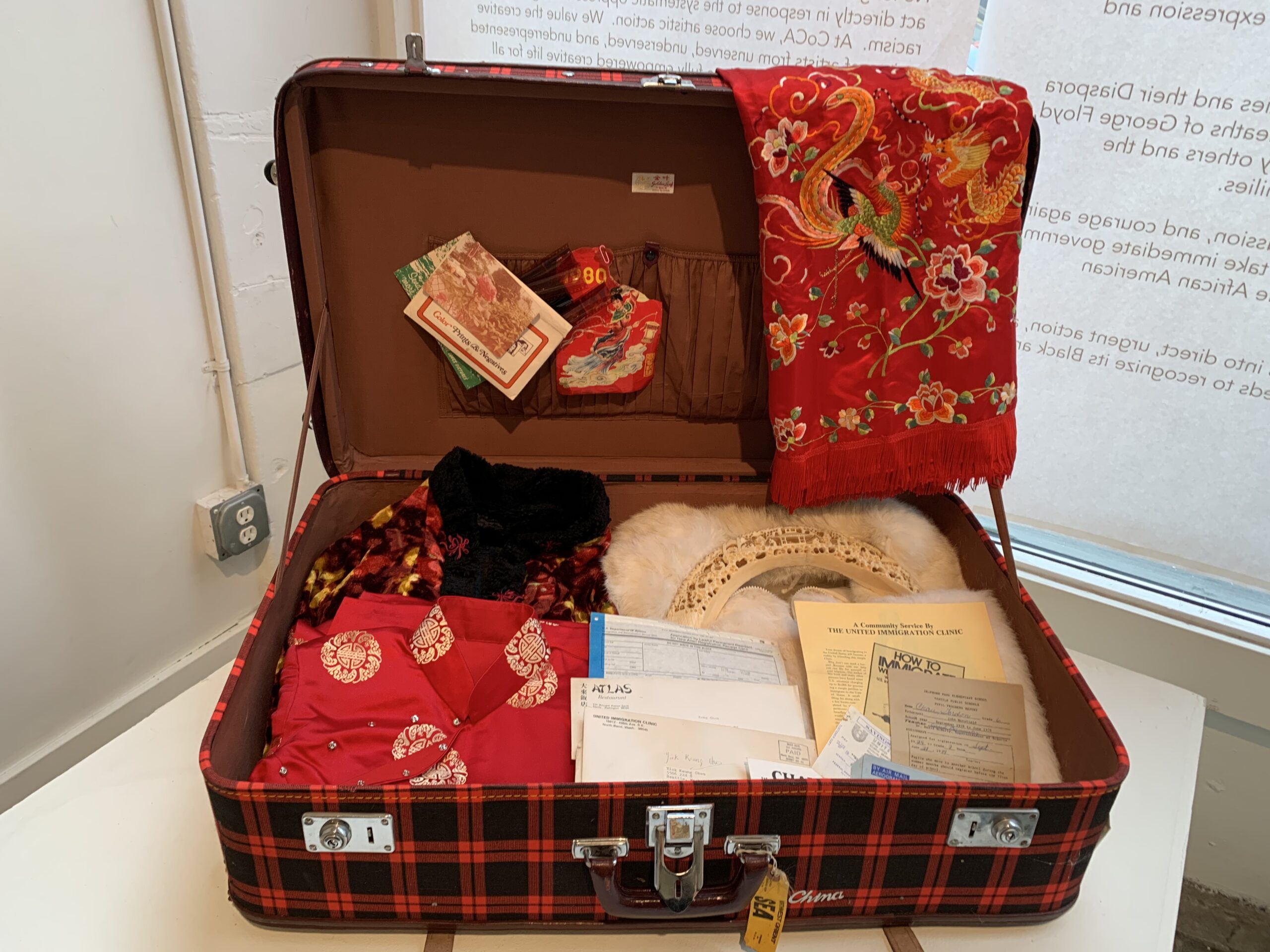
The Things They carried 2018
And then there is the fascinating Monyee Chau addressing the Chinese American experience.
Finally there is Lisette Morales with her wonderful series of Latina portraits. Here is one.
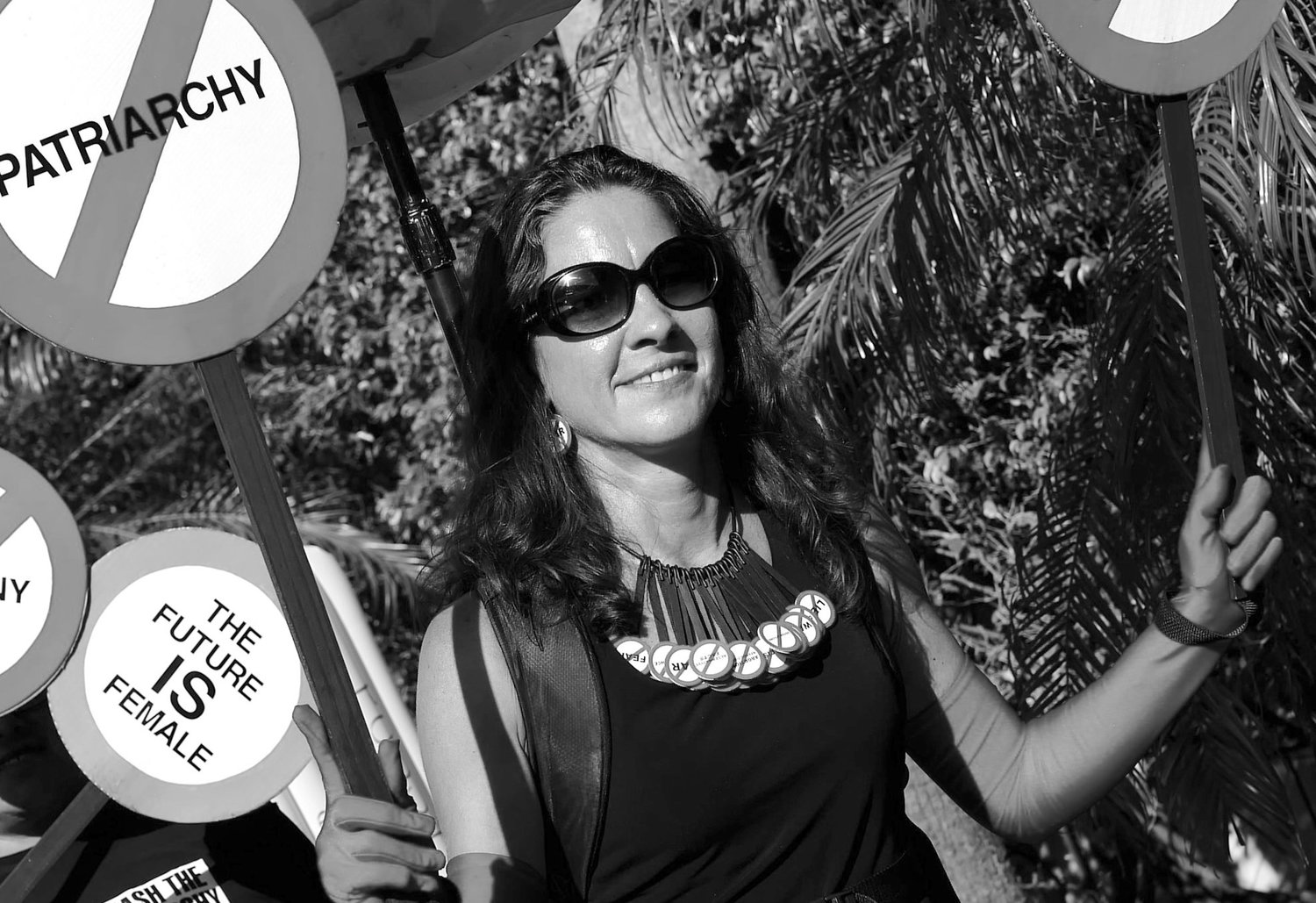
Alessandra Mondolfi | Artist and Activist
the artist has described her series as “Compathy: Latinas on both sides of the lens” is a collection of 22 Black & White portraits of Latinas. See the rest of the series on her website.
They include a wide range of Latinas of different ages and professions
Ivette Gomez describes them in her eloquent statement
“They are embodied compassion and empathy in action. Sometimes heroines, like the nurse that risks her life in a pandemic, other times women that are considered arrogant or prideful because they dare express what they consider to be unfair, for being advocates of the rights of those that have not yet found their own voice.”
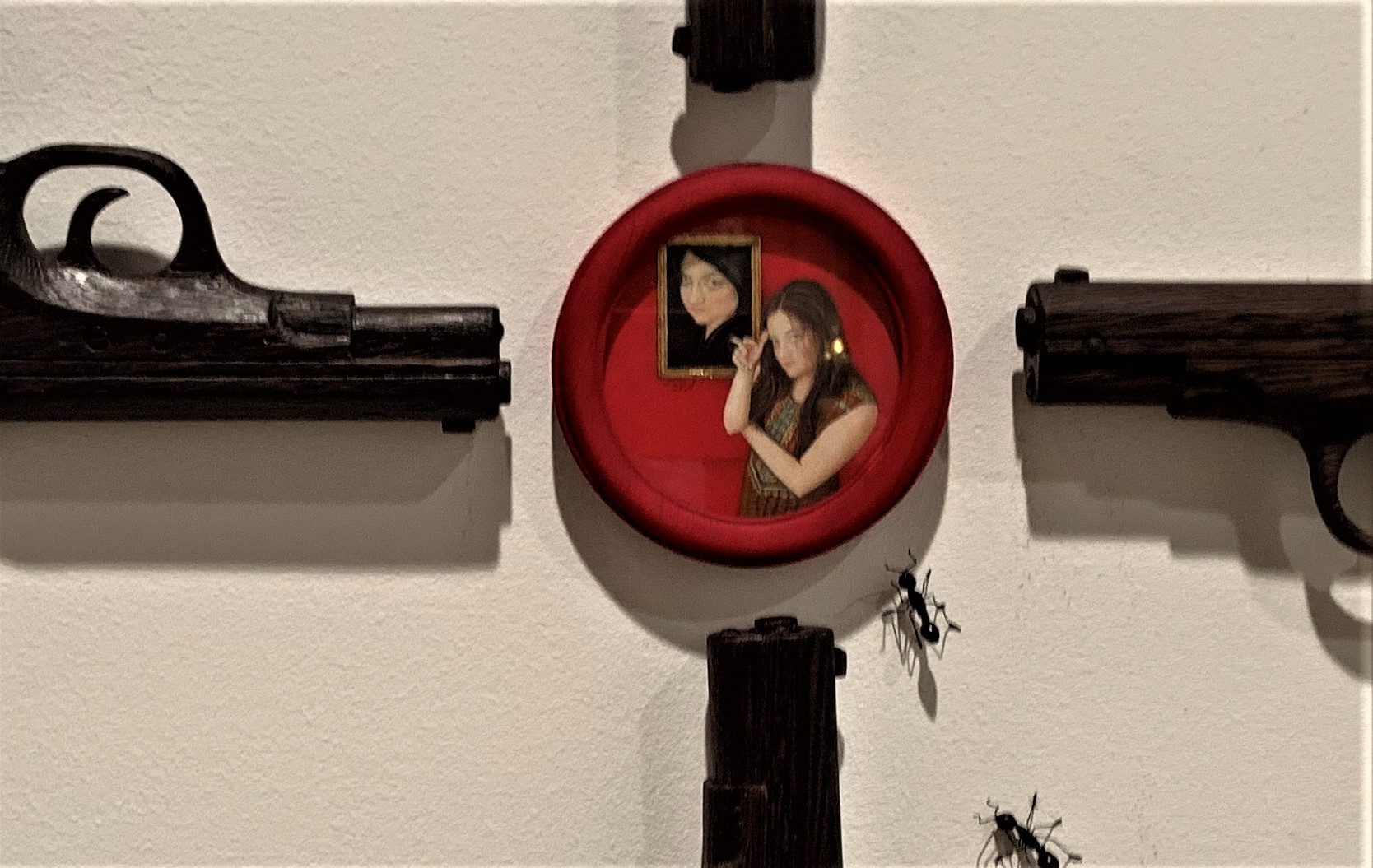
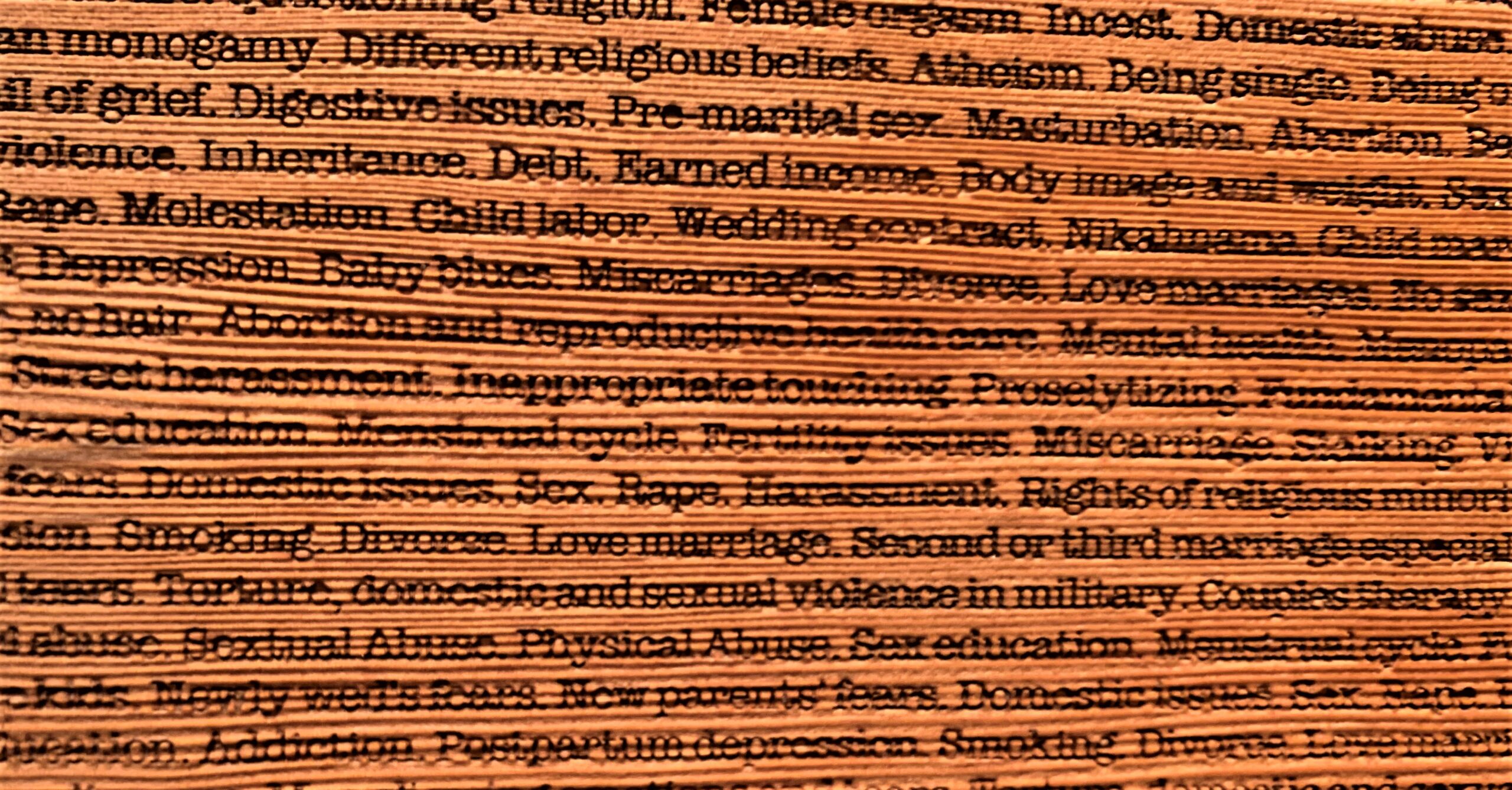
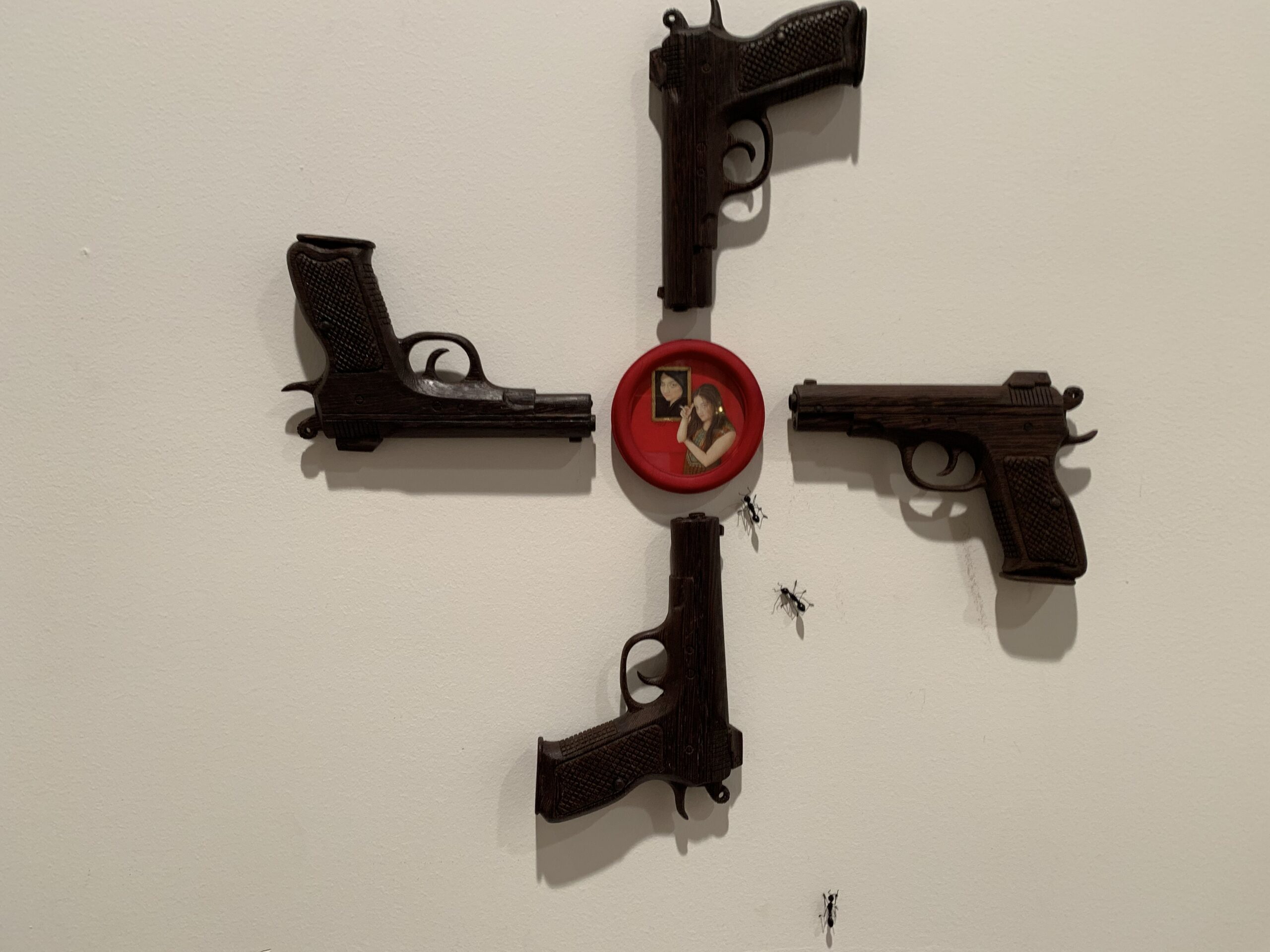
Another important show is at Greg Kucera until November 7 “Humaira Abid, Sacred Games” This amazing exhibition, her first at Greg Kucera’s, reveals her secret sorrow. At first it looks like ordinary objects brilliantly fashioned from wood, a purse, a shirt, but as we go deeper into the exhibition we learn that she was molested repeatedly as a child by a family member, and everything acquires a new layer of intense meaning. There are also explicit references to her traumatic experiences. Here are a few of her works
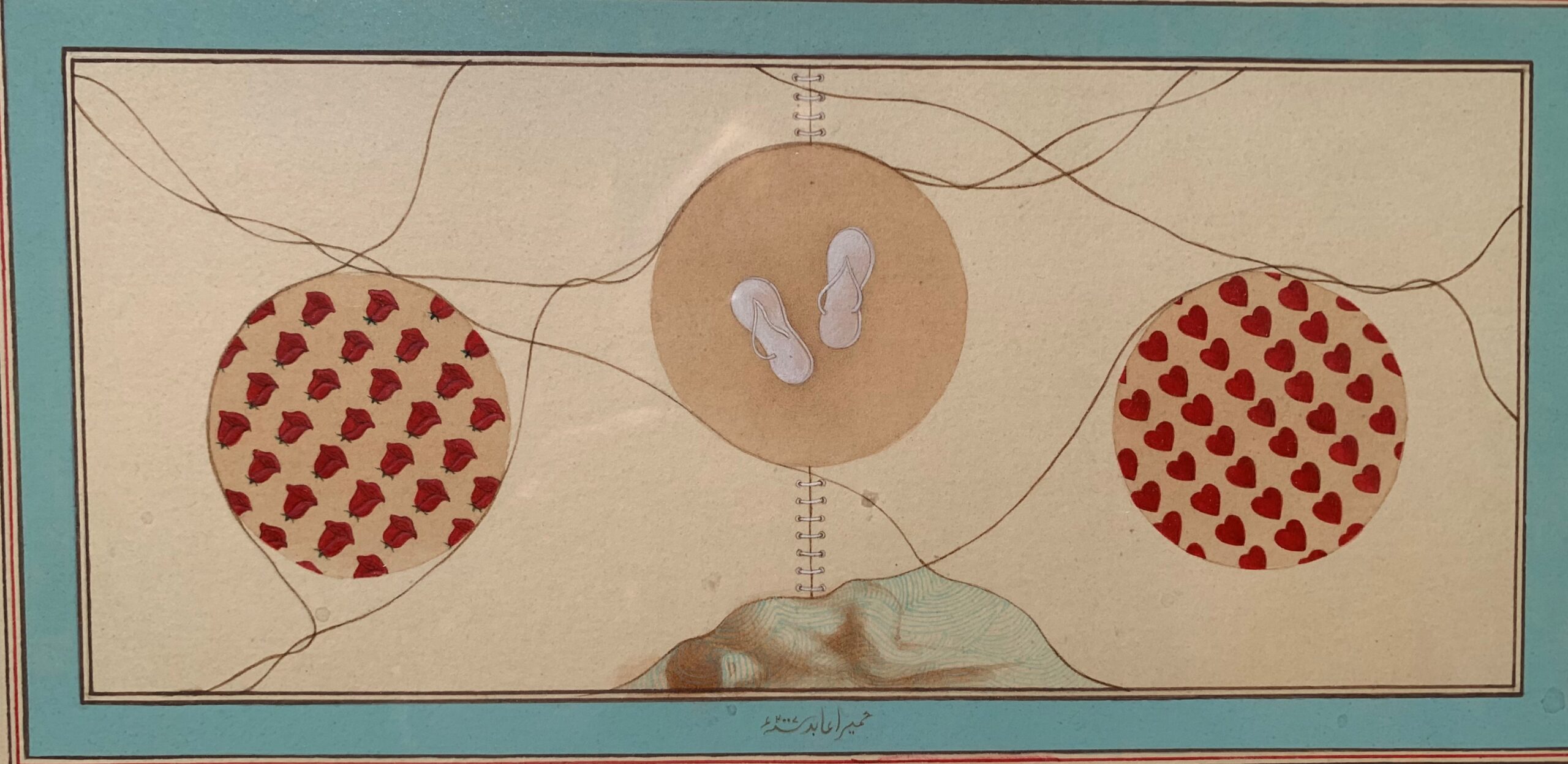
WOMAN’S PLACE IN A MAN’S WORLD – I, 2007 Gouache on hand made wasli paper 17.5 x 13.75 inches
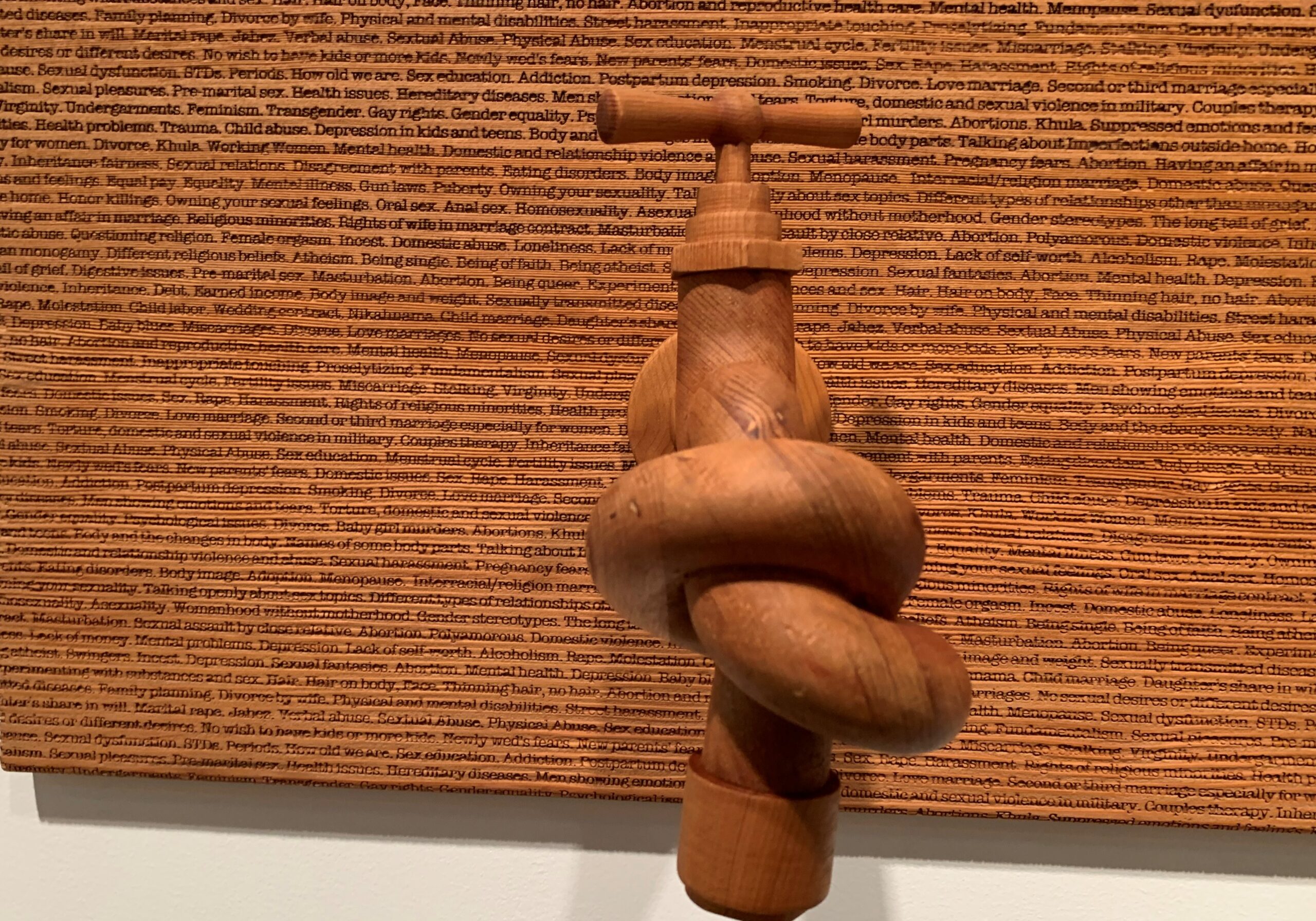
CONVERSATION, 2020, carved pine and laser etched fir, 48 x 11 x 8.5 inches
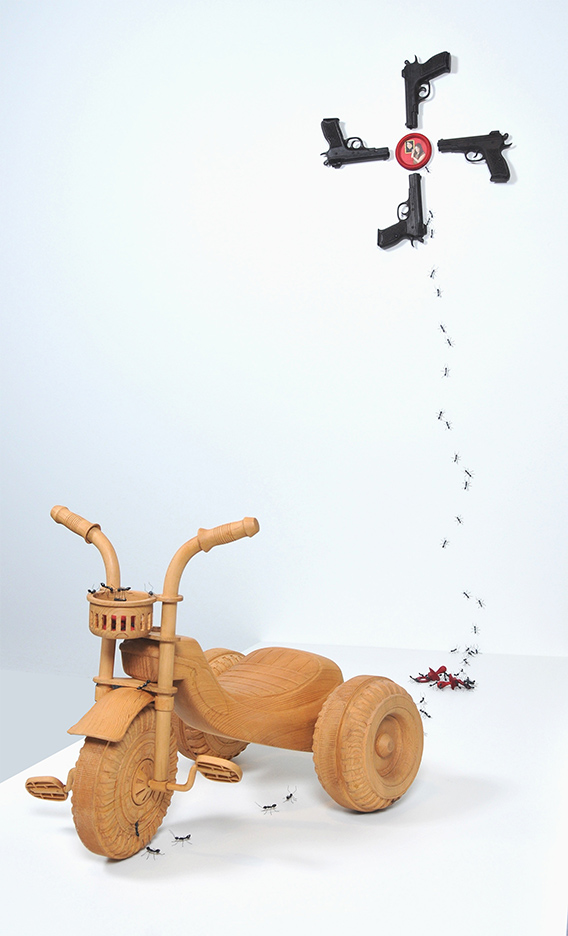
SELF PORTRAIT, 2014 Carved wenge and pine woods, wood stain, wire, epoxy putty, paint, gouache on handmade wasli paper, 24k gilding Installation dimensions: 72 x 60 x 36 inches
It is appropriate that as we celebrate Women’s Suffrage and remember all those who were not included, we also think about domestic violence and the trauma of family violations. As we dread the appointment of Amy Barrett, who will remove the right to abortion practically immediately, we grieve for the women who will suffer as a result.
Not to mention that suffrage itself is under attack on all fronts by the desperate right wing.
I hope we have a landslide, but that won’t undo the damage already done to the environment, to women, to our social fabric which is being ravaged by the virus.
As we head into the dark winter, it is crucial that we find a way forward to be actively resisting darkness on all sides.
This entry was posted on October 22, 2020 and is filed under African American history, Art and Politics Now, art criticism, Black Art, Carletta Carrington Wilson, Feminism, Uncategorized.
Take a Stand: Art Against Hate: The New Raven Anthology
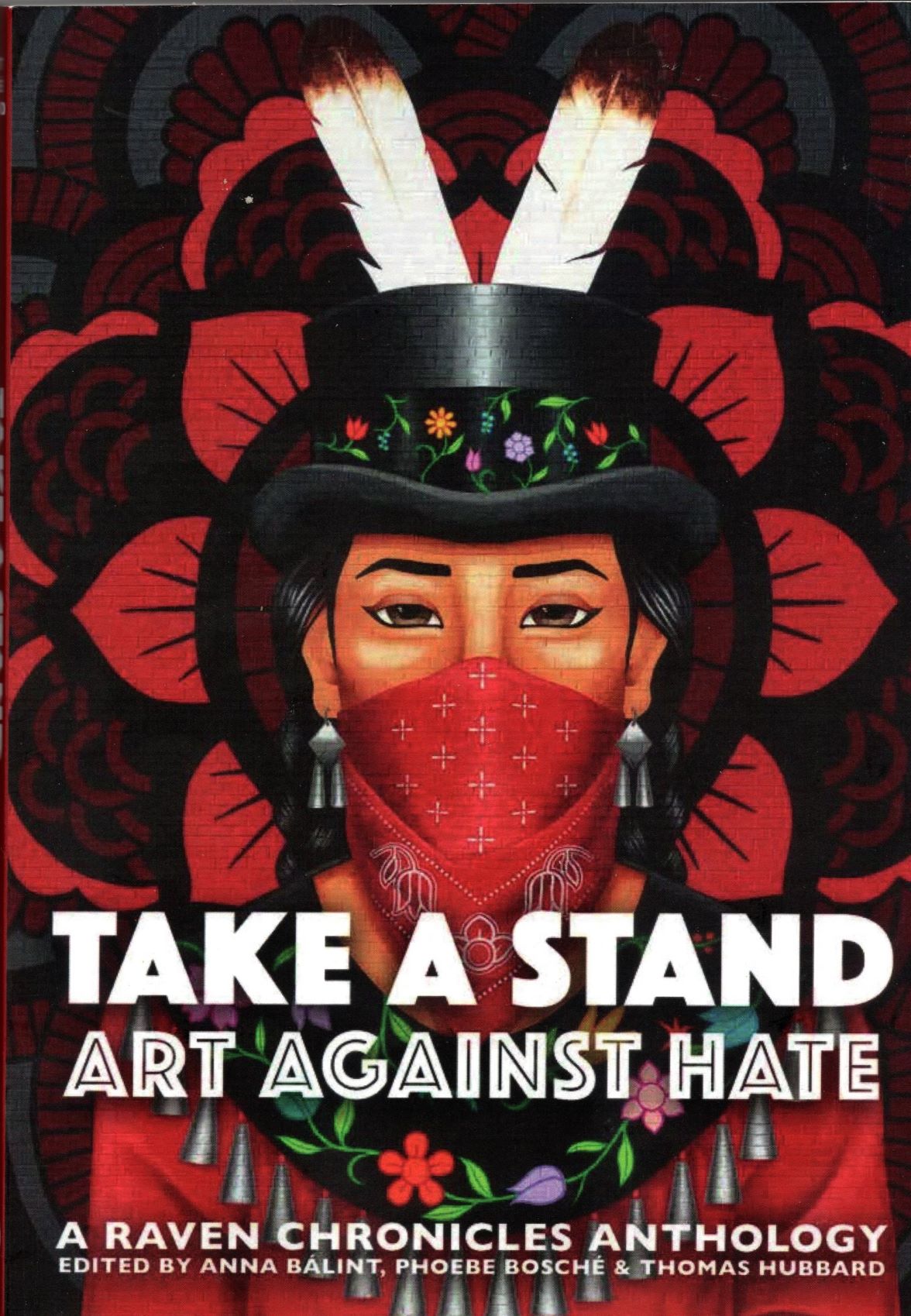
Raven Chronicles Press, for those not familiar with this important Seattle-based literary project, began in 1991. The amazing Phoebe Bosché has been the editor of Raven Chronicles Press and published a regular magazine for many years, but she now focuses on anthologies. These provocative collections of visual art, poetry, fiction, and non-fiction bring together writers with many voices. I treasure and constantly re-read these books. They are not books that you read cover to cover, but books for when you have a few minutes, or half an hour, and you feel like expanding your focus, certainly crucial at the moment.
Take A Stand, Art Against Hate first stuns us with its cover: a detail from a mural, a collaboration between AICHO (American Indian Community Housing Organization), Honor the Earth, a nonprofit environmental organization, and Mayan artist Votan, with the assistance of Derek Brown of the Dine’ or Navajo tribe, and members of the community. Ganawenjiige Onigam (Caring for Duluth in the Ojibwe language): A New Symbol of Resilience in Duluth, Minnesota, is a declaration of the issues facing Native American women such as violence, sex trafficking, and environmental racism. Primarily, however, the enormous portrait of an Ojibwe woman is a symbol of resilience, the bandana covering the woman’s face is a reference to women who participated in the Zapatista uprising in the Mexican state of Chiapas in 1994, as well as the water protectors at Standing Rock. The jingle dress worn by the woman in the mural has special significance to Ojibwe people. A woman dancing in her jingle dress is thought to possess great powers to heal.
But on to the anthology itself divided into five sections, “Legacies,” “We Are Here,” “Why?,” “Evidence,” and “Resistance.” As one of the editors points out, some works could be in more than one section, and in each section the anthology sets up a type of call and response between the different voices.
Before each section are often five separate quotes from major thinkers like James Baldwin, Adrienne Rich, Arundhati Roy, Joy Harjo, and Sandra Cisneros, to name a few.
The poems ( I can only give one example here of many) address subjects such as historical colonialism (“Love Letters in a Time of Settler Colonialism” by Tanaya Winder), slavery (“slaveships” by Lucille Clifton), current police violence, (“The Day John Coltrane Died, July 17, 1967” by Frank Rossini, a poem about Eric Garner), homelessness, (“Lower Queen Anne” by Thomas Hubbard), immigration (“Journeys” by Anna Bálint), climate crises (“The Continent of Plastic” by Judith Roche).
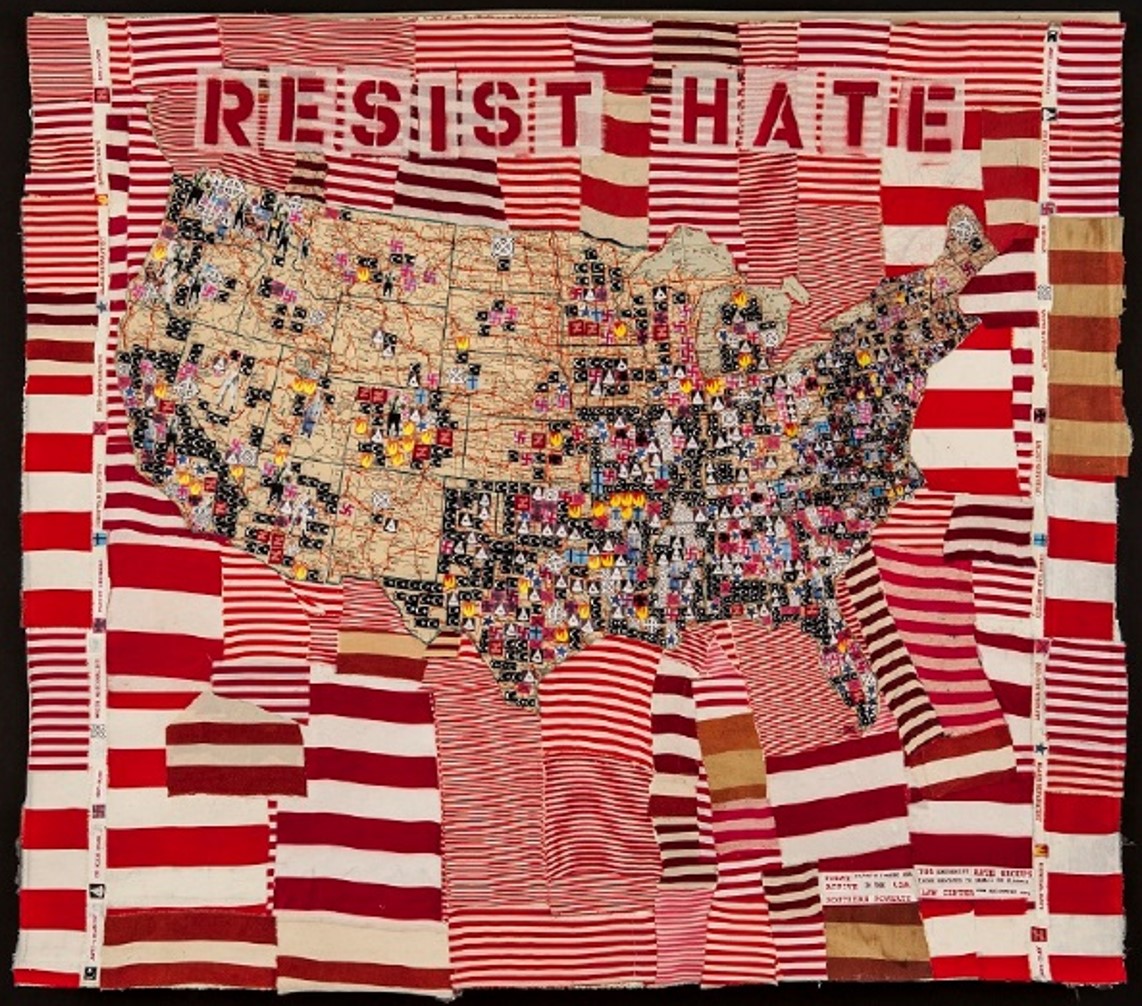
Deborah Faye Lawrence Resist Hate Map 2015
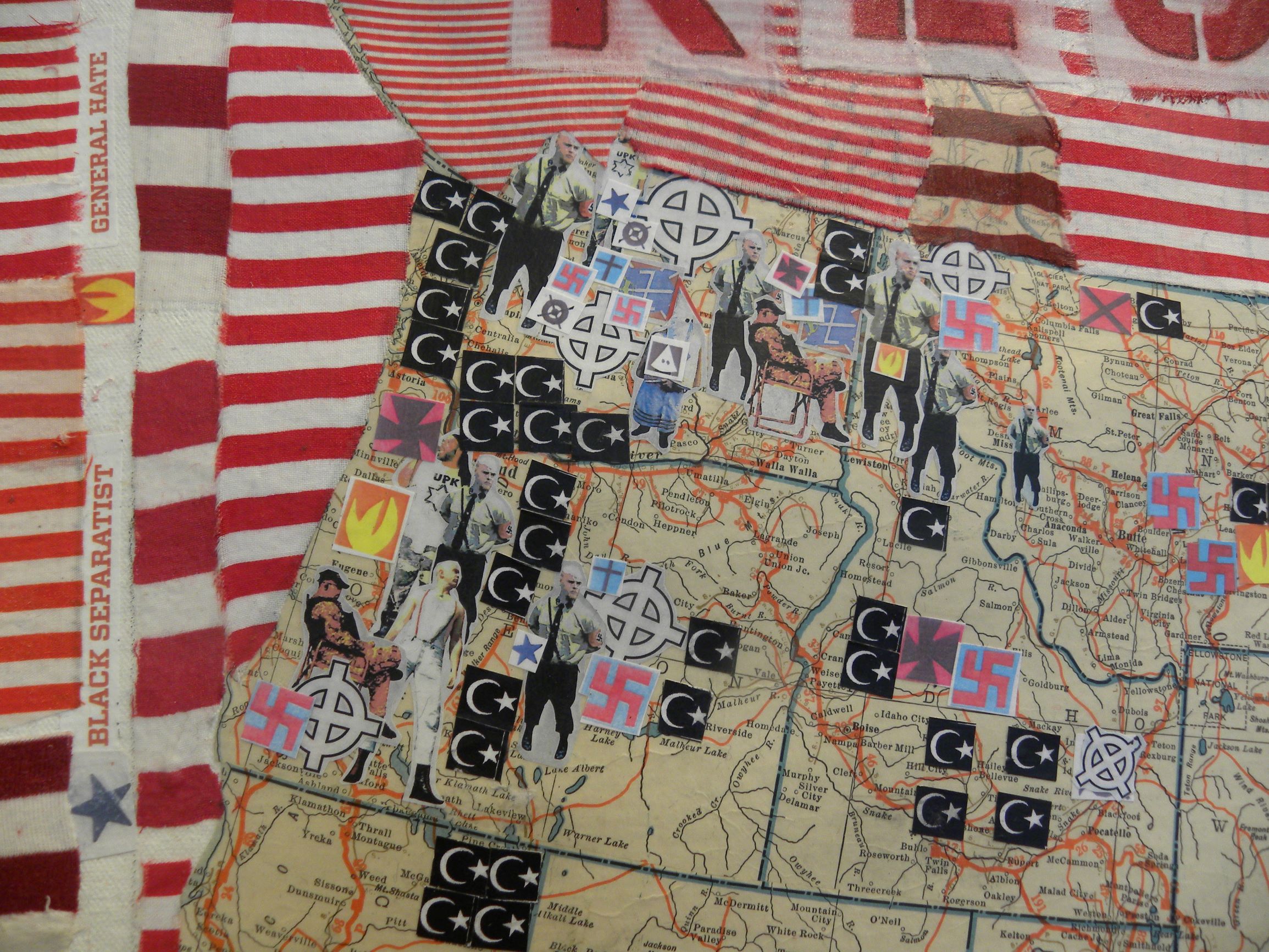
Detail of the Northwest
Interspersed throughout the book are artworks, some by familiar artists, Alfredo Arreguín, Deborah Faye Lawrence, Tatiana Garmendia, Matika Wilbur, and an artist from Haida Gwaii, Michaela McGuire.

MIchaela McGuire 2012
As I read these poems and short essays, I had a feeling of connection, of community, of hope, in this time of such separation and difficulty. Knowing that this many creative people (53 artists and 117 writers) address the challenges we currently face is comforting and uplifting.
The anthology was completed before COVID and the huge BLM protests this summer. But we see the same conditions already in place. Eric Garner said “I can’t breathe” 11 times. Protests against racism have been going on for decades, with their roots in slavery, where this anthology begins. The planet has been deteriorating, but Rajiv Mohabir offers hope: “Why Whales Are Back in New York City”: “Our songs will pierce the dark / fathoms. Behold the miracle: / what was once lost / now leaps before you.
The final poem by Ellery Akers also suggests a way forward: “At Any Moment, There Could be a Swerve in a Different Direction”: “it sounds like the click of knitting needles as hundreds of thousands of women knit pink hats; / it looks like a coyote, crossing the freeway to go home. “
You can buy the anthology on their website
This anthology will have a virtual reading Thursday, October 8, 2020 at 7:30 PM – 9 PM. You can access it from this link.
This entry was posted on October 4, 2020 and is filed under Art and Politics Now.
Maya Lin’s Confluence Revisited 2020
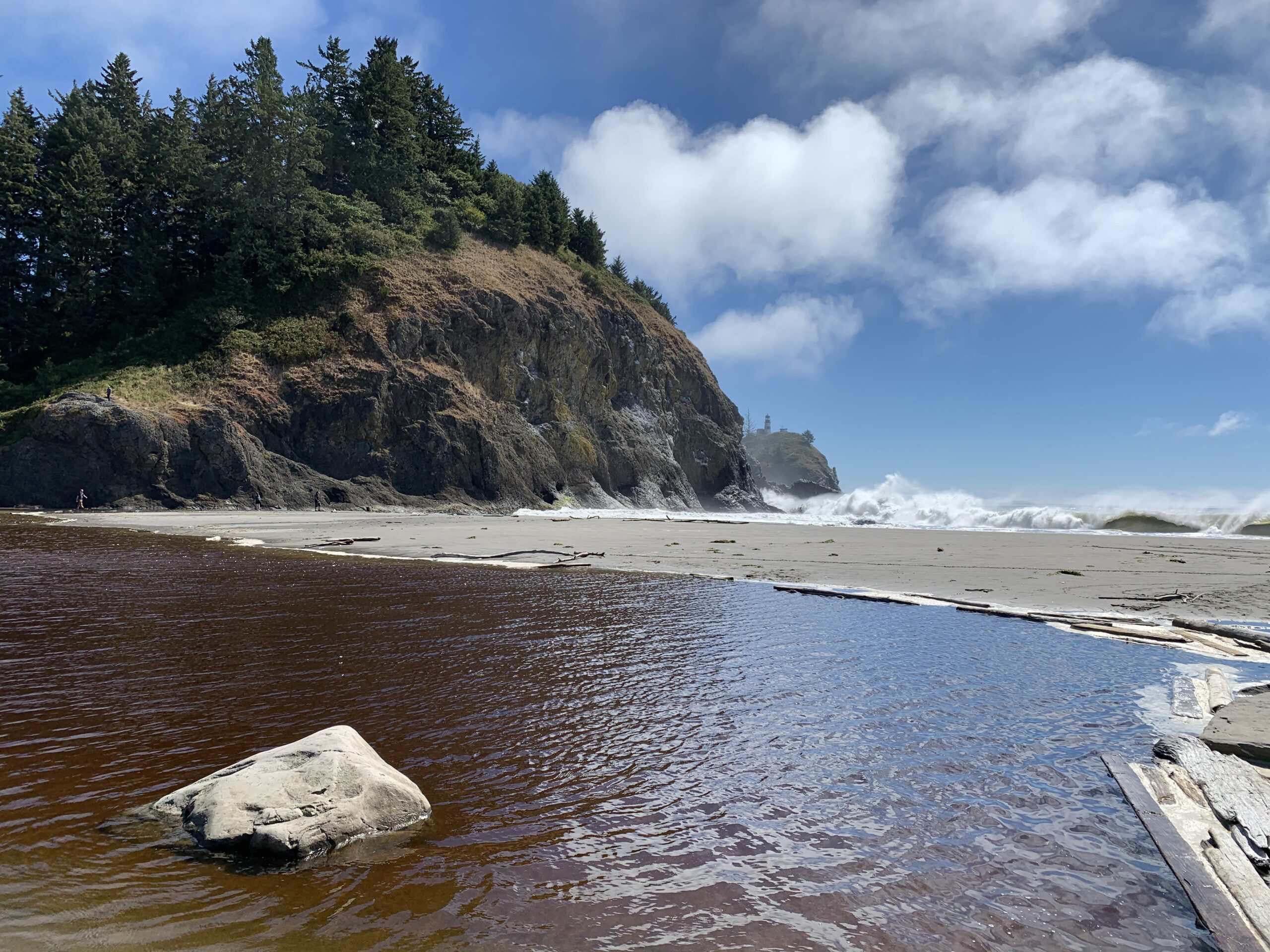
We revisited Cape Disappointment (it should have the native name of Cape Kais). This site marks the confluence of the Columbia River and the Pacific Ocean. It is one of the most rugged places to navigate on the planet. We saw the power of the currents as the Columbia River smashed into the Pacific Ocean. Out there in the background. Hard to catch the immense drama.
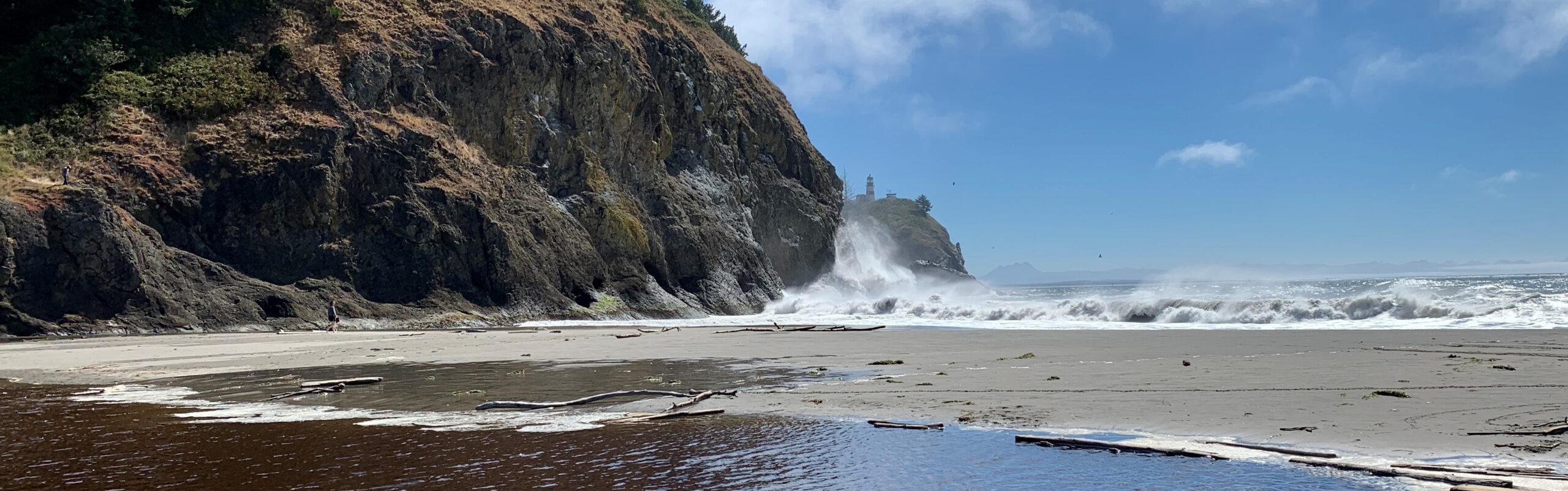
For those of you unfamiliar with The Confluence Project, this is one site of six ( five completed) along the Columbia River, celebrating and marking various aspects of native life and loss as well as using the Lewis and Clark journals to track extinctions since they came through in 1803-5. Maya Lin was lured into accepting this multi year commission by Native elders who saw the movie about Maya Lin’s memorial to the Vietnam war and believed she would be the perfect person to commemorate the native losses since Lewis and Lark came through.
I have blog posts about three of the other sites here and here.
and here.
Lin is particularly tracking extinctions, a project she began long ago. Here is her incredible website “What is Missing” about extinctions.
We were there in 2006 for the dedication at the completion of the
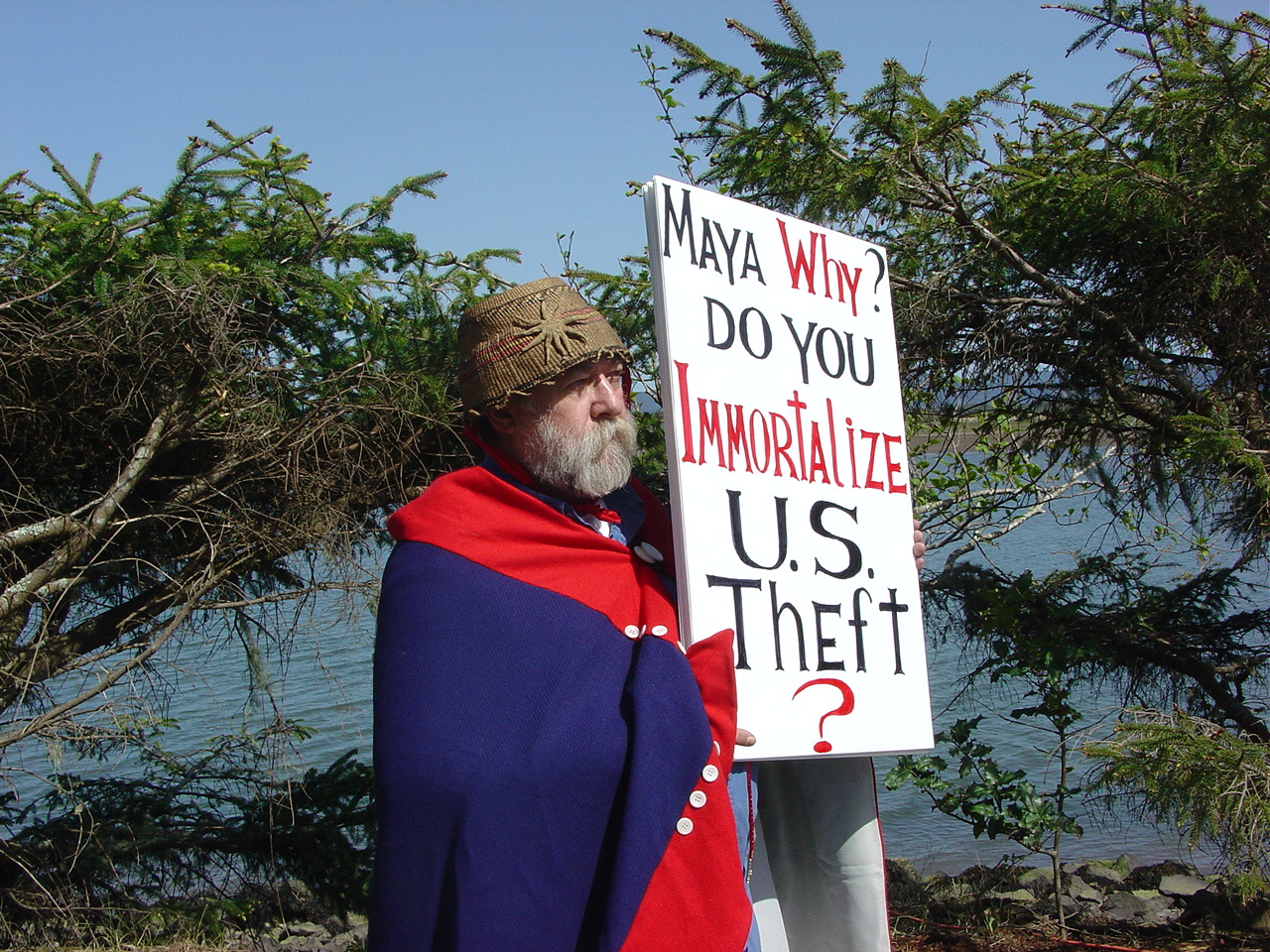
site, when Maya Lin was there with her family as well as the Chinook peoples both supporting and protesting.
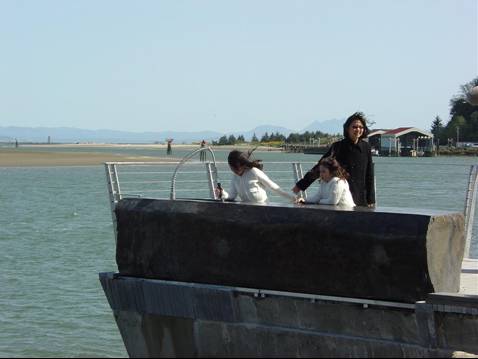
Maya Lin with her daughters at the cutting table 2006

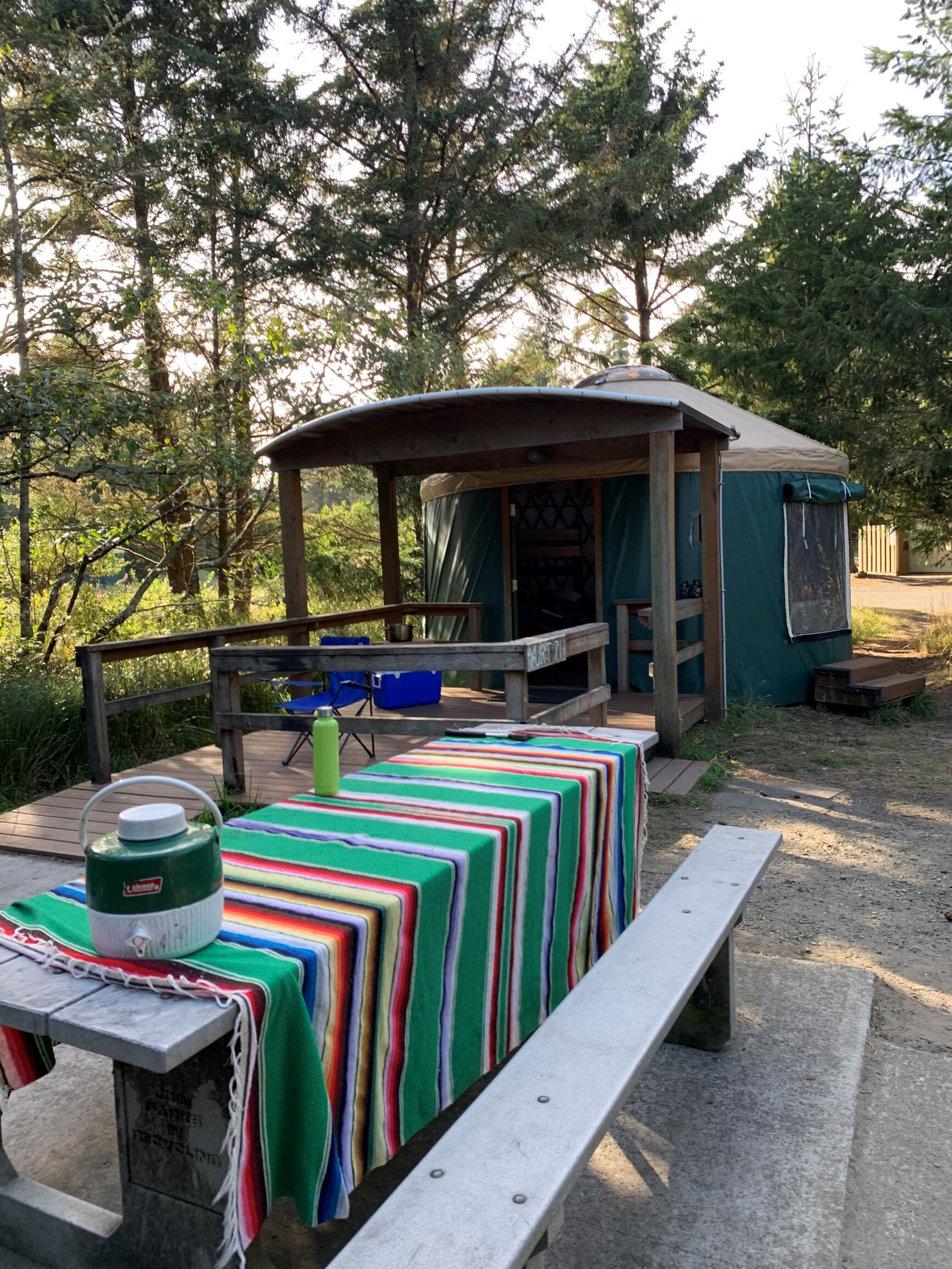
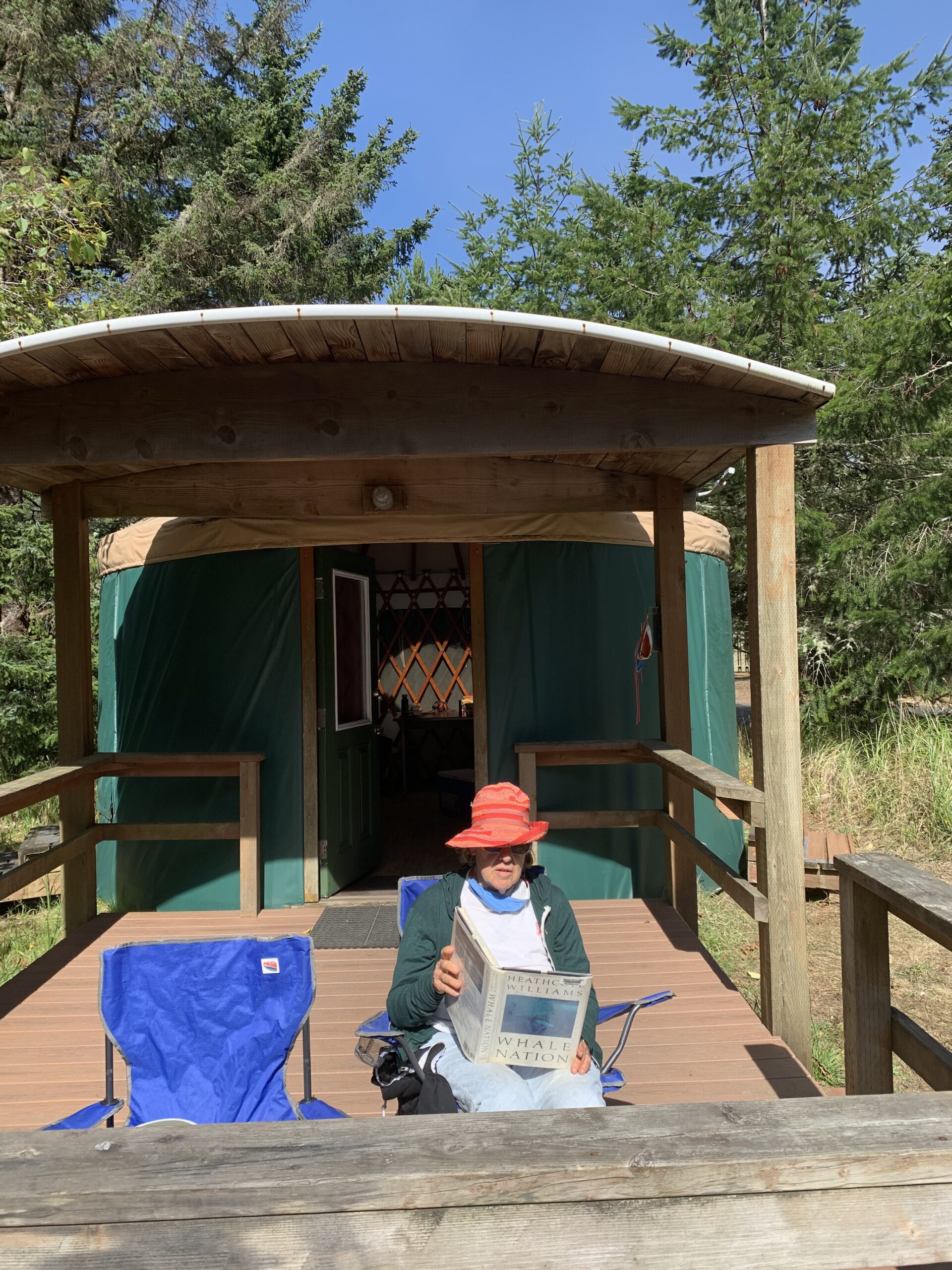
We went again in 2008 and camped in a tent. This year we stayed in a yurt.
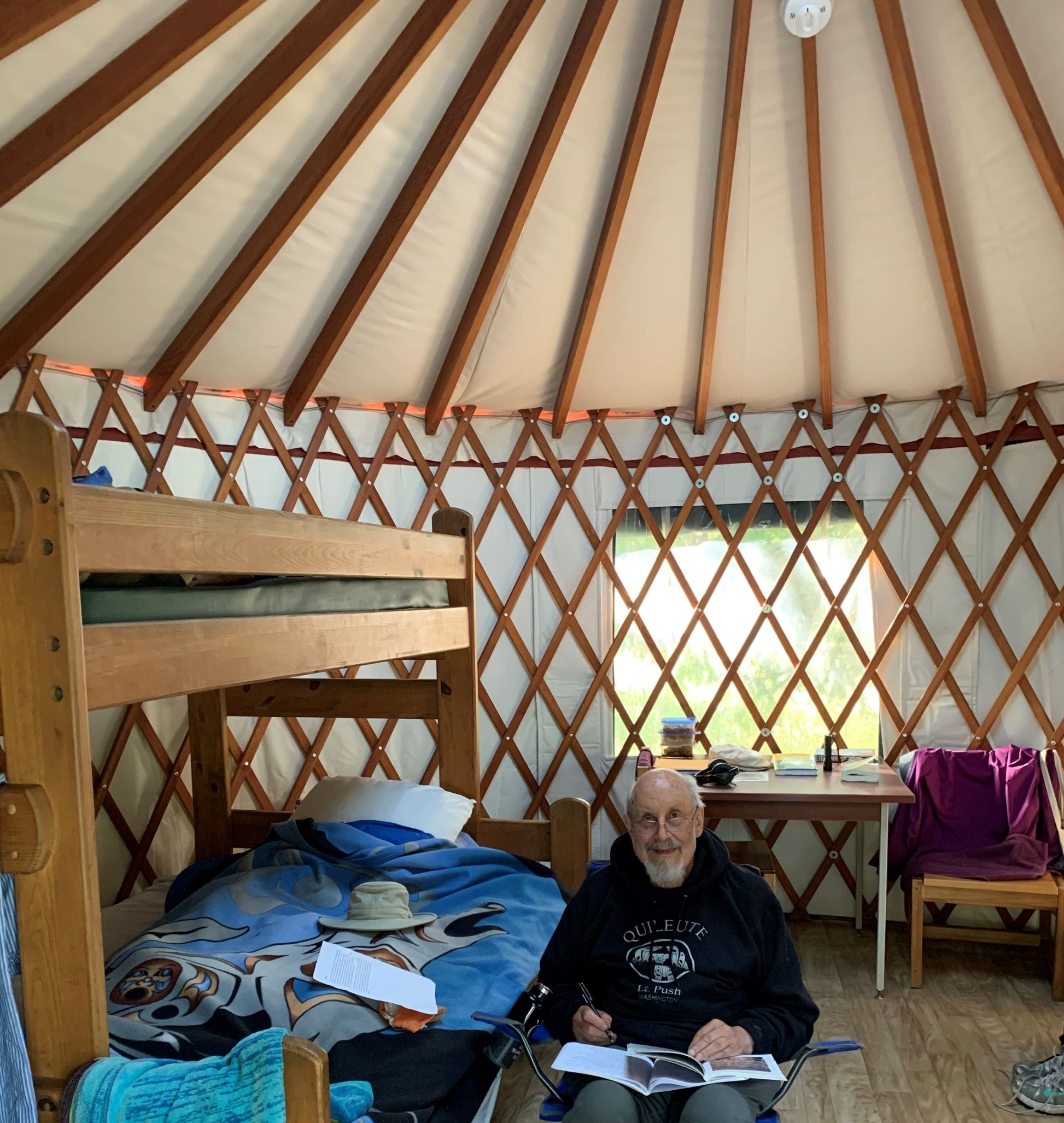
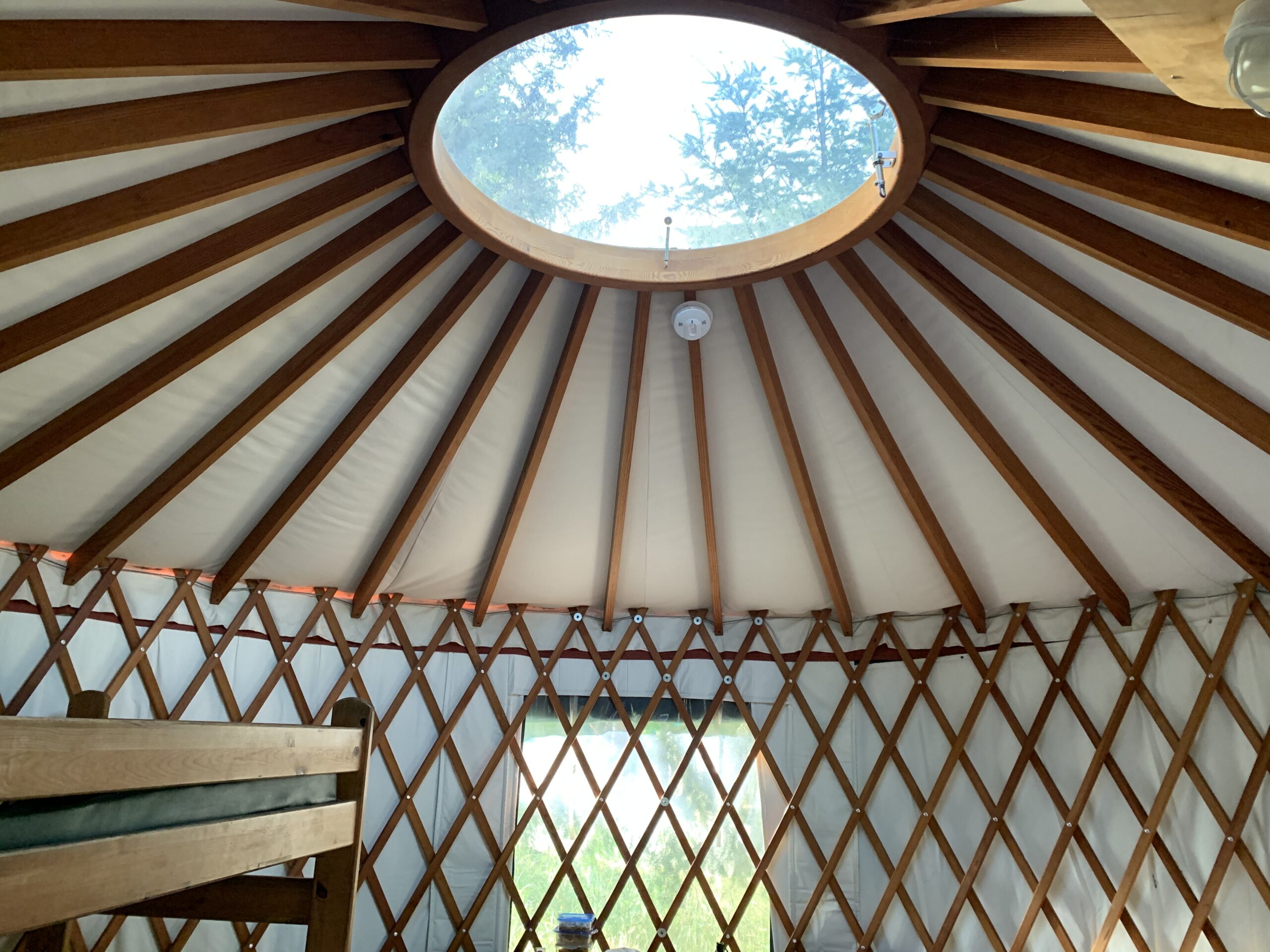
The site has now filled with grasses and trees where before there was empty dirt, ( that was replacing parking lots and toilets). Maya Lin cleared the vista at so called Waikiki Beach and made it more natural.
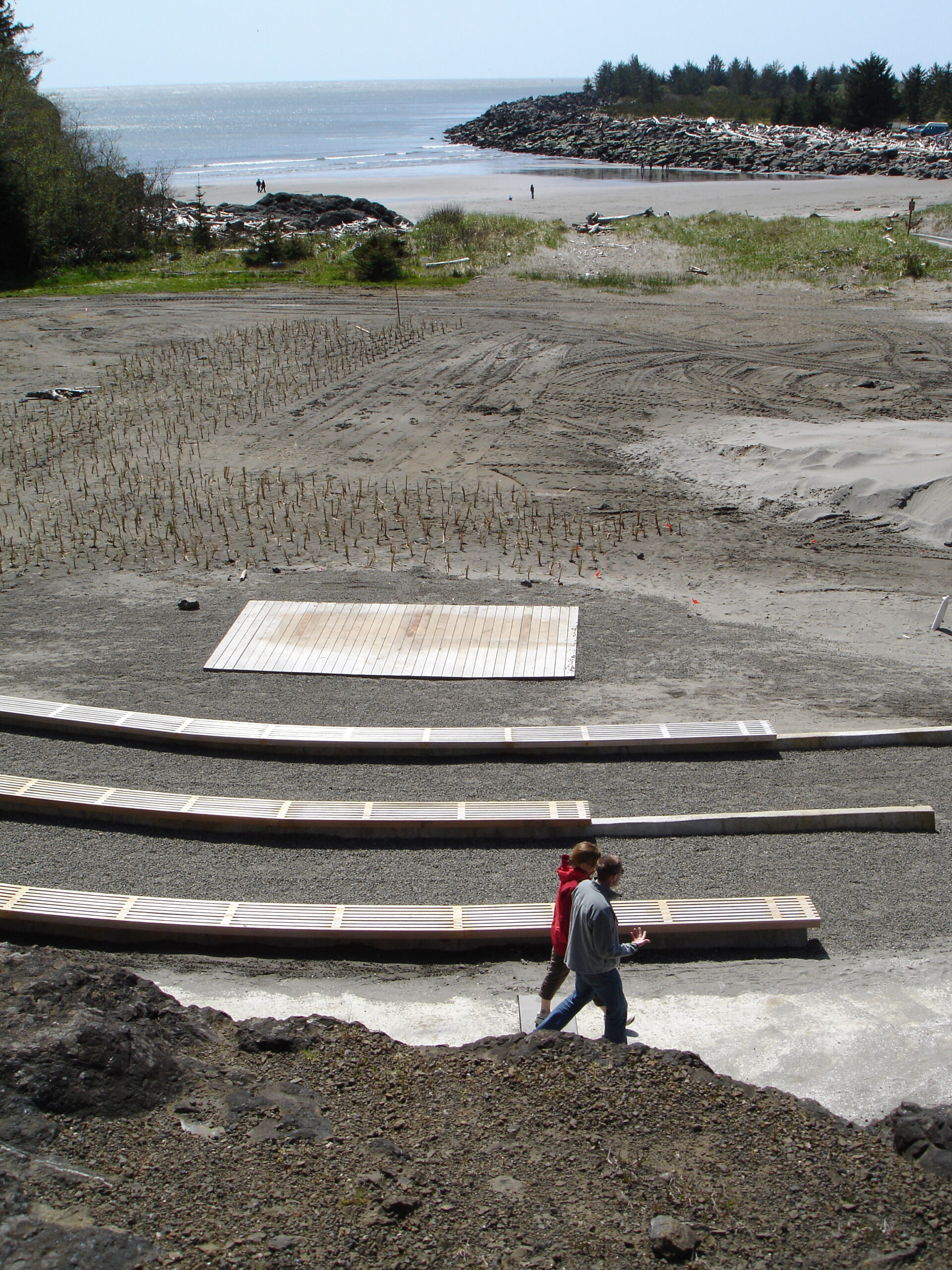
amphitheater in 2006 at time of dedicaiton
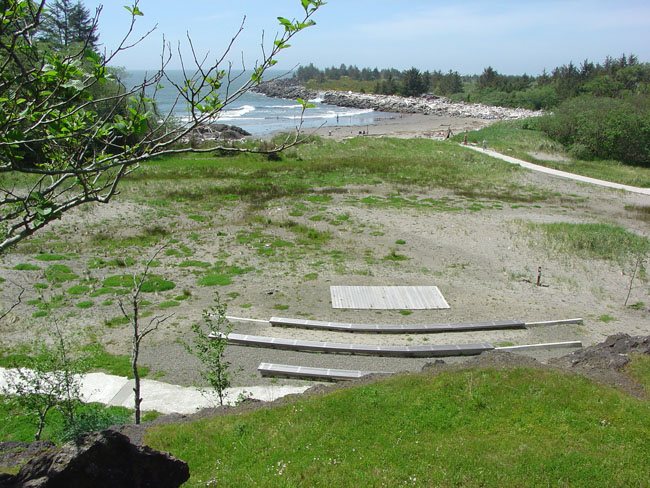
amphitheater 2008 some green has returned
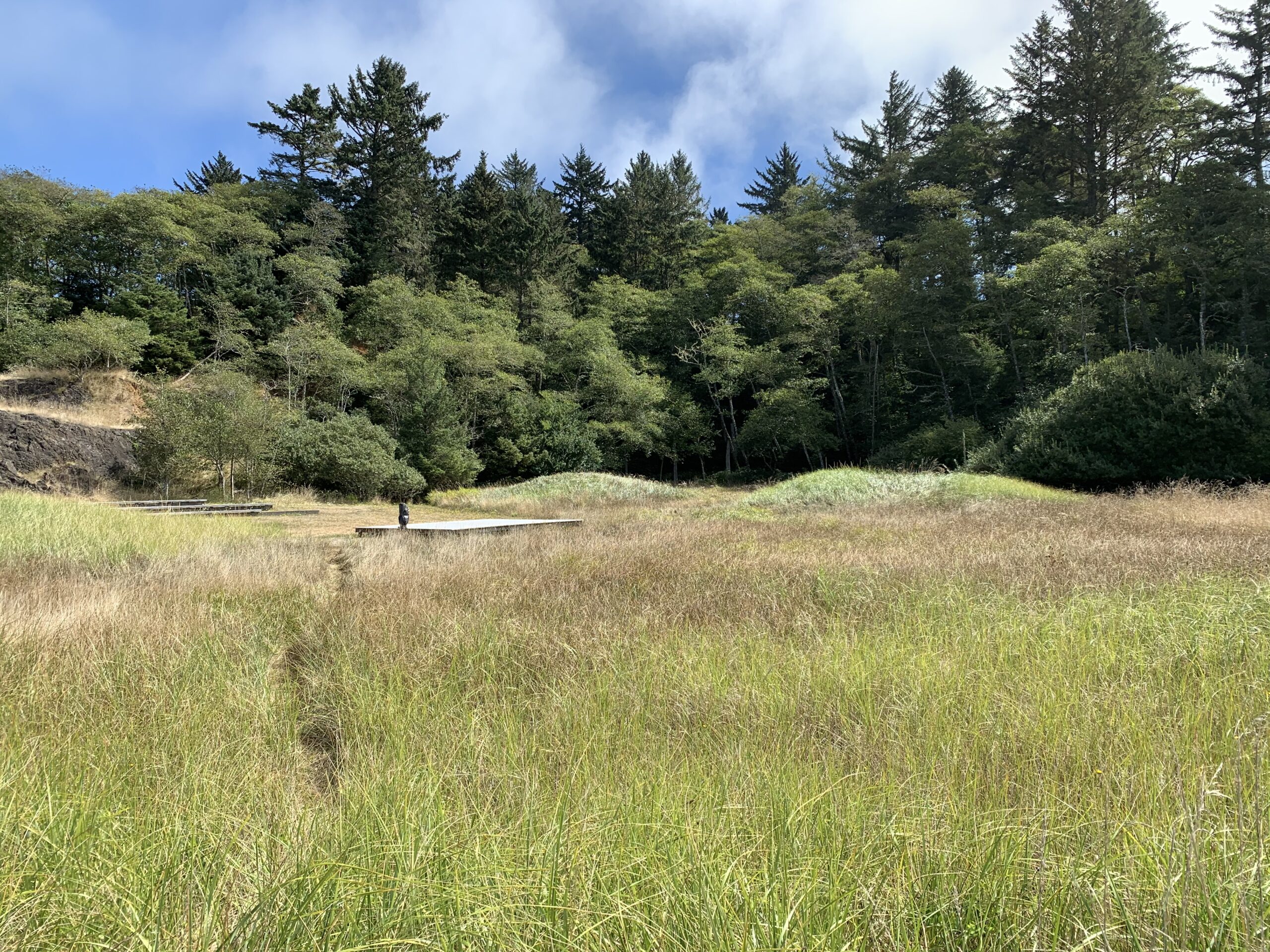
amphitheater 2020 Entirely grass filled field
When the Chinook peoples first dedicated the site before work began, they sang a beautiful song that so impressed the artist that she changed the design of the piece. Her original plan was to create concrete planks leading to the sea with inscriptions from the journals of Lewis and Clark documenting their measurements, names, and distances between places on the planks.
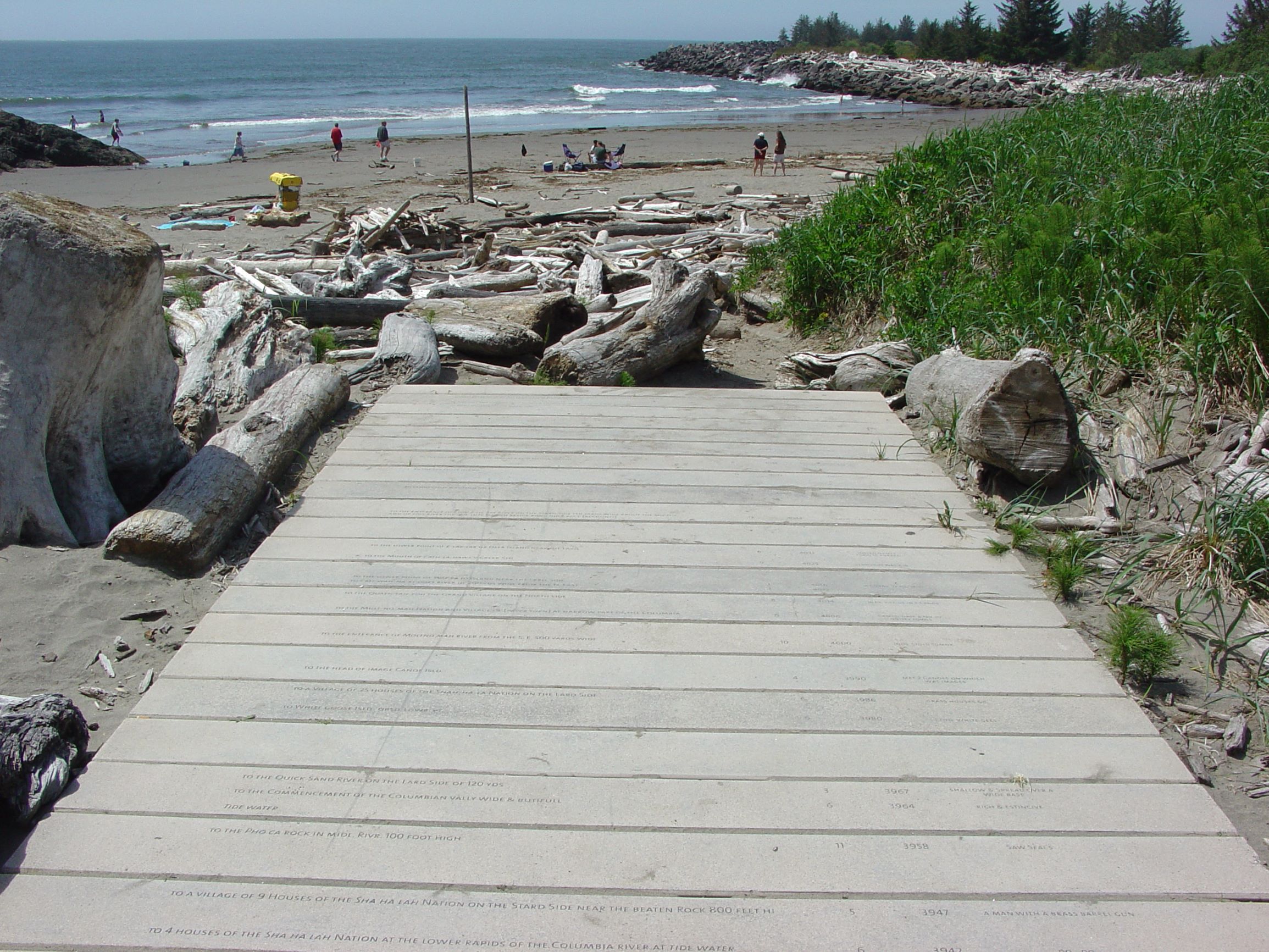
end of original walkway at Waikiki beach
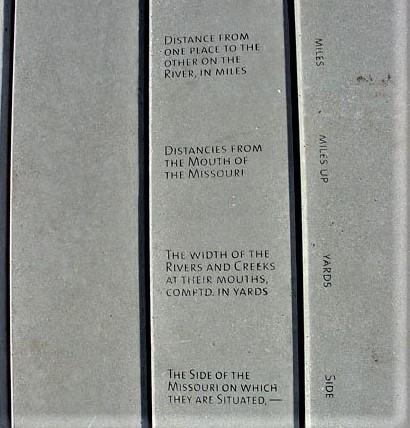
sample of texts by Lewis and Clark 2008 now 2020 almost entirely rubbed out
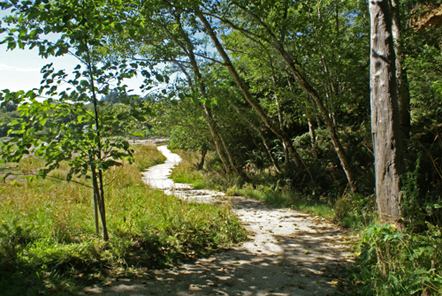
As a result of being overwhelmed by the beauty of the dedication song, she added a second path, a winding, oyster path. It also has planks, but much more subtle and spread out. That path marks the original shoreline before jetties were added to aid navigation and reduce ship wrecks.
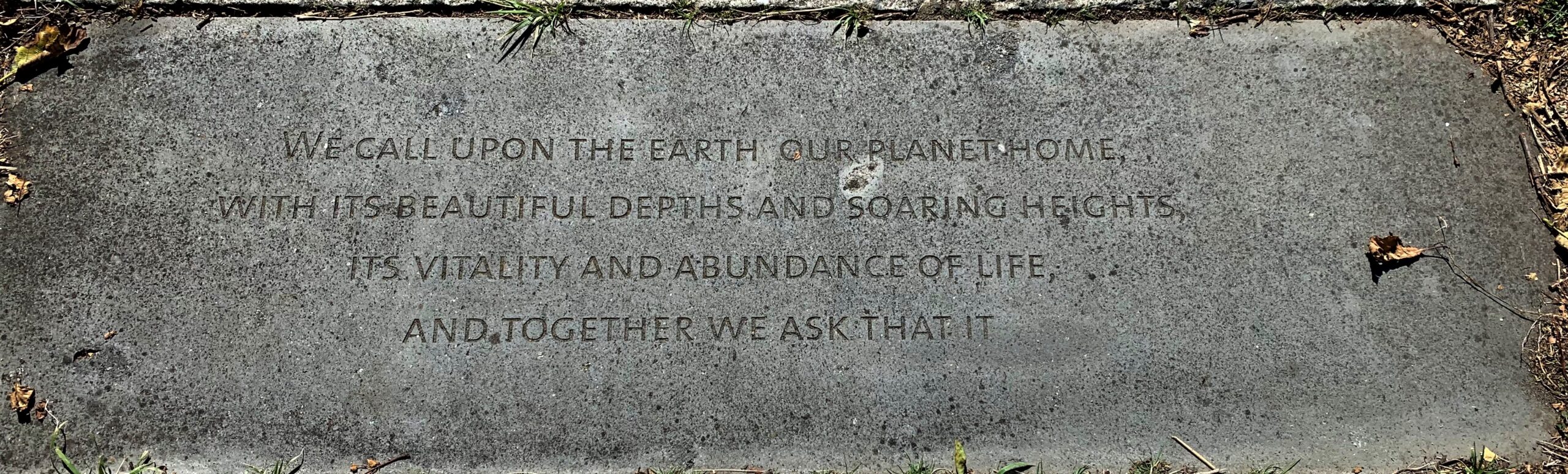
The Chinook people’s prayer was
We call upon the earth our planet home
with its beautiful depths and soaring heights
its vitality and abundance of life
and together we ask that it
Teach Us and Show us the Way
We call upon the mountains
Saddle Mountain, and Wakiakun Mountain,
The Willapa Hills and the summits of intense silence
and we ask that they
Teach us and Show us the Way
We call upon the waters that rim the earth
the waters of our great Iyagatthlmath RIver
The waters of Willapa Bay and all the waters
the flowing of our rivers and dreams,
the water that falls upon us
And We ask that they
Teach Us and Show us the Way
We Call Upon the Land which grows our food
The Nurturing Soil that Sustains our Lives
And we ask that it
Teach us and Show us the Way
We call upon the creatures of the Fields and
Forests and the Seas,
To Teach Us and Show us the Way
We call upon the great cedar trees
Reaching strongly to the sky with earth in their roots
and the heavens in their branches
The Cedar tree, the keeper of all knowledge and
we ask them to teach us and show us the way
We call upon the creatures of the fields and the forests and the seas,
our brothers and sisters
Little Wolf, Mulak the Elk and Mawich the Deer
Ch’akch’ak the Eagle,
the Great Whales, and the Sturgeon, and the Salmon People
Who share our Chinook Waters
And we ask that they
Teach us and Show us the Way
We call upon all those who have lived on this earth
our ancestors and our friends
Who have dreamed the best for future generations
and upon whose lives our lives are built and with thanksgiving
we call upon them to
Teach Us and Show us the Way
And lastly we call upon all that we hold most sacred
the prescience and the power of the Great Spirit which flows through all the universe to be with us
To teach us and show us the way.
November 18, 2005
The winding prayer filled path leads to a Sacred Circle constructed of drift wood reinforced to stand up and the natural woods that have grown up around this amazing stump.
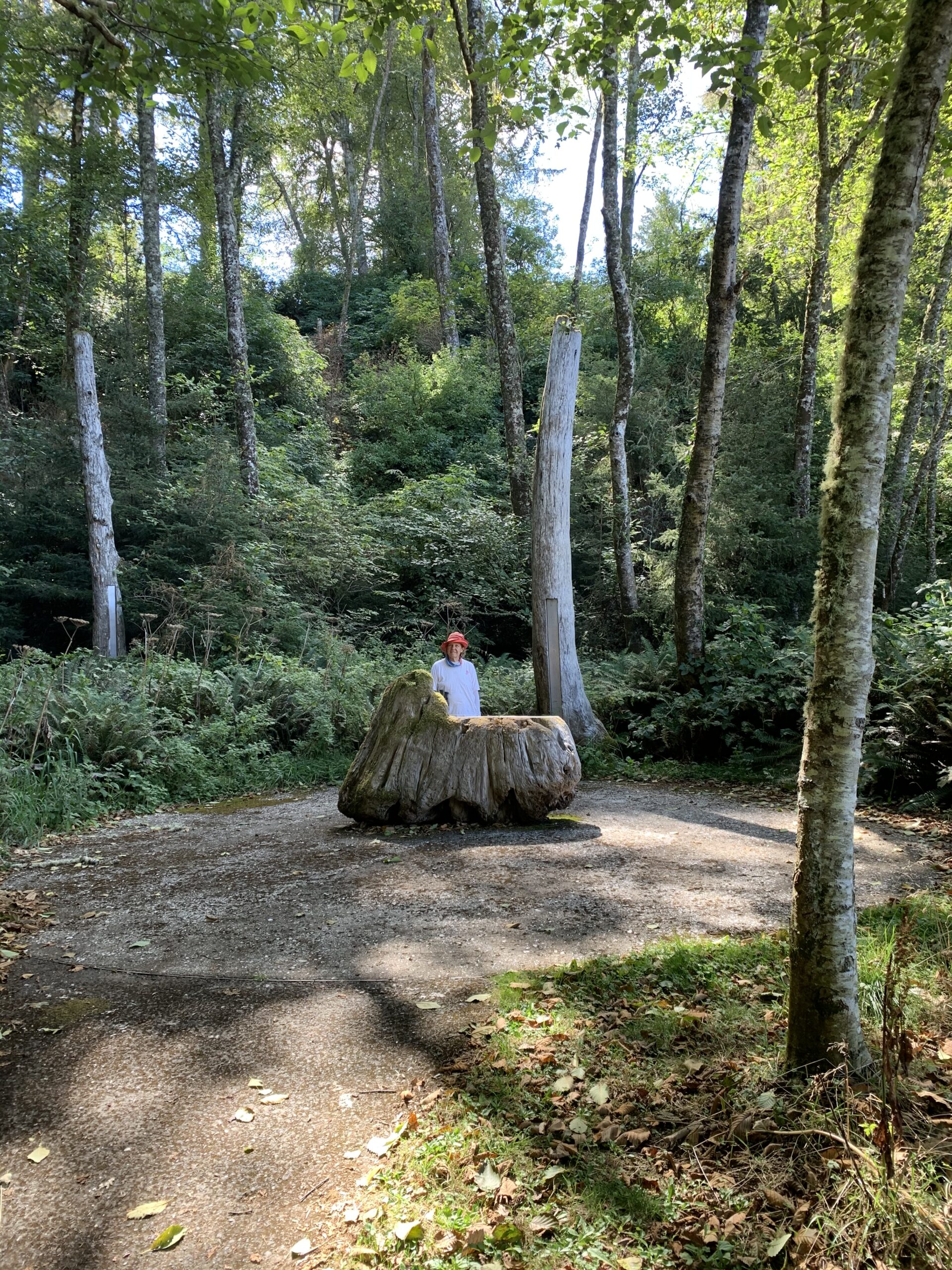
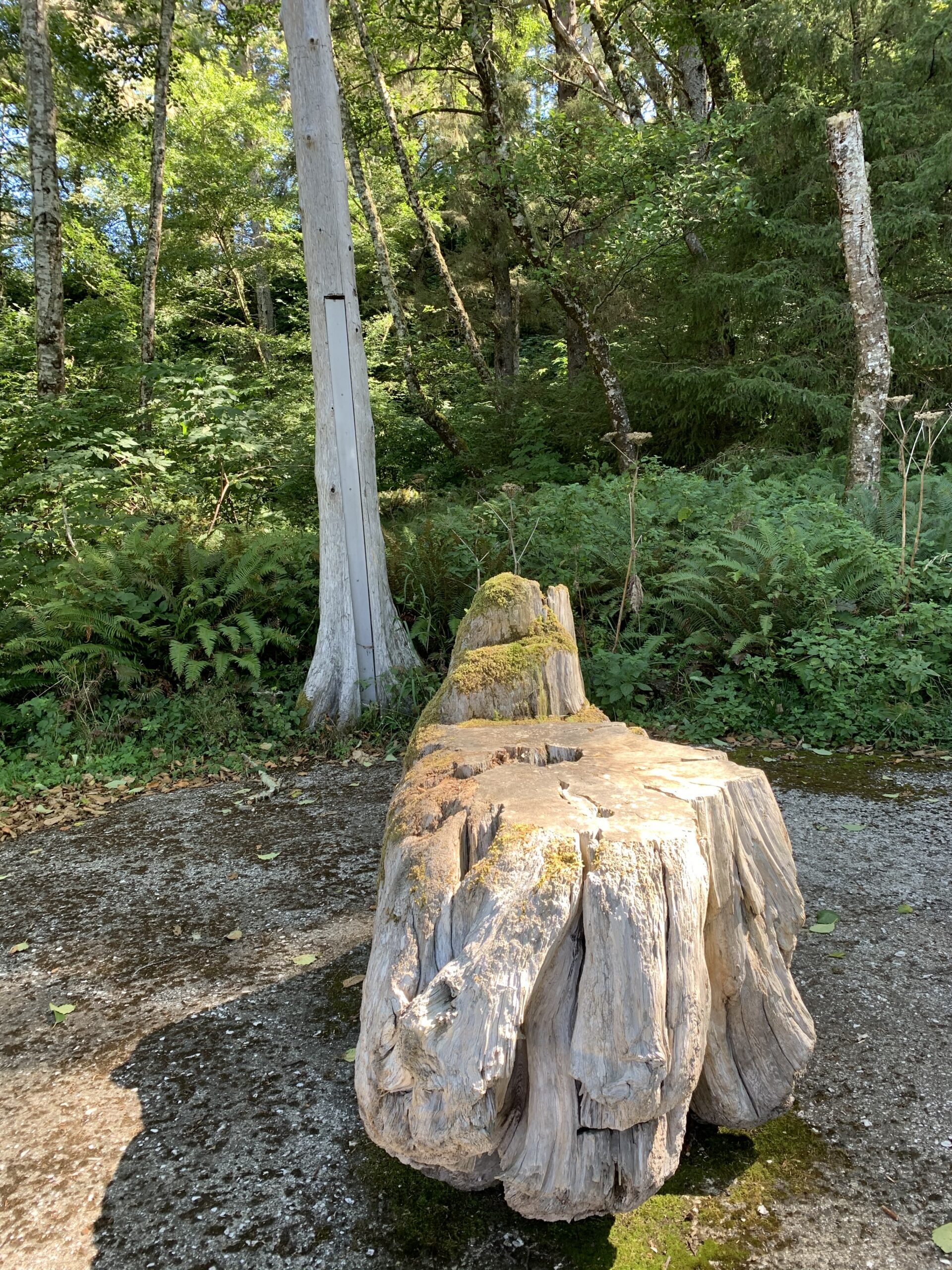
We need this prayer more than ever today!
We also visited the other parts of the Confluence installation at Cape Disappointment.
The Fish cutting table
It has a Chinook creation prayer incised on it about cutting the fish in the right direction in order to enable the creation of humans.
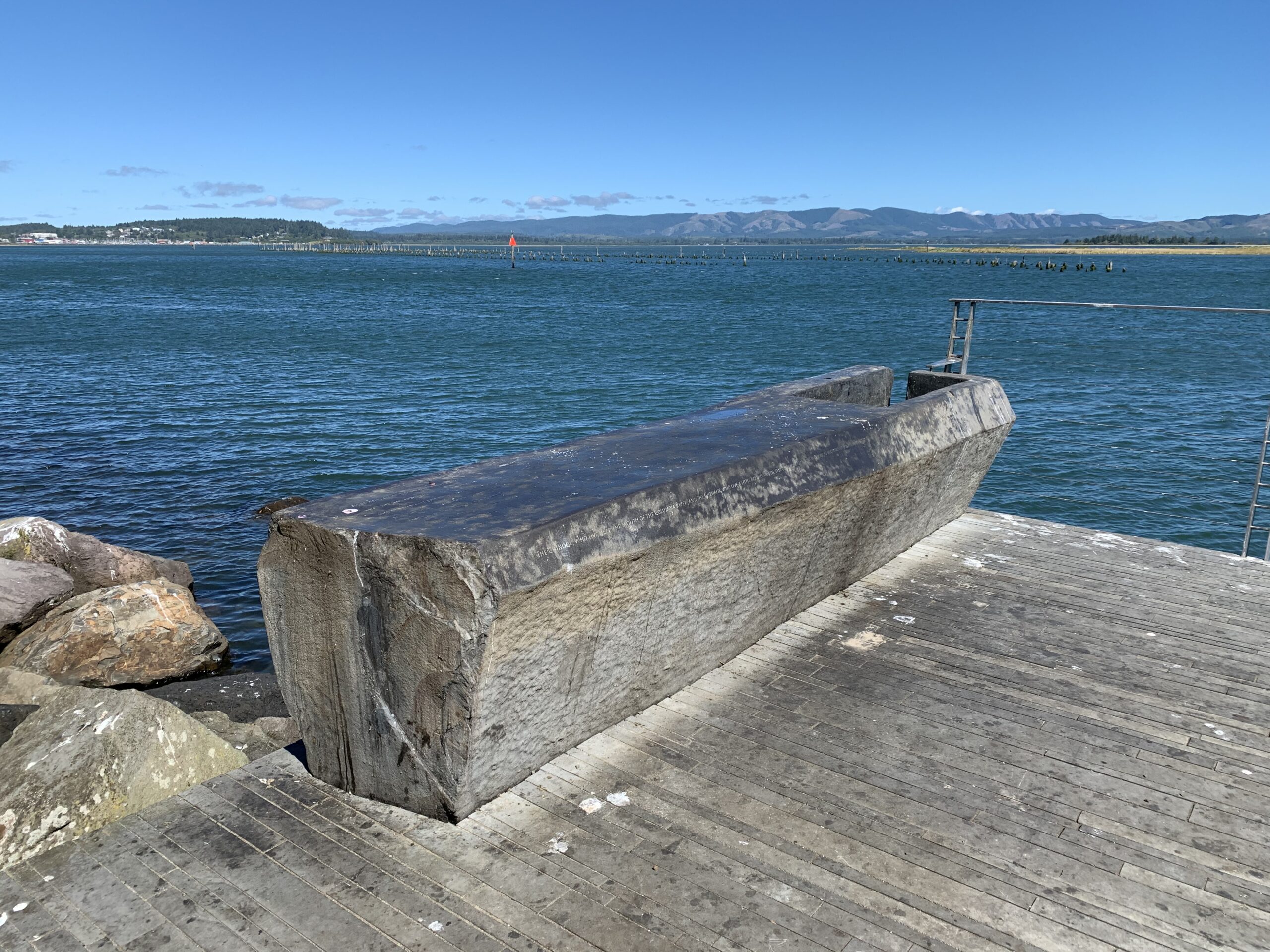
cutting table 2008
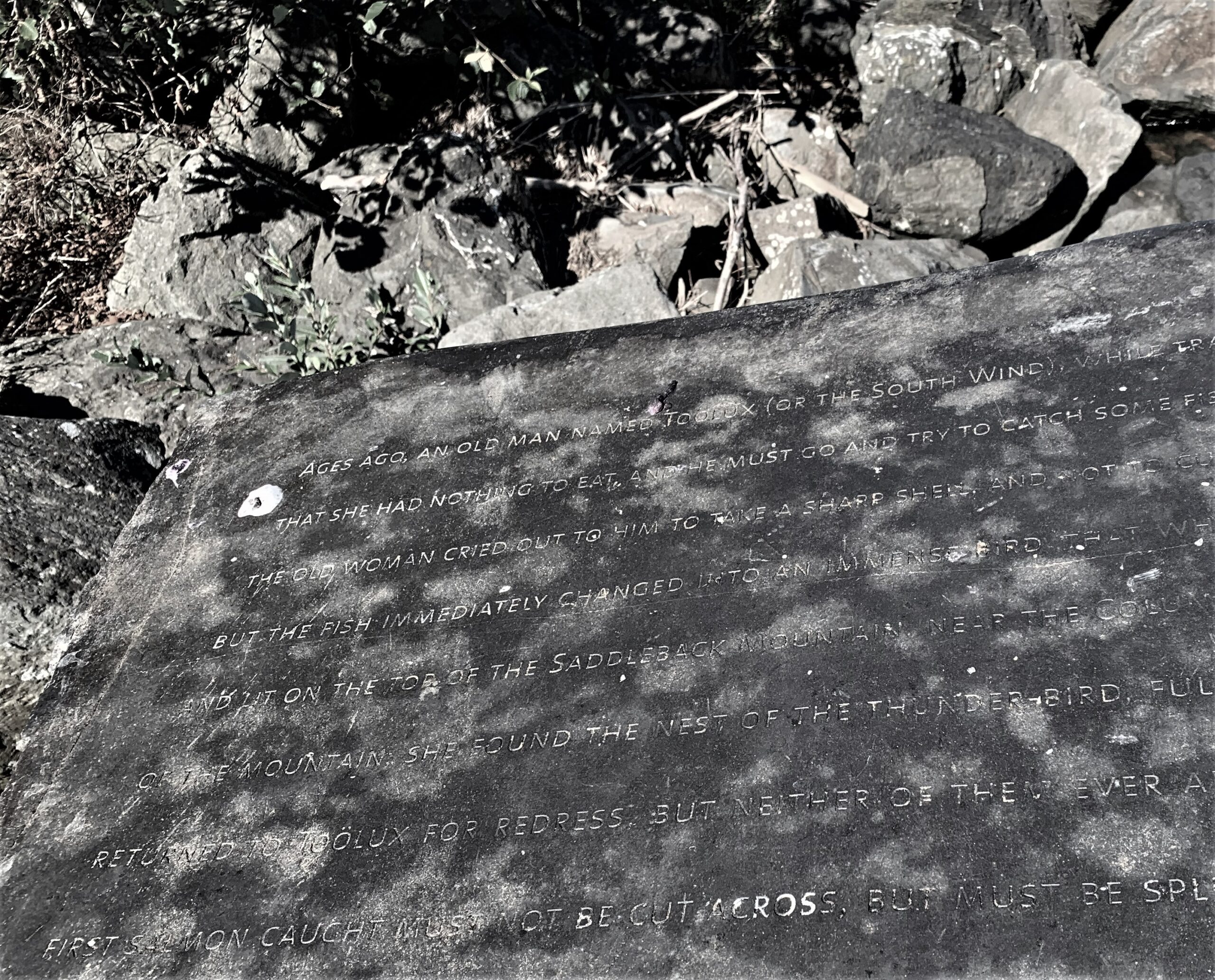
detail of creation prayer on fish cutting table 2020
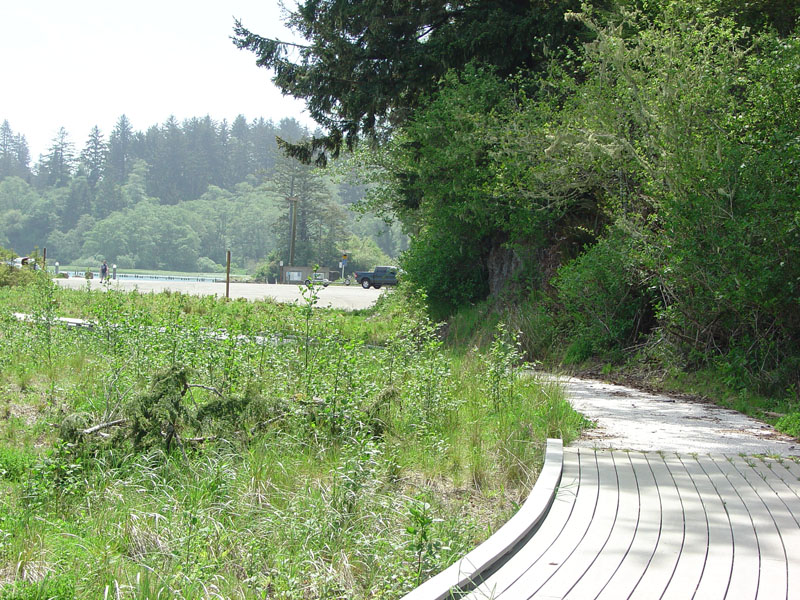
path to estuary 2008
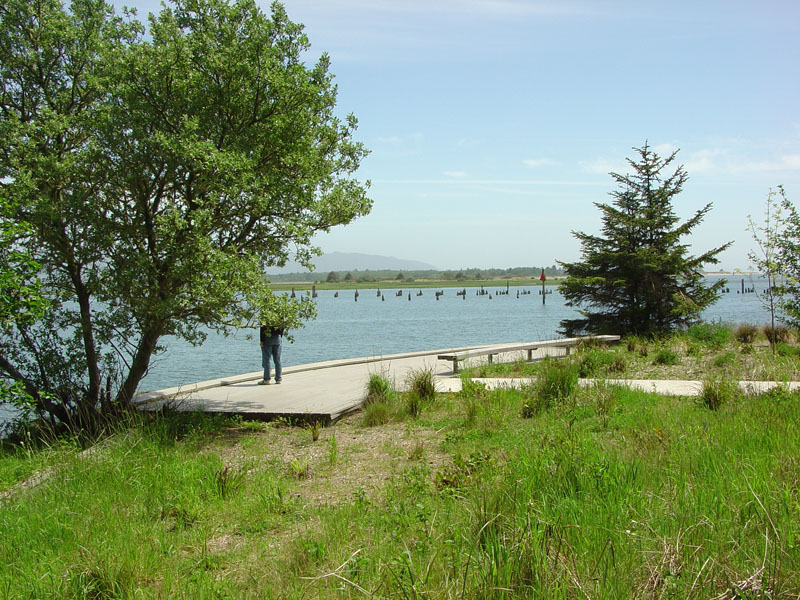
Estuary view 2008
and the view over the estuary, the path between them also grown up significantly.
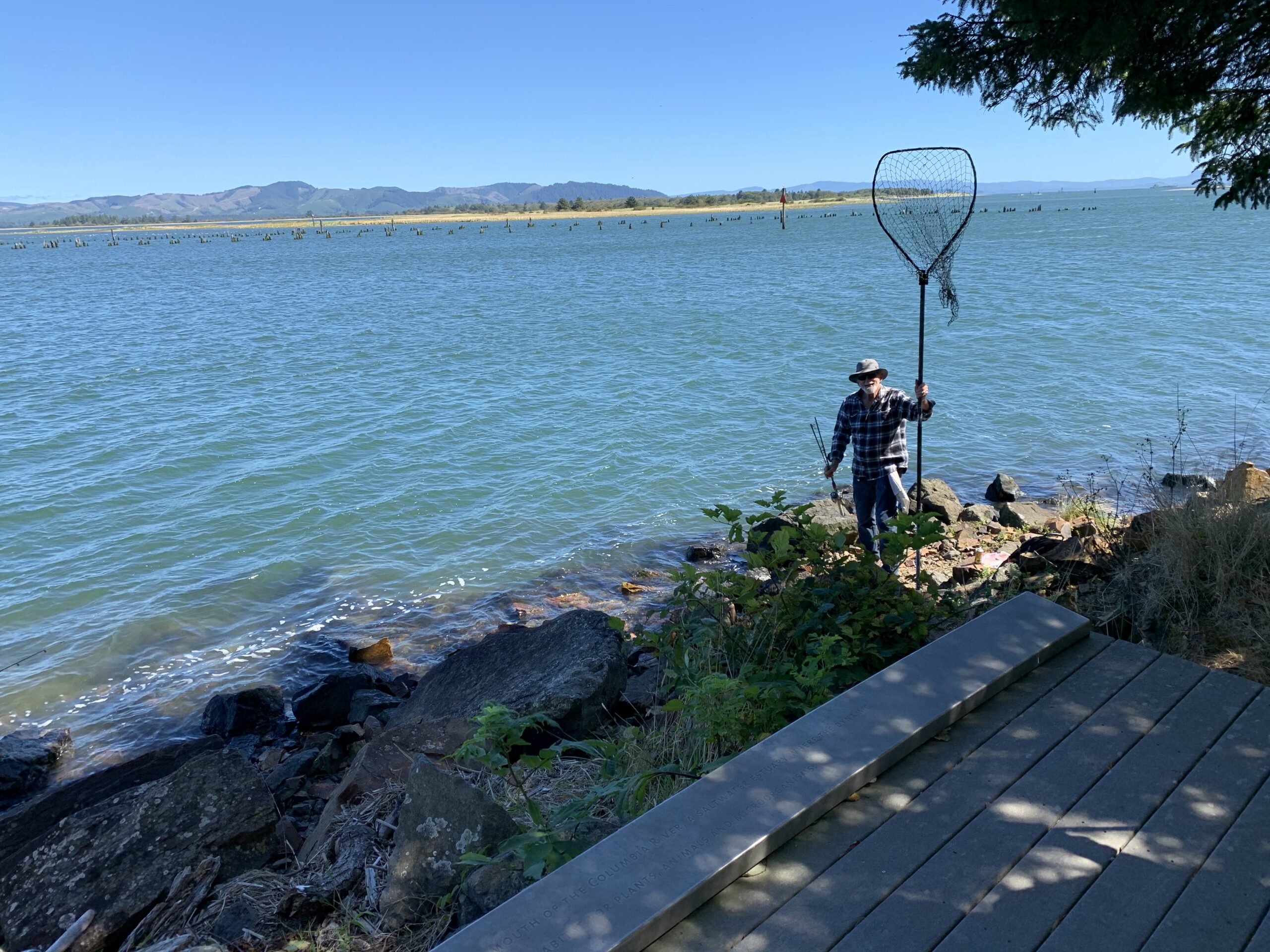
Estuary 2020
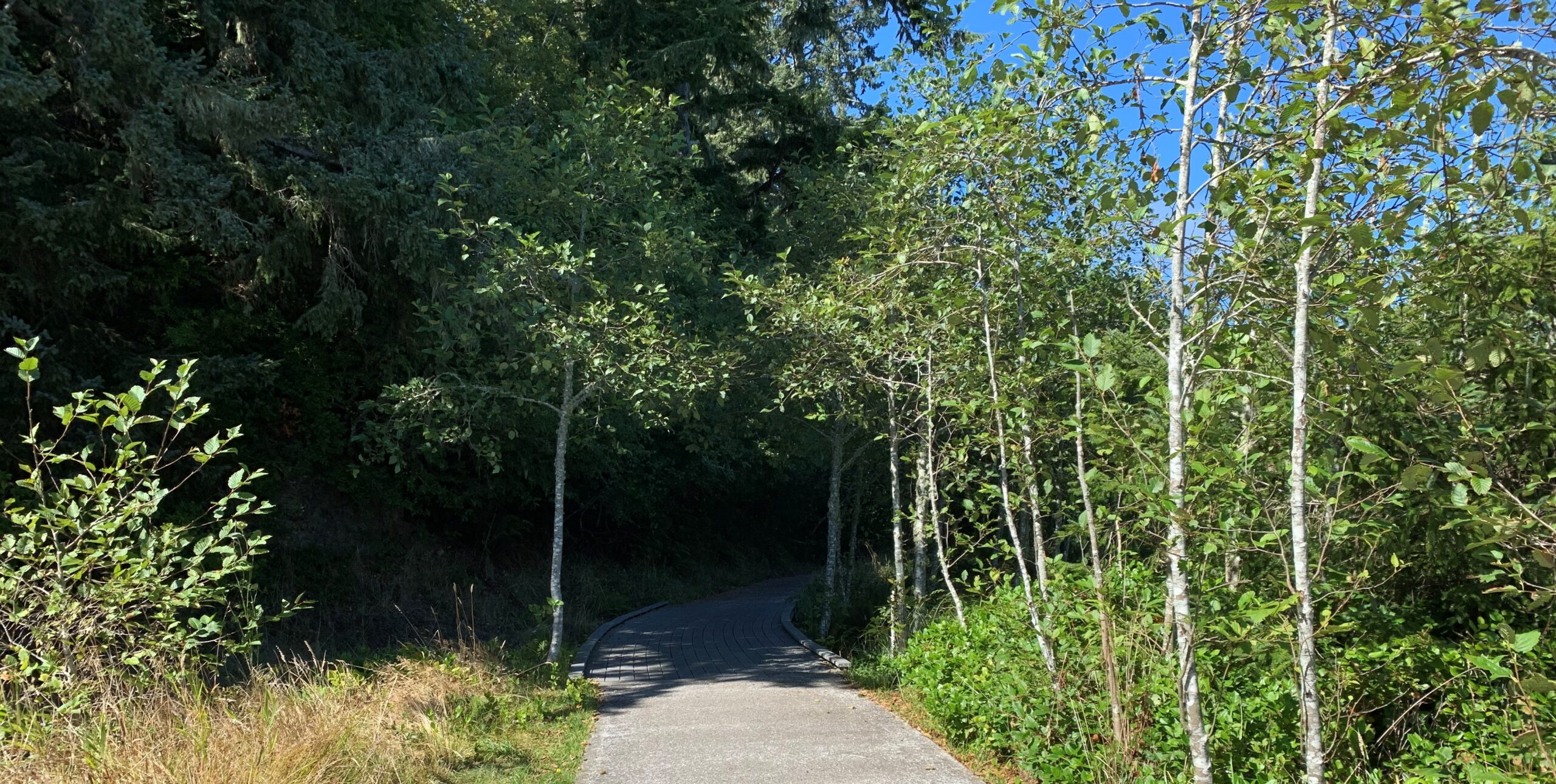
The path to the estuary with trees surrounding it 2020
This entry was posted on September 12, 2020 and is filed under a green future?, Art and Ecology, Uncategorized.
Climate Calamities and Mt Rainier (Tahoma)
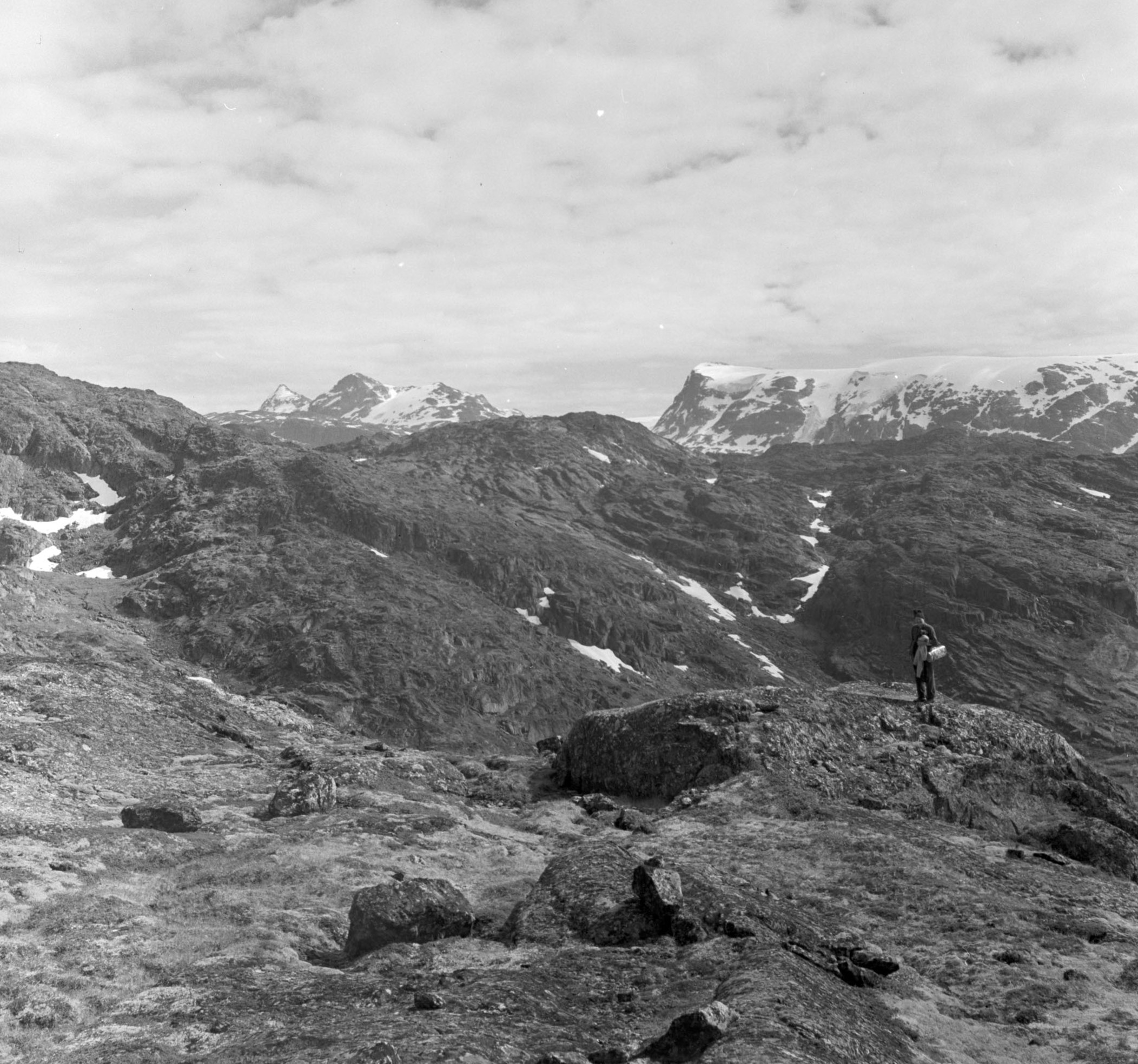
Rutherford Platt; Rutherford Platt standing on rocky landscape, heavy clouds above; Jul-54; image; cellulose acetate; 6 x 6cm (2 3/8 x 2 3/8 in.); North America
I wanted to announce the launching of my new website Climate Calamities.
I am inspired by two different impulses: my father Rutherford Platt’s career as a naturalist and explorer, particularly in the Arctic. His writings such as This Green World, Our Flowering World, and the River of Life, are filled with the wonder of nature. He was a self taught naturalist and his great desire was to share his knowledge with the general public. I deeply appreciate what he did and want to honor it on my new blog as a starting point.
The second impulse is, as seen in the name, the current situation for the planet.
I feel ever more urgently that we are looking at the end of life as we know it within the lifetimes of our grandchildren and maybe sooner. As I look at newborn babies, and then at the predictions for 2030 2040 I think of them as children and teenagers.
Today we are all suffering from the Covid 19 pandemic in many different ways, immediately, with death of family members, with the excruciating service of front line workers, of the anxiety about our own health, with fear for exposure, and fear of travel. And of course for parents there is a whole other layer of anxiety about their children, the schools, their future.
I see the virus and the spread of the virus as a manifestation of climate change: as we destroy animal habitats the viruses they carry will ever more frequently be passed to us. Many people say this is only the first pandemic and not the worst.
Recently I read Octavia Butler’s book Parable of a Sower, it is a dystopian view of the future ( set in 2025! written in 1993). I am planning to write about all the books I have been reading about climate change on my new blog.
Meanwhile we have the forest fire season, the virus, and the immediate opening or not opening of schools.
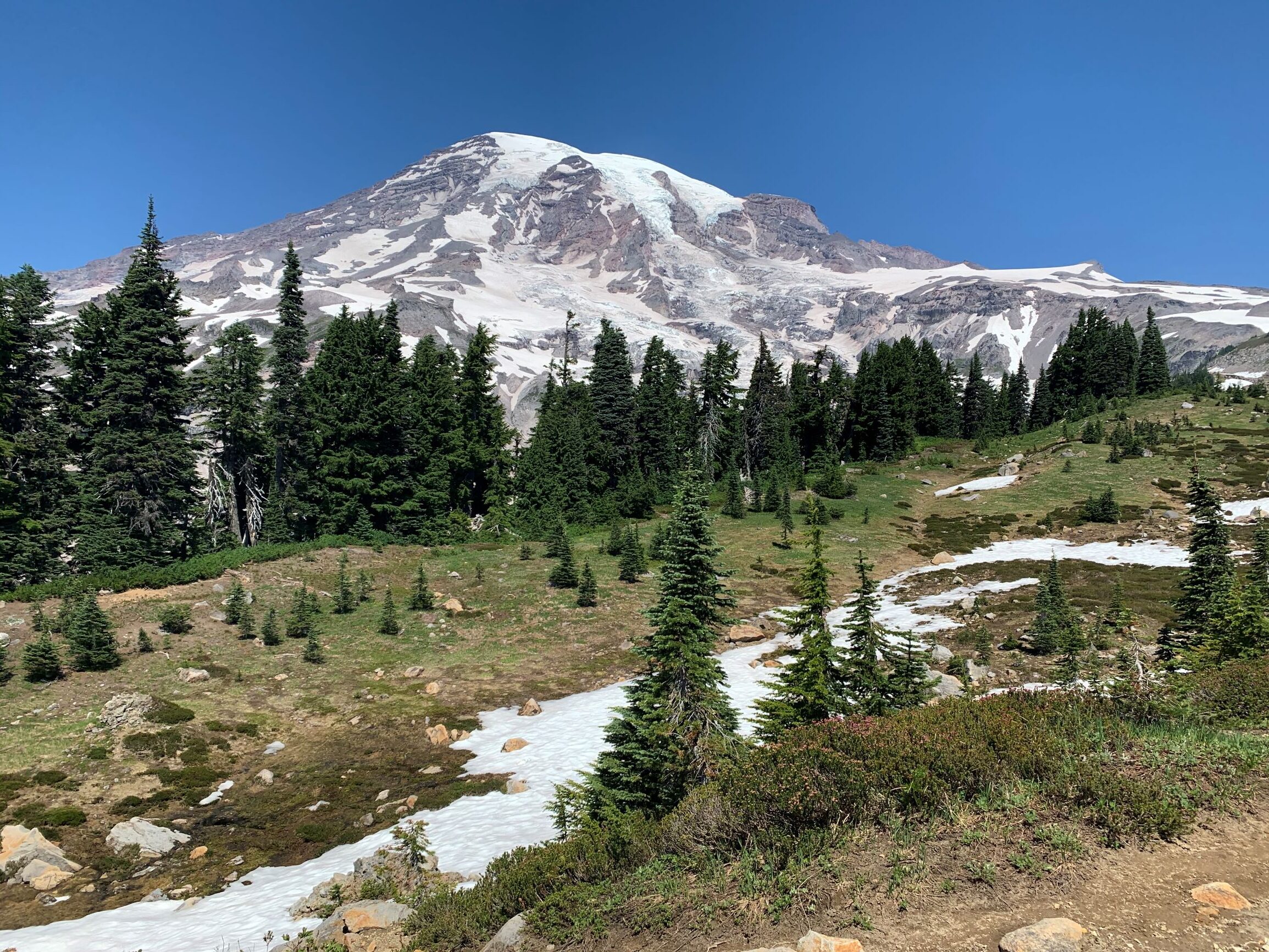
The book I am reading now follows my recent trip to Mt Rainier, TAHOMA AND ITS PEOPLE A Natural History of Mount Rainier National Park by Jeff Antonelis-Lapp
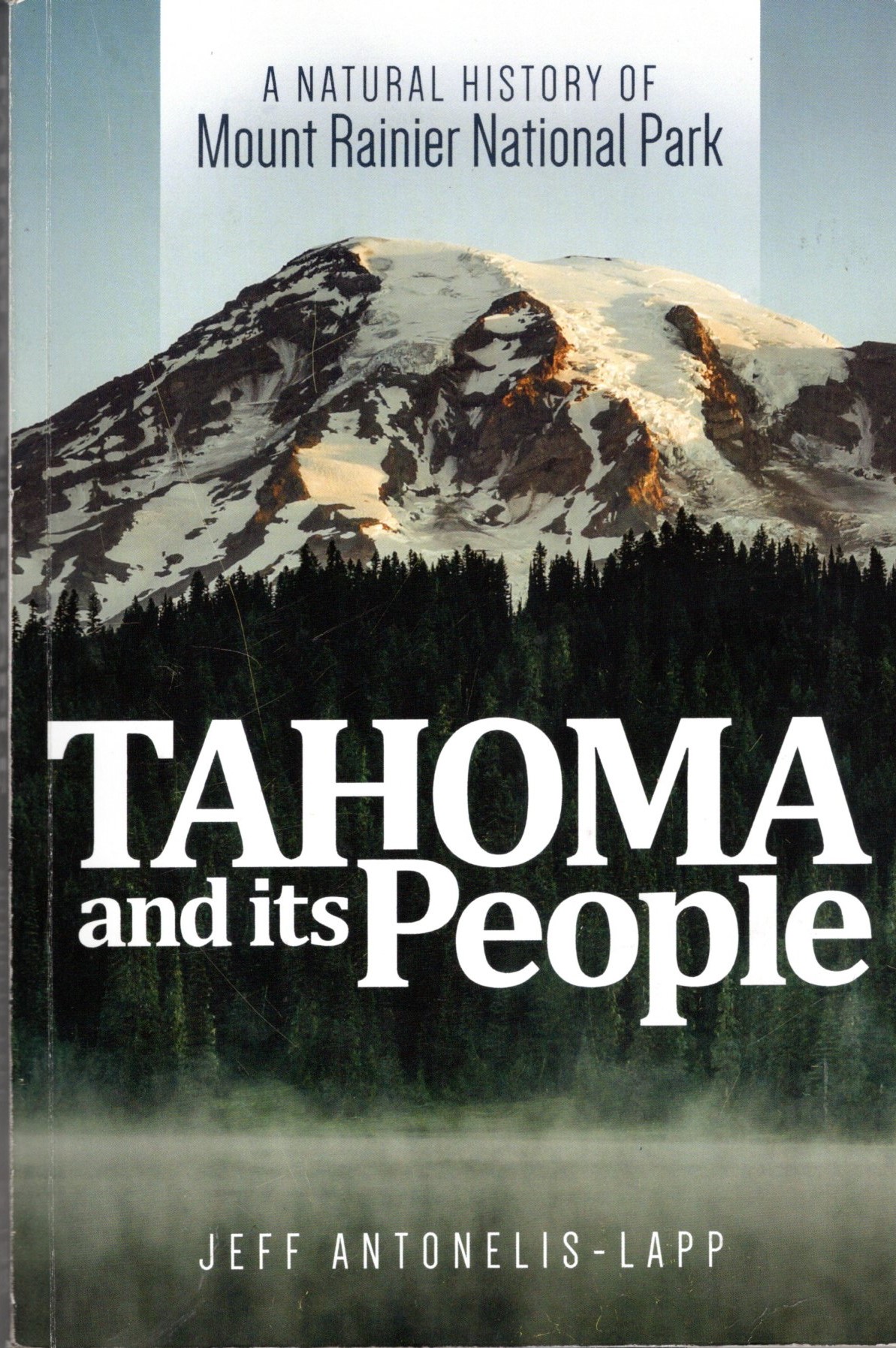
It has clarified for me exactly what I saw on the trip ( and didn’t see) as a result of the European races massive destruction of the ecosystems here in the Northwest starting in 1851. In such a short time we have destroyed ecosystems on an unimaginable scale.
The book elaborates on the glaciers ( I hadn’t realized that there are many different glaciers composing the mountain), the meadows, the trees, the wild flowers, the birds, the creatures, the water systems, and much more, all of them threatened, destroyed, or partially saved through massive efforts.
In particular the wildflowers we saw in the meadows had to be carefully re established and maintained! 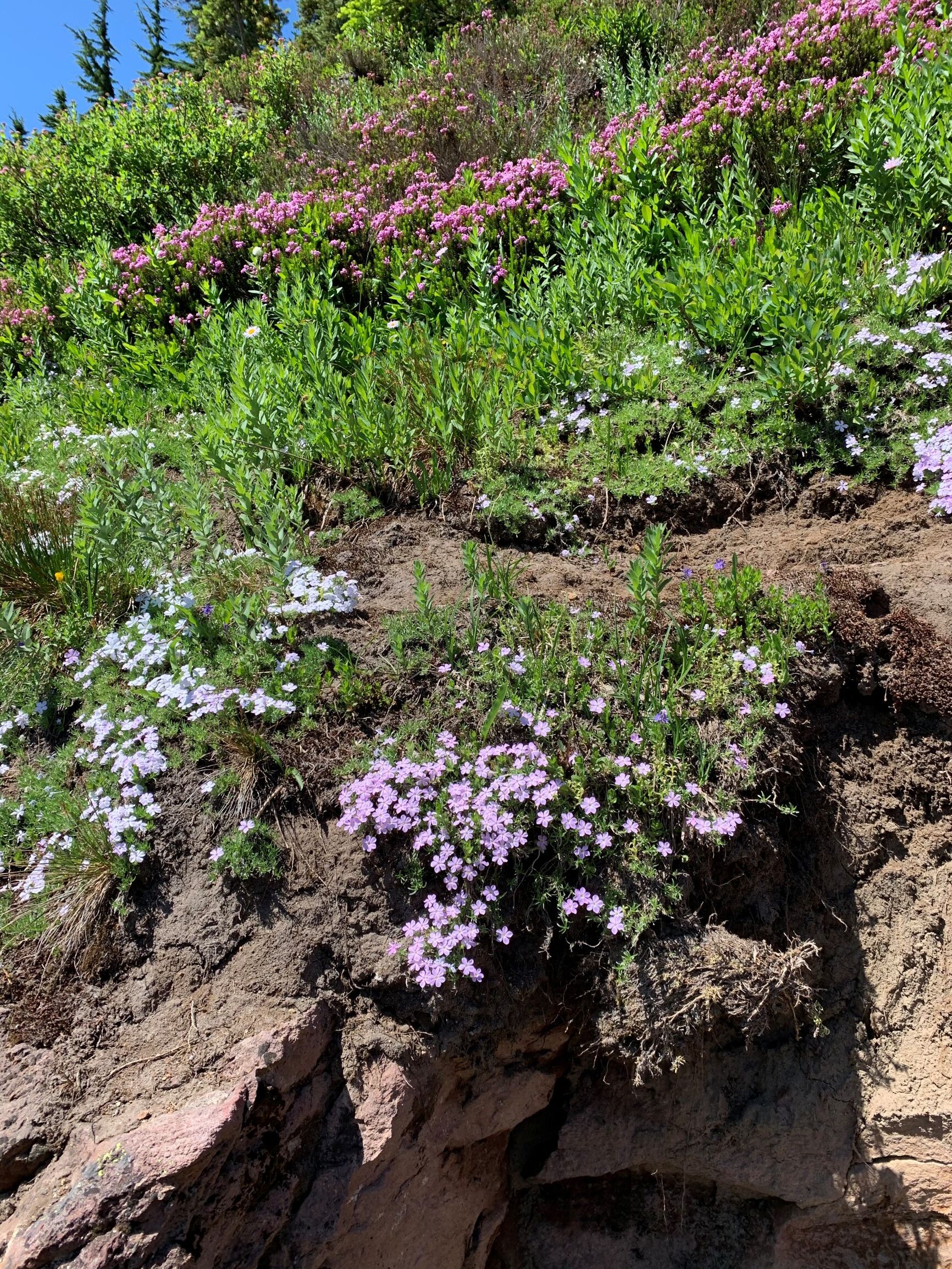
He also writes about the Nisqually River and its incredible lahars, outburst floods from the glacier.
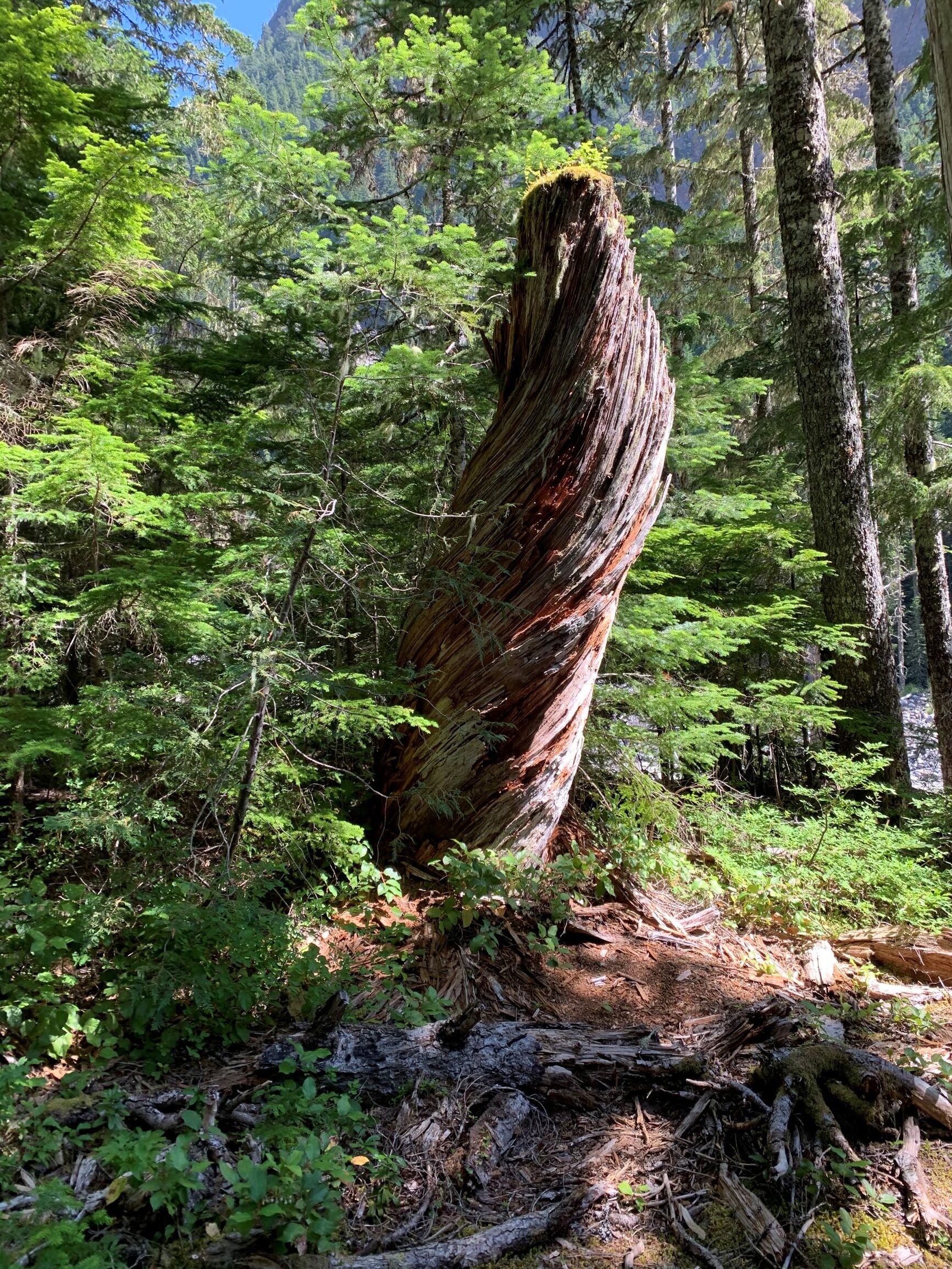
We were baffled by this twisted tree. A huge force led it to twist, or it grew that way?
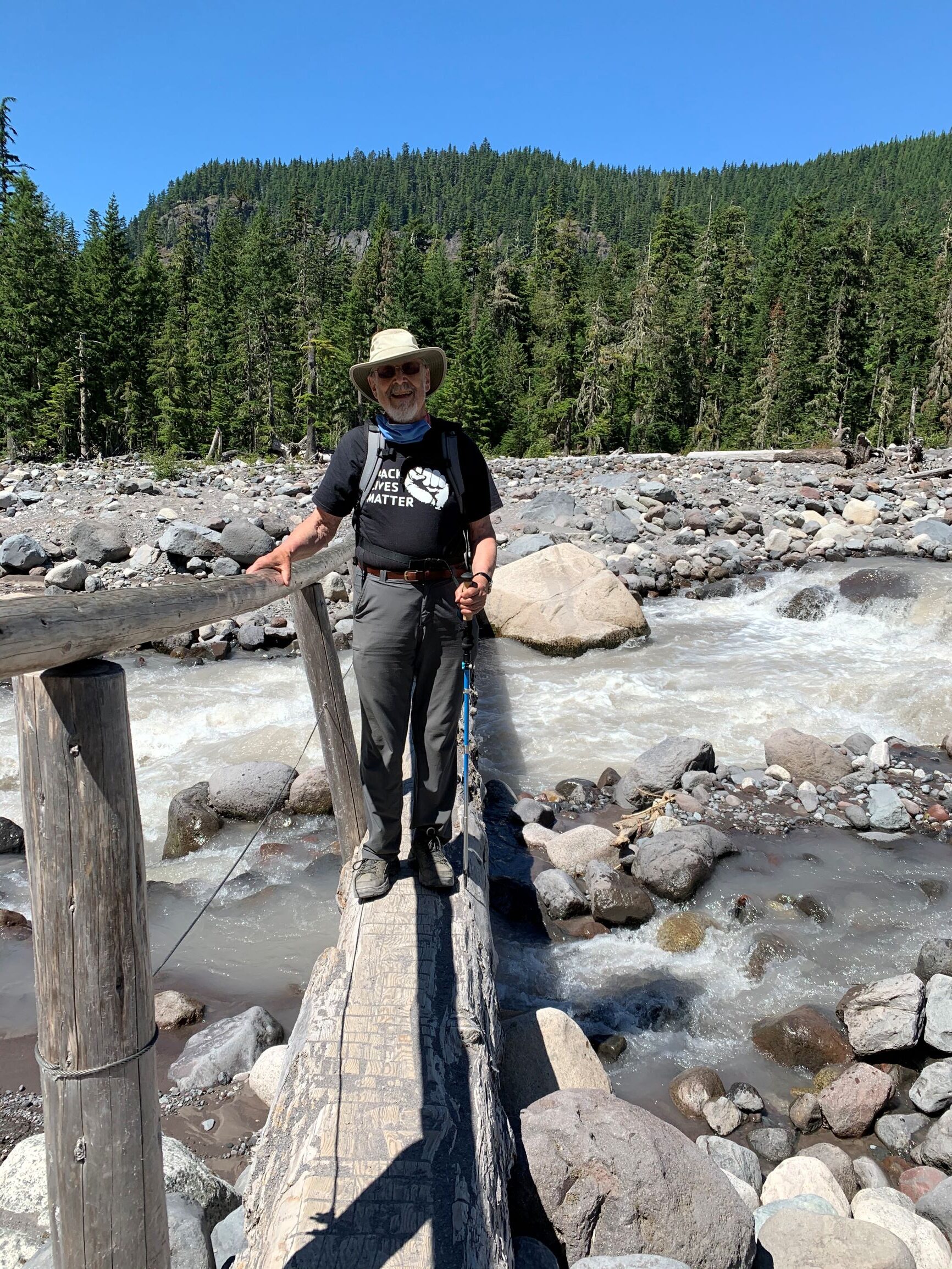
The bridge across the Nisqually. You can see how wide the river’s bed is as a result of huge lahars.
That is why we saw a huge wide channel with random dead trees standing in it. 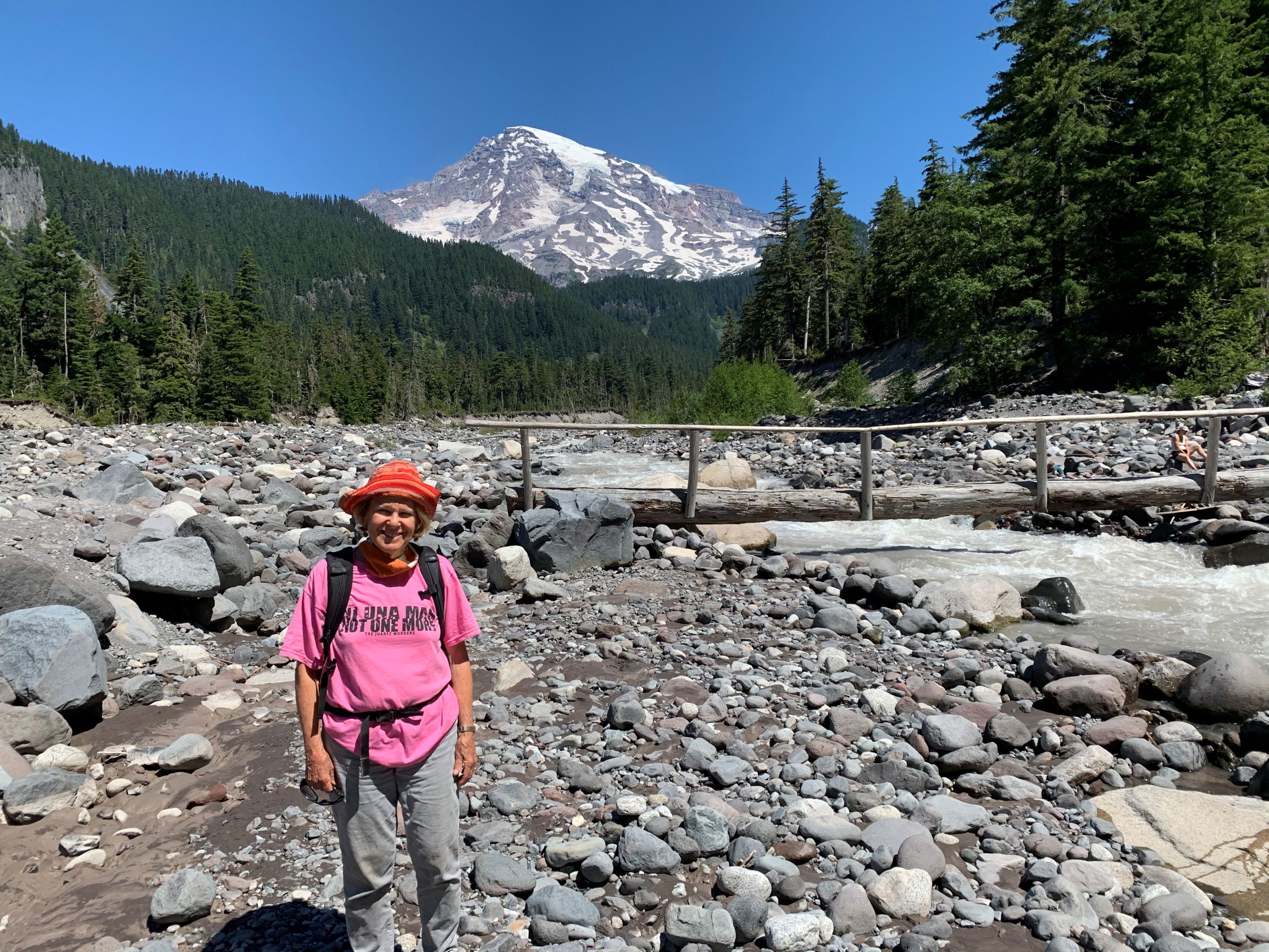
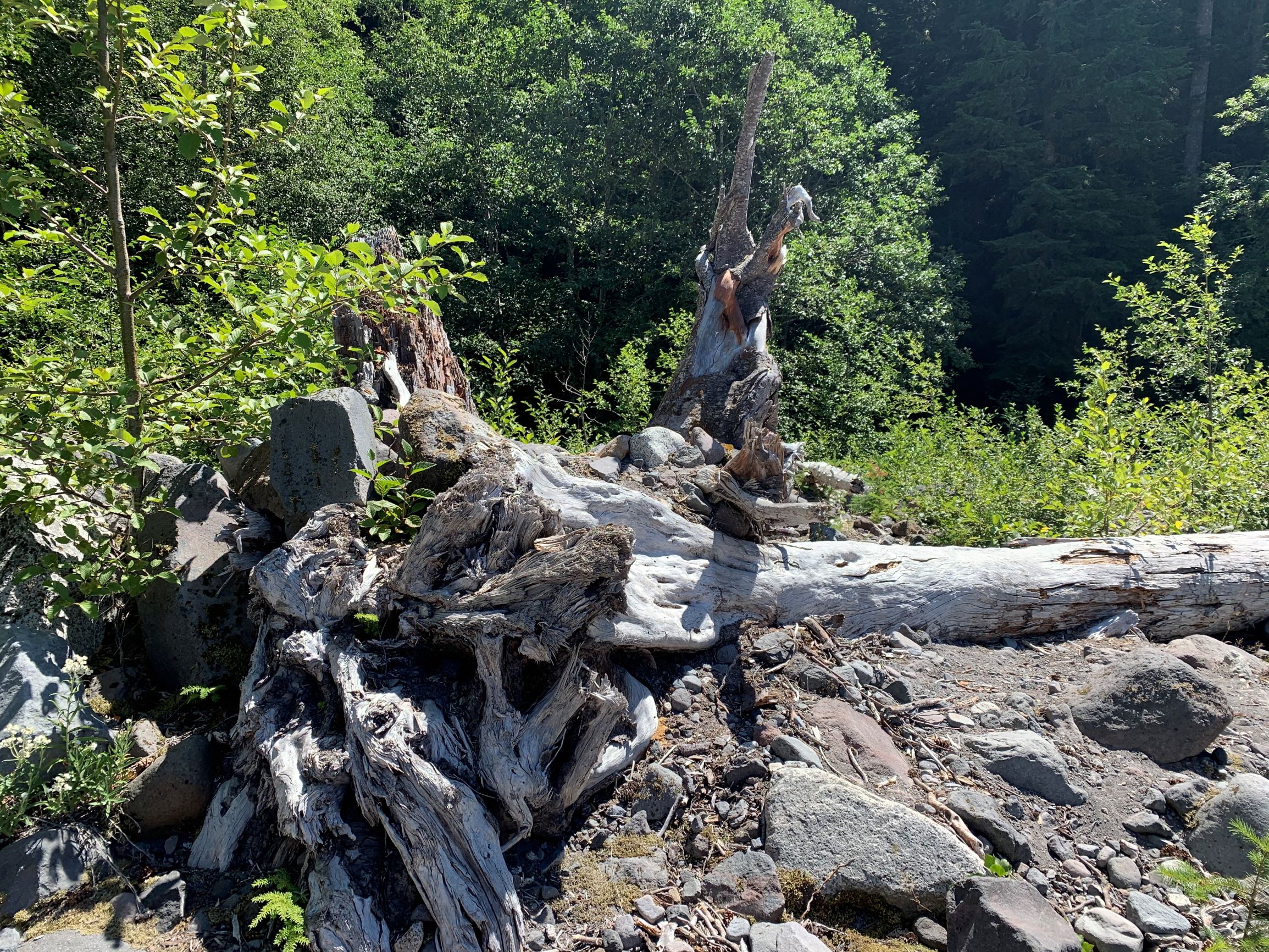
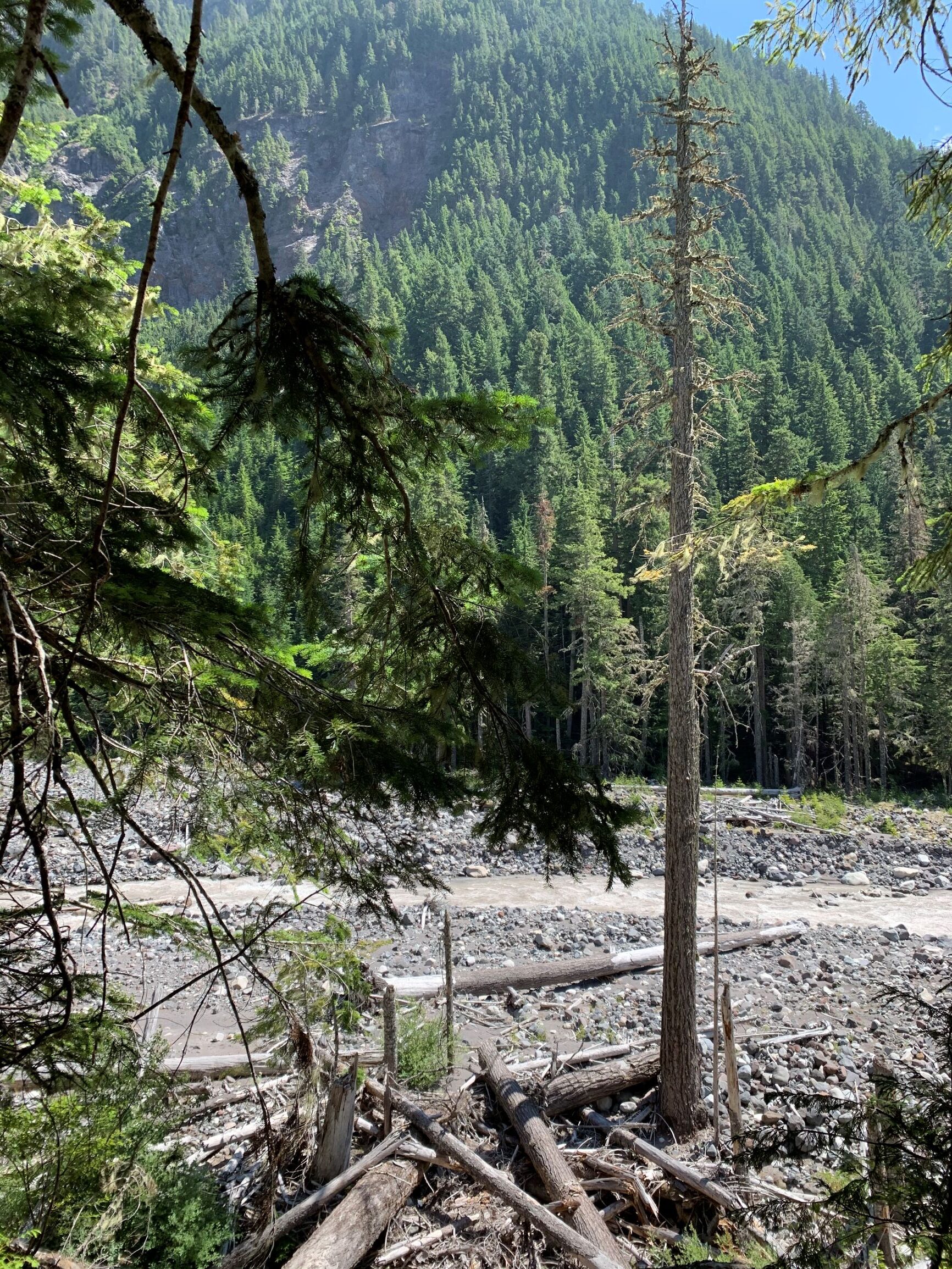
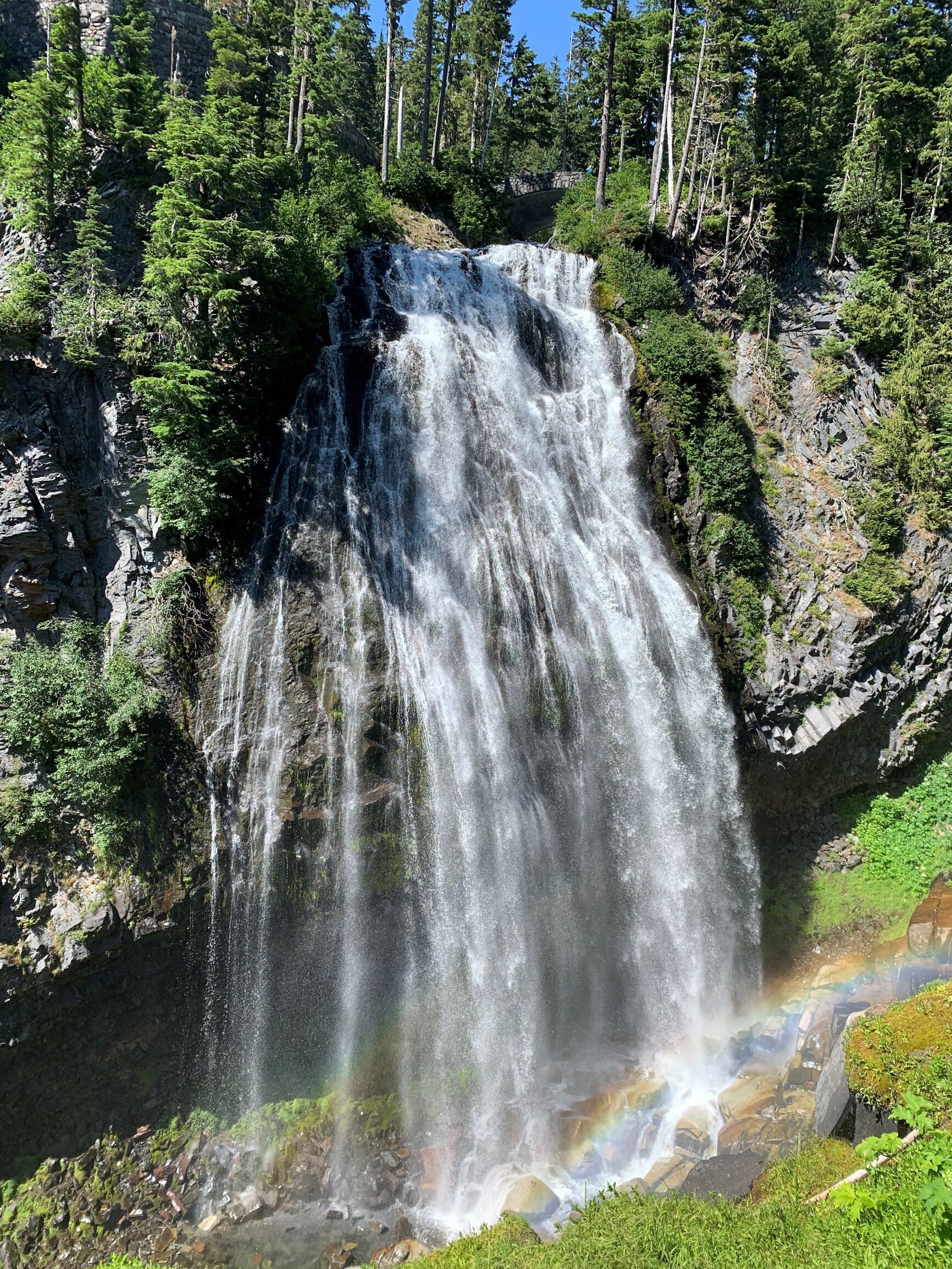
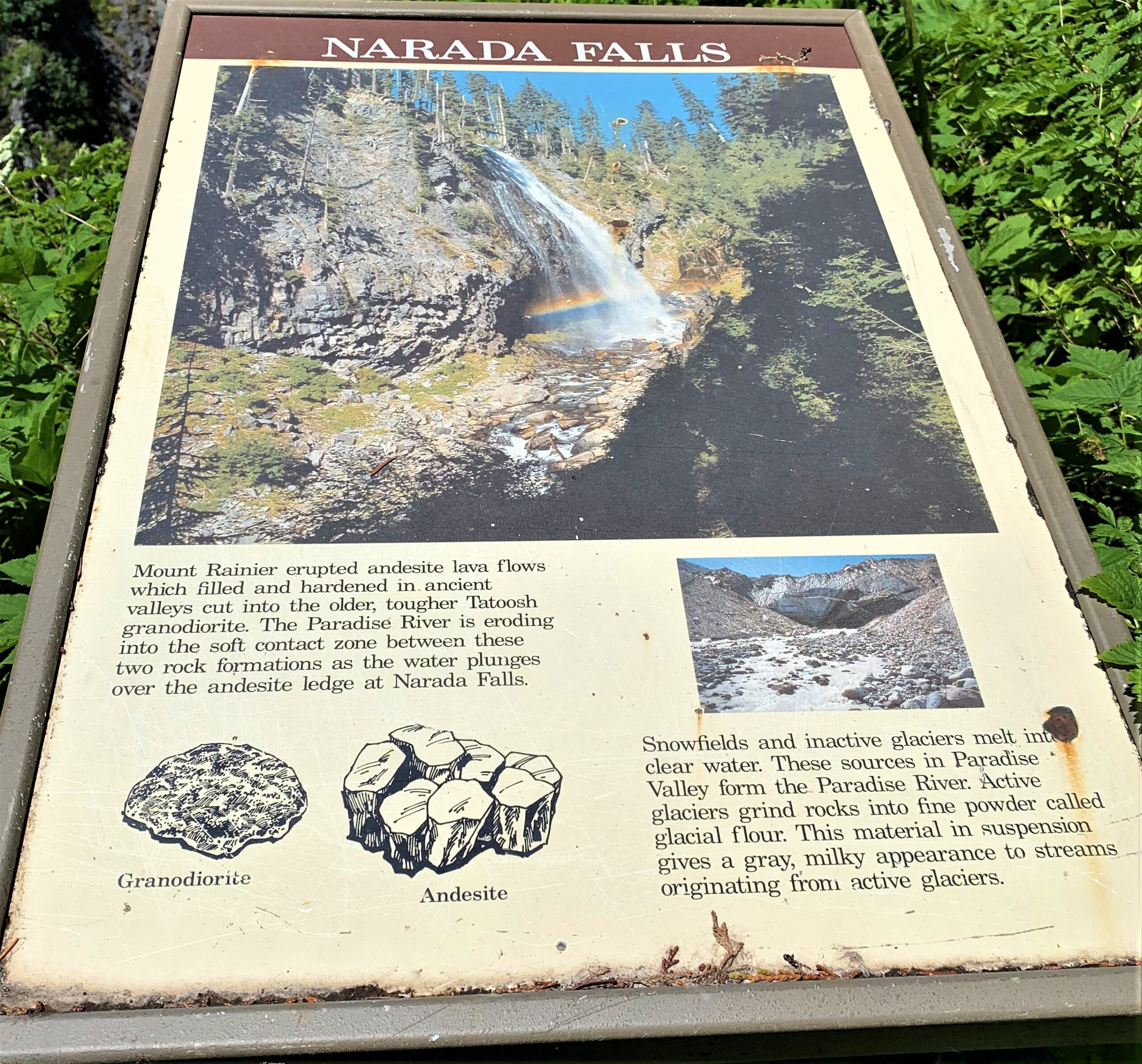
The Narada Falls were explained on a sign as falling between two layers of rock, the lava from the mountain and the underlying, much harder granite.
and the deep woods around the Wonderland Trail. Not as deep as they used to be, and many ecological balances are disturbed by warmer winters, leading to infestations of pine bark beetles among other changes. We heard about pine bark beetle damage at Crater Lake four years ago as a result of warmer winters. The Clark’s nutcracker, the iconic bird of these forests, is disrupted in its key functions by pine bark beetle damage.
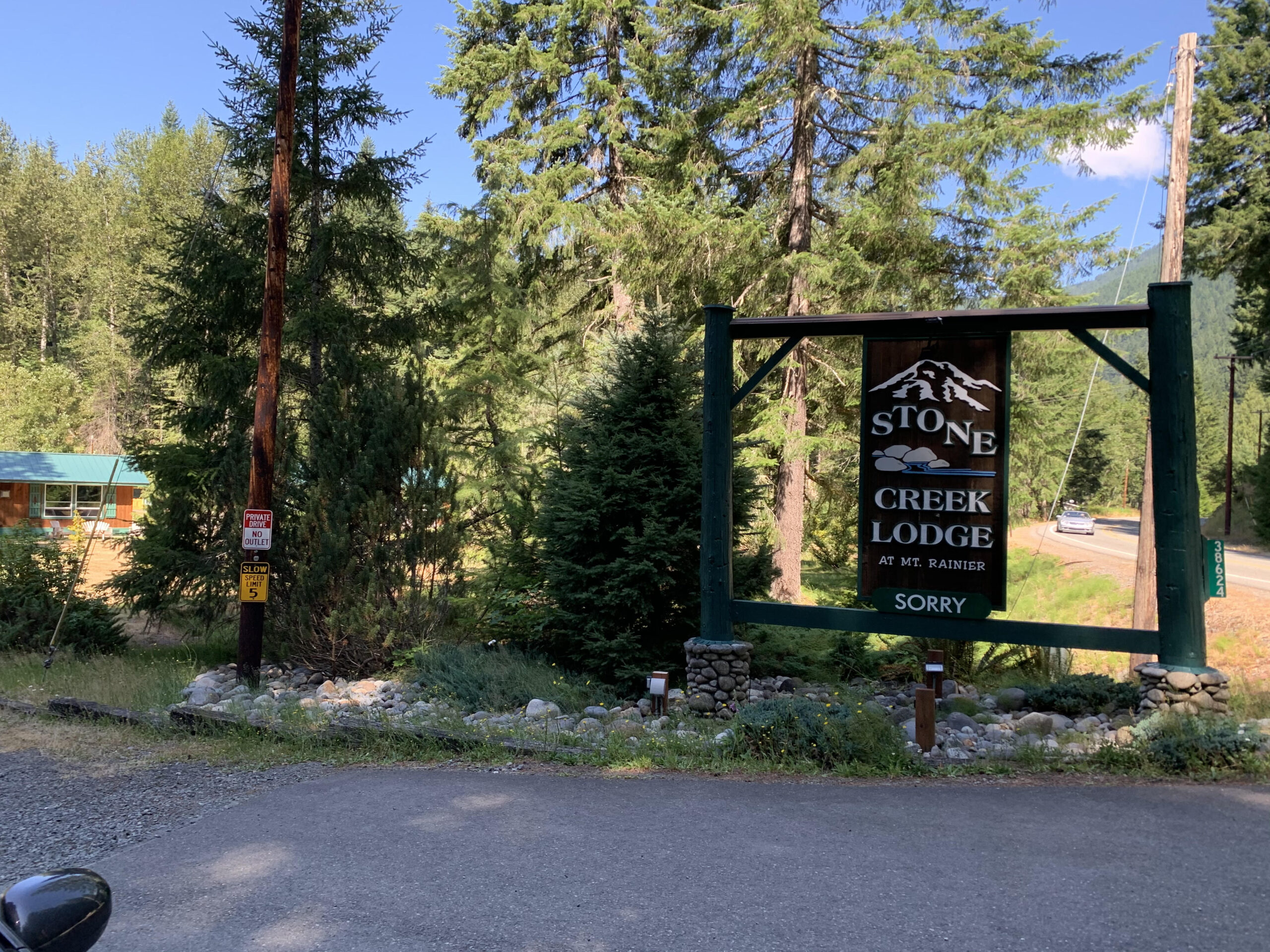
Our landlords at the Stone Creek Lodge showed us photos of ground water flooding in the winter behind their lodge. This is a result of climate change as well, more rain in the winter. And they mentioned that they had mosquitoes for the first time this year. But it was a wonderful place to stay. They couldn’t have been more gracious hosts.
Jeff Antonelis-Lapp’s book includes ancient Indigenous histories, recent cultures of Indigenous peoples as they found so many natural resources there.
He basically circles the mountain going to each entrance, and speaks of the special features of each part of the mountain, its ancient history, its native history, its current state.
The tribal groups have been essential to present day efforts at restoration especially in the Nisqually delta, near the home of the famous Billy Frank at Frank’s Landing. So when you go to Mt Rainier or even when you just gaze on it from Seattle, remember its long long history geologically, and its present state, threatened by climate change.
But above all feel uplifted by its majesty. 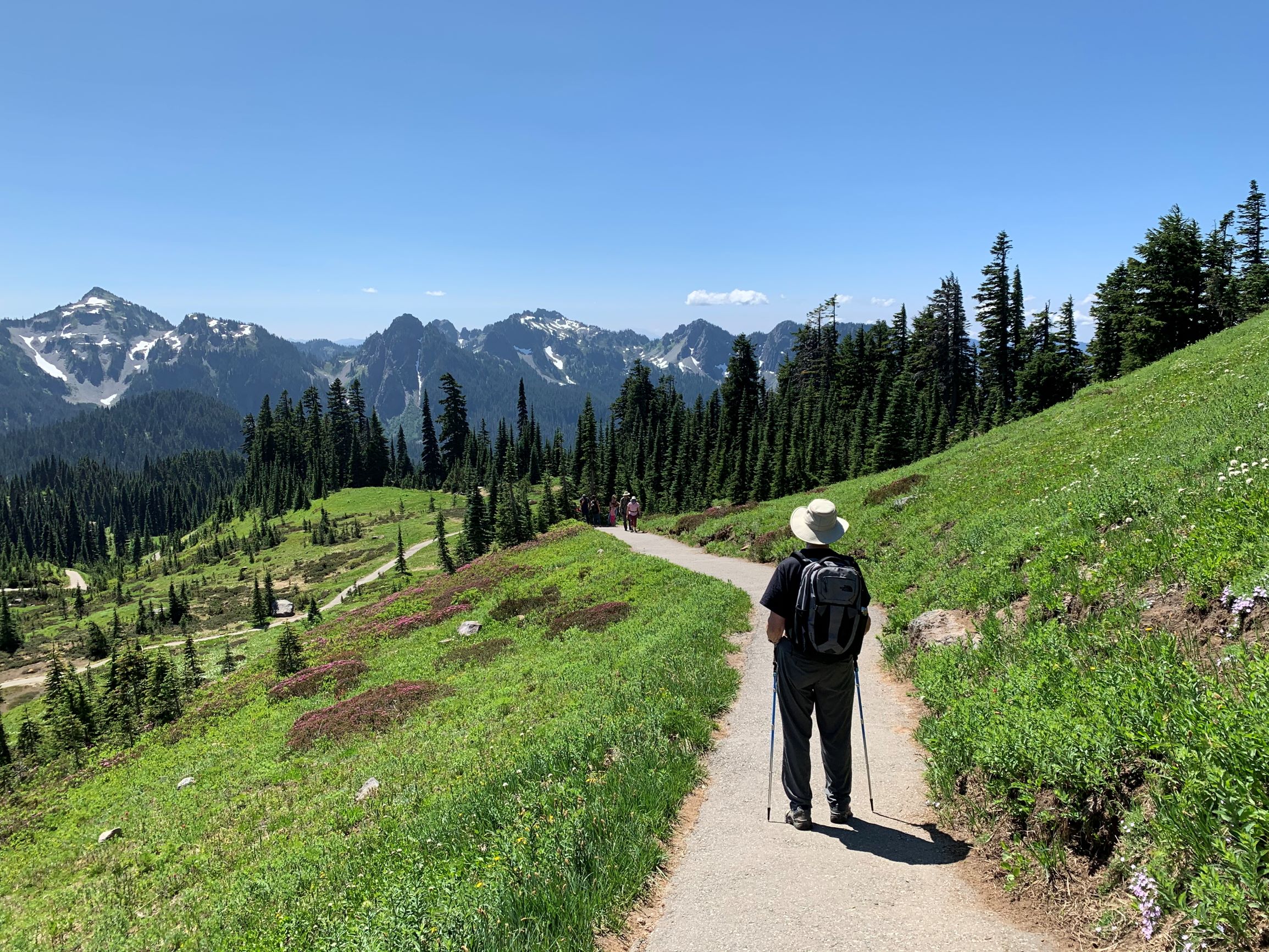
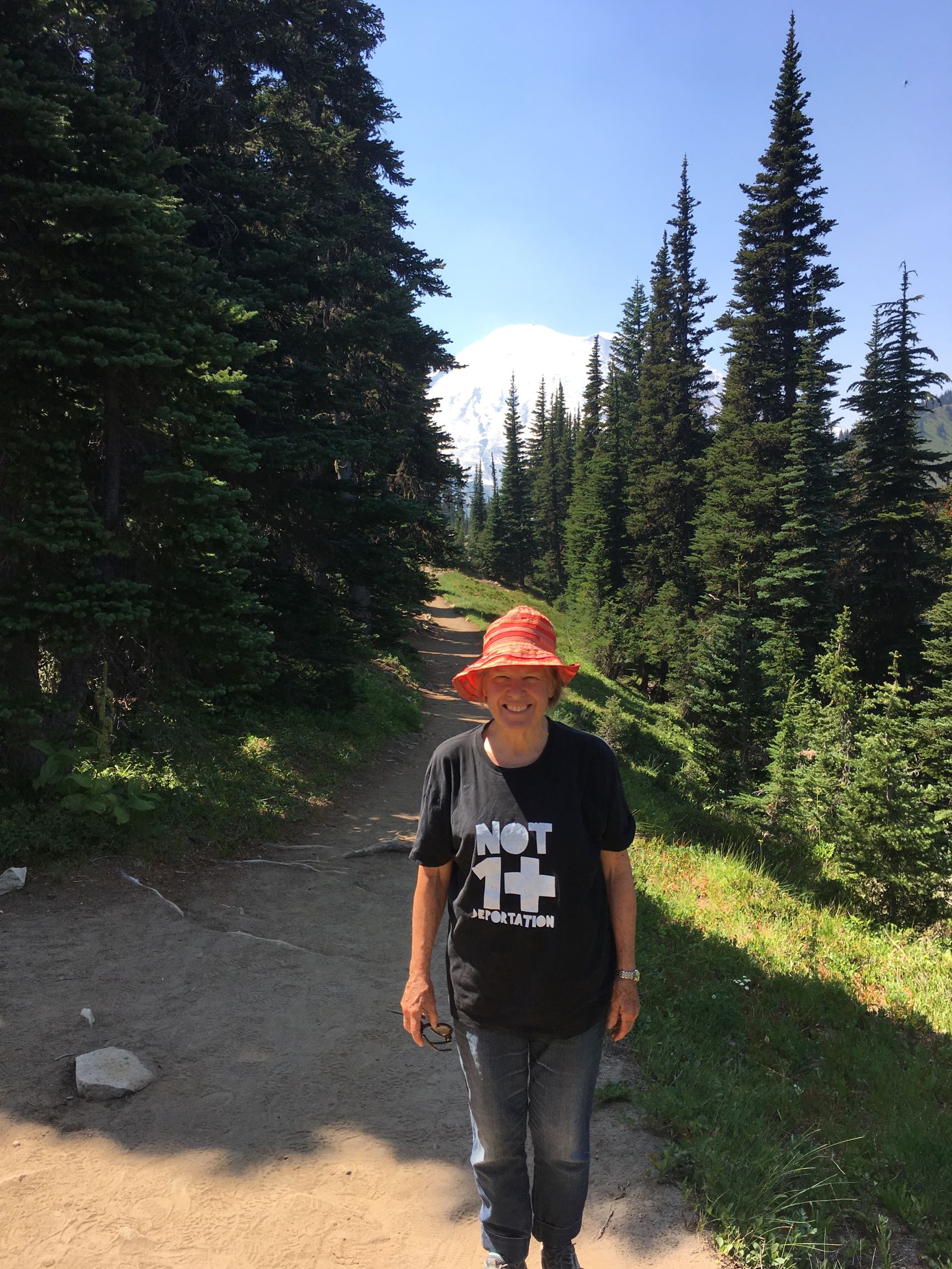
We could easily see that there was less snow on the glaciers of Mt Rainier than even two years ago when we were at Sunrise.
We know that the Greenland glaciers are melting very very fast. And today ferocious wild fires are burning in California and a huge hurricane is headed for the Gulf Coast of the US. Climate Calamities are here.
Go to my new blog Climate Calamities soon for more reporting on that topic. I am so inspired by remembering my fathers trips to the Arctic in 1947 and 1954 to follow the situation today.
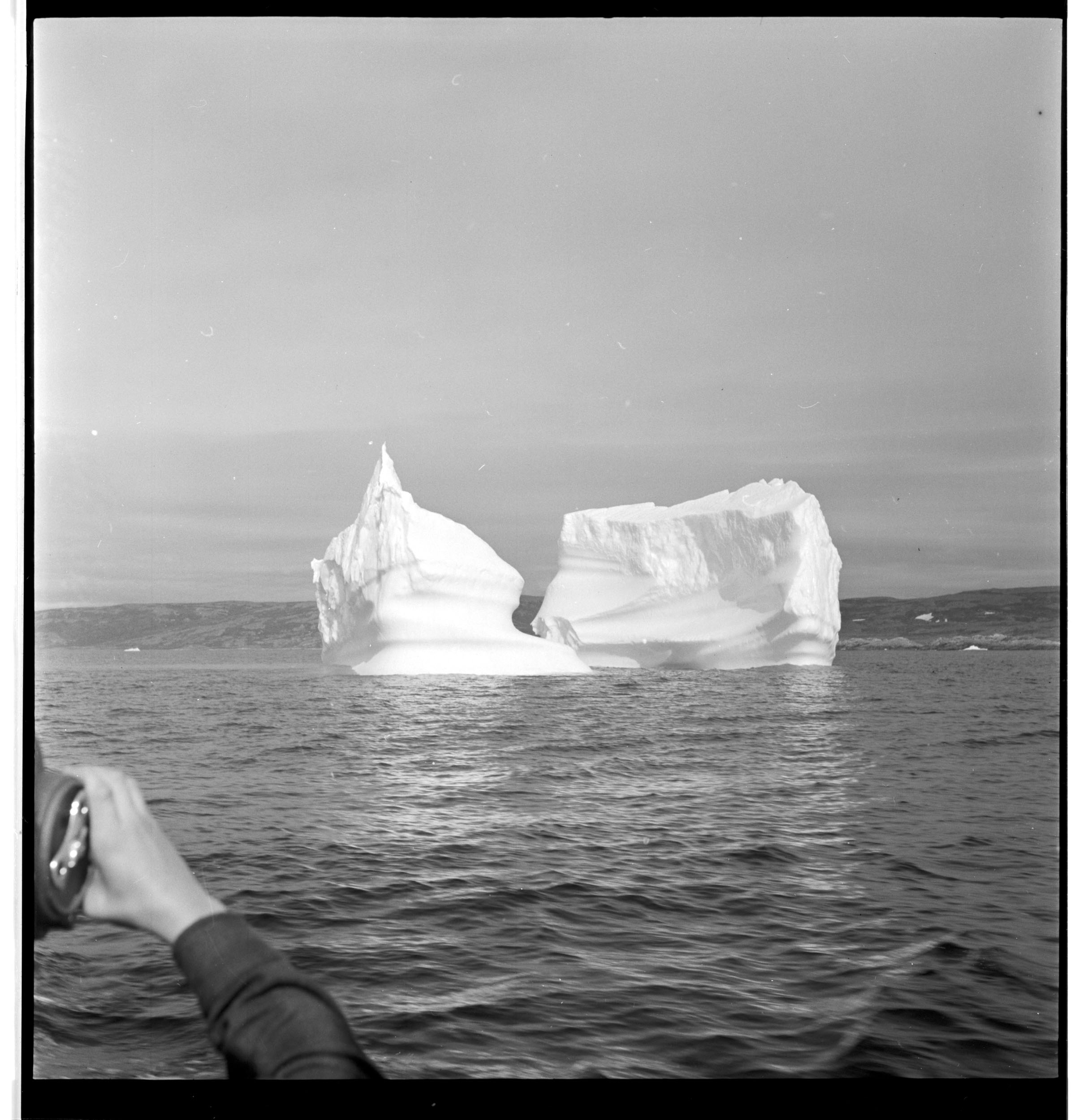
Rutherford Platt; Icebergs; Jul-54; image; cellulose acetate; 6 x 6cm (2 3/8 x 2 3/8 in.); North America
This entry was posted on August 26, 2020 and is filed under ecology.
Ling Chun Apostrophe S
Galleries are slowly reopening. Method Gallery has a wonderful new installation by Ling Chun. When I first saw it, I was confounded.
Ling is a ceramic artist in her training, but what she does with ceramics is so innovative, that she must now be called a multimedia artist at the intersection of pop, modernism, and contemporary politics.
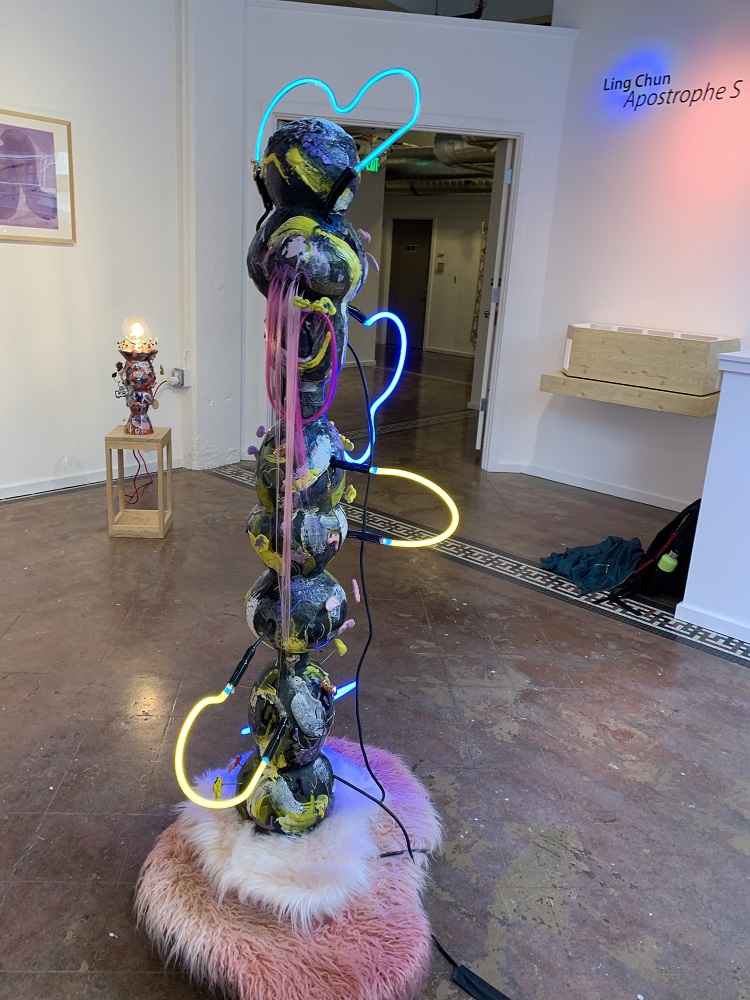
As I looked at this complicated work, with the title, The Neon She Remembered ( 2020), I first had to set aside my own preconceived aesthetic ideas. In her combination of fake pink fur, neon, ceramic purposefully declaring its own glazes ( more on that), Ling comes from an entirely new aesthetic generation. But each element of her work is layered with meaning.
Originally from Hong Kong ( she came here at age 17), Ling learned Chinese calligraphy as a child. She spoke of learning chinese characters, practicing a single stroke all day, to create harmony between one stroke and the next of a single character.
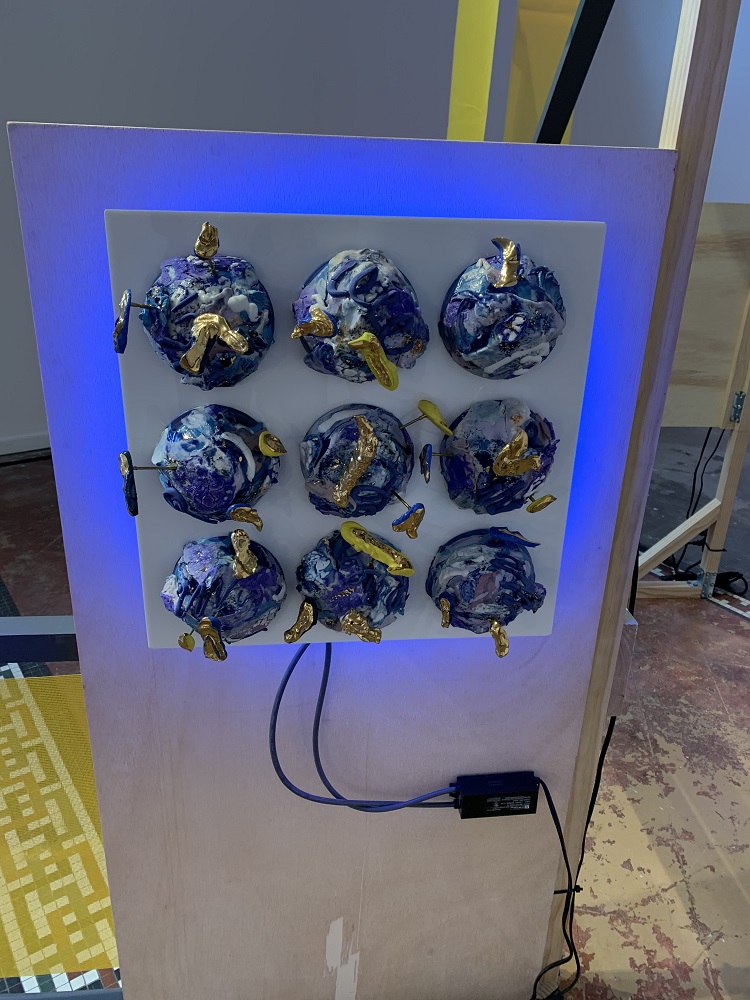
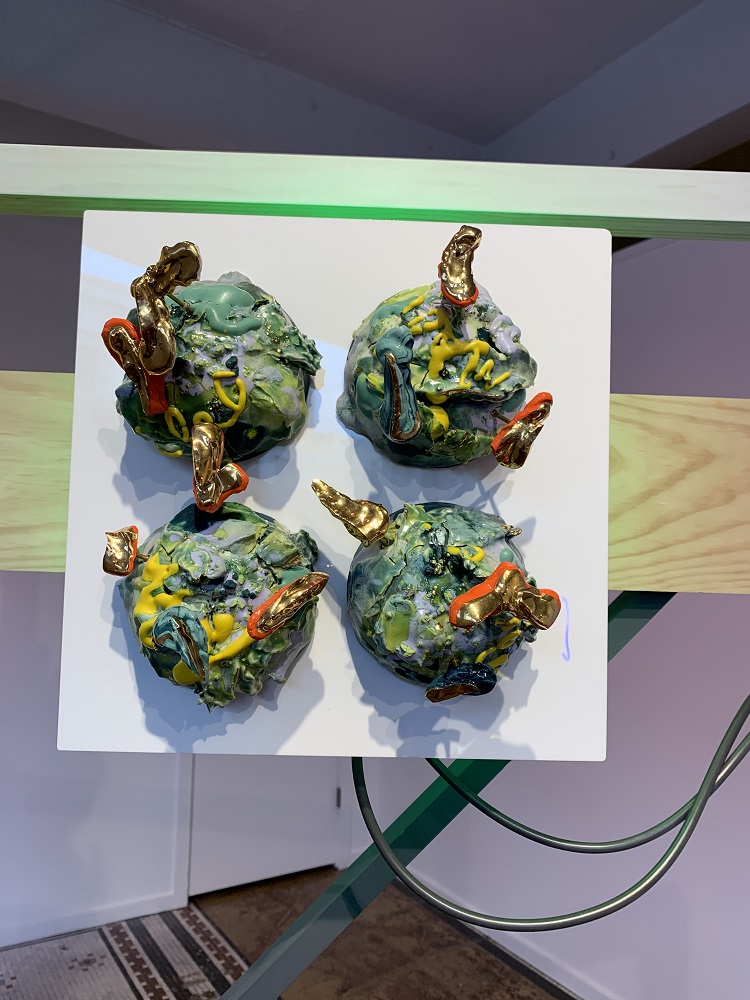
For her ceramics are a symbol of language, that is why you see curved shapes flying off her central form. These are individual strokes of Chinese Calligraphy.
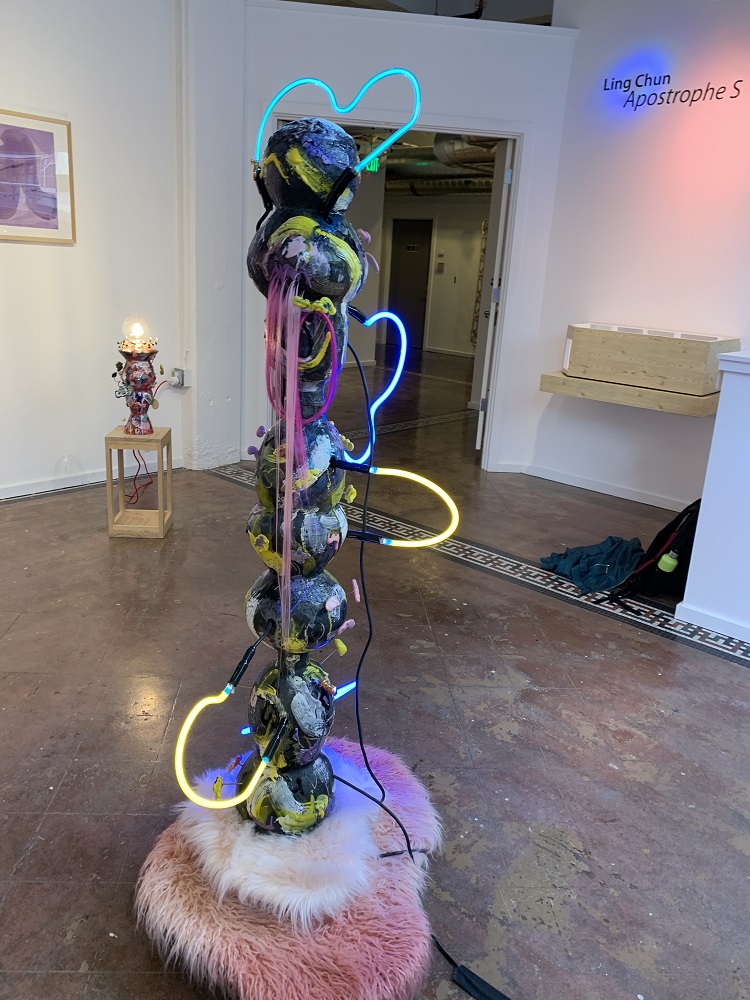
Lets go back to The Neon She Remembered. The neon is itself a complex medium, now archaic, as she has pointed out, with the emergence of LED lights. For her it is deeply associated with Hong Kong as she remembers it from her youth, filled at night with neon street signs. She took a workshop in order to understand how to create neon. Here it seems to wander outside the main structure, creating visual connections between the separate segments. The colors connect to the Hong Kong democracy movement, yellow pro democracy, blue pro government.
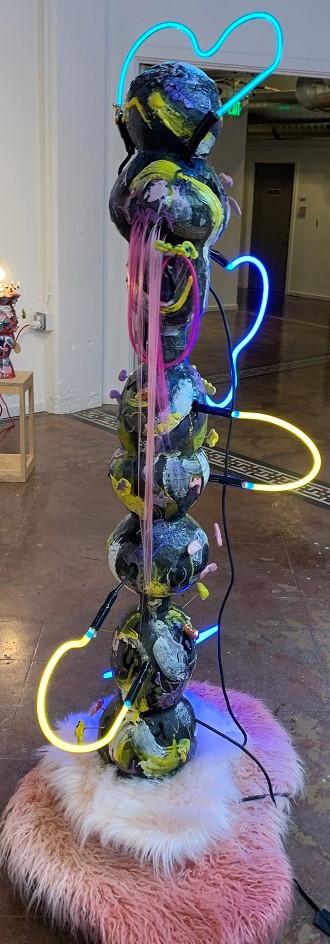
That pink and white fur as a base represents perhaps the soft foundation of the current world, Hong Kong, our lives, maybe it is simply a cushion for the piece, giving it an unreliable place to stand. I associate it with the Asian girl fashion that we heard so much about a few years ago ( as in Hello Kitty of course).
Then there is the magenta hair. Ling went to beauty school at some point, but quit, yet she has a life-long love of hair, and here we see it hanging down straight on this female figure.
Is this a self portrait actually, caught between the different forces of the world?
Ling speaks of yearning for home without having a sense of belonging either here or in Hong Kong. She is caught in between, a feeling of so many immigrants. Here she gives us fragments of memories, of who she is, of who she remembers being, of perhaps who she is becoming.
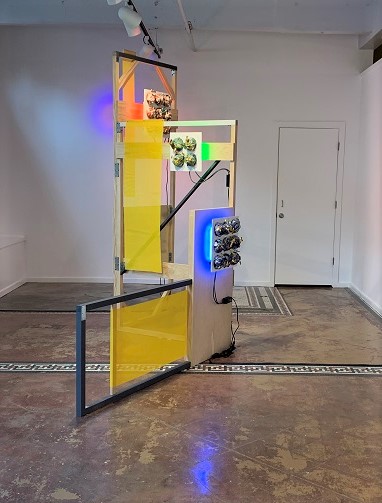
The second large piece in the exhibition Sign/Sigh is an installation. Again blue and yellow are the dominant colors, here on a plywood construction that echoes classical modernism. But plywood as a material is suddenly so prominent in the windows of closed stores everywhere.
The sculptural elements of the squares with balls in a grid refer to Chinese characters. The balls are “signs” ( in both a literal and metaphorical sense of the word) of calligraphy. Chinese square calligraphy is a simplified version of writing in Chinese characters.
Ling stated that the works evoke belonging and memories of home. But they are also expressing our current disrupted world in which all the familiar structures and habits are altered, suspended, cancelled, coming apart, disappearing, or destroyed.

Returning to the ceramic itself, an ancient medium, a modern medium, a medium that can rise up in rebellion, or subside into quiet utility. Here it rises up, literally off the surface. The glazes are individual sculptural elements, they refuse to blend, lie on the surface or subside. They are a churning sea of color and form.
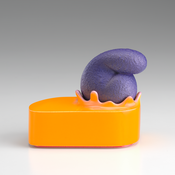
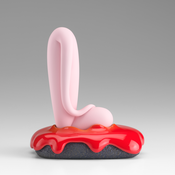
When asked who inspired her, one of the artists that she mentioned was Ron Nagle. Nagle is an old friend of mine from the three years that I taught with him at Mills College. On first glance his meticulous ceramics seem far from Ling’s work, she seems closer to the work of Peter Voulkos, the ceramic artist who broke through the prejudice against ceramics to achieve international acclaim during the era of Abstract Expressionism. Nagle is entirely different, his work is small in scale, but his glazed colors and shapes are layered, surprising and completely unpredictable. As a personality, he is outrageous, and funny. He is also a musician. So he mixes it up too.
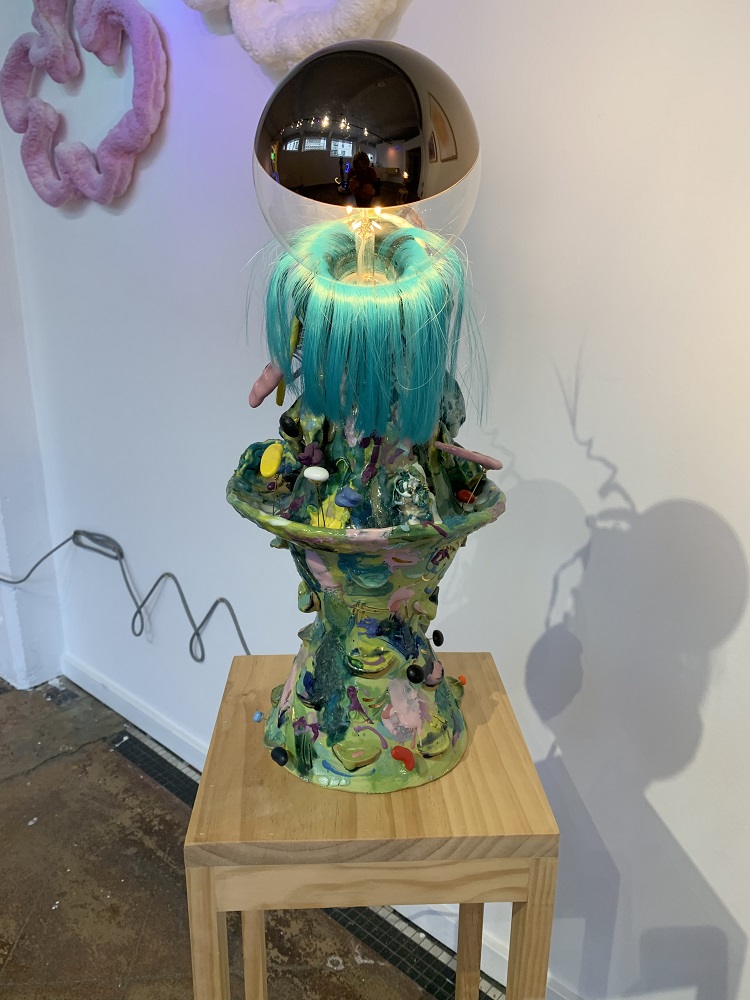
Here is Light Me Up Green: pop color and offbeat juxtapositions are crucial in all of her works, and the same is true of Nagel’s work. The surfaces are entirely different, but the juxtapositions of unexpected hues is similar.
The entire exhibition called “Apostrophe S” ( what does the title signify? belonging, not belonging?) is initially alienating then provocative because it provides insights into Ling and her life experience, as well as a window into the chaos of this turbulent moment.
.
This entry was posted on July 26, 2020 and is filed under Uncategorized.
CHOP the Garden
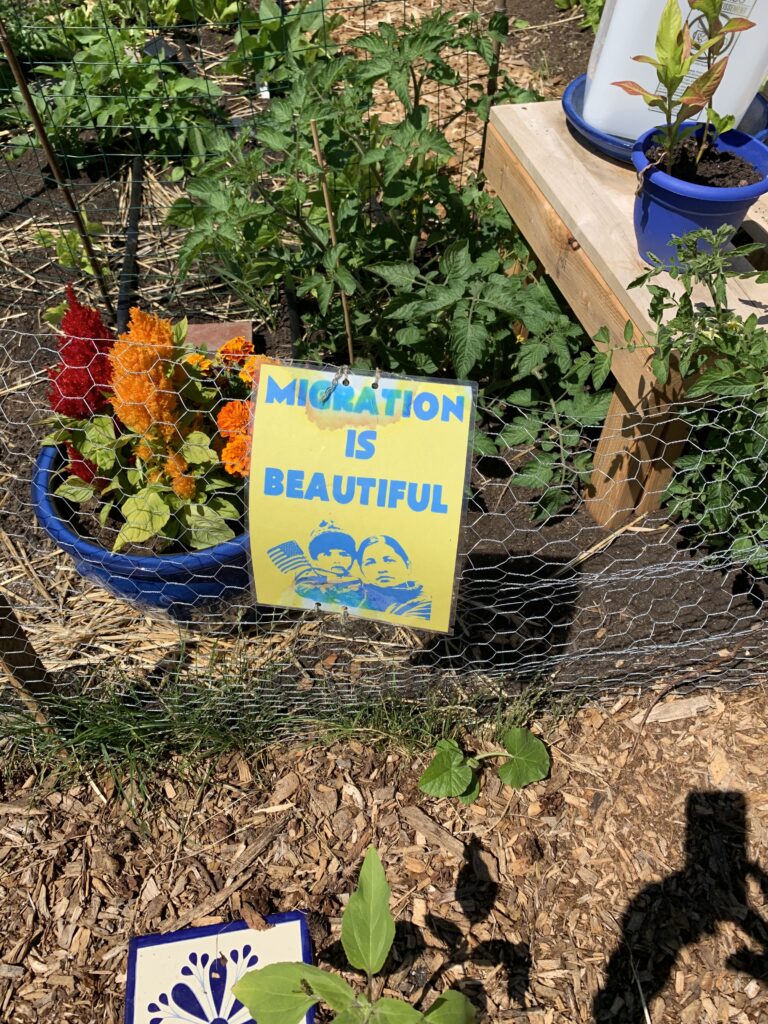
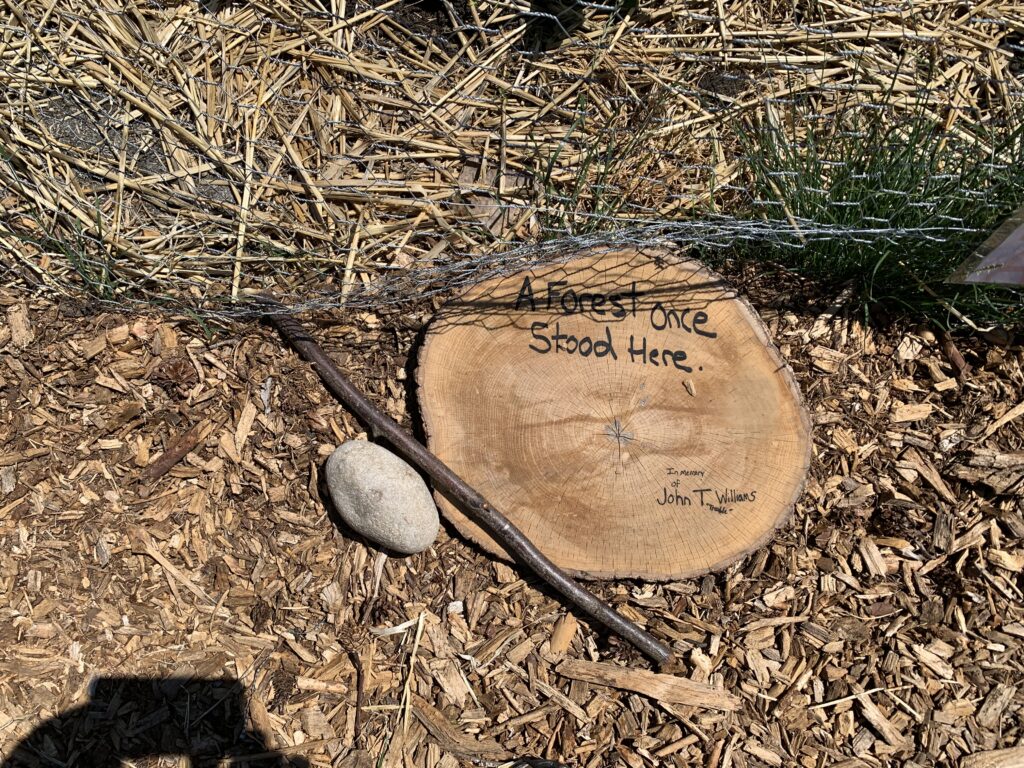
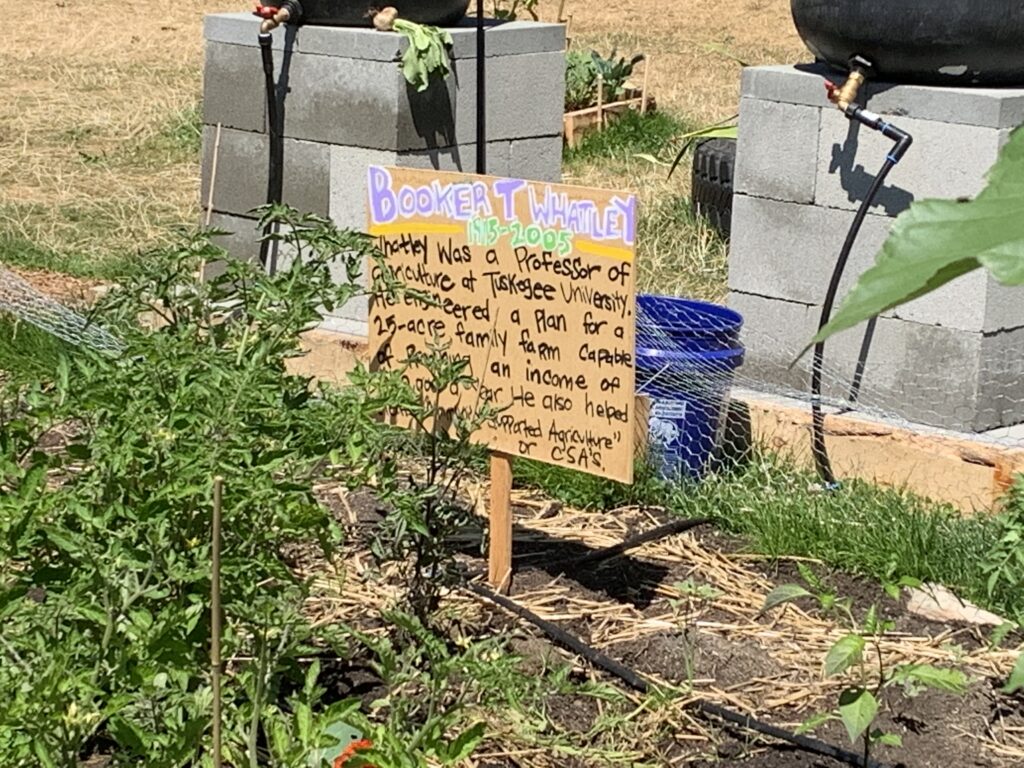
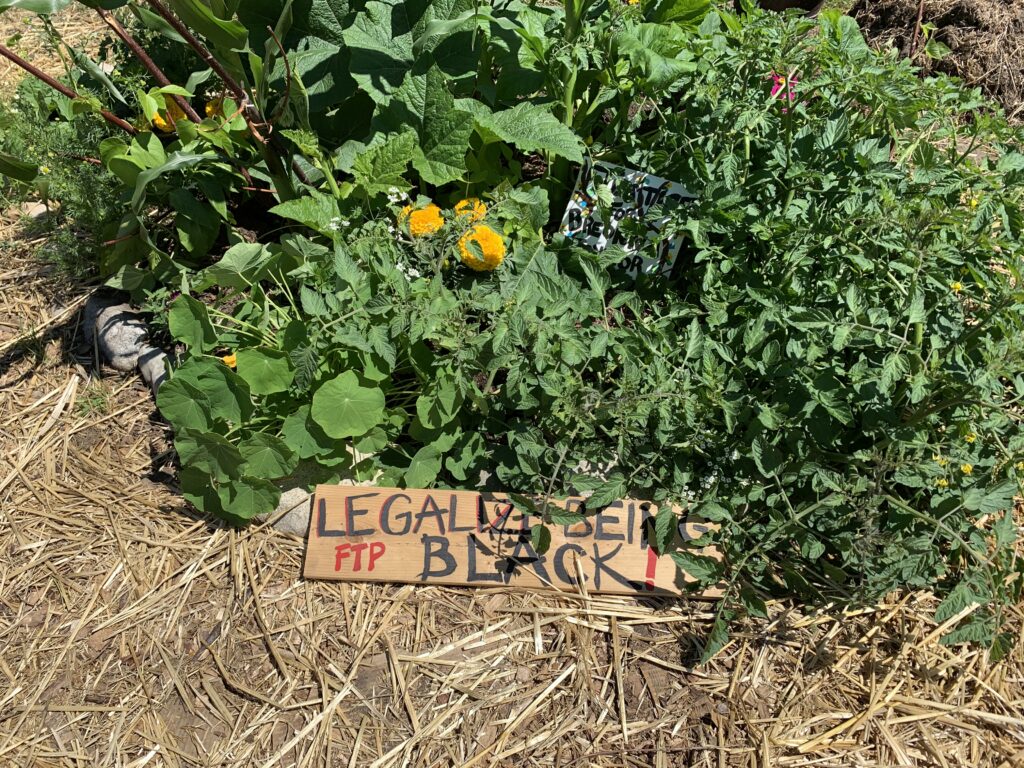
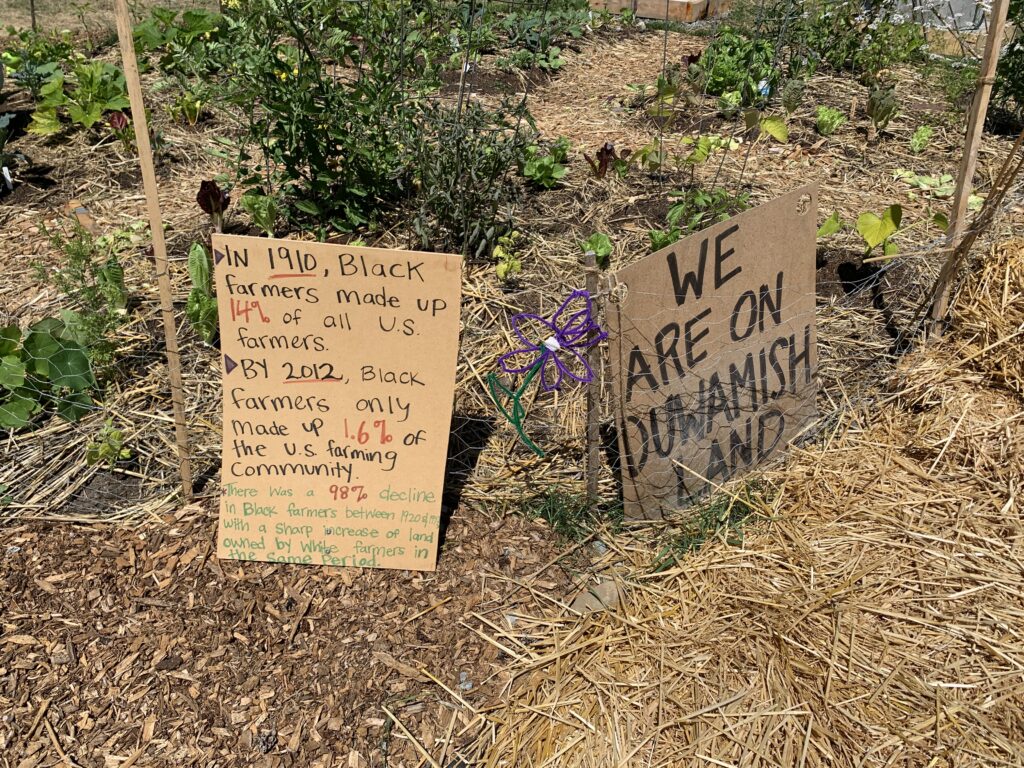
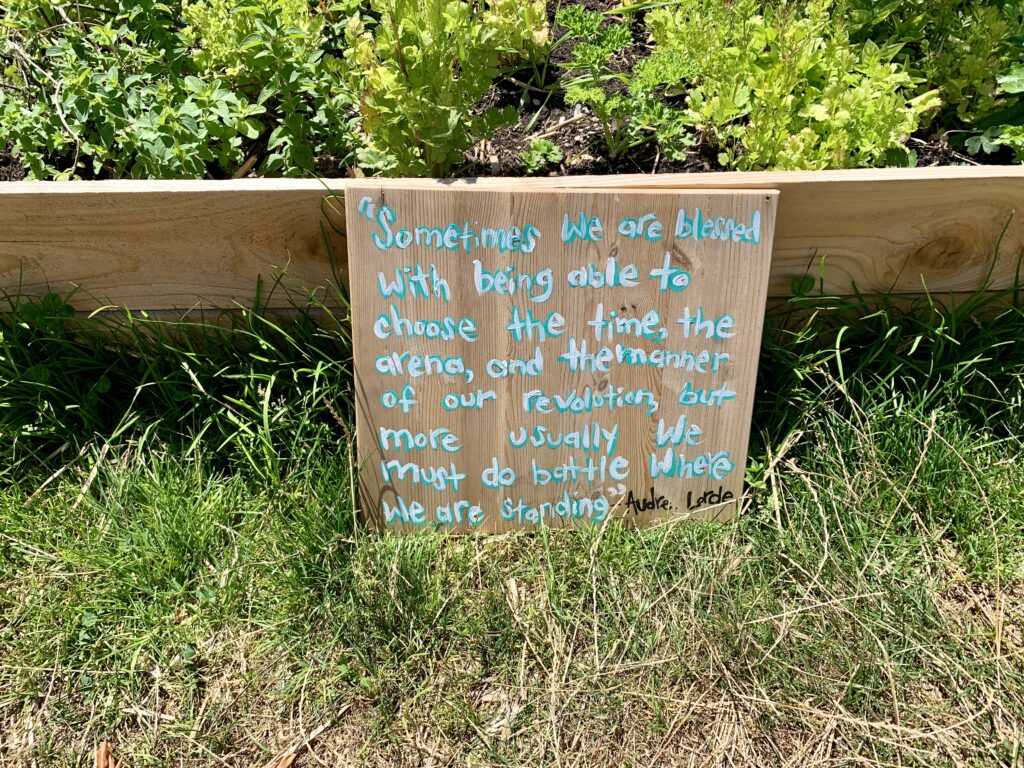
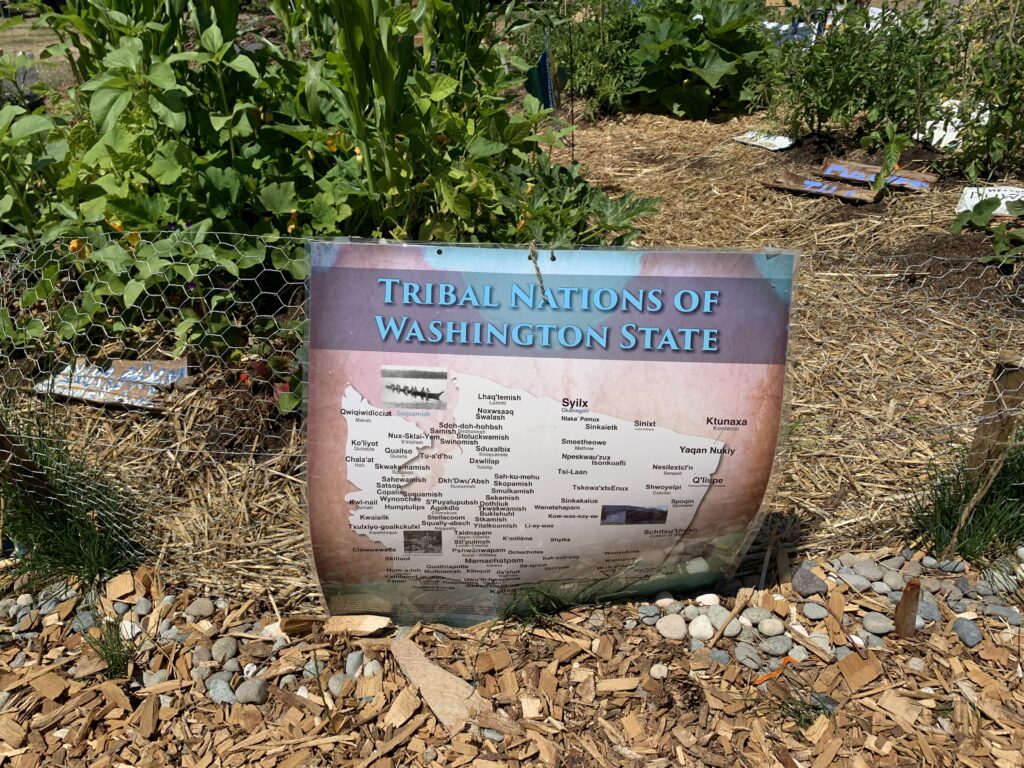
July 18 I went back for another look at the site of CHOP and found it was a large garden in Cal Anderson Park sponsored by Black Star Farmers. They have grown a lot of vegetables all with volunteer help. When I was there they were rinsing kale leaves to donate to a community kitchen for unhoused people.
In addition, there is a lot of historical information, homages to victims of police violence and reminders that we are on indigenous land.
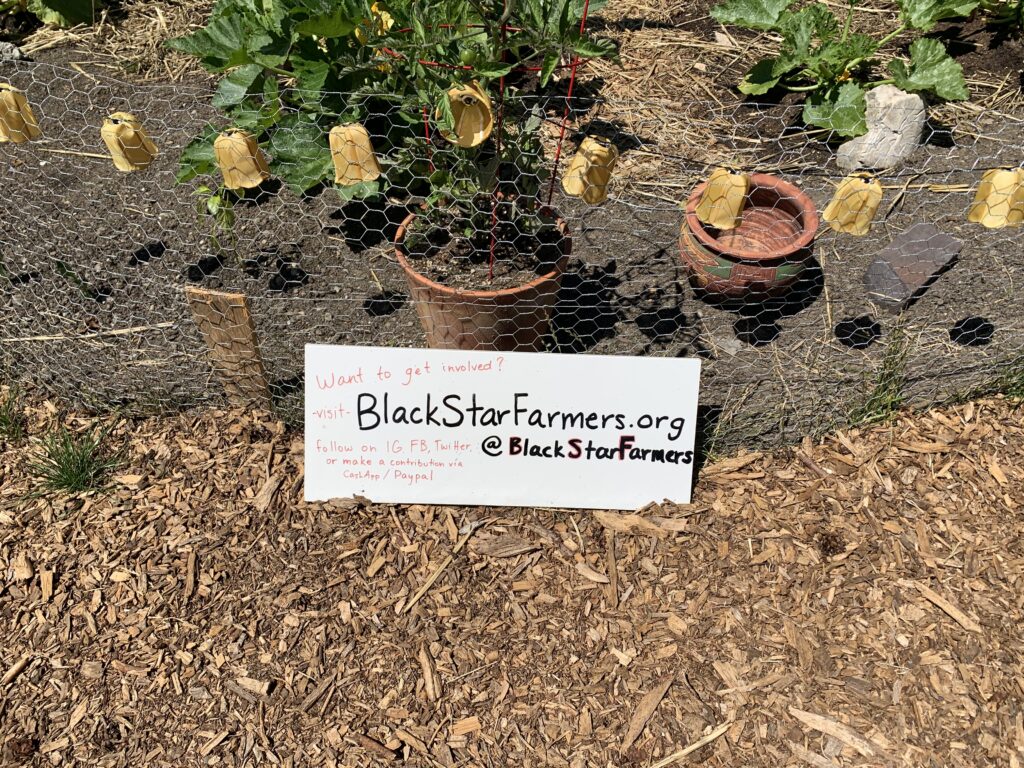
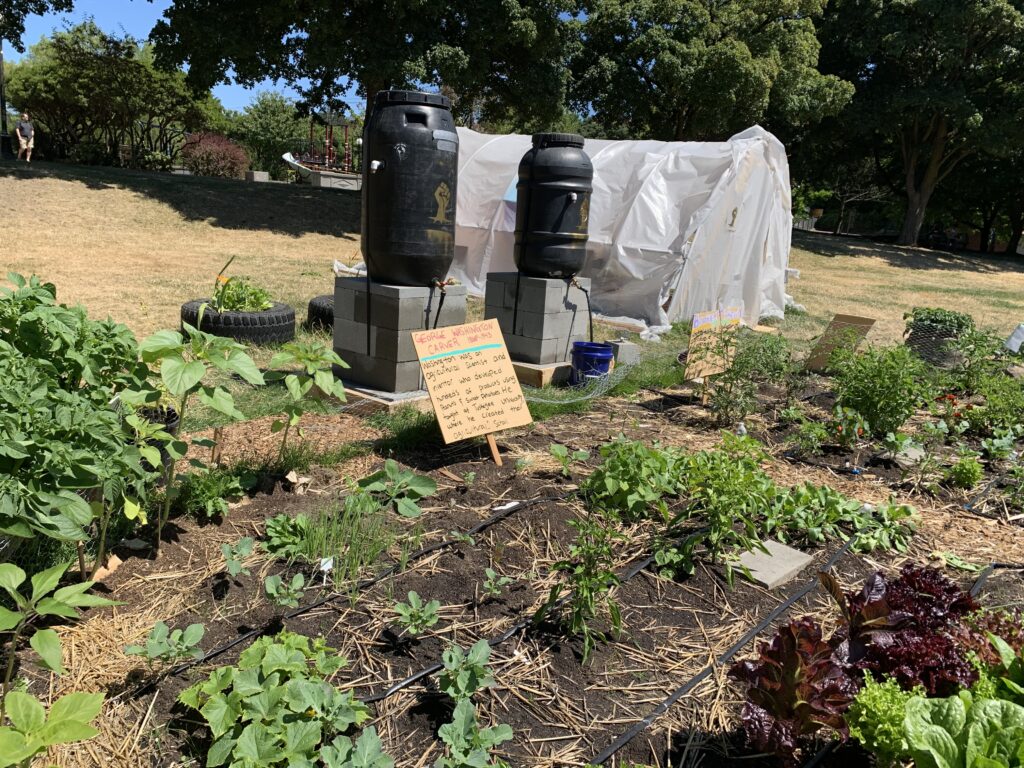
Homage to George Washington Carver, original brilliant agriculturist at Tuskegee
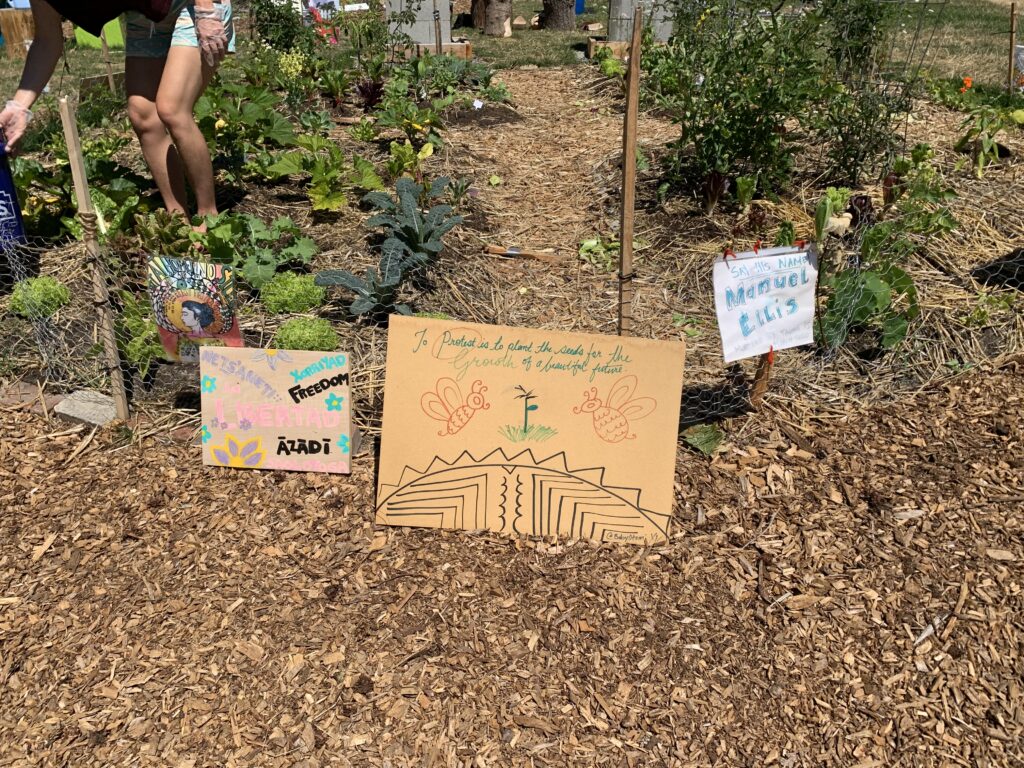
Note Manuel Ellis sign on the right, he a focus in Naomi Ishisaka’s column today in the Seattle Times about how police reports can be fabricated.

This entry was posted on July 18, 2020 and is filed under Uncategorized.
A Sunday Trip to the Olympic Sculpture Park
Taking a break from the heavy news and politics, we take an”expedition” every Sunday in Seattle. Last weekend we went to the Wooden Boat Center and went rowing. This Sunday we went to the Olympic Sculpture Park.
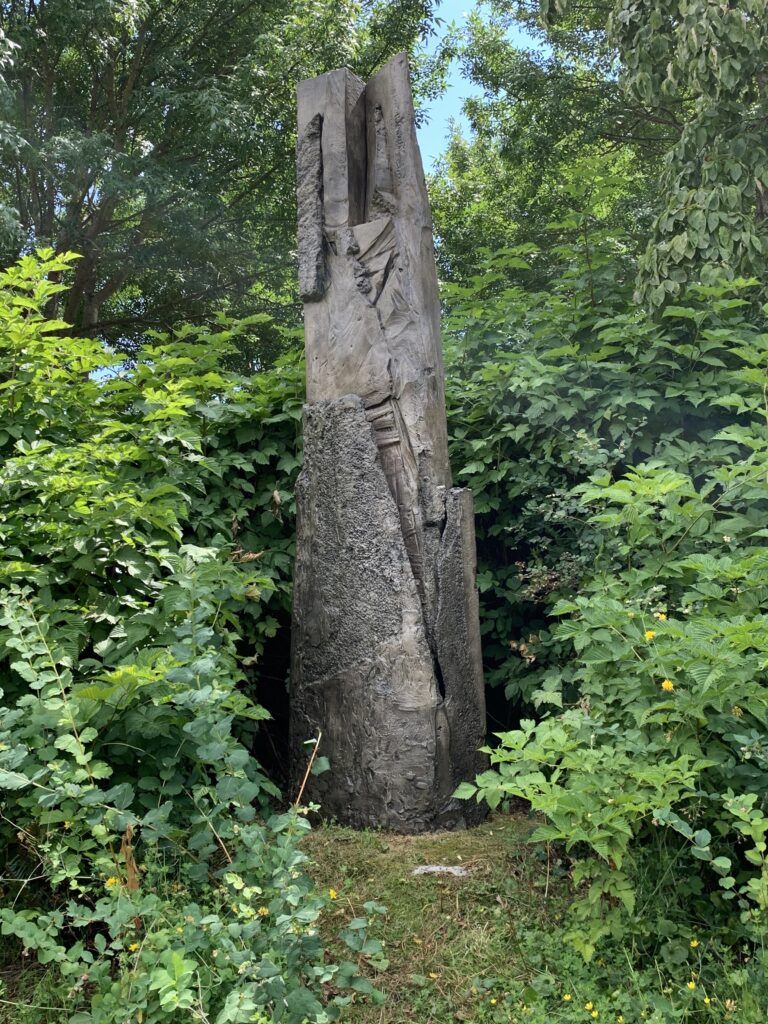
Here is Beverly Pepper’s Persephone Unbound. 1999. “The abstract language of form that I have chosen has become a new way to explore an interior life of feeling …I wish to make an object that has a powerful presence, but is at the same time inwardly turned, capable of self-absorption.” Beverly Pepper just died on February 5, 2020 in Todi Italy at the age of 97.
We haven’t been back to Sculpture Park for quite a long time, and it is stunning to see how much the vegetation has matured. Of course the art is almost all white modernists, but it looked great there, and it marks the extraordinary generosity of Seattle’s culture supporters. Hopefully SAM will be planning to diversify the artists as soon as possible, given the new awareness of the need to do that. There is one Latinx artist, Teresita Fernandez who created a glass bridge ( which is very hard to photograph), and all the signs included Lutshotseed and native practices.
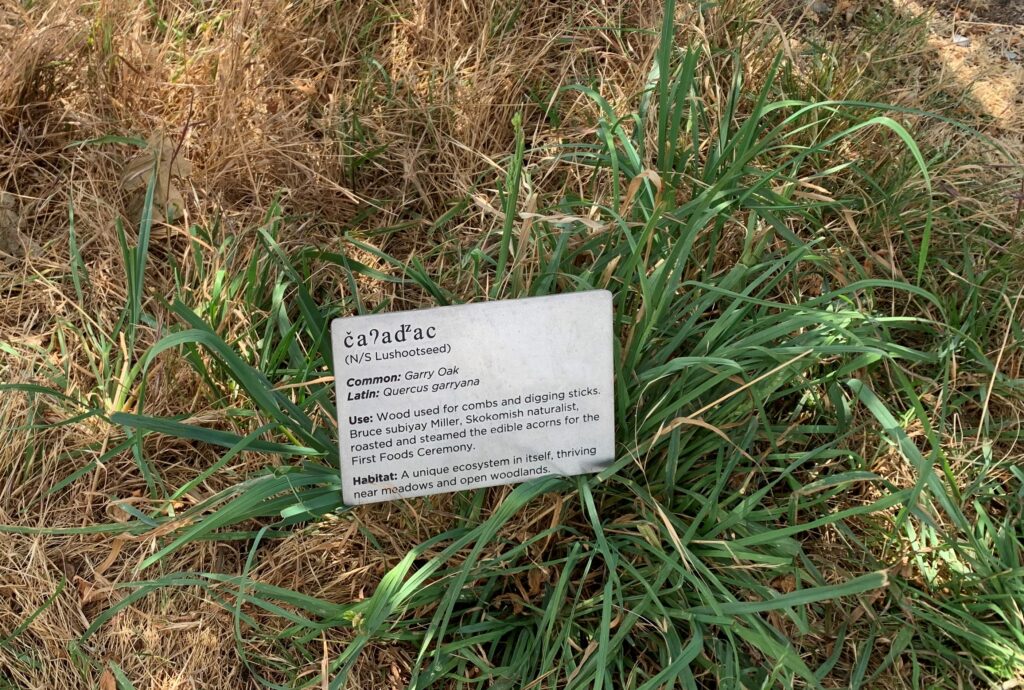
The extraordinary accomplishment to take a derelict toxic waste site on a steep hillside that is crossed by a highway and a train track into an uplifting green space in the center of the city is to be honored. The museum literally moved mountains to create it. So here are a few images, just to inspire you to visit.
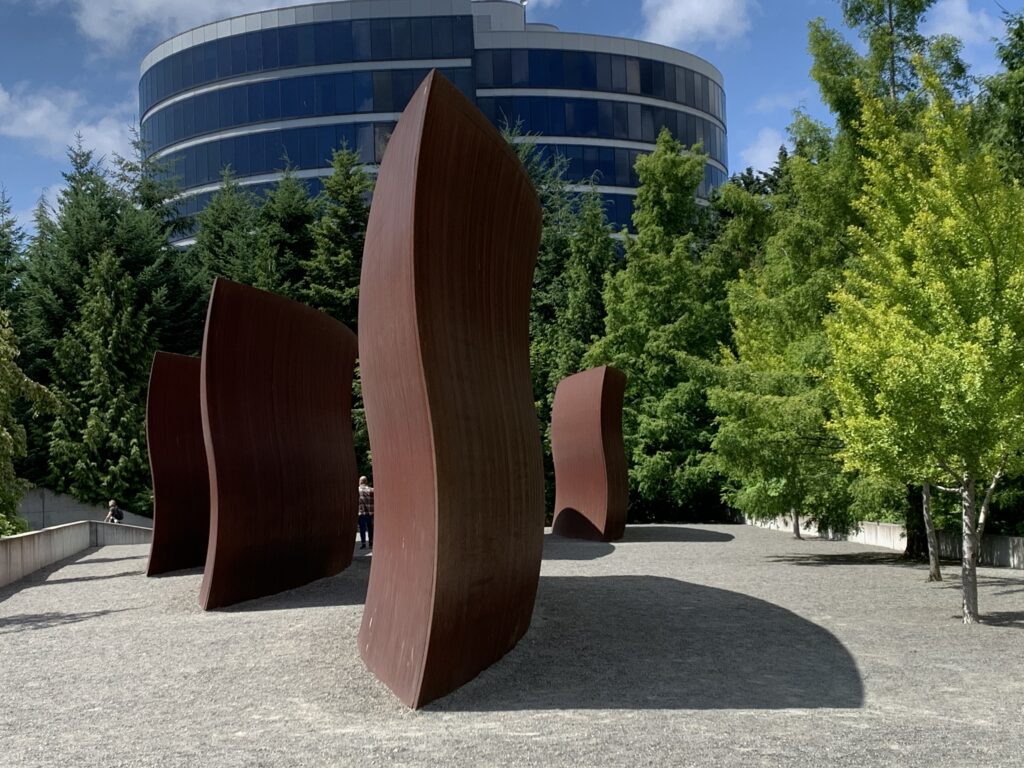
Richard Serra’s Wake 2004 This piece by Serra evokes giant ships going through the sea. It is of course overwhelming, but I certainly like this installation, compared to some of his work in public places. He has a working class background and grew up around a waterfront in San Francisco, where his father worked in a shipyard, so he has a connection to this subject. I met Serra years ago, when he installed a piece called One Ton Prop, House of Cards, at the Rhode Island School of Design, where I was part of the curatorial staff. It was traumatic because the House of Cards fell down, each “card” was 500 pounds!
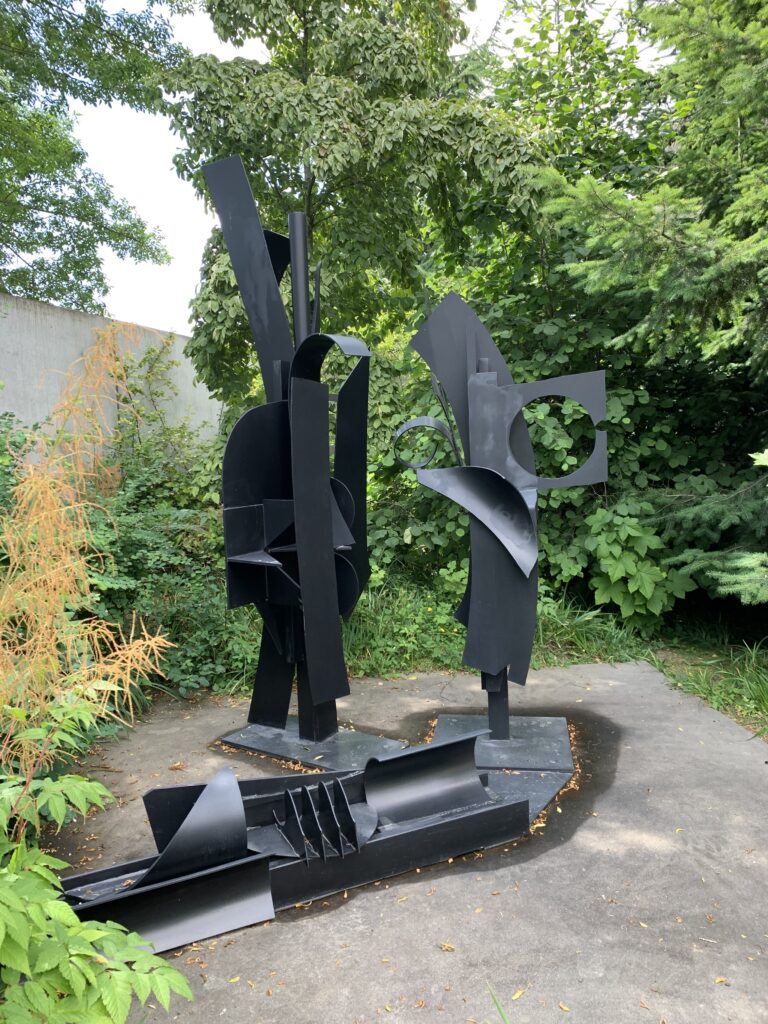
Louise Nevelson’s Sky Landscape I 1976 – 83 sits in corner of the park with now a lush background. We really enjoyed this piece and thinking about Nevelson. She was such a distinctive presence in her later years with her triple false eyelashes. This piece is distinctly different from what she is mainly known for. But it is black. She says “I fell in love with black; it contained all color, it wasn’t a negation of color …blackis the most aristocratic color of all … you can be quiet and it contains the whole thing.”
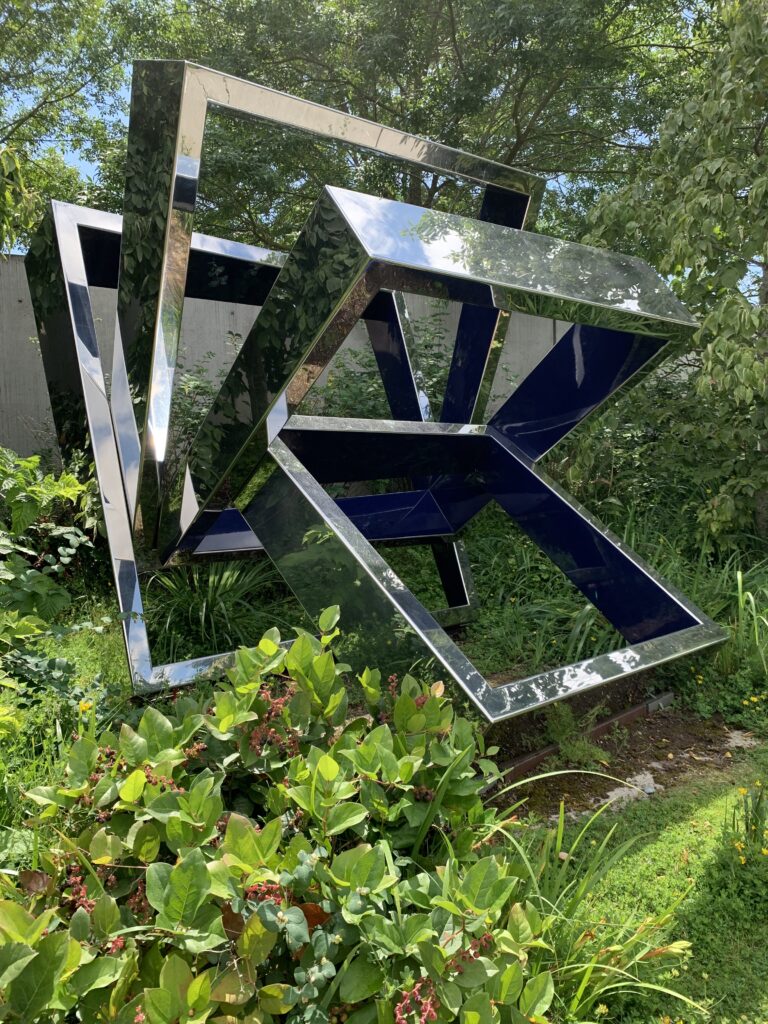
Here is another work by Beverly Pepper Perre’s Ventaglio III 1967 from her earlier phase, more angular, but still provocative: she said “the idea is that from whatever angle you view it, the voids seem filled and the solids seem empty.
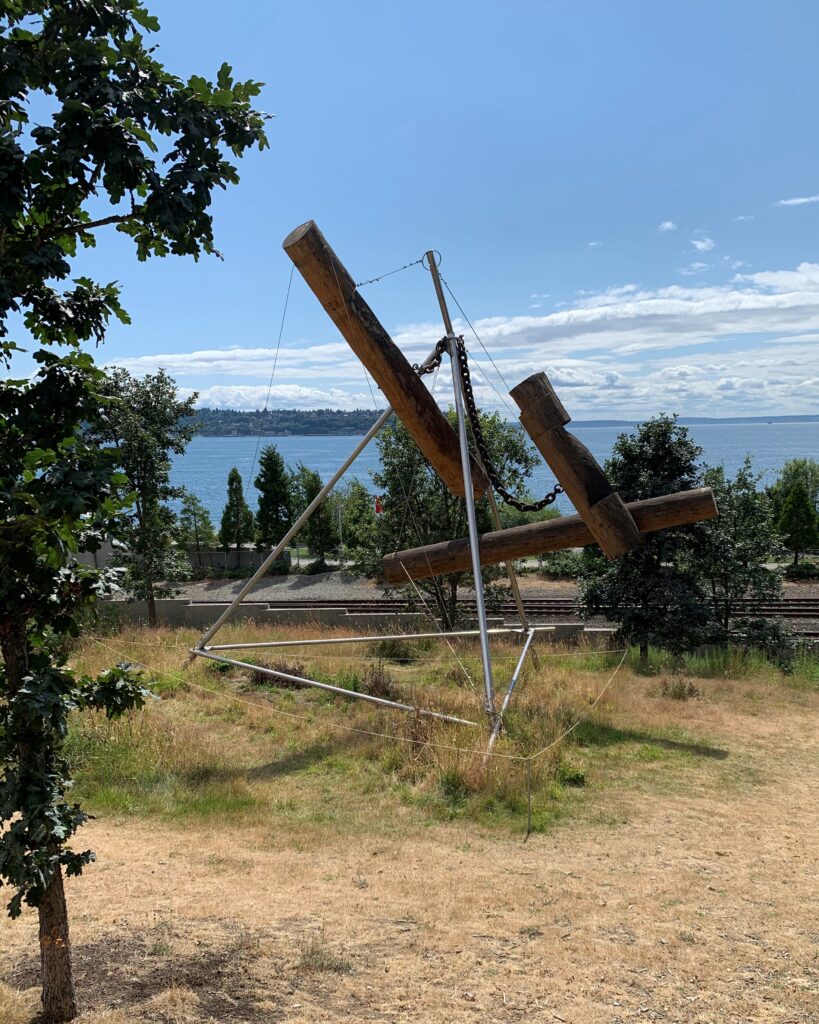
Mark Di Suvero Bunyan’s Chess 1965 “Unity and joy. That’s why I like to suspend elements from the beams of my works, so they can interact with the wind and other forces.” I love this work with its great chunks of wood. Di Suvero had an accident early in life and was disabled but never stopped making sculpture.
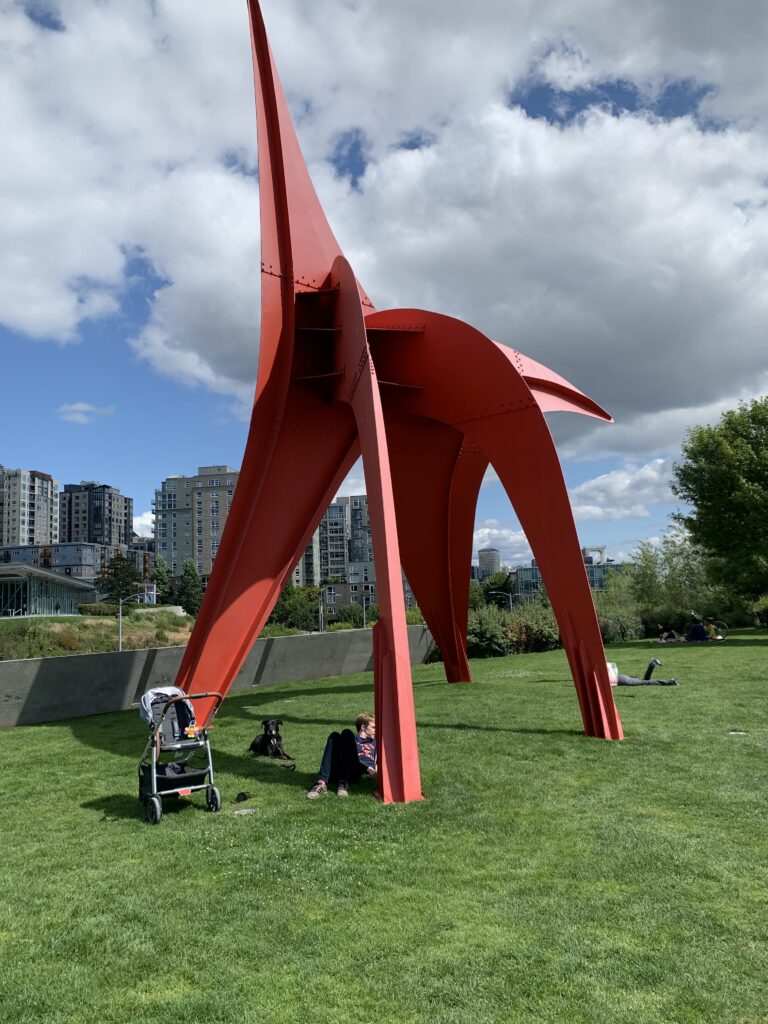
Alexander Calder Eagle 1971, the icon of the park needs no explanation.
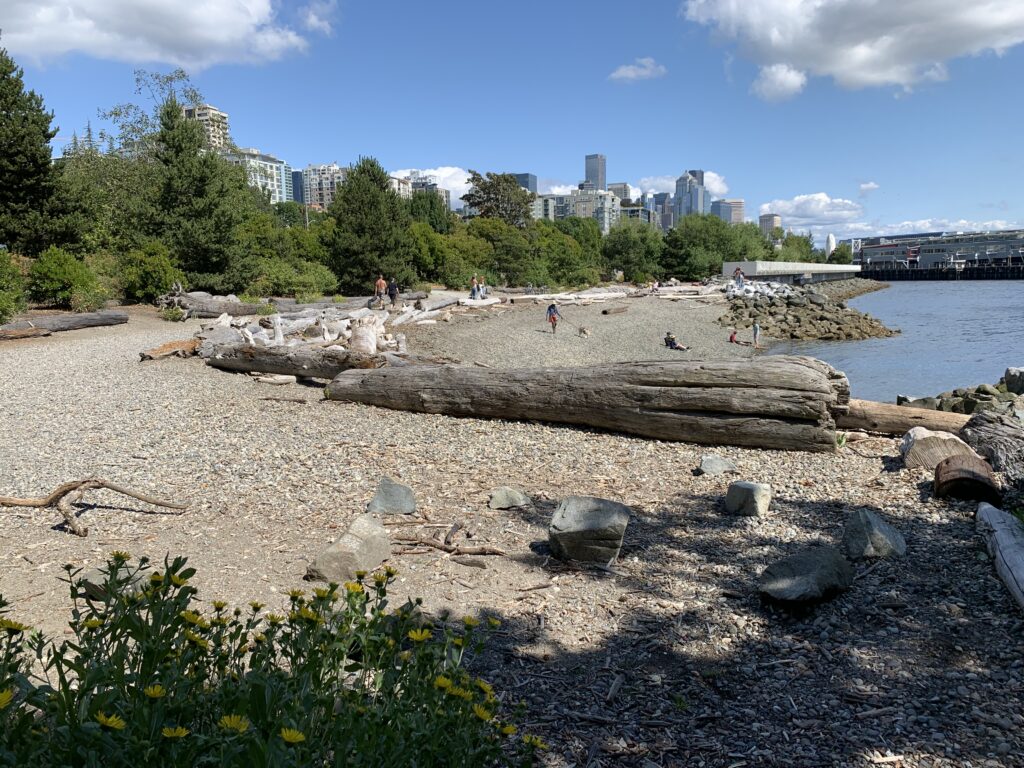
The shoreline is intended to be a safe place for young salmon to grow up. I don’t know if that is successful or not. It apparently has an undrwater bence for near shore habitat. The pocket beach was created by means of excavation, driftwood, beach grass and pines.
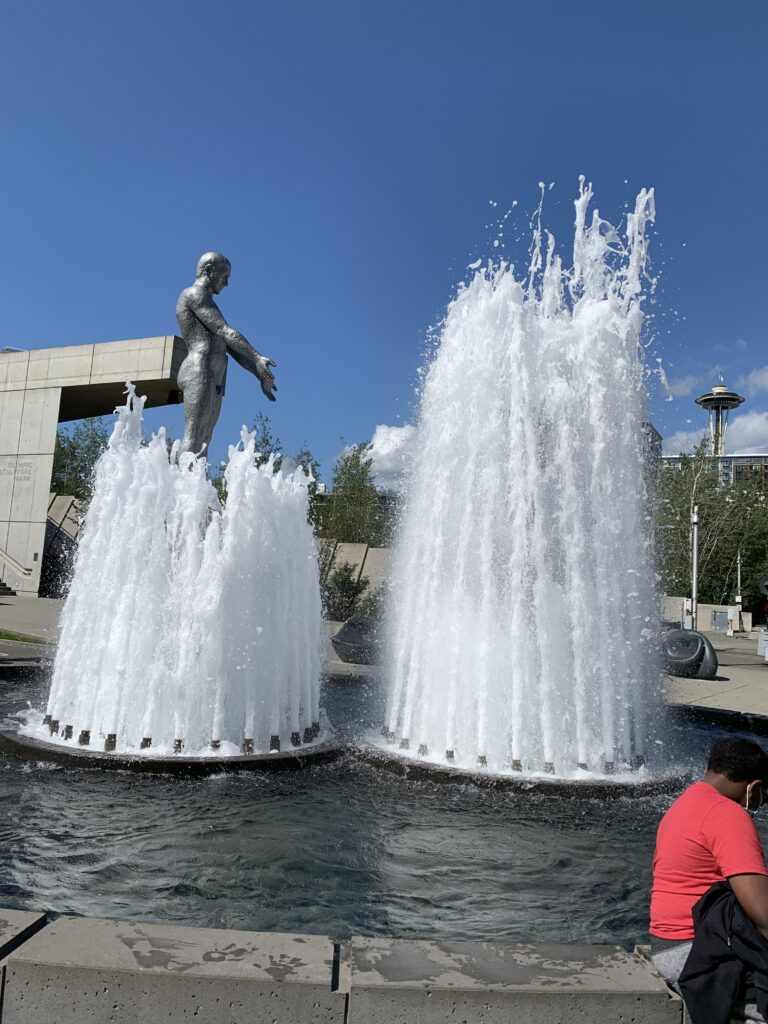
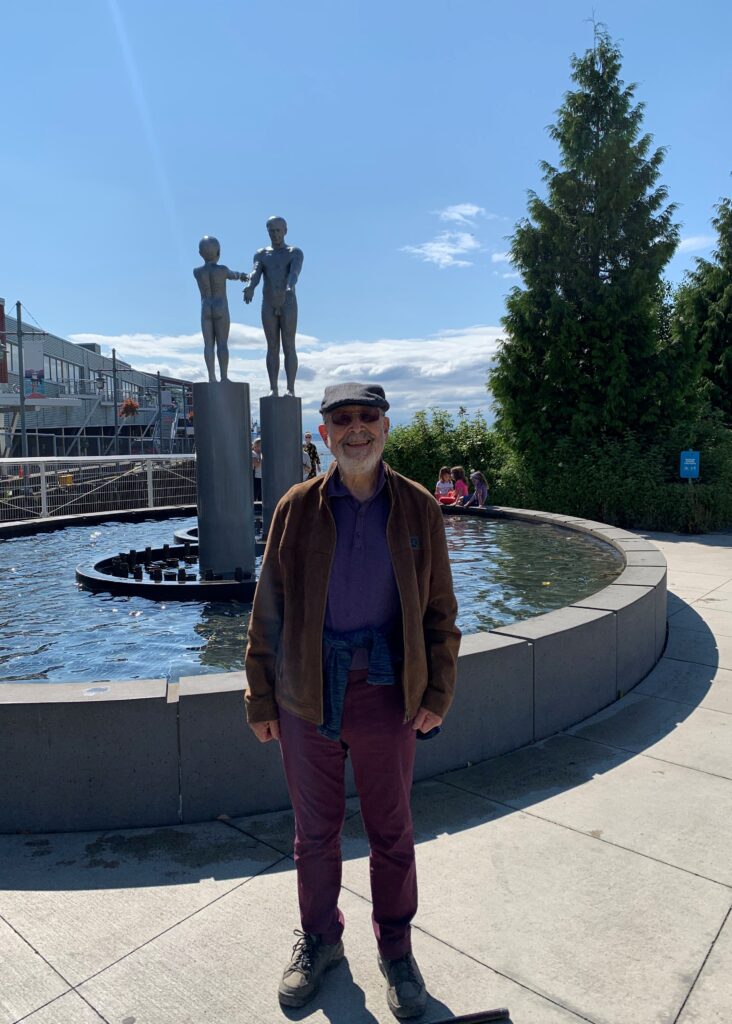
Louise Bourgeois sculpture Father and Son 2004-2006 at the South end of the park is another iconic work as well as her chairs.
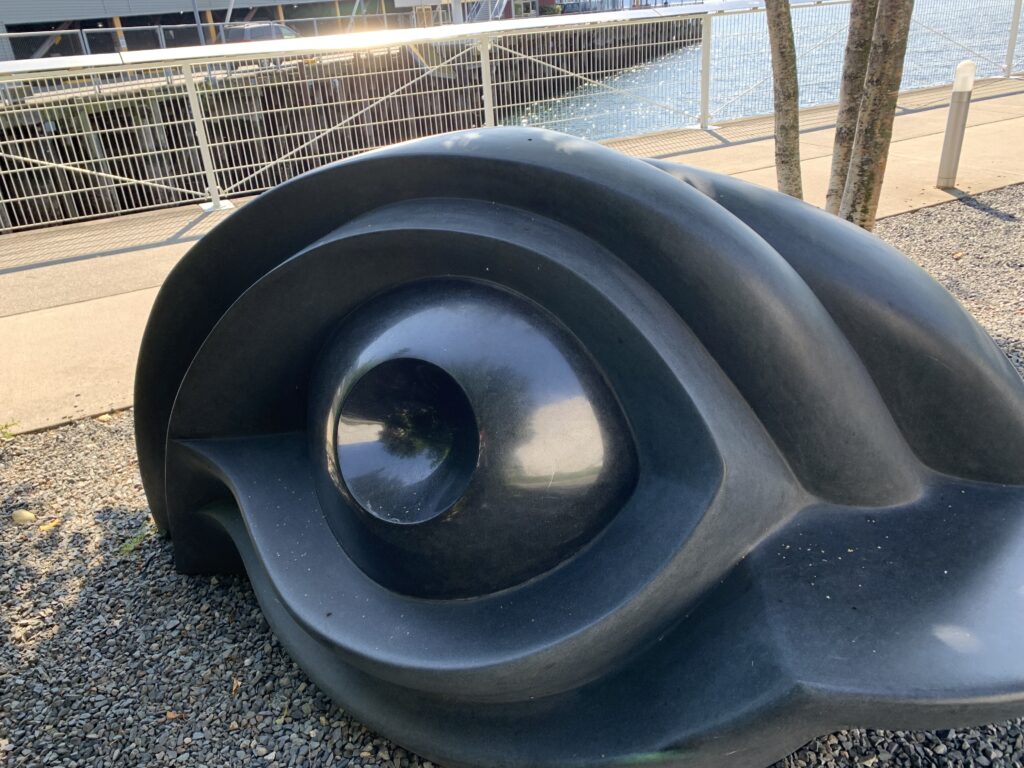
Of course, there is a lot more sculpture that I didn’t include here. I suggested to them to install the boxes from CHOP here! Wouldn’t that be a great change of pace. There is also the Vivarium by Mark Dion, which was closed. I always felt that they should have asked Buster Simpson to do a piece there instead. He has been doing sculpture that incorporates natural process for decades. And now of course there are lots of new approaches to public art. The pavillion that is a changing installation site for large projects was also closed. And we somehow missed the Anthony Caro! But it was a great Sunday.
This entry was posted on July 13, 2020 and is filed under Uncategorized.
Occupying the Northwest African American Museum
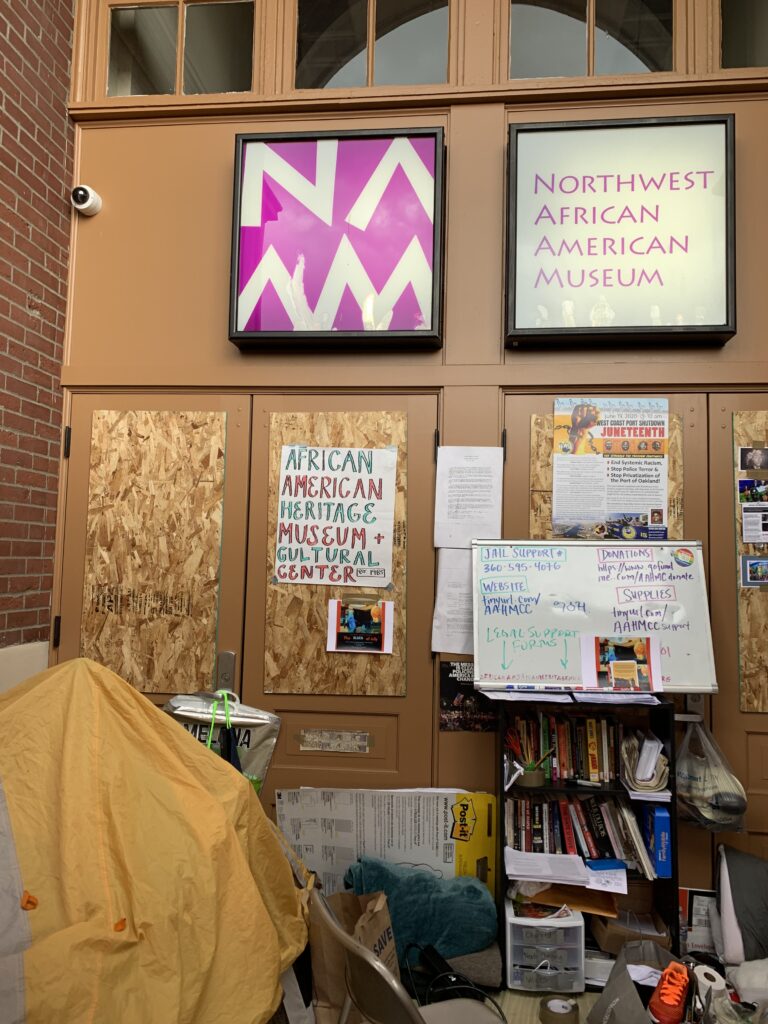
The Colman School, site of the Northwest African American Museum, has been occupied since Juneteenth by Omari Tahir, Earl Debnam, and others to declare that they are the rightful owners of the property based on a purchase agreement and loan agreement from January 1998, a copy of which they provided to me. Tahir and Debnam were involved in the original occupation in the 1980s and 1990s.
They state that they are the “real museum” with the name of African American Heritage Museum and Cultural Center. They have a report from the Mayor in 1994, that was Norm Rice, outlining the programs for the museum that included a visual arts center, musical center, artist in residence program, intimate performing/workshop space, practice space, instrument library, and a recording studio.
They state that the current museum does not fulfill these intentions and it is not “supporting the community.” They occupied the school for amazing 13 years between 1985 and 1998 during which they created an exhibition of displays of African artifacts that Omari brought from Africa, they “led workshops, held concerts, engaged with youth to be proud of their heritage so they would not turn to the streets.” That was a huge motivation for both their original occupation and their current occupation: as shootings of black youth continue to escalate, their desire to connect to youth through African heritage is remotivating them to continue their campaign.
So what happened to their plan? You may recall that Omari’s son, Wyking, then identified as Kwame, staged an intervention at the opening of the museum to call attention to this project. Apparently the original board had members who opposed the African American and Heritage Museum and Cultural Center as conceived by the occupiers. The group were evicted and all the displays were taken away and never reappeared. Then the building was sold to the Urban League, in spite of the purchase agreement that had been signed.
After many more years, the current Northwest African American Museum opened. I asked the occupiers what the NWAAM response to the occupation had been. The chair of the board called the police to evict them three times, but the program director has, according to their account, been more amenable to listening.
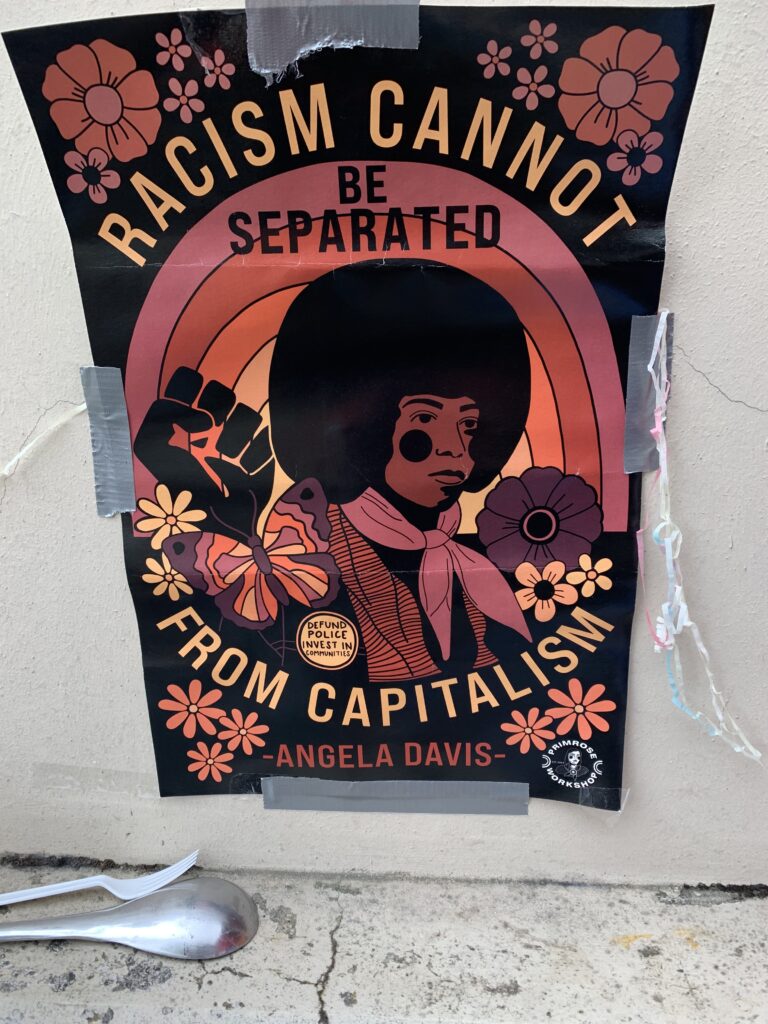
Clearly some new programming is not enough to satisfy the occupiers, but it seems to me to be a starting point as a resolution. Personally, I find that the NWAAM is a positive presence in our community. Their focus has not been music, which is clearly an aspect of the lack of connection to the community in the opinion of the occupiers, ( 5 of 7 parts of their original program concern music). As far as other parts, like a Visual Arts Center, their complaint is the absence of a connection to Africa. But of course we do have the fantastic Seattle Art Museum collection and curator. An artist in residence program is a great idea if they get the funding. The James W. Washington House had an an artist in residence program that was incredibly successful while the funding and direction lasted.
So I am going to simply report on this important event. It needs to be covered, there has been no press on it at all. Underlying the issues here is class conflict, between elites and ordinary people as well as between middle class liberals and radical left politics ( Omari participated in the occupation of Centro de la Raza and Discovery Park with Bernie Whitebear and the Gang of Four). Also there is the legal issue based on the purchase from 1998, that was prevented from being completed.
Museums all over the country are hopefully examining their elitism right now. Black Lives Matter certainly has opened up awareness that ALL museums suffer from elitism, whitism, and lack of connection to ideas for connecting to community in a way that can address mitigating violence, gangs, and drugs in the streets. If Police departments were defunded to provide more money for community, this is one direction it could go.
My good friend Georgia McDade sent me an article outlining how black creatives perform for white audiences, white cultural power structures. That is definitely something to think about here. Is NWAAM partipating in that? I don’t think so. In fact the white power structure of Seattle’s cultural community has not embraced the museum and its programs as anyone can see if you attend a program there. The same is true of the Wing Luke Museum in the International District. Segregation is alive and well in Seattle culture, even as the Central District fights for its identity as a center of black culture in the midst of rapid gentrification. Africatown is resisting this process. So are these occupiers, ironically, as they protest the “gentrified” NWAAM departing from their vision.
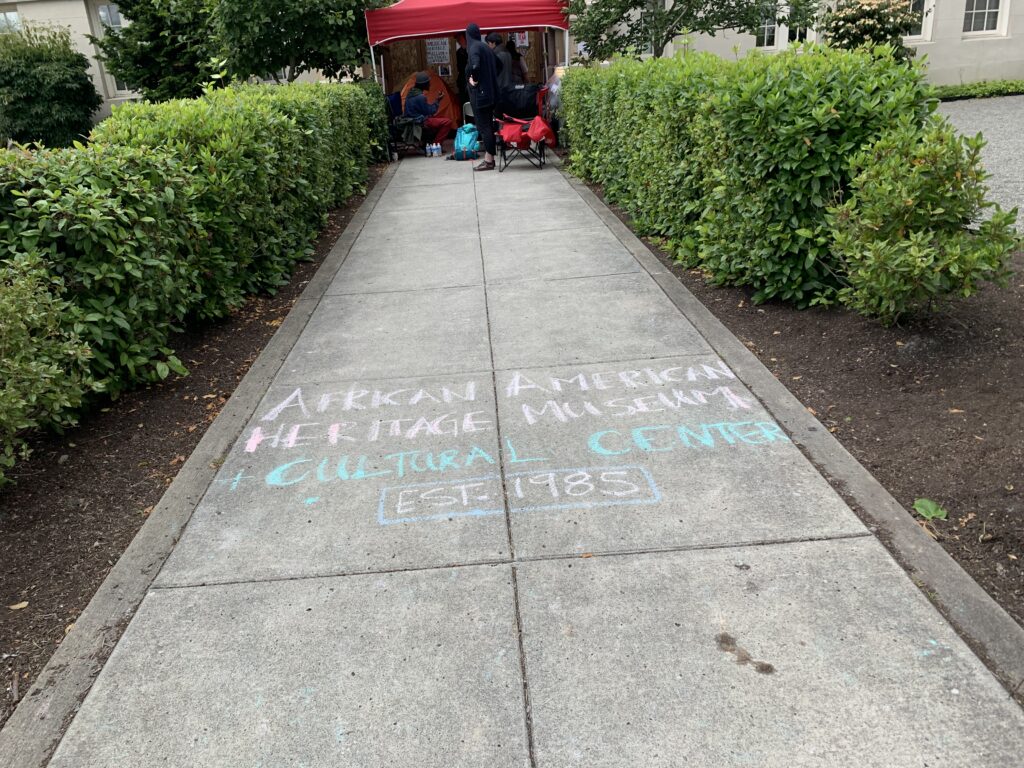
This entry was posted on July 7, 2020 and is filed under Uncategorized.