Ruth Asawa Sculptor of Space in three books

Ruth Asawa: Sculptor of Space
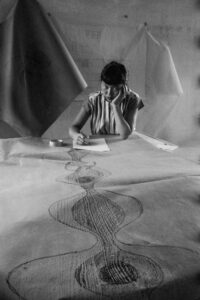
Ruth Asawa had an extraordinary childhood. In her early years she grew up on a farm with her immigrant parents, sharing in the hard work.
That idea of hard work stayed with her throughout her career as an artist. In April 1942, when she was sixteen her family was sent to a detention camp, first at Sant Anita racetrack, then Rohwer Camp in Arkansas. At the Santa Anita camp she had the fortune of learning from three Asian American artists for Disney.
After she graduated from high school in the Rohwer camp in August 1943, she was allowed to leave as long as she stayed away from the West Coast. She went to Milwaukee State Teachers College,
After learning she could not teach, she had the opportunity to go to Black Mountain College the experimental interdisciplinary arts school. It changed the course of her life.
These are some of the details with which Marilyn Chase begins her book , Everything She Touched, The Life of Ruth Asawa..
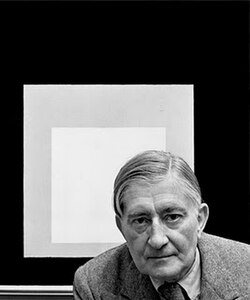
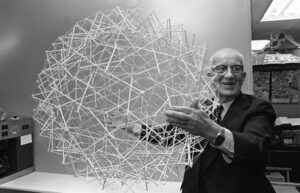
Chase carefully describes the artist’s unusual education at Black Mountain College, her study with Josef Albers and Buckminster Fuller, her love affair with Alfred Lanier, and her move to San Francisco to start her family and her career. She was life long friends with Albers and Fuller.
Chase’s book is an easy read and it includes a continuous narrative that focuses on her professional activity and her personal life, much of it based on letters.
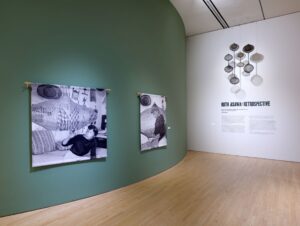
Asawa’s woven wire sculpture were embedded in her home. In the current retrospective exhibition at the San Francisco Museum of Modern Art, photograph of her living room in front of a partial recreation of the space. We see her sculpture hanging from the ceiling throughout the huge space.
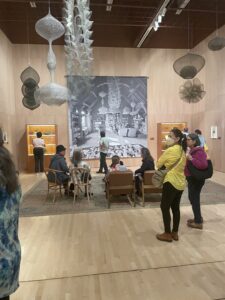
She welcomed her children to be part of the creativity,: a baby sitting in a wire basket as Asawa wove around him, and her other children pursued their own creative endeavors as she worked. Shw was photographed by Imogen Cunningham, her dear friend, many times.
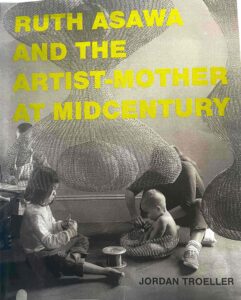
Jordan Troeller Ruth Asawa and The Artist-Mother at Midcentury emphasizes the ways in which Asawa, together with other what she calls “artist-mothers” managed to produce extraordinary art as they were raising children. Troeller’s focus is to combine motherhood and creativity (she leads a research group on “The M/Other Project: Creativity, Procreation, and Contemporary Art,”).
Ruth Asawa raised six children, defying the idea that having children prevents woman from making creative art. Various Asawa techniques such as weaving and knitting, connect to female traditions, Troeller suggests, because they enable the artist to start and stop as is necessary with children. Actually Asawa’s incorporation of her children into her art process defies that logic. Asawa’s work ethic and ability to embrace creativity as a generous gift, meant that she worked almost nonstop, with her children helping as they grew older.
Other chapters in Troeller’s bookfocus on flowers, folding, or
pregnancy, to name only a few, themes, integrating them with aspects of her work.
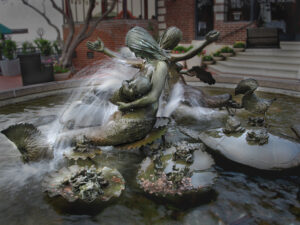
The best known image of pregnancy is the “Andrea” cast bronze public sculpture in San Francisco. I found the book a bit overboard in connecting everything to a feminist analysis- if she had not been so focused on motherhood, as metaphor and literally, her analysis would have been more useful. It is clearly, though, a feminist answer to patriarchal tropes and the parameters of making art as a woman.
As an art historian, I have to say that the large book accompanying her major retrospective at the San Francisco Museum of Art is comprehensive and invaluable. Janet Bishop, editor, Ruth Asawa: Retrospective, includes essay after essay that clearly follow a theme such as “From Tool to Ornament, Ruth’s Intricate Refusals,” and “What Cannot Be Produced Alone : Ruth Asawa’s Public Art.”
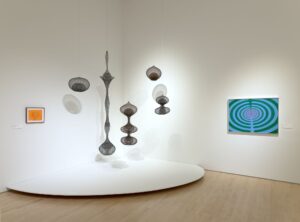
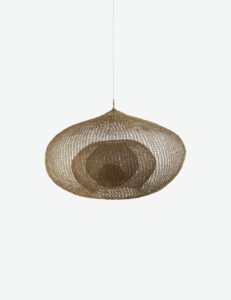
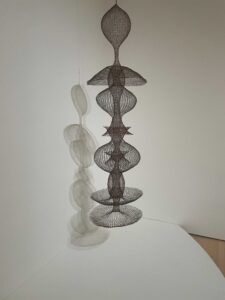
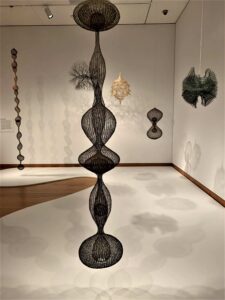
The exhibition follows all the stages of her art career, from single woven wire baskets to complex hanging sculptures enclosing one orb inside another. Then a new technique of tying wire, electroplating it,
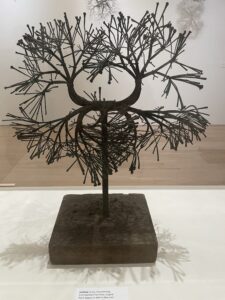 and much more. These dazzling hanging works are her best known work.

The complete discussion of her public art is also represented in the catalog and the exhibition, where we saw studies and photographs. The installation at the San Francisco Museum of Modern Art even included a sample of her garden.
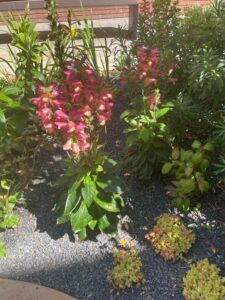
For Asawa, as we learn in this thorough study, Zen Buddhism was part of her world view, as well as nature itself. Her drawings of leaves and plants show her understanding of the intricacies of the natural world.
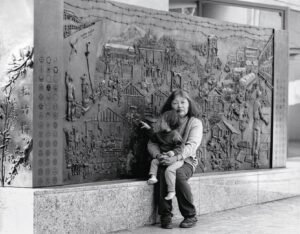
In the chapter on public art, bronze casting is a major departure, as well as the scale of the works she took on, a huge low relief of the Japanese Internments camps, a wall called San Francisco Fountain, with many small reliefs of life in San Franciso, and many more..
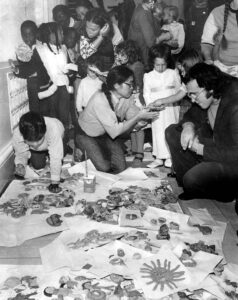
Her creativity also extended to schoolchildren, teaching innovative ways to make art with materials such as milk cartons, and “bakers clay” (flour, salt and water.)
Last, Asawa engaged with civic affairs, founding an art school, now called the “Ruth Asawa San Francisco School of the Arts,” and lobbying for more art education in the public schools.
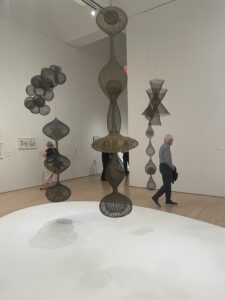
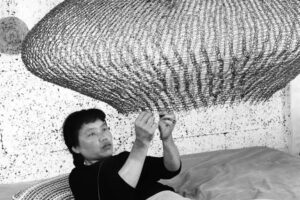
The magnificent sculptures that Ruth Asawa created hang in space, and surround space. They embrace interior and exterior, the delicate and the strong, the idea of growth and the idea of stasis. It is hard to overstate her contribution: her wire-based art, at first seen as simply decorative, is now understood as major accomplishments of twentieth century sculpture
This entry was posted on August 30, 2025 and is filed under American Art, Contemporary Art, Contemporary Asian American Art, Contemporary Sculpture by Women, Feminism, Uncategorized.
Arpita Singh : Remembering – at the Serpentine Gallery, London
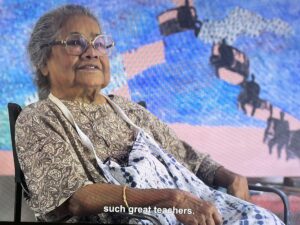
video still of Arpita Singh

Arpita Singh’s retrospective at the Serpentine Gallery in London gives us her career from the early 1970s to the present. It includes huge narrative oil paintings and small abstract watercolors.
I could feel the intensity in each work no matter what the style or size. Each viewer can find a different story here. I found a trajectory from calm but eccentric domesticity to political chaos.
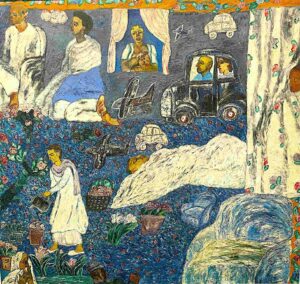
Munna Apa’s Garden 1989
As Munna Apa waters her garden, we see a dead man covered by a white sheet behind her and another figure fearfully peeking through a curtain on the right. Other people in the car and upper part of the painging seem oblivious, but in the center of the bottom we barely see a policeman- harbinger of things to come.
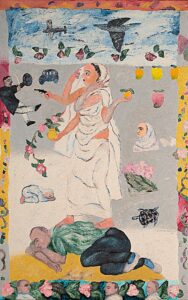 This painting “Devi Pistol Wali ” 1990 gives us a transition. A pistol in one hand and fruit in two others, this goddess is standing on a sleeping? man held up by three others. Small figures suggest a man with a sword, a car, a worshipping person, an airplane, a bird, and various other details.
The Devi ( Goddess) is dressed in white as a widow and pointing a gun at the small man with a sword? or just self protection.
It is easy to make a narrative out of these details
Only three years later she painted her iconic picture of her mother
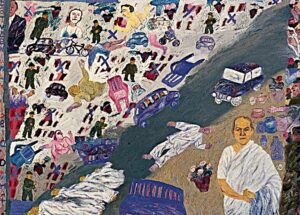
Following the destruction of the Babri Mosque in 1992, the mood of this painting is entirely different. Her mother stands stoic in the right hand corner, but there are dead people near her. Across a road is a lot of small figures : policemen, more dead people, chairs, cars and much more. So her mother stands against the chaos.
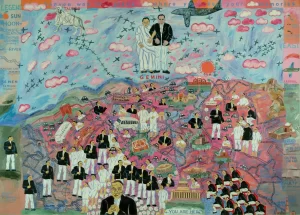
My lolliipop city: Gemini Rising 2005
this painting is hard to interpret. Gemini Rising suggests something positive as we see the couple in the sky, but the gathering crowd may point to something more ominous
Moving forward to increasing chaos
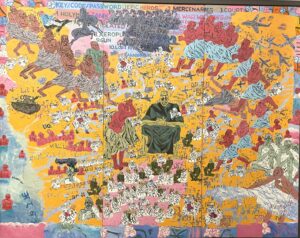
 detail
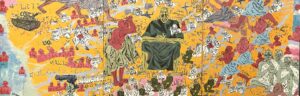
Whatever is Here, 2006 has a somber praying figure in the center surrounded by white praying men, but above him are two groups of aggressive fighters in dark red and light brown with a cavalcade of gray horses between them. Some of the red men are spilling into the praying figures

Searching Sita through Torn Paper Strips, Paper Strips and Labels, 2015
Sita is the wife of Rama who is kidnapped by Ravana, King of Lanka. In this extraodinary painy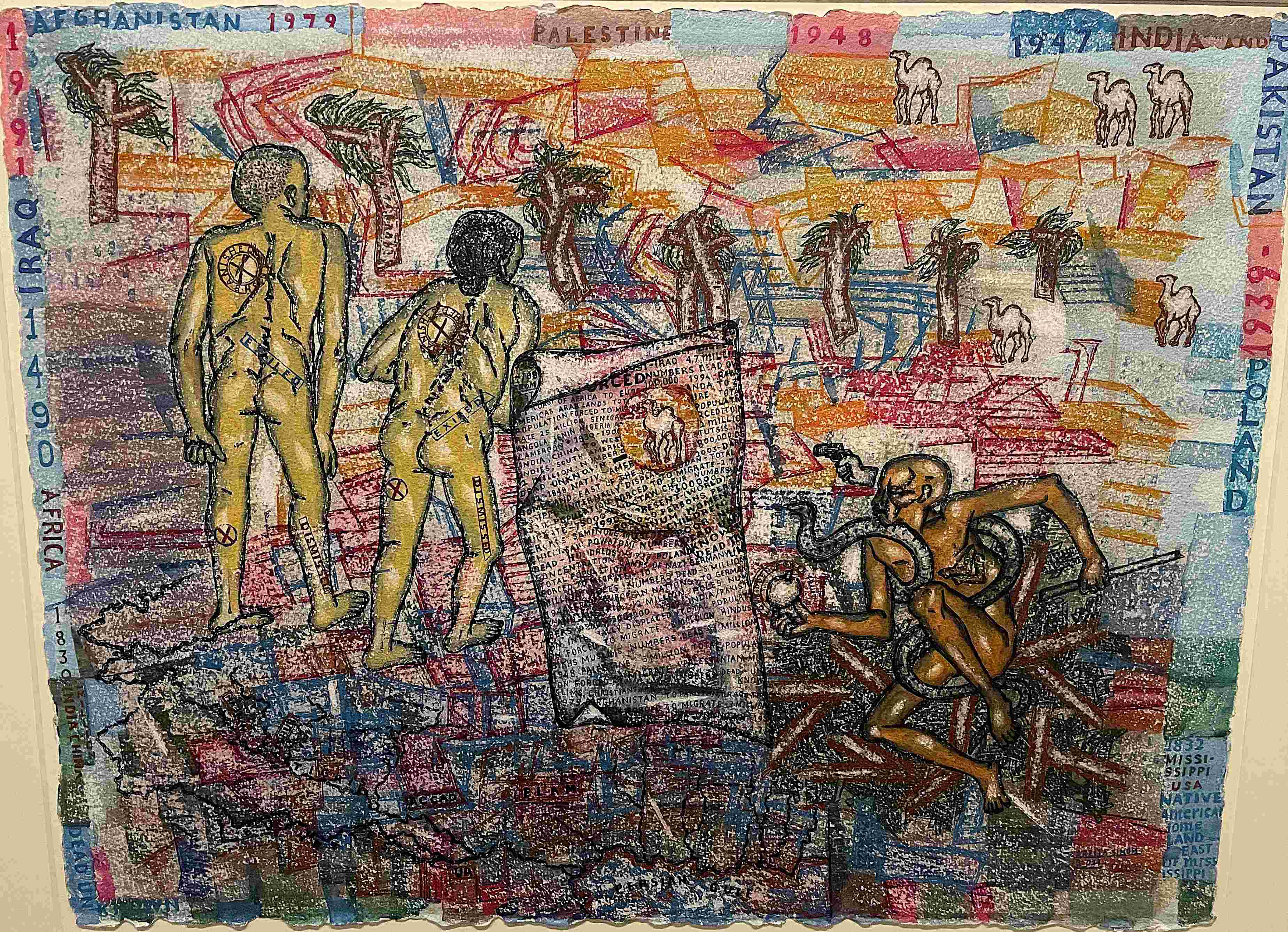 ing we see red deer in the center amidst a landscape of torn up letters. In the Ramayana golden deer distracted Rama as his wife was kidnapped.
Here we see an entire herd of red deer at the center
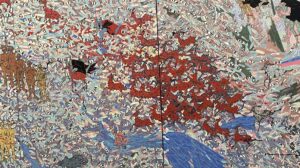
and a repeated image of capture with black covered people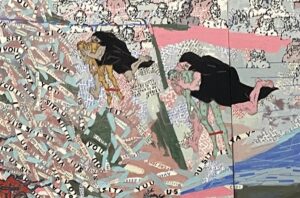
Also note the use of words in the backgoundL Sita repeated with other incomplete words
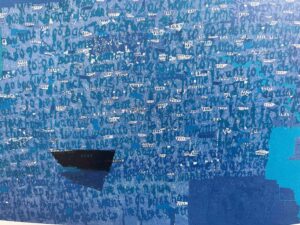

Homeward 2020

She has written boat over and over in a boat shaped white image
The date suggests wishful thinking in 2020, the year of the Covid shutdown, but this beautiful image is comforting if a little desolate
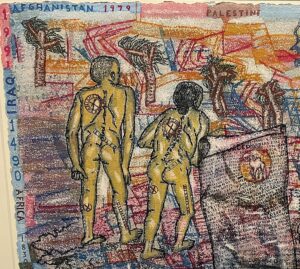
The Exile 2011 really states the deep problem: she names countries that led to refugees around the edge 1939 Poland 1947 India and Pakistan, 1948 Palestine,1979 Afghanistan , Iraq 1991, Africa 1990

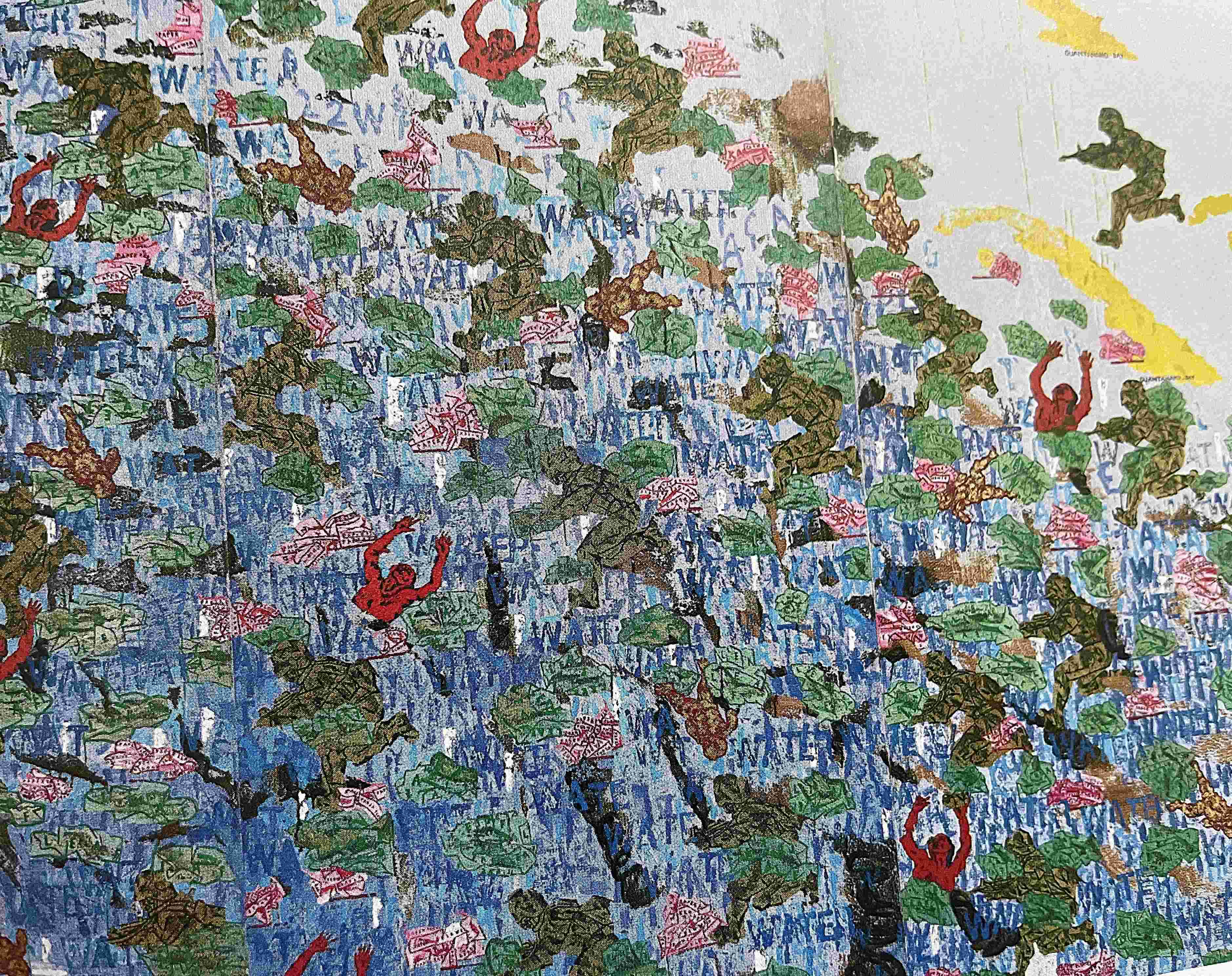
My Lily Pond 2009
This huge painting shows the soldiers overruning the water and a few desparate people raise thei hands as they drown.
What we see is an increasing move away from myth and towards reality. Although passages across the sea can be seen as allegorical, here the figures are very specific as is the writing.In the image of exile an even more heartfelt image suggests the tragedy of Forced departure. With the specific dates around the border we recognize that this is a global condition. I wonder if she is going to address the tragedy of Gaza.
Arpita Singh is a soothsayer and a truthteller embedded in complex and deeply felt images of our human condition.


This entry was posted on July 20, 2025 and is filed under art criticism, Art of Democracy, Uncategorized.
Hanaa Malallah : Ruins and Research
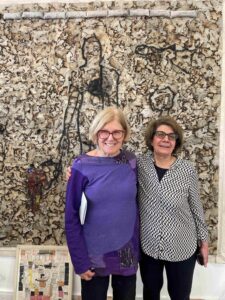
in front of Self portrait 2012 lower left bus tickets 1993 (during sanctions)
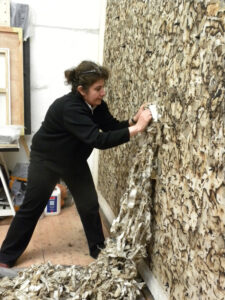
I first met Hanaa Malallah in 2007 just after she came to London from war torn Iraq. . Above you see her applying burned and shredded canvas to one of her works The burning of her canvas was her response to the nightmare of destruction she faced in Baghdad every time she walked down the street
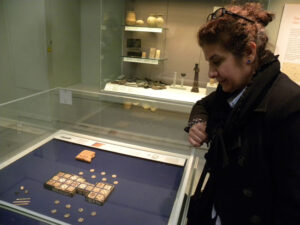
In 2007 we went to the British Museum and visited the art from Mesopotamia
Here Hanaa explains how the Royal Game of Ur was played
I returned to the British Museum on my recent trip
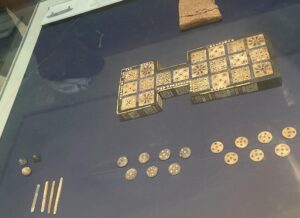
Games are a theme in Hanaa’s work. She is also knowlegable about mathematics and semiotics. So nothing is simple in experiencing her art. She speaks of the historical study of other symbolic systems. “Logic is elaborated by philosophy to examine ancient art”
In this statement she is thinking about Shakir Hassan al Said whom she studied with in Baghdad. He wrote her a series of letters in the late 1990s when he was living in Jordan and Hanaa was experiencing the severe sanctions in Iraq. She answered him in 2004 in the depths of the American attacks on Baghdad published in This Green is not Green,2021.
Both of the paintings below are complex references to those ideas
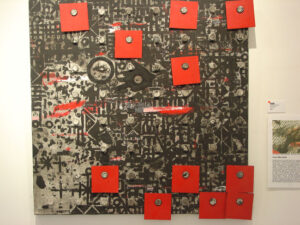
Ineffective Game 2006
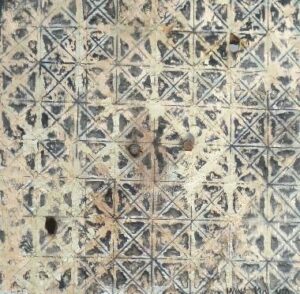
Sophsticated ways in the destruction of an ancient city 2006
Let us move to the present!
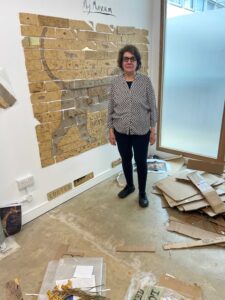
Hanaa May 2025
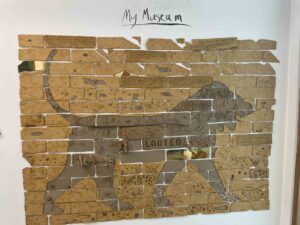

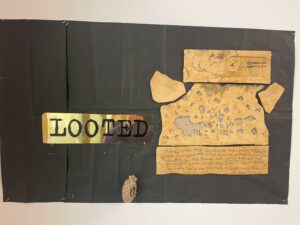
In our recent visit to her studio she showed us her new work. Above she stands in front of a lion of Babylon made of cardboard and labelled “My Museum” In the middle printed on a brick shaped form is the word looted .” We saw another replica of this lion in the British Museum, the label said the original had been moved to Berlin.
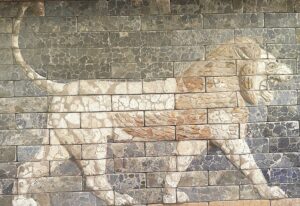
That is where the Ishtar Gate and other artifacts from Babylon were taken after being stolen from Babylon by the 19th century archeologists. In the 20 th century American archeologists built a structure on top of Nufur using mudbrick slabs from the site with cuneiform inscriptions!
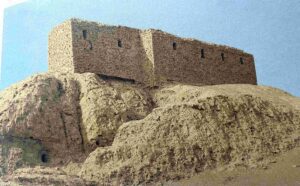
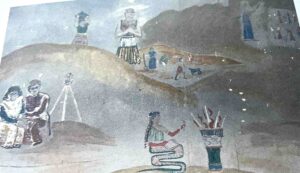
They painted the walls with a crude mural of current archologistts at the site mixed with goddesses.
Another project based on archeology is “Co-Existent Ruins “Exploring Iraq’s Mesopotamian past through contemporary art.”
 She invited seveal contemporary artists to go to Ur, Nirud
and Nufur and interact with them in various ways
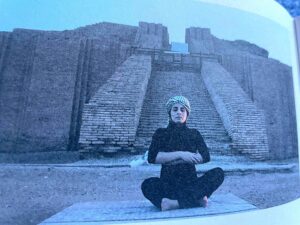
assuming pose honoring the famous ruler Gudea of Lagash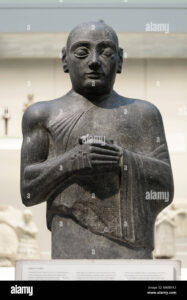

At Nimrud, destroyed by ISIS, locating a remnant ( a hand) of original Assyrian monument. (video still) These intersections with contemporary artists explore
“the critical question of how contemporary collaborative art projects can enable a renewed engaaagement with this ancient heritage and history”( Quote from brochure “Co-existent ruins, Exploring Iraq’s Mesopotamian past through Contemporary art”
She wrote for another exhibition brochure
“My practice addresses the difference between the remains of a Civilization (Ruins) in contrast with the remains that are precipitated by human destruction and armed conflict ( (Rubble)
My work reflects upon my own experiences in Iraq, I postulate that the region embraces both Ruins and Rubble. Ruins of the remnants of Mesopotamian archaeological sites, that position themselves as a constant “time travel”, the physical evidence of a society long past, yet still holding deep connections to our present and future. By contrast “Rubble” that is the palpable outcome of lethal effects of war chaos and human destruction indicating a loss of culture and identity.
These small objects of mine will suggest I am concerned with tackling the possibilities for addressing ruins and rubble as a new aesthetic that attends to this history, the latent power of ruins in the present as that which might provide for a new relation between past and present”
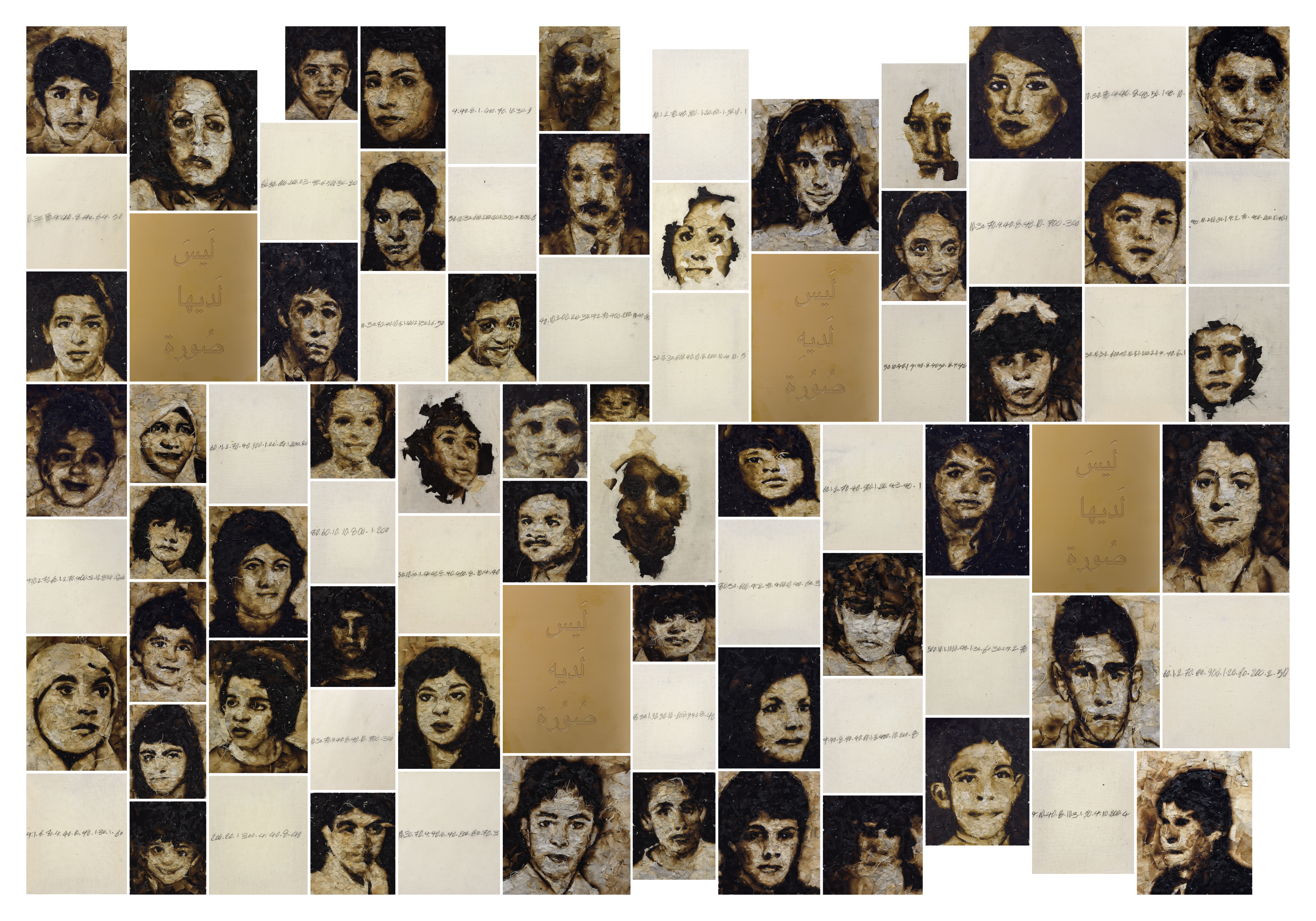
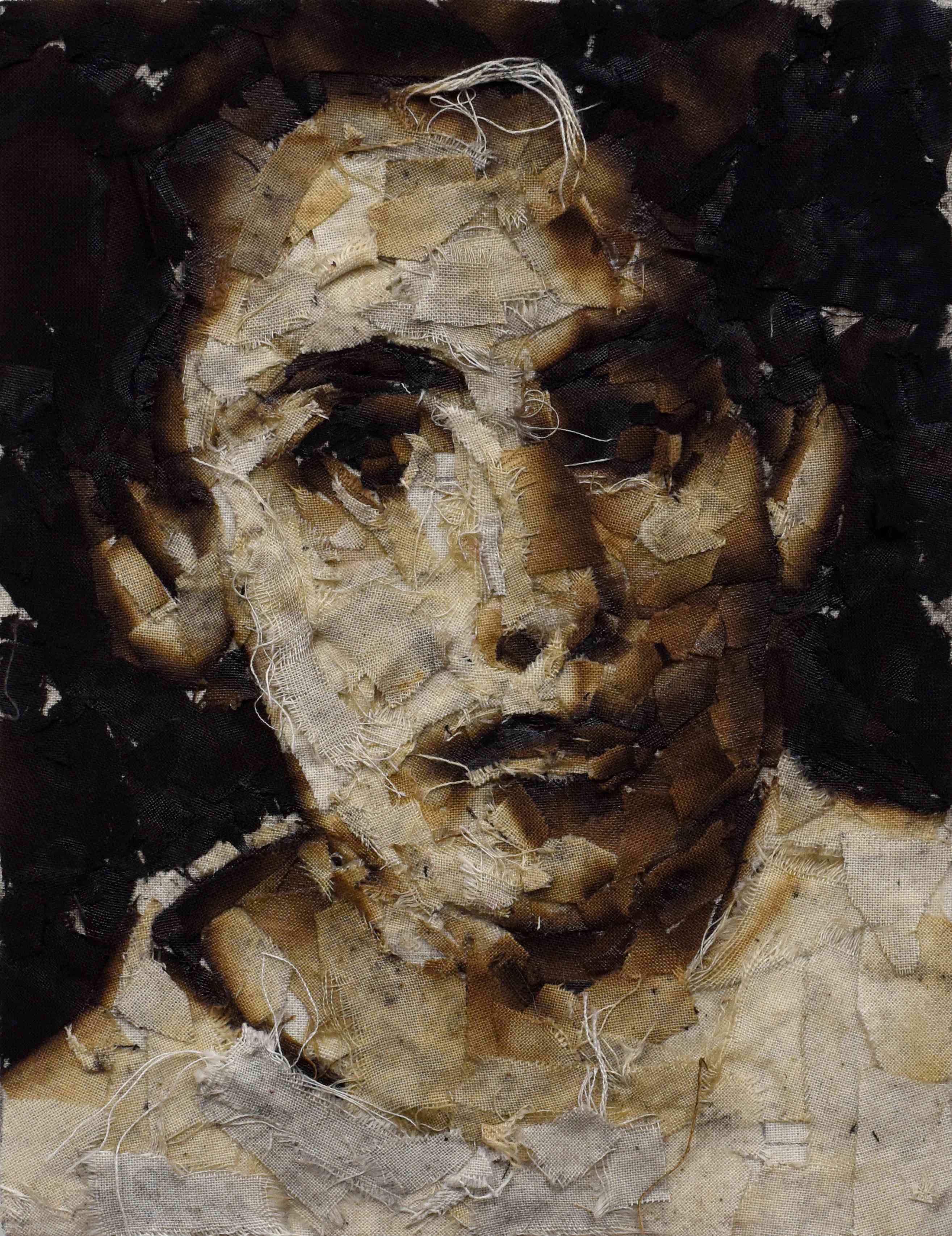
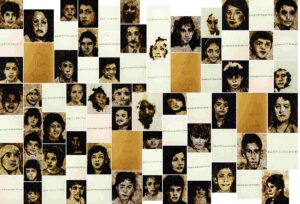
Another long term project is about the ruthless U.S. bombing of the Public Shelter 25 in the Al Amiryia region of Baghdad in 1991. 400 people were killed;in a book about the disaster only 100 people were identified with photographs. She/He Has No Picture is Hanaa’s response
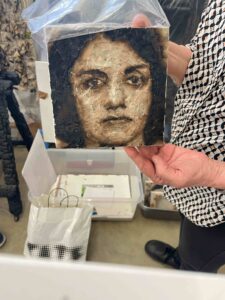
She went to visit the shelter “A toxic smell of smoke and charerd bodies permeated the air”. Many years later she has been able to create faces for the victims with layers of burnt canvas.
A current project is exploring the legacy of Gertrude Bell. Bell was hired by the British to demarcate borders in the Middle East. Hanaa is pulling quotes from Bell’s letters that reveal how terribly colonial she was.
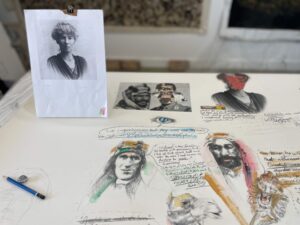
Photograph of Bell, drawing of Lawrence of Arabia and future King Faisal of Iraq
A quote froom Lawrence of Arabia
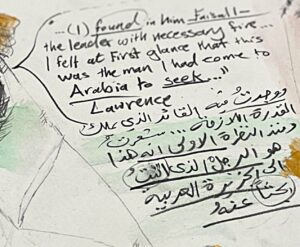
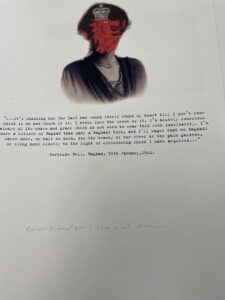
…it’s shocking how the East has wound itself around my heart till don’t know which is me and which is it. I never lose the sense of it. I’m acutely conscious always of its charm and grace which do not seem to wear thin with familiarity. I ‘m more a citizen of Bagdad (Sic) than many a Bagdadi born, and I’ll wager that no Bagdadi cares more, or half so much, for the beauty of the river or the palm gardens or cling more closely to the right of citizenship which I have acquired. . .”Gertrude Bell
Hanaa has been appointed artist in Residence at the British Museum this year. She is now included in major exhibitions in many contries.She is an artist of extraordinarily rich intellectual interests as she works with the materiality of art . She explores her relationship betwwn human and natural worlds and between the material and the virtual, the organic and the symbolic.
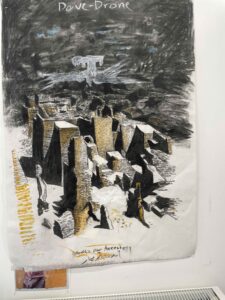
“Stones” Our Ancestors” Dove = Drone
This entry was posted on July 16, 2025 and is filed under colonial images, Conceptual Art, Contemporary Art, Uncategorized.
UK is still a great place to visit
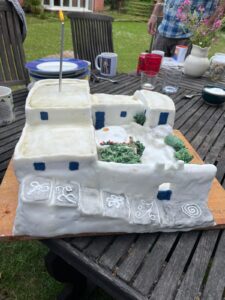
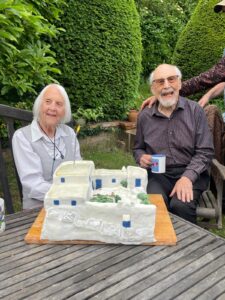
This cake is a replica of Henry’s house on Amorgos in the Cyclades
It was the star of his 90th birthday party in Ufford Suffolk hosted by his niece Tig. More on that soon
We went from the airport
directly to Saffron Walden where Henry’s sister lives in a small 16th century house.
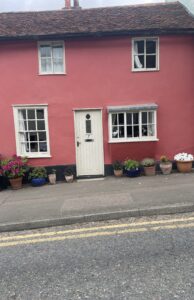
We stayed nearby in a 16th century hotel the Cross Keys

It has quite a steep staircase that goes around two corners,but Henry managed it beautifully.
we went to beautiful public garden near Imogen’s house
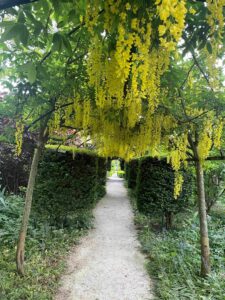
and learned about the Bardfield painters. Eric Ravilous who died during world War II and Edward Bawden are the best known.
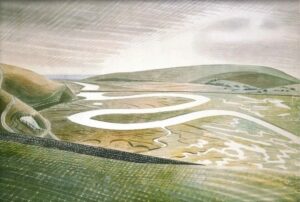
Eric Ravilious
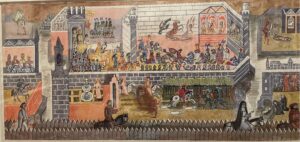
Edward Bawden Canterbury Tales
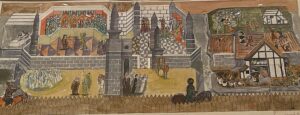
Edward Bawden Canterbury Tales
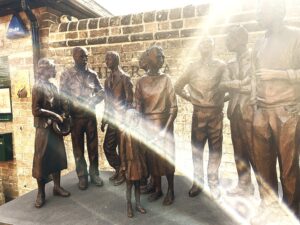
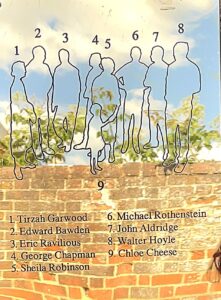
Bardfield painters in statues identified
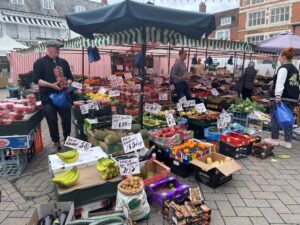
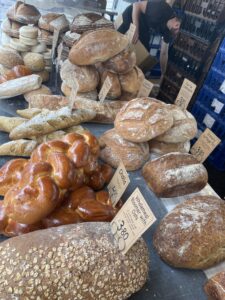
Saffron Walden has two weekly markets in the town square
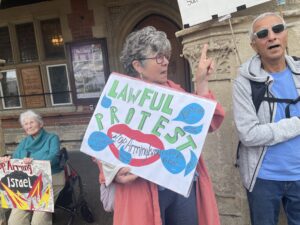
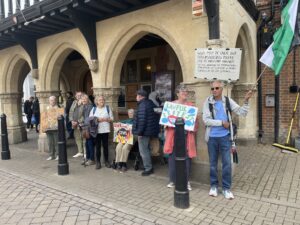
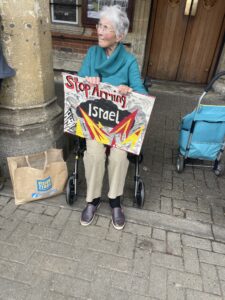
They also included deonstrators against the genocide in Gaza
we also went to the circus!
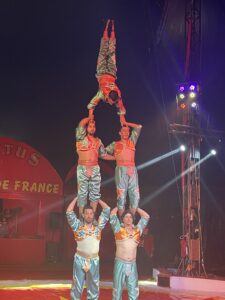
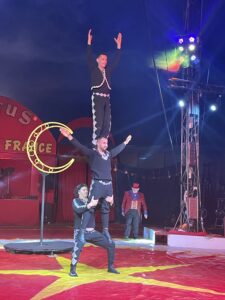
We sa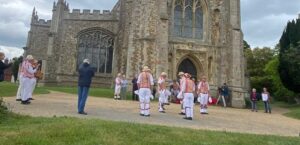 w Morris Dancers in a nearby town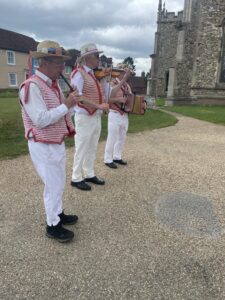
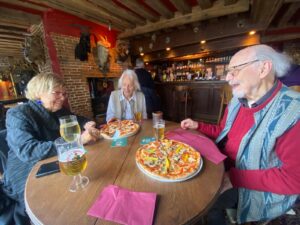
and ate pizza in a strange pub filled with animal heads
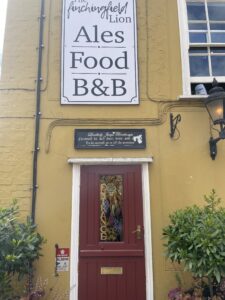
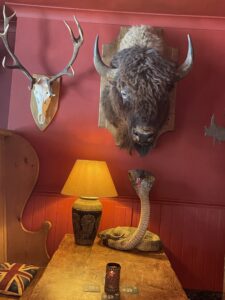
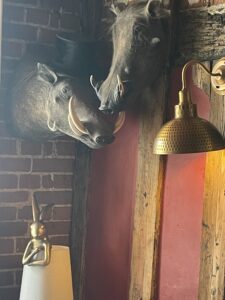
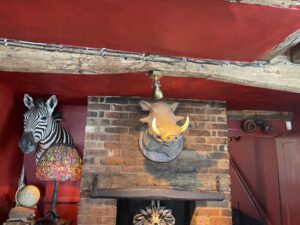
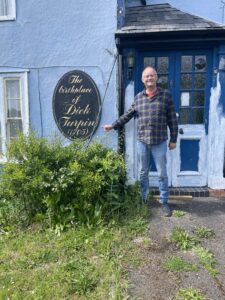
and the home of Tom Turpin, a famous highwayman in England
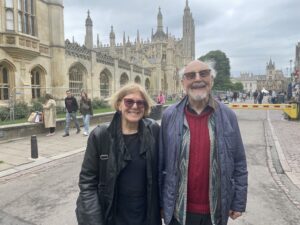
We also went to Cambridge, Henry’s alma mater
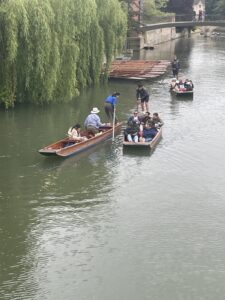
Henry owned a punt and ate lunch with his friends there everyday
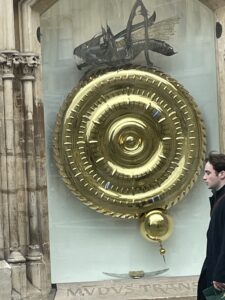
the huge grasshopper clock
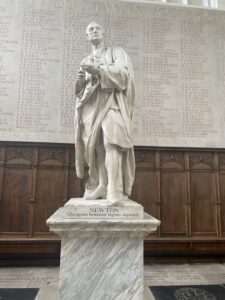
Sir Isaac Newton
a beautiful gate
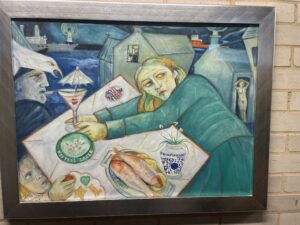
Just ouside of Cambridge we visited an incredible collection of women’s art.
https://www.murrayedwards.cam.ac.uk/womens-art-collection/explore-collection This is only one example, the others don’t want to load, but the collection ranged fromfamous international artists like Faith Ringgold to local artists
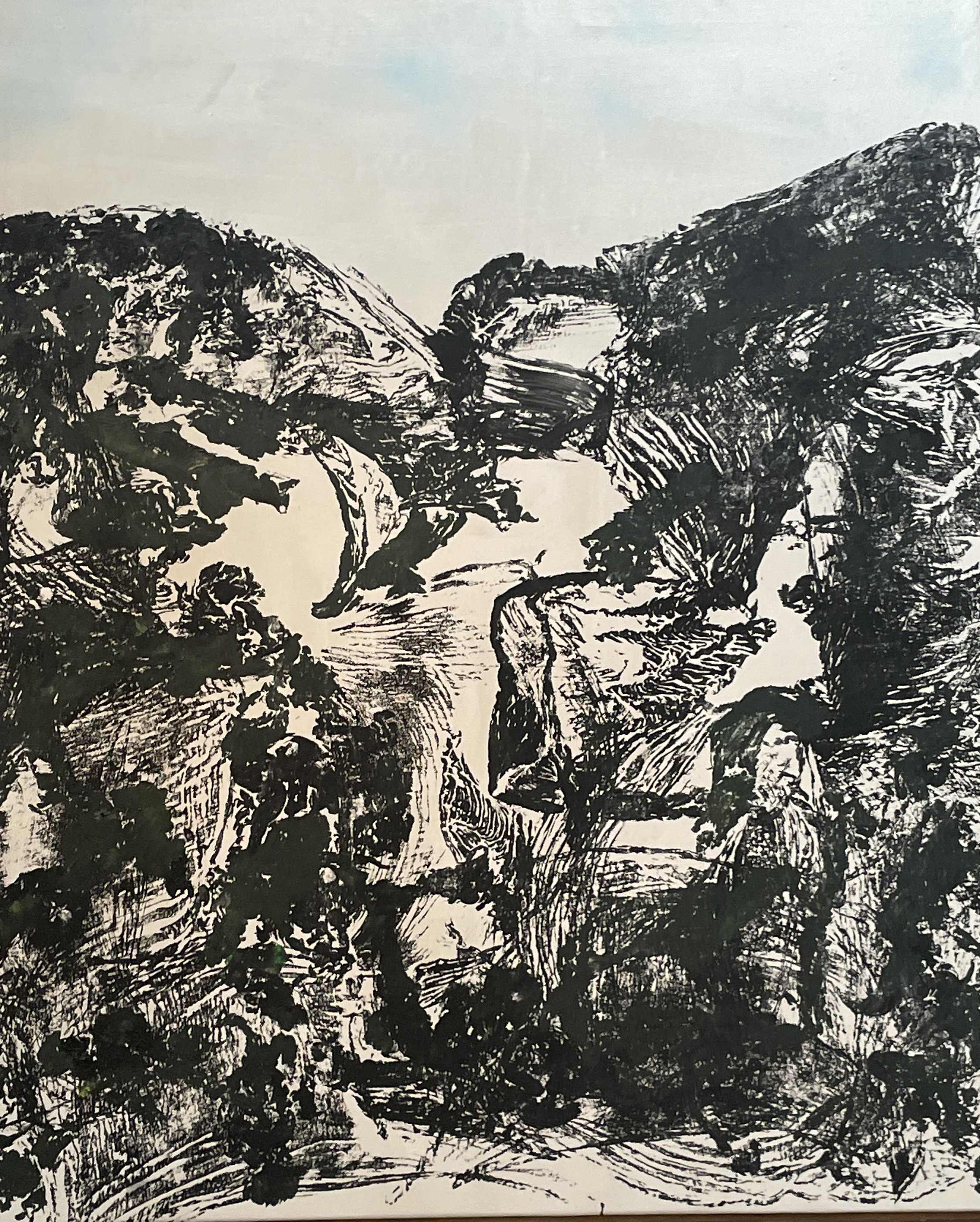
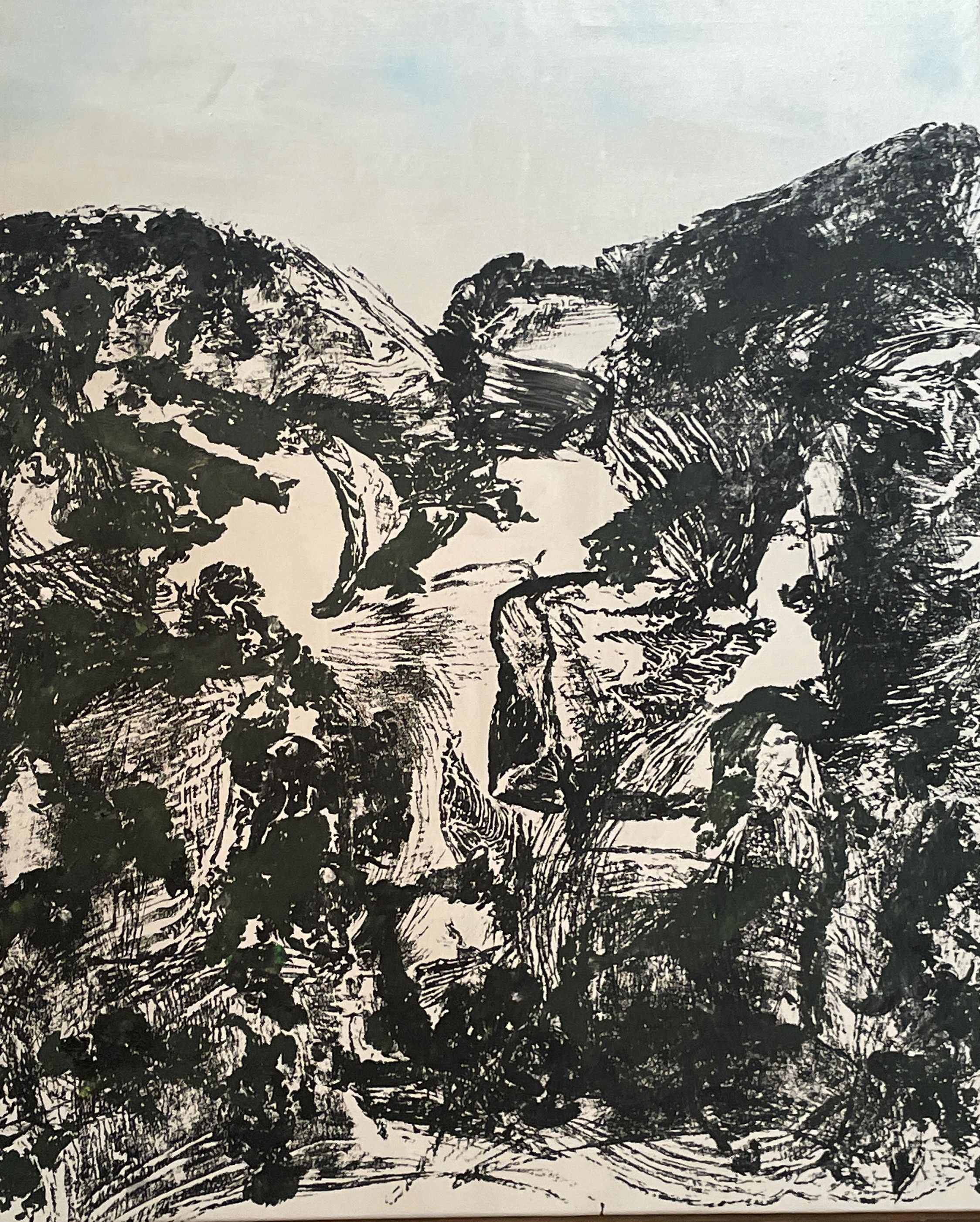
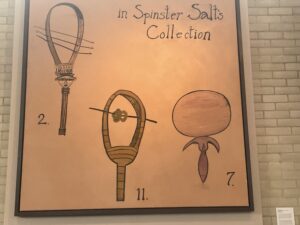
We also had a lot of wonderful meals especially the Sunday dinner by his niece Lucy McKinzie
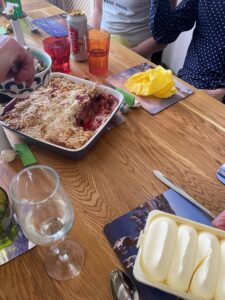
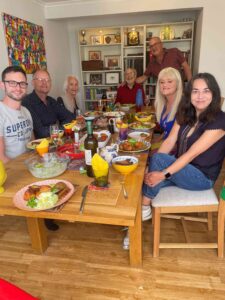
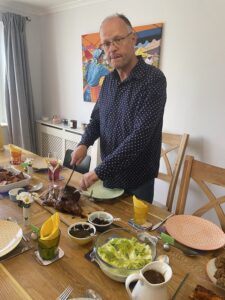
Charlie carving the roast
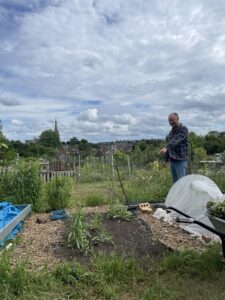
We visited Charlie’s “Alottment) land given out for growing since World War II
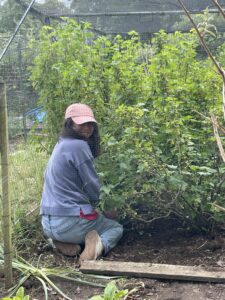
From Saffron Walden we went on to visit his niece Tig in Suffolk. She lives in the country. that’s where we had the birthday party!
with the cake
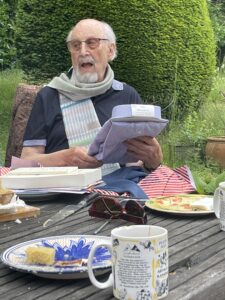
We had a contest drawing a portrait of Henry
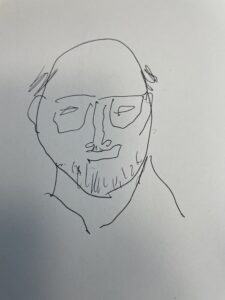 This is mine
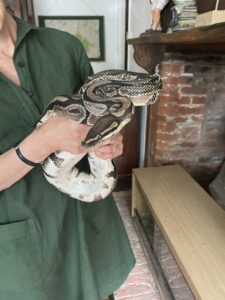
Tig had amazing pets torotises and a python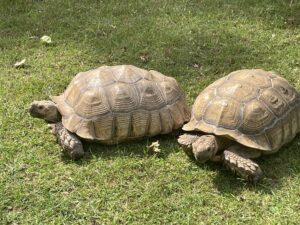
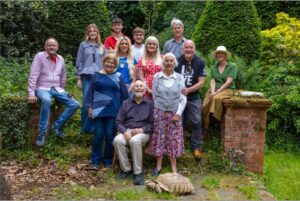
And here is the whole party
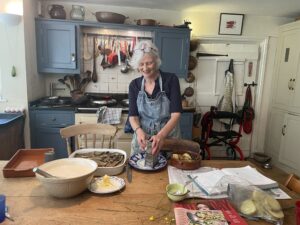
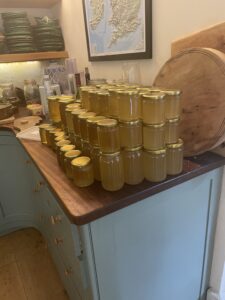
and the miraculous Tig who makes honey from her own bees
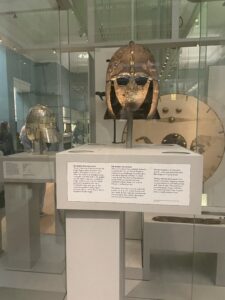
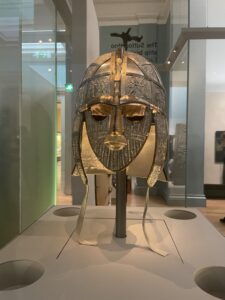
Tig took us to Sutton Hoo, the Saxon burial site. These are images from the British Museum. The fragments and the reconstruction of the famous helmet
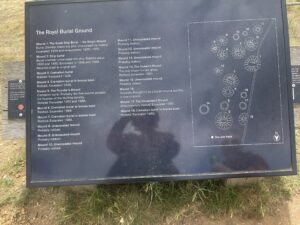
How many graaves are at Sutton Hoo!
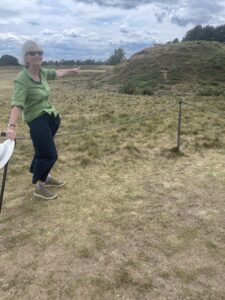
The hill where it was excavated
From Ufford in Suffolk we went on to Haleworth which is further North into Suffolk to Halesworth a charming lttle town.
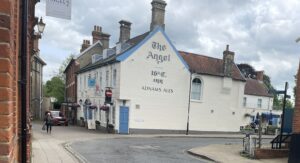
The Blue Angel our hotel
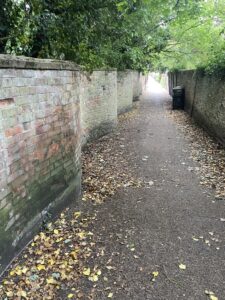
curving walk
We met this lovely artist and her son. Susan and Harry Knox
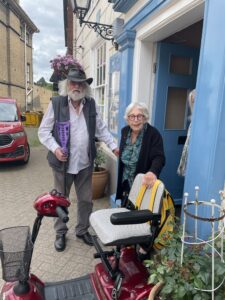
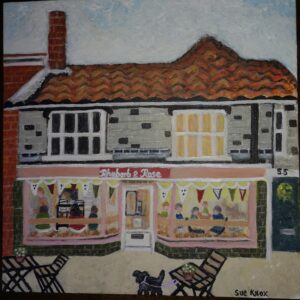

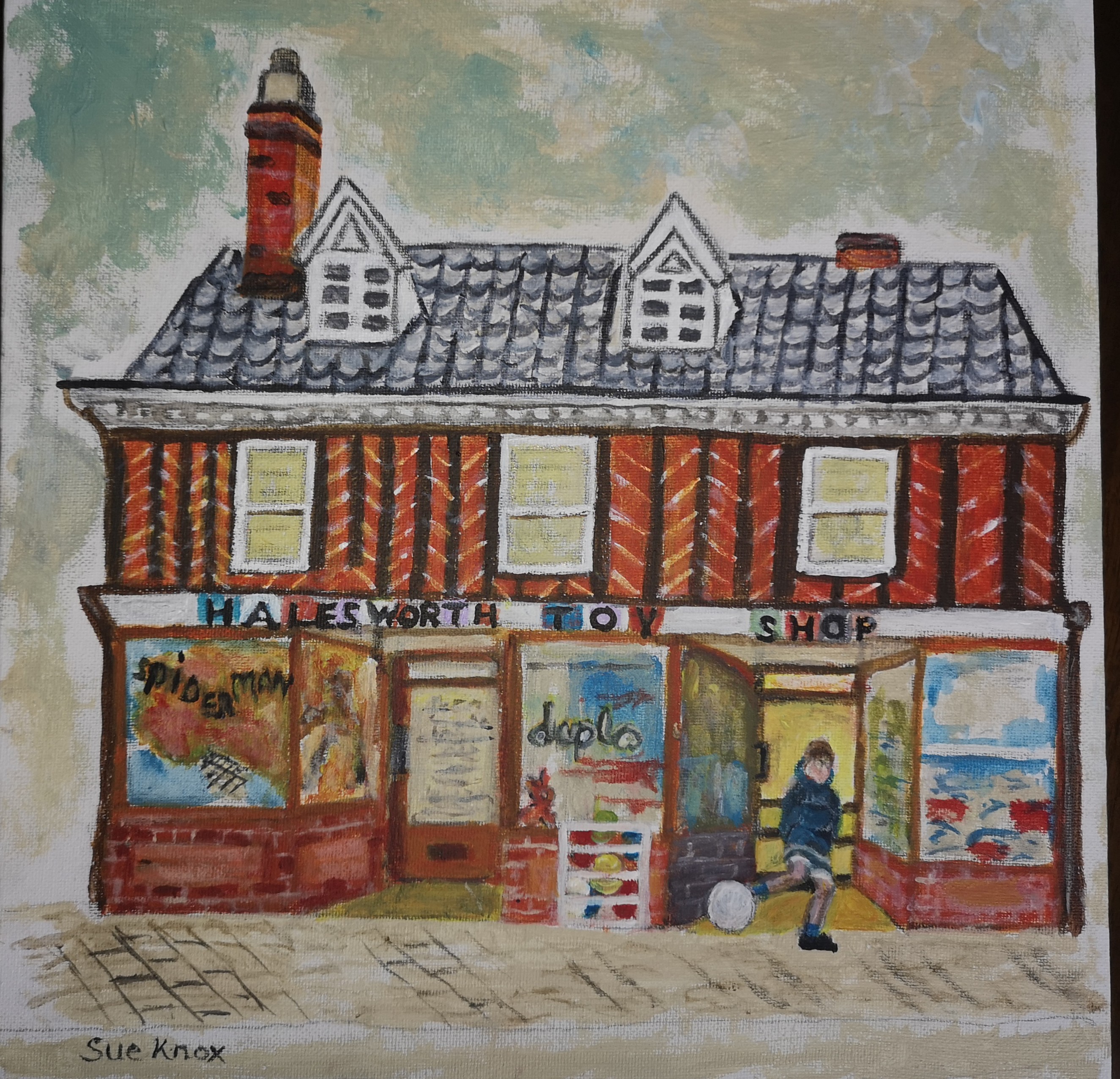
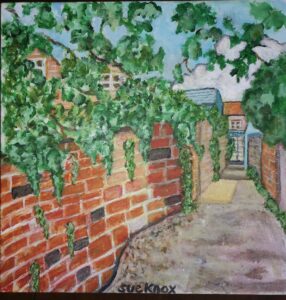 I loved her paintings of Halesworth
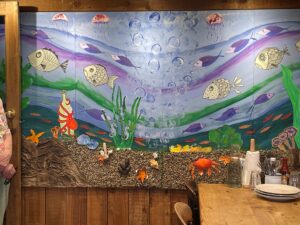
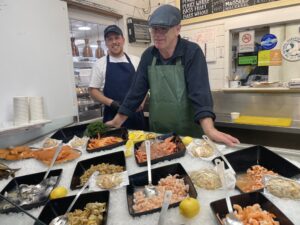
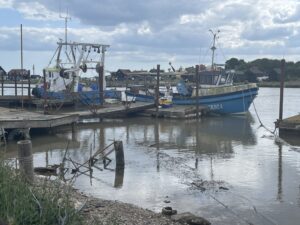
My dear friend Cynthia and her husband took us to Southwold a seaside town with an amazing fish restaurant and a beautiful church
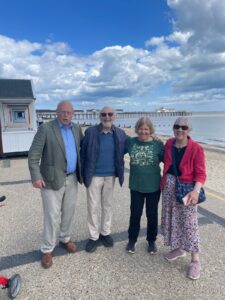
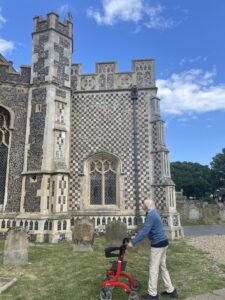
St Edmund King and Martyr church
This entry was posted on July 1, 2025 and is filed under Uncategorized.
Zodiacs by Ai Weiwei coming to Seattle in the fall
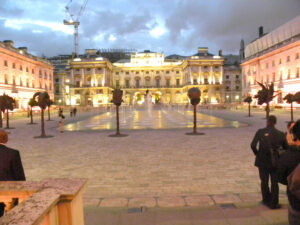
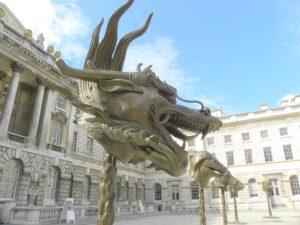
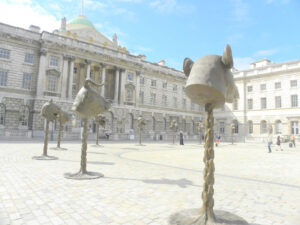 The larger than life Zodiac heads by Ai Weiwei that are coming to Volunteer Park this fall( too bad not there for the summer) represent the following animals in the usual order: Pig, Dog, Rooster, Monkey, Goat, Horse, Snake, Dragon, Rabbit, Tiger, Ox, Rat. Each of these Zodiac animals have specific traits which you have if you were born under their sign. My (1945) sign is the rooster : it says “Those born under the rooster are profound thinkers. Talented and capable they can also be eccentric and may have difficulties in their relationships with others. Highly observant and analytical they are strong decision makers who speak their minds freely.” How about that. You can look up your year online in 12 year cycles.
These heads, which I saw in London and can therefore offer a photograph of them, have a long story. In the exhibition of smaller heads inside the Seattle Art Museum they are displayed in a different order in two parts Dog Monkey Horse Dragon Tiger Rat/Ox Rabbit, Snake, Ram, Rooster, Boar. I asked the curator Foong Ping why and he said the answer would be revealed when the large heads arrive. He called it a “an easter egg.”
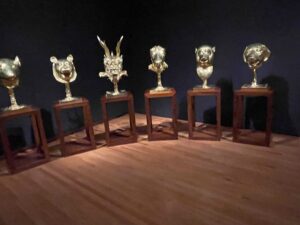
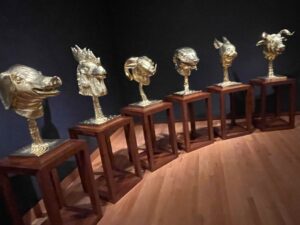
The story of the zodiac heads is worth telling. The original zodiac heads were attached to seated draped torsos that were part of an elaborate water clock fountain created by an Italian artist. They combine sculpture, hydraulics, and Chinese and European aesthetics.
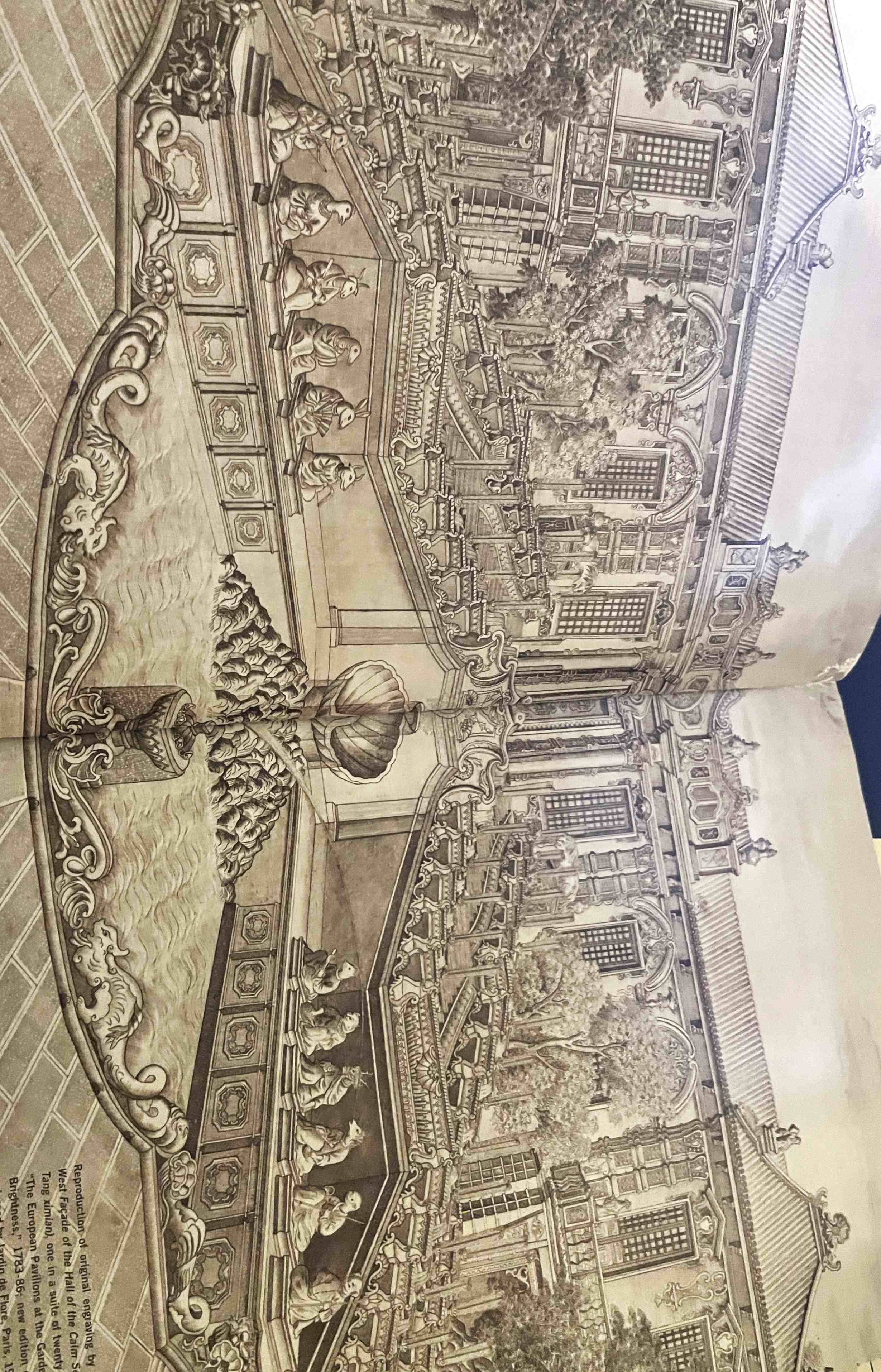
The location was called the Garden of Perfect Brightness or Yuanming Yuan where originally there was a complex of European style palaces gardens and fountains. It began in the mid 17th century and was greatly expanded by the Quianlong Emperor (1736 – 1795).
In 1860 the Yuanming Yuan was looted and burned by, guess who, the British and French troops at the end of the Opium wars. “It was retaliation for kidnap and torture of a group of British diplomats and in part to force the Chinese to comply with the 1858 Treaty of Tiensin- one of a series of trade agreements imposed on China by more powerful nations and collectively referred to as the “Unequal treaties.” Sound familiar?
This was part of the Opium Wars that began in 1845 to 1945 “ the century of humiliation”
As the Chinese have become a world power they are reclaiming national treasures like the bronze heads of the zodiac fountain clock which are now looked on as “symbols of the cultural achievements of the Qing dynasty, the losses of 1860 and the humiliations that followed.” Seven heads turned up at an auction. Five have not reappeared.
Enter Ai Weiwei: Ai Weiwei thinks about China’s history and its relationship to history. He collects artifacts of which there are several collections in the Seattle Art Museum exhibition such as the feet of Buddha statues.
As young man he returned from exile in Xinjiang province where he had been with his family since 1958. When he returned to Beijing after the death of Mao in 1976 , he wandered the ruins of Yuanming Yuan. He also went to art school and founded several early avant garde groups.
Fast forward to 2010. He recreated all twelve Zodiac heads from the fountain! He sees it as playing with history and the idea that they are national treasures because of course they are fakes of a pastiche: the heads were made by Italian artists!
But the zodiac signs have long been significant in Chinese culture: Here is the information online
“These animals, along with their associated traits, are deeply intertwined with Chinese culture and influence beliefs about personality, relationships, and fortune. The Chinese zodiac is also known as Sheng Xiao, which literally translates to “birth resemblance: it is a part of a broader system called Four Pillars of Destiny, which is used in Chinese astrology to understand an individual’s life path and personality.”(Wikipedia)
But the literal representations at Yuanming Ying is more European than Chinese.
So when we get to see these larger than life zodiacs in our Olympic Park, keep all of this in mind. Ai Weiwei has placed them not as heads on a stone body as in the original fountain, but on a thin column of metal. To quote Ai Weiwei ”( The Circle) is pointing to all the people who would question whether the work is valuable or not valuable, real or not real, or better than real, or not as good as real.”
The quotes, except for Wikipedia, are from Ai Weiwei Circle of Animals, Zodiac Heads, Somerset House London 2011.
This entry was posted on May 18, 2025 and is filed under Conceptual Art, Contemporary Art, Uncategorized.
Suchitra Mattai She walked in reverse and found their songs
 Suchitra Mattai: She walked in reverse and found their songs
Asian Art Museum to July 20

Suchiitra Mattai was born in Guyana (on the North Coast of South America, bordering on Venezuela and Brazil). Her family moved to Canada when she was four, but she has vivid memories of her life there. Her artwork is about recovering and healing the wrongs suffered by her ancestors and telling new stories. The title of her show “ She walked in reverse and found songs” refers to the process of being in the present while thinking about the past.

As we enter her exhibition at the Asian Art Museum we first see a small house structure with red pointed domes as decoration. Suchitra explained that she was invoking Indian Palace architecture. Called “Pappys House” she is creating a type of structure that she imagines her grandparents might have lived in, with her own interpretation added to the exterior. It is more than decorative, it elevates her ancestors to royalty.
In the early 19th century, when the African slave trade was declared illegal, many South Asians were brought to Guyana as “indentured servants” (in reality they were enslaved.) Massai imagines recovering their stories as she undercuts colonial realities.
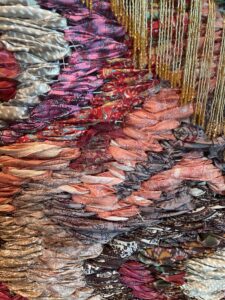
All of her work is made from the torn up saris of laboring women, that are then woven. She also practices needlework and embroidery taught by her forbearers. All these media are an homage to her ancestors and all the indentured slaves who came from South Asia.
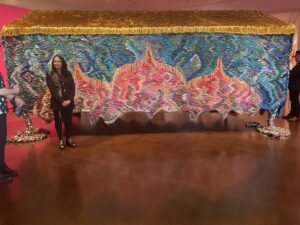
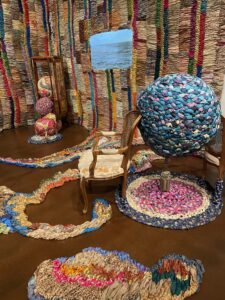
In the large installation “memory palace” she carefully placed five pieces of colonial furniture. Each one is covered with large balls made of braided and woven saris that render the furniture useless as well as amusing.
In one chair she has placed a Victorian antimacassar on the seat. Antimacassars were placed on the back of chairs to protect them from hair oil. Putting it on the seat is obviously a joke. This chair also has a large South Asian processional umbrella stuck in the back which can’t serve its purpose of providing shade.
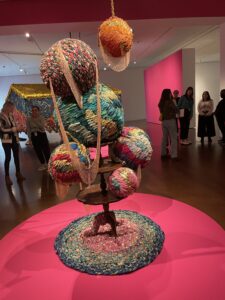
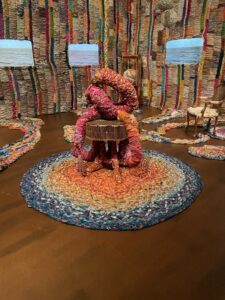
The large woven balls seem as though we might want to pick them up, they pour out of one piece of furniture or balance between two chairs, but they are much bigger than the size of a beach ball and much heavier Fat snake like forms weave over and under another table ornamented with gold tassels. Woven pieces crawl around on the floor.

The larger theme of this room is memories of migration and colonialism: three video screens show the sea moving by as though from a ship.
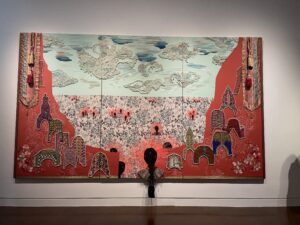
Individual works, also made of woven saris such as “the sea wall,” tell other stories. Apparently Guyana had a sea wall that blocked all view of the sea for workers: Massai has broken it down and imagines workers escaping.
Another surprise is “a self portrait” with its dried grass cape hung across the middle and a colonial medal at its center. Perhaps she is speaking of her own relationship to colonialism.
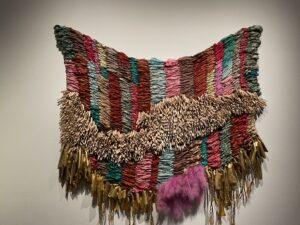 “A Rich Life Lived” has a similar format but the central cape motif is constructed of clothespins. The artist honors domestic labor and rewrites the colonial narrative to honor workers.
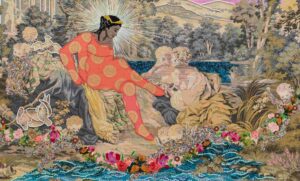
Surprisingly, the title work of the exhibition “she walked in reverse and found their stories” is based on an entirely different starting point: a found 18th century tapestry on which the artist has highlighted a goddess wearing a sari tupe pattern. Many of the details of the tapestry are highlighted with beads and fake gems.
The theme of the exhibition thus takes it point of departure from the idea of a “goddess” wearing a sari pattern , her head sending out rays like a halo from a golden crown, being waited on by European-based putti: what a mixture of references!
Massai speaks of “creating a new mythology and a new way of thinking.” Her provocative works easily speak to us of disrupted narratives, opening the way to create new stories.
Ai Weiwei
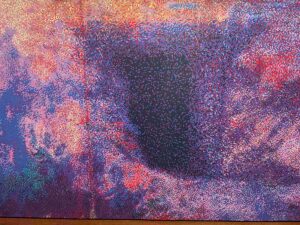
While you are at the Asian Art Museum be sure to spend time viewing Ai Weiwei’s recreation of Monet’s “Water Lillies.” It is created with 650,000 Lego and spans fifty feet (Monet’s is built from six foot panels). Inserted into the waterlilies is the dark cave (square) that invokes Ai Weiwei’s childhood experience shut in a cave for many years because his father was expelled to the desert of Western China for “rightism.” We can sense Ai Weiwei’s claustrophobia. The stunning lego surface seduces us, although it is much more fiery than Monet’s calm blue greens.
This entry was posted on May 17, 2025 and is filed under art criticism, Contemporary Asian American Art, Uncategorized.
Ai Weiwei in Seattle!
Ai, Rebel: The Art and Activism of AiWeiwei
Ai, Rebel runs until September 7 at Seattle Art Museum; Water Lilies Lego opens March 19 at Asian Art Museum; Circle of Animals: Zodiac Heads opens May 17 at Olympic Sculpture Park.

First we see a tree bolted together from different woods. A poem by Ai Weiwei’s poet father Ai Qing about trees: “One tree, another Tree, each standing alone and erect….”. Accused of “rightism” his father was exiled to Xinjiang province in 1958 when Ai Weiwei was a baby. After twenty years they were released in 1976 with the death of Mao and the end of the Cultural Revolution. In the 2022 Water Lilies, Ai Weiwei makes a direct reference to that traumatic experience, with a large black area referring to the underground dug out where he lived with his family. The gnarled tree in this gallery symbolizes longevity and perseverance in adversity.
Ai Weiwei joined an early avant garde group in Beijing, then moved to New York City in 1981 for 10 years. Amidst his black and white photos from the East Village is the artist with Allen Ginsberg, who lived near him. Ai WeiWei spent a lot of time listening to the poet.
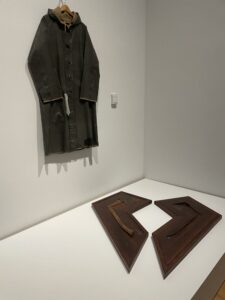
In the next gallery are his last large paintings of Chairman Mao and not far away Safe Sex, 1988, a Chinese Army raincoat with a condom coming out of the pocket. In New York he was impressed by Marcel Duchamp and Andy Warhol which is clearly seen in these works.
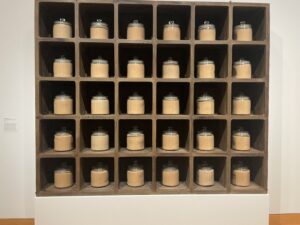
Then we see Ai Weiwei destroying or modifying ancient artifacts and remaking them as contemporary art. One extreme example is pulverizing neolithic vases and showing the dust in square glass containers.
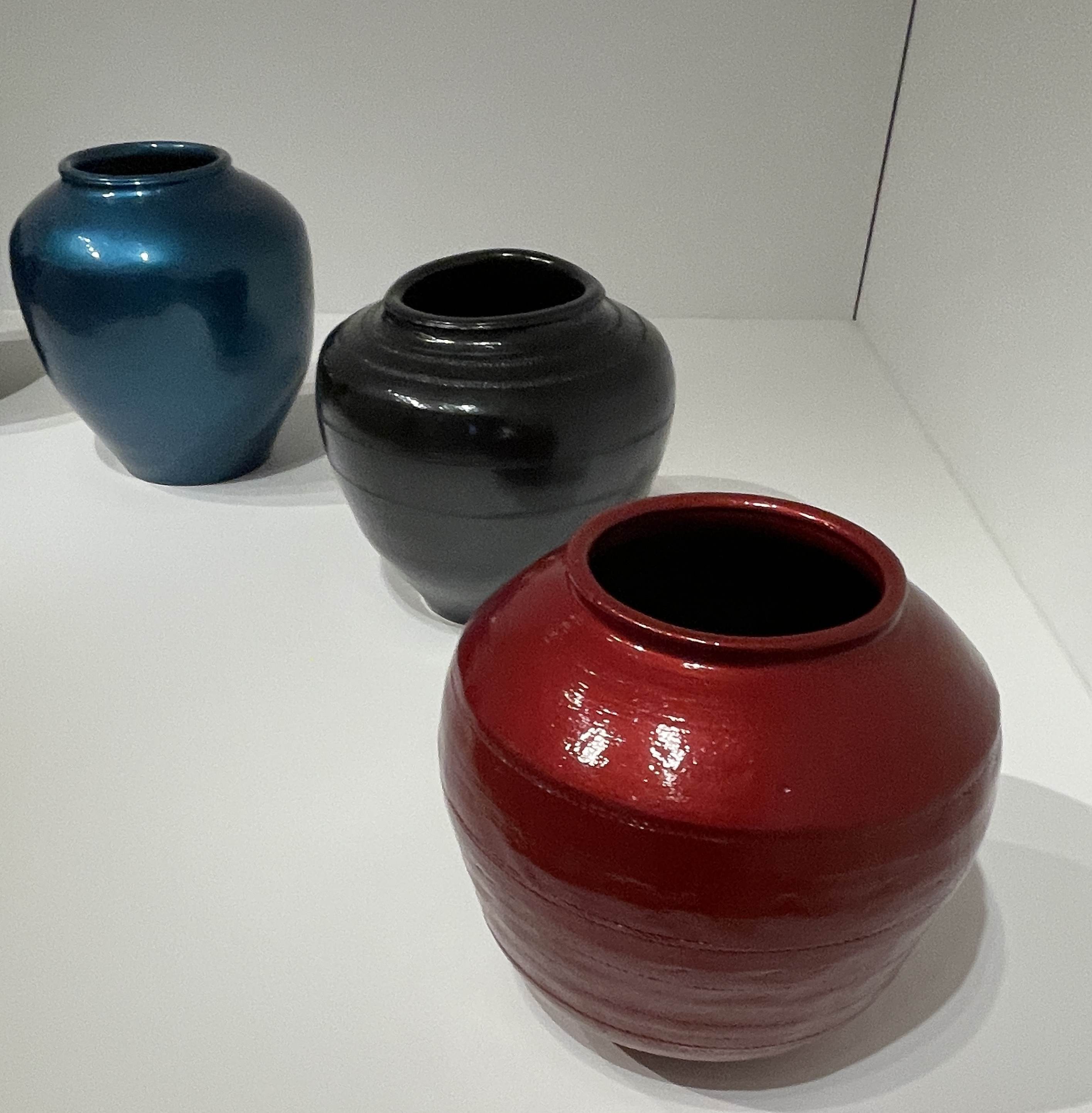
His most famous act is dropping a Han pot, but here he has painted them with brightly colored industrial paint. I feel discomfort with this act, as a lover of ancient pottery.
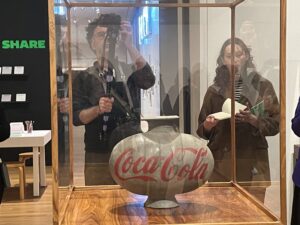
 He also painted them with a coca cola logo.
But he reveres the ancient ciulture of China as we see in his collection of Buddhas feet and stone bricks from the destruction of traditional Chinese houses.


He was obviously horrified when he went back to China after being in New York City, to see the widespread destruction of historic China.
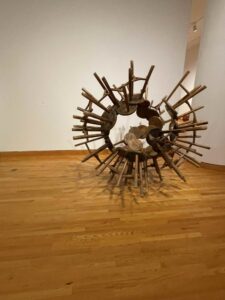

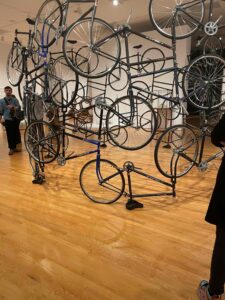
He rendered handcrafted wooden Qing dynasty stools nonfunctional by removing a leg for example. Other sculptures are transformations are bicycles and stools arranged in abstract forms or a sofa and chair made in marble.
But these are gestures compared to his work after the earthquake in China in 2008 when he discovered that hundreds of children had died because of the poor construction of their schools.

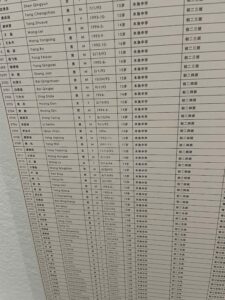
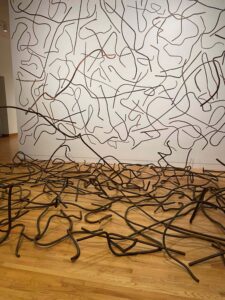
He traced them and honored them, with students’ backpacks formed into a huge snake and listing all their names on a huge sheet of white paper in the exhibition. Nearby is the rebar from the destroyed schools shaped into abstract sculpture.
His own detention in 2011 probably is a result of this project in which he recorded parents of children heartbroken with how they were ignored by the government. Or it may have been his huge presence on the internet, where elitism gives way to populism. We can walk into the re-creation of the spare room in which he was detained. But the scars of the 81 days stayed with him.
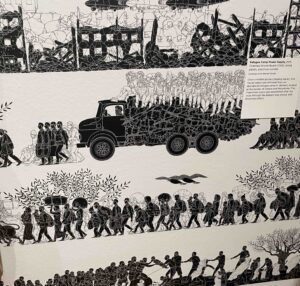
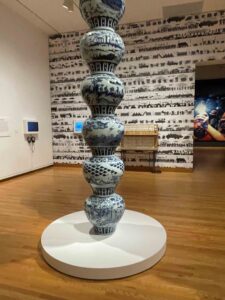
MIgration shown on blue and white porcelain endless column
Ai Weiwei moved to Europe in 2015, just as many hundreds of Middle Eastern migrants were trying to cross to Greece from Turkey. His long scroll depicts migrants walking or jammed on vehicles, negotiating ruins or crossing rivers. Called the Odyssey, the title does evoke the travel of Odysseus multiplied by many hundreds of people.
As we approach the room at the end of the exhibition we see a giant Lego portrait of Ai Weiwei in a flash image, a photo he took as he was being taken into detention, here recreated.
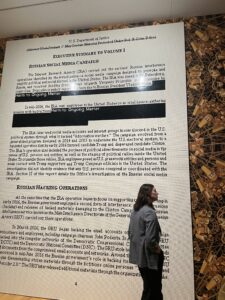
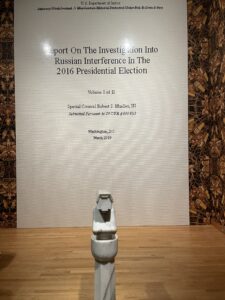
The exhibition has other Lego pieces, but the most important given our situation today is the Mueller Report, the cover page and the first page, heavily redacted. This report on Russian hacking during the 2016 election tells us what was happening, as we think about our cozy relationship developing today with Russia. A marble surveillance camera is positioned in front of the report.

There is so much to see and experience in this exhibition! Don’t miss the wallpaper loaded with symbols.
Even a US mail box comes into his show
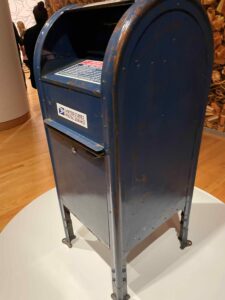

Trump questioned the role of mail in voting claiming without evidence widespread fraud
The exhibition provokes us rather than allowing us to sink into admiration. Each phase of his work represents a challenge about the meaning of authenticity. Ai Weiwei defies us to think about that through his constantly changing media and subjects. After his traumatic childhood, it is not surprising that he is willing to strip away obvious meanings and challenging us to look deeper.
At the AsianArt Museum you can now see his lego Monet’s Water Lilies. We see a large black hole in the midst of the water lilies making reference to Ai Weiwei’s traumatic childhood.
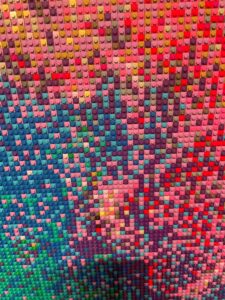
detal of legos
The Zodiac circle will open in the fall at the Olympic Sculpture Park
Meanwhile you can see the small replicas in the exhibition at the Seattle Art Museum
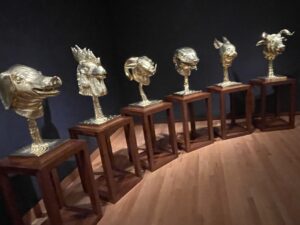
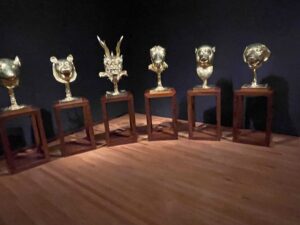
This entry was posted on April 21, 2025 and is filed under Art and Activism, Art and Politics Now, Contemporary Art, Culture and Human rights, economic imperialism vs democracy, Uncategorized.
Katy Deepwell: Critic of Feminist Art


Katy Deepwell has contributed more to feminist art criticism than any other critic I know.She published the journal n.paradoxa for 19 years. She has edited and published collections of feminist writing like De-/Anti-/Post-colonial Feminisms in Contemporary Art and Textile Crafts and 50 Feminist Art Manifestos. She has received many awards,organized conferances, online courses available on her website. She has a Ph.D, taught in universties. It is hard to overstate her importance.
And yet Katy has always stayed accessible. She has not sunk into deep theory. She has interpreted feminism in art according to the artists she writes about, not her own imposed ideas.
Her most recent collection Converstions on art, artworks and feminism demonstrates her deep knowledge of feminist artists. The book is drawn from her various interviews published in n.paradox.
It is organized with various approaches: major projects, individual artworks, feminist strategies for curating, and histories of feminism and feminist organizations.
It is clear that Katy has travelled and read extensively. The shows are in many far flung places ranging from Istanbul to Dak’Art in Senegal Poland, Denmark and more. She thoughtfully frames questions for the artists and curators clearly based on a lot of preparation, but she digs into the meanings and intents of the artist she is interviewing.
It is very rare for an art critic to stay with one focus – in her case faminism- and yet allow that focus to expand and change and reach in many different directions. She acknowleges the complexity of each artist. Even the title of her new book,Converstions on art, artworks and feminism acknowledges that. The cover is a series of questions that she posed to the differnt artists


In the first section ” major projects and exhibitions” she chooses a fascinating selection including Ida Applebroog, Karen Finley, Mary Kelly, Suzanne Lacy and Marina Abramovic among others. In the next section focusing on indivudual artists she asked artists such as Sue Williamson, Zineb Sedira, and Maureen Connor to make statements. There was also a “cyber knitting” event that she partipated in.
In the” feminist strategies for curating,” she asked short questsions that triggered long responses. In “histories of feminist organizations” her questions were sometimes much longer, demonstrating her own knowledge.
The varied approaches adapting to the artist themselves give us a clear voice directly from the artist.
In short, this book is a set of primary source essays, that Katy edited, rather than a book of her own opinons.
As such it is an invaluable resource for all of us.
Thank you Katy Deepwell!
Tomur Atagök: Painter, Historian, Critic, Curator, Mentor
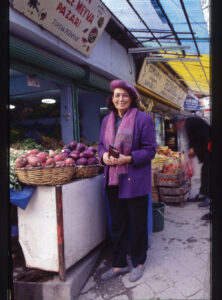
Tomur Atagök 1939-2025
We are all mourning the passing of our beloved mentor and teacher
I first connected with Tomur Atagök in 1997 through her collaborations with Katy Deepwell in n.paradoxa.
Tomur had just published in the first volume of Katy’s amazing magaine, an essay on “Contemporary Turkish Women Artists”. ( She went on to publish a second essay in n paradoxa in 2003, “Tomur Atagök in Conversation with Gulsun Karamustafa, Inci Eviner, and Nur Kocak Turkish women Artists and Feminism.”
When I told Katy I was going to Turkey for a trip in she gave me Tomur’s name and contact number. When we arrived at our hotel in Istanbul I called her and she immediately invited me over to her office!
Tomur suggested I apply for a Fulbright Fellowship and offered to be a sponsor. She had just been on a Fulbright in the US in 1996 so she knew the ropes. It had never occurred to me. So I went home and I did apply and I got it for 1999-2000 to teach American Art History at her university, Yildiz Technical University.
Right after we arrived there was a big earthquake! Since we had just arrived , we felt we couldn’t do much to help (although later I did teach a workshop with some children who had lost their homes)
We retreated to Lycia on the Southwest coast of Turkey for two weeks ( two fruitful weeks for my husband Henry Matthews who later wrote two books about the Greek ruins on that coast) Then we went back to Istanbul
Tomur settled us into a comfortable apartment in Tesvikye, an upscale neighborhood of Istanbul.
The big catch I discovered when I started was that her students did not understand English!. This was not the usual University that Fulbright sent scholars – Boğaziçi University- where English was the stamdard language of instruction
Well, I did have a translator at least.
I was mainly teaching twentieth century American art history, with an emphasis on post 1945. So Tomur began to take me to meet various contemporary artists in Istanbul. At that time in 1999-2000 there was no modern art museum although one of Tomur’s ongoing projects was promoting Turkish art both contemporary and historical.
That meant that I met the artists in their homes or studios if it was a different place ( rarely); almost all of the artists I met then were showing internationally in Europe. but were unknown in the US. Their work was completely different in media and topic than I had seen before, so it took me a while to write about them. I wrote a few short reviews and eventually a longer essay which was published in Frontiers magazine and is now included as the first chapter of my most recent book Around the World in 25 years, Provcative Art From Europe,thte Middle east, Asia and the Americas
All of these artists are now very well known, Gülsün Karamustafa, just was the artist in the Turkish Pavillion at the Venice Biennale

has been showing brilliant installations since the early 1990s
Her work in the 3rd Istanbul Biennial was censored

and Inci Eviner.who represented Turkey at the Venice Biennale in 2019.

During my year in Istanbul and after, Tomur and I collaborated on writing an essay for Third Text, “The Digestible Other” speaking about the history of the Istanbul Biennial and how artists “fit” into the international scene. Ironically Tomur herself was never included in a Biennial, she refused to be digestible. This,in spite of the fact that she created the seeds for the creation of the Istanbul Biennale
with earlier exhibitions, as we explained in the article.
We also wrote a review of a the 8th Istanbul Biennial “Poetic Justice ( these essays are also reprinted in my new book.) I also wrote short essays to introduce exhibtions she curated. My essay on the “Anatolian Goddess Series” appears in my last book, Setting Our Hearts on Fire
Tomur and I went to London to speak at an art historian’s conferance
and to Macedonia invited to participate in giving lectures by Suzana Milevska, curator.
Later, when I returned to Seattle, Wa, I also invited her to give a lecture at the University of Washington.
The last time I visited her was in 2015 when I stayed with her for several days after the Biennial. I wrote a blog post about the art in her home at that time. Here she is in 2015
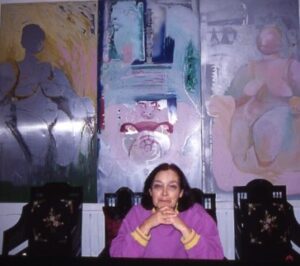
Here is an overview that I wrote a few years ago with additions.
Tomur Atagök,a leading feminist artist from Turkey, was born in Istanbul. After graduating from Robert College in Istanbul, she trained in the United States from 1960-1973, first at Oklahoma State University where she immersed herself in abstract painting and earned a BFA. She then went on to the California College of Arts and Crafts and the University of California, Berkeley for an MA. During her years in Berkeley, she experienced the Free Speech movement, then the civil rights uprisings, and third, protests by feminist artists .

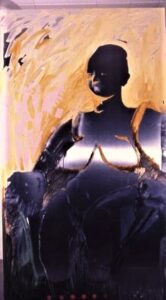
After returning to Turkey in 1973, she pioneered, first of all as a painter, then as a teacher, curator, and historian. In the 1980s her painting focused on contemporary women, often painting on a metallic surface. Above you see one of her paintings featuring Madonna . The three graces appear on the right.
I remember seeing it in the hall of our department where we passed it everyday
Her work follows several intersecting themes although feminism is a central focus throughout her career. In her works of the 1980s, we see her assertion of the figurative in the midst of dynamic abstract expressionist brushstrokes. these dynamic paintings exude incredible energy of the brushstrokes and the figures.
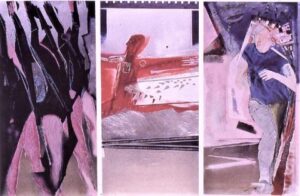
At this time she began to paint on metal.
She explains: “The pictorial reality and space on a metallic surface contains the hints the artist gets from the environment, the symbols and the descriptions she uses in making references to the outside world, the different realities of the materials and the techniques, the images reflected from the environment and the perceiver on the surface of the metallic work, and finally the interpretation of the perceiver each time create different subjective and materialistic realities of art.
On the other hand pictorial reality and real space, change physically with the reflections from the environment and the perceiver himself, and join with the physical environment and movement, creating a connection of life with art.”
In 1990 the critic William Zimmer asked about her frequent use of the color pink “It’s a color which she confided in me she cannot abide, but which also stands for humanity from a feminist perspective. Pink which traditionally connotes softness is applied to metal, meaning toughness.”
During these same years she was the Assistant Director of Mimar Sinan University Museum of Painting and Sculpture , where she also earned a Ph.D. in Museology. She then moved to Yildiz Technical University where she founded and chaired the first Museum Studies Program in Turkey in 1989. Atagok has trained many of the current museum professionals in Turkey.
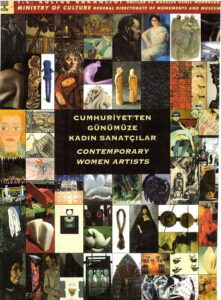

At the same time she began collaborating on ground breaking exhibitions of contemporary Turkish artists and historical studies
In honor of the 75th anniversary of the founding of the Turkish Republic in 1993, she co organized the first exhibition of the history of women artists in Turkey and Anadolu’da Yasamakta Olan Ilkel Comlekcilik |(Ancient Pottery-making Still Practiced in Anatolia) by Gungor Guner as well as “Contemporary Turkish Women Artists, organized by the Ministry of Culture, Istanbul Archaelogical Museum
Tomur had a Fulbright Fellowship at the American University in DC. in 1996 where she met some powerful feminist artists who suggested she look a the Anatolian goddess tradition. When she got back to Turkey she did just that. She took those small statues amd blew them up to an enormous size. Here is an installation of the entire series

Dominating this series is the great Anatolian Mother Goddess from Çatalhöyük. That twenty centimeter statuette, excavated from the oldest city in the world, dates from around 5700 BC.
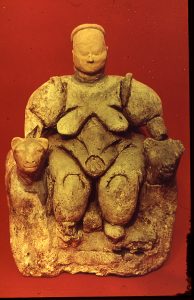
The small figure has enormous power: she is seated comfortably between subdued leopards as she gives birth. Her breasts, hips and buttocks swell to enormous proportions, further increasing her power. Far removed from the slender, even emaciated, ideal for a female body that is now common for some contemporary societies (notably the United States), this goddess proclaims her physical presence and her authority at the same time.

In the paintings the Goddess assumes much larger dimensions as she joins our world as a life size figure who stands as a guardian. Rather than a fertility symbol, she is now a symbol simply of the power of women. She is an affirmation of women’s energy and authority. On her head she wears a type of mechanical diadem/crown in one painting, and sits in front of a golden shower of sun in another. These two large goddesses frame a third panel that makes reference to the interior of woman, specifically here, the vertebrae and ovaries. The woman’s interior, so often altered today by contemporary medical science, is here protected by powerful traditional forces.
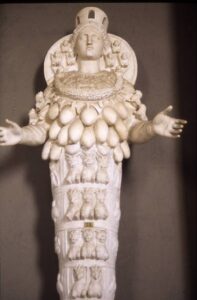

Another of these grand paintings is based on Artemis of Ephesus. Artemis, later changed to a slender virgin hunter by the Romans, is here seen in her guise as Cybele. Her many breasts carry the power of nurturing and life.
In place of the animals under her protection on the traditional statues, Tomur put guns tanks and other references to military warfare. Artemis also has black gloves and a contemporary face with bold red lipstick and blond hair. It was done in response to the violation of sacred lands by military weapons, particularly during the Gulf War. This powerful statement could be about any war and its destructive effect on life as a whole
The collective presence of these goddesses is a powerful commentary on contemporary women and their connection to historical traditions. Painted in a technique that has its roots in abstract expressionism, they are major examples of contemporary art in Turkey. She has created versions for hanging in shopping malls with a strong
statement against war written o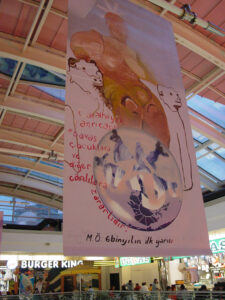 n the back

Say no to war

Games, Toys, Childrean, War, Love 1999- 2000
dedicated to Uğur Mumcu

One of her most famous seriers is an homage to Uğur Mumcu an investigative journalist researching terrorism in Turkey who was murdered in 1993. In her homage Tomur wrote on the painting in Turkish a quote from the journalist:
Translated into English it said:
There are those who have preferred a lifestyle of silence
pulling inward as a personal symbol.
Their freedom and weapons do not speak
Every injustice takes strength in a way from their passivity.


A complete heart in another offers a brighter tone.
The heart is only partially visible as a double or single curve in some works.

Against that motif emerge silhouettes of guns, toy soldiers, bones, paper doll cutouts, hands, dots, crosses, and crescents. In addition the artist uses stones, sticks, feathers, and glossy advertising images of beautiful people. Scattered throughout many of the works are poetic phrases, of various moods, hopeful, sad, cynical.
The theme is a belieft in humanity’s ability to survive though poetry and creativity in spite of the many ways leading to war. She saw the children’s toys coming from cereal boxes turned into violence and yet she aso saw love.
The series as a whole is an homage to Mumcu, but also a response to him. Atagök has decided not to remain passively silent in the face of her own distress at his death and her support for his ideas.
Doğanin çağrısı Nature’s Call
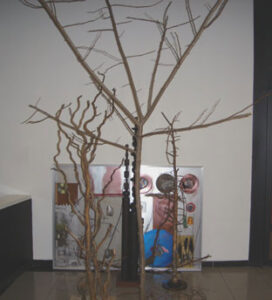
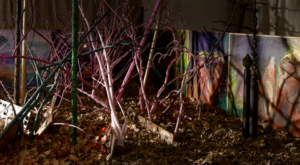

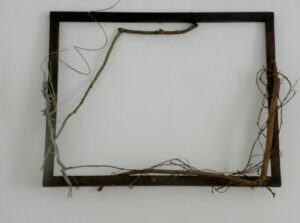
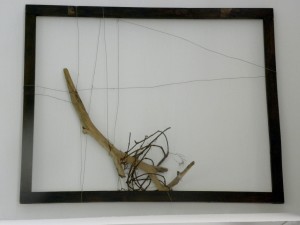
Another theme that intersects with both politics and women is nature. It takes many forms. Her home is filled with examples of recreating nature in the midst of her life–she even created a forest in her basement and had an exhibition in 2011 that featured an installation of branches, paintings, diaries and other pieces.
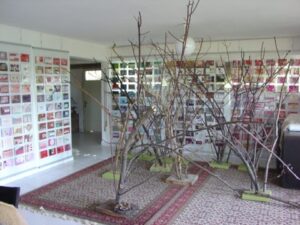
Her commitment to calling attention to the small details of branches or bones and repositioning them on the surface of her painting results in a subtle relationship between abstraction and realism. In other works she takes random trash found in the woods and creates constructions. When asked what is most important to her at this time in her life (she turned 82 in May), she answered her nature installations.

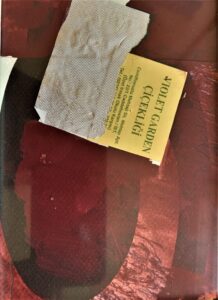
In addition to all of these major works, Tomur has made hundreds of small works, part of her ongoing Diaries. Each one is composed of a the detritus of everyday life, a candy wrapper, a ticket to an exhibition framed in a small format with her signature expressionist gestures added. These small diaries tell the story of her life in collage. They have been exhibited on their own and in connection with larger works (such as perched on top of the goddess series). They tell us as much about who this prolific artist is, as do the large scale works.
Here is one diary postcard:
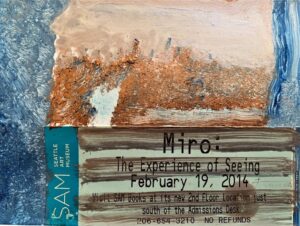
A Miro exhibition we went to when she came to US in 2014
As the Elgiz Museum described the Diaries in 2006 :
“a collage of over 1000 post card sized mixed media works produced between 1990 and 2006. Journeys through France, Germany, Italy, USA, UK, Macedonia, Greece, Azerbaijan, South Korea, Yugoslavia and Turkey represent the subjects for the artist’s reflection; instead of following the conventional literary format of a diary where passages are added simultaneously with the event, Atagok chooses to reflect on each event after a period of time has passed; this allows her to effectively fuse the past with the present. She chooses not to focus on isolated moments but on a collection of memories illustrated through everyday items such as tickets, wrappings and photos.
‘The Diaries’ do not function as a commentary on life but is intended as an accumulation of recycled materials intercepted by art. These works are personal, informal and social
Tomur Atagok as an artist, a feminist, a pioneering writer and historian of art by women in Turkey, an educator of museum professionals, an activist. Yet all of these identities still do not fully encompass her accomplishments. She is above all a deeply feeling human being who when asked about her dream project stated: “ I would like to work more on human equality with man and woman . . . We are all equal!”
How much we will miss her!

At the time of my visit during 15th Istanbul Biennial. ( I still have that hat)

This entry was posted on March 31, 2025 and is filed under Art and Activism, Contemporary Art, ecology, Feminism, landscape, Uncategorized.
Buster Simpson Town and Country Crier
“I believe artists’ work often functions as the equivalent of a town crier, calling out concepts in public. Traditionally the crier’s message is of civic or community importance, here we add construct. The Town and Country Crier exhibition presents a range of environmental and social issues. These issues often inform actions creating artwork that connects indicator, mitigator and story teller.” Buster Simpson
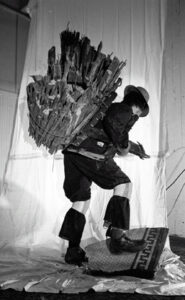
Buster Simpson ” Woodman”
In the 1970s Buster Simpson picked up pieces of wood off the street and at sites of building demolition.

 This photo is a recreation of that action.
When Buster first arrived in Seattle his first exhibition was simply cleaning up a filthy warehouse where he was staying with a fellow artist Chris Jonic. The exhibition was titled “Selective Disposal Project” Buster Simpson is idealistic and humourous but practical. He really wants to improve the environment and encourage us to do that also, but he has a good time doing it.

His recent exhibition at Slip Galllery in Belltown
“Town and Country Crier” is an appropriate place for Simpson to show his work. Belltown has been a focus of his work for many decades.We are greeted at the door by a photo of the word “purge” written in chalk and glass bells with bronze clappers.
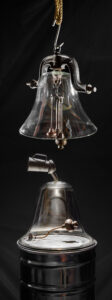
His themes are embodied in these works, purge referring to cleaning toxins out of water, and the bell points to his ironic sense of humor. It suggests an announcement is coming ( as in Town Crier calling attention fo an emergency. But if you actually ring this bell it will shatter. That takes our imaginations to where we are today. Emergency bells that can’t be heard.
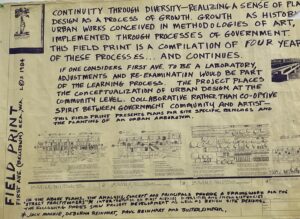
The first gallery is a mini retrospective of his Belltown work with a team of collaborators planting trees on First Avenue. He included a document from that project.The diagram at the bottom indicates where trees were to be planted ( many were); The project also included benches.
The handwritten document from the First Avenue Project identifies the larger issue at stake: working from and with community rather than top down through government mandates. The archival documents fill a wall.
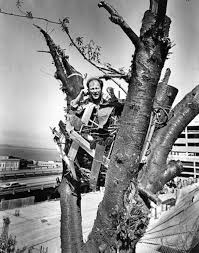
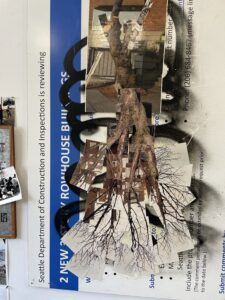
He stayed in one tree to protest its cutting down : the photograph of the upside down tree on the right is another truncated tree.
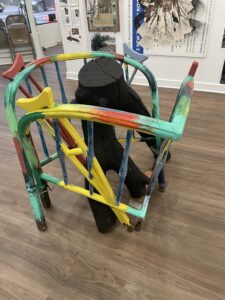
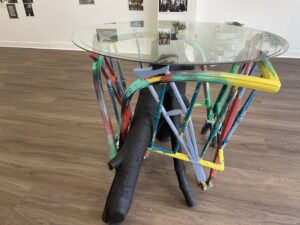
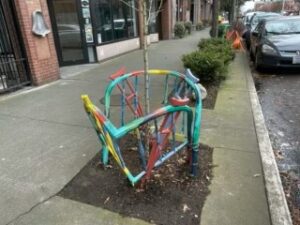
One long term project was to use iron bedsteads from SROs that were being torn down to protect the trees that he and others planted in Belltown.Here is a sad statement in the exhibition of the bedstead protecting a burned tree root. When I went back to the exhibition a second time, it was covered with a glass tabletop, which diluted the emotioinal immediacy of the bare black tree. Now it is protecting a small tree outside the gallery
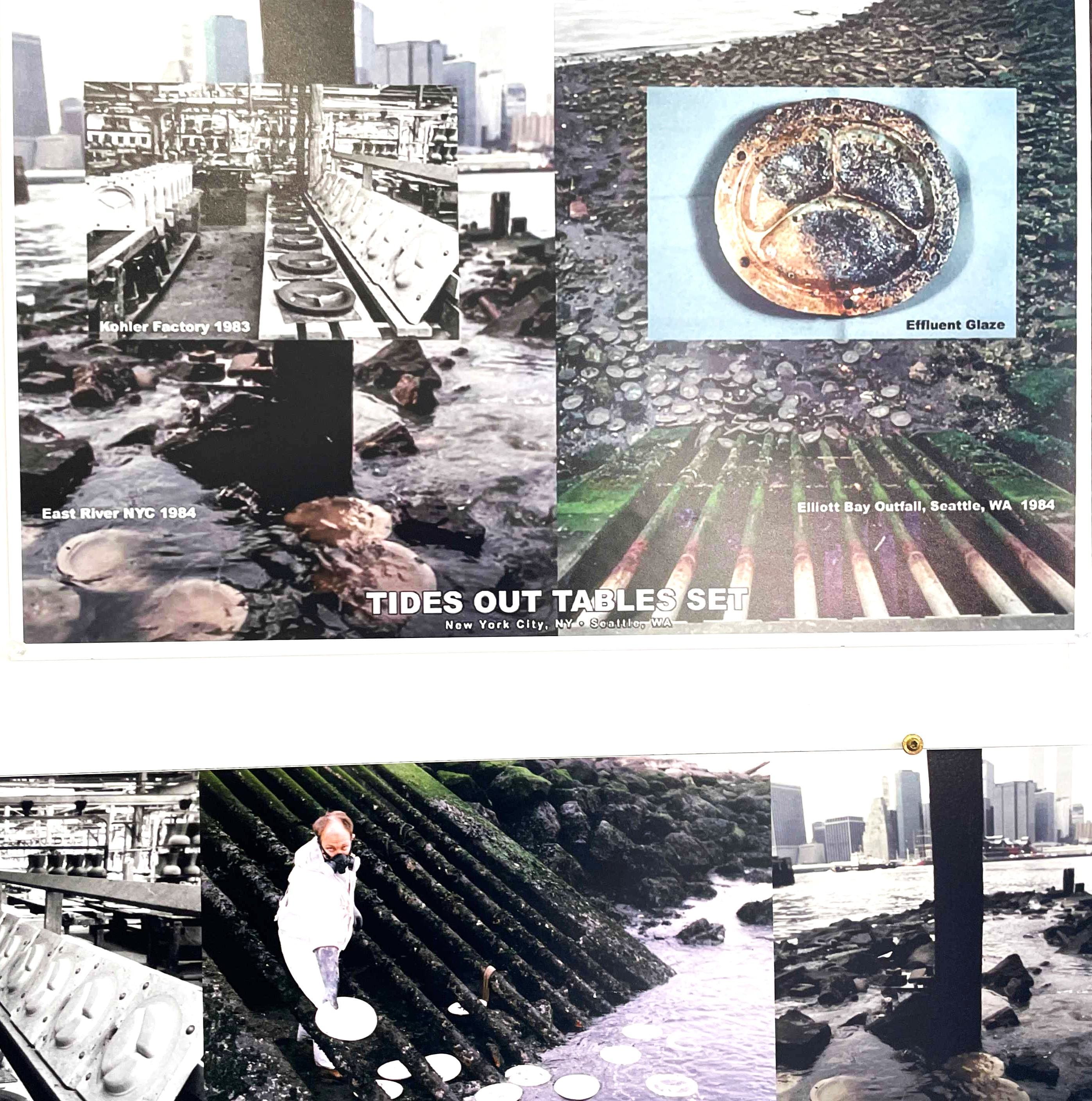
In this first gallery there are also references to two important ongoing projects,”When the Tide is Out the Table is Set”. This is a not at all amusing quote from Native Americans description of the Duwamish River before the white Man came. Now we have intense polution on that same river
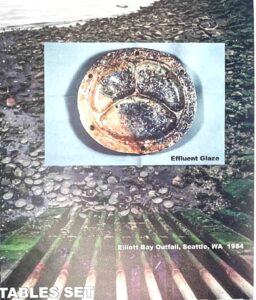
This dinner plate picked up pollution from being placed in Elliott Bay
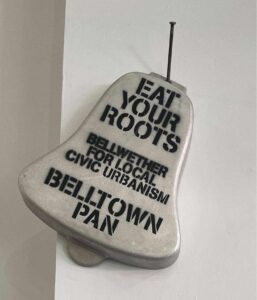
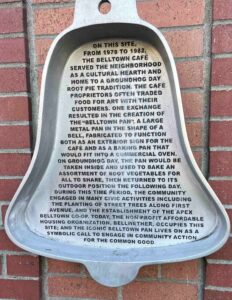 Another series of works are based on the bell shape made into a pan in which a community meal was cooked. The Belltown cafe was a community gathering place that traded food for art.
Purge is a major theme Buster Simpson’s work. Many of his actions over the years have focused on detoxifying rivers. Here you see on the floor the limestone frog, whom Simpson said was an indicator species. The limestone frog when placed in water detoxifies the water, to the extent possible,
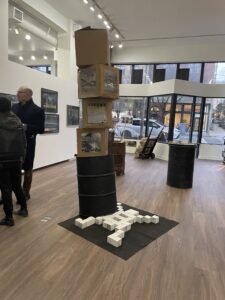
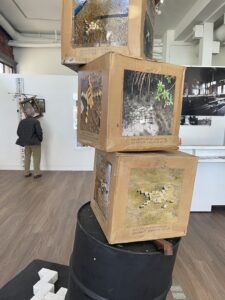
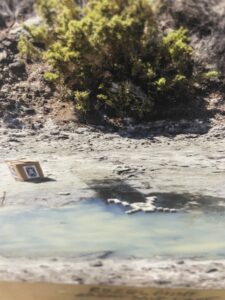
an action repeated in many places recorded in the stack of boxes. ( He mentioned that it was a special limestone found only in Texas, which I found amusing). Here is the frog in the Great Salt Lake which is of course disappearing( both the lake and the frog)
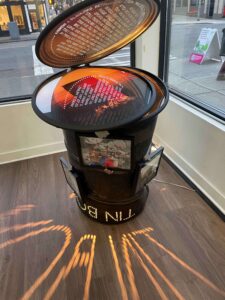
Another reference to toxins, in this case deadly, is a rusted oil barrel with a reference to the smallpox ridden rags that were passed on to Indians.
In this room there is also a complex and amusing multimedia piece referring to changing coastlines and climate change with a giant depth measure as well as a crucified haloed “figure” made from branches holding dipsticks. Across the front is a large level with monopoly pieces inside. Simpson’s specialty is multiple overlaid references to what he cares deeply about laced with humor.
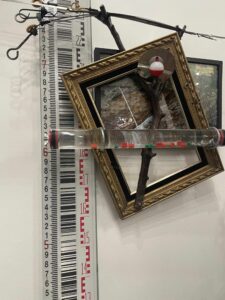
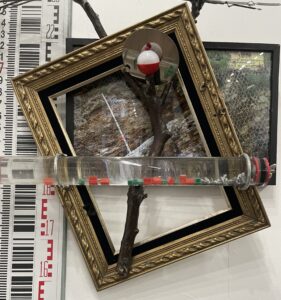
Simpson’s roots are in conceptual art, artists who didn’t believe in making objects for sale-instead they make gestures or draw plans. Simpson stands out because he continues to work with the real world and physical things, but always in a subversive and amusing way.
Brightwater watermolecule and pipe
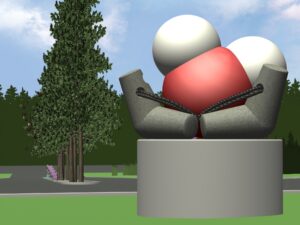
molecule
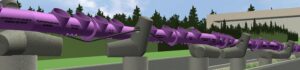
Brightwater Bio Boulevard
Simpson also works often with large committees and successfully completes projects such as the Brightwater Treatment Plan (with many other artists)
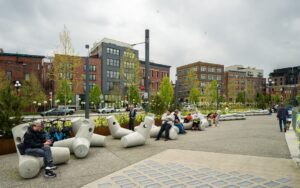
photograph by Joe Freeman
and the waterfront “Anthropocene Migration Stage” on the beach near Yesler. Simpson conceived it as a place to sit temporarily until the sea level requires it to migrate away from the water. He frequently uses these concrete dolos . Dolos are also a metaphor:
“a wave-dissipating concrete block used in coastal management (dolosse), a personified spirit of trickery and guile in Greek mythology, and a source code plagiarism detection tool”
No wonder Simpson likes them!
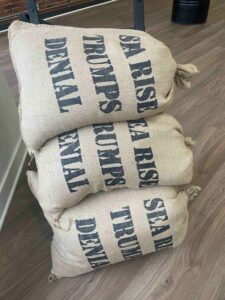
As we leave the gallery three bags filled with sand say “Searise Trumps Denial.”
A large sack of chalks invite us to take one and make our own protests in the street