“Beau Dick : Insatiable Beings “ until January 18th Frye Art Museum 704 Terry Ave, Wed- Sun 11-5
When I first came into the Frye Art Museum and saw the mask by Beau Dick in the front gallery I was horrified and frightened. They seemed so aggressive and ugly. But by a stroke of good fortune I was able to see a long film about Beau Dick in the museum and it explained how his unique masks are created and animated with performances at gift giving potlatches at Alert Bay Canada.
As he performs he creates a magical atmosphere with the mask. Each mask has its own particular function and name and as you begin to get used to his incredible distortions and originality it becomes a fascinating exploration.
Beau Dick belonged to a secret society called Hamt’sa. To become part of this secret society the young man must become possessed by and purged from the spirit of Bax wbakwalanuksiwe’, a cannibalistic giant. In the end they are cured of the disease to consume everything. Beau Dick’s subtitle of his catalog is “devoured by consumerism.” suggesting that most of society is not yet cured.
Consumption of animals as well as the planet itself by humans is the driving force behind Beau Dick’s work. In 2012 he took 40 Atlakima masks from an exhibition of his work in Vancouver, brought them back to his home in Alert Bay and burned them as a strong statement to “short circuit the commodification of northwest coast ceremonial objects.” Valuable objects are traded not sold between the people of the Kwakwaka’wakw. By burning the masks the objects were returned to the ancestors. The Atlakima also known as the “Dance of the Forest Spirits” includes 40 different characters ranging from supernatural to human.
“Winalagalis The War Spirit Puppet” creates trouble wherever he goes. In the exhibition there were several examples of this disruptive spirit. Under the theme of Hamat’sa we saw Moogums four masks representing the “bird henchman” of the cannibalistic giant. Another group are the ghosts who seem to be taking care of the giant and they can resurrect people from the dead. Apparently there is also a reference to Dickens’ Christmas Carol ghosts! The layers of meaning and materials are complex and can only be touched on here.
A second exhibition by an indigenous artist features multimedia work by Priscilla Dobler Dzul. “Water carries the story of our stars.” (Ja’e’ ku bisik u k’ajláayil k Eek’/El agua lleva las historias de nuestras estrellas”) (until April 19).
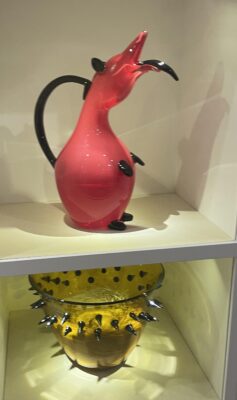
In niches in the wall outside the gallery blown glass vessels make reference to various specific animals and activities with the collective title:
“’When the three armadillos arrived with the water, the lords of the underworld brought the offerings and vessels removed their thorns to weave the threads together.”
All of these vessels have unique forms with precise titles such as “Turtle rabbit also known as armadillo has been called many names, knows many things that the water, land, and winds carry.”
The artist is a mix of Mayan and Mexican heritage as well as Scottish. She, like Beau Dick, is making reference to the critical situation on the planet, in her case with a focus on water.
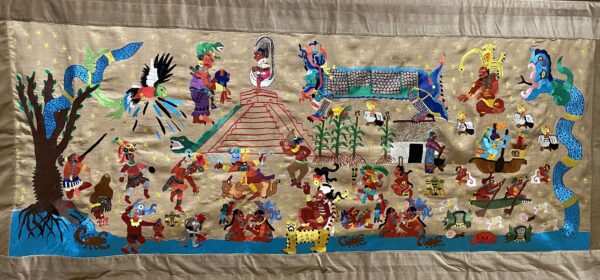
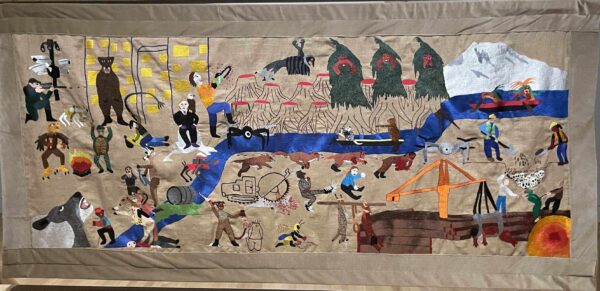
At the entrance to the gallery the artist has placed a large embroidery with the title “here is the beginning the lands of the Mayas.” Looking carefully we can see a myriad of traditional gods, headdresses, people dancing , animals running around and the river flowing at the bottom of the tapestry also filled with creatures.
A second embroidery facing the other way is titled our “skies were once filled with stars.” It shows the deterioration of the environment. All is chaos, fear and conflict. A white man in the foreground stands on a pile of bones.
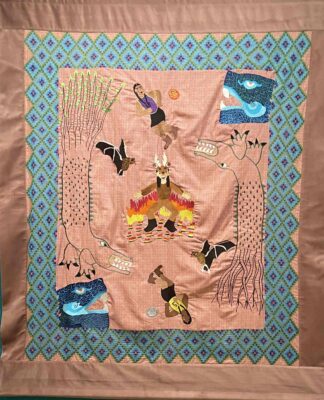
A smaller work made in collaboration with Doña Chela (Maria Graciela Cante Peraza) references that Kulkulcan descends from the skies.
We see a feathered serpent deity who descends from the sky and bridges earth and sky as a symbol of protection.
In the center of the exhibition an installation large ceramic vessels suggest women’s torsos. “The four winds gathered around Tree and her threads.” They contain whistles and are connected by backstrap weaving, a long tradition in Mayan culture, to a “tree” representing the Mayan tree of life.
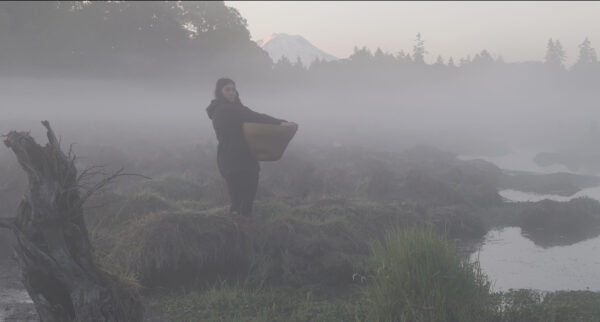
In the last corner of the exhibition a video documents a performance that Priscilla created focusing on polluted water in the Yucatan and Tacoma (where she also lives). Near it are guardian figures in clay.
These two exhibitions are remarkable examples of contemporary indigenous artists that address environmental concerns in entirely different media. The Frye Art Museum shines as it gives us new ways to understand our contemporary crisis. We are indeed fortunate to have it in our neighborhood (and it is free!).
This entry was posted on January 22, 2026 and is filed under Uncategorized.
Note: I have some better picutres of Alan from the opening but for some reason the website won’t let me
put them in blog
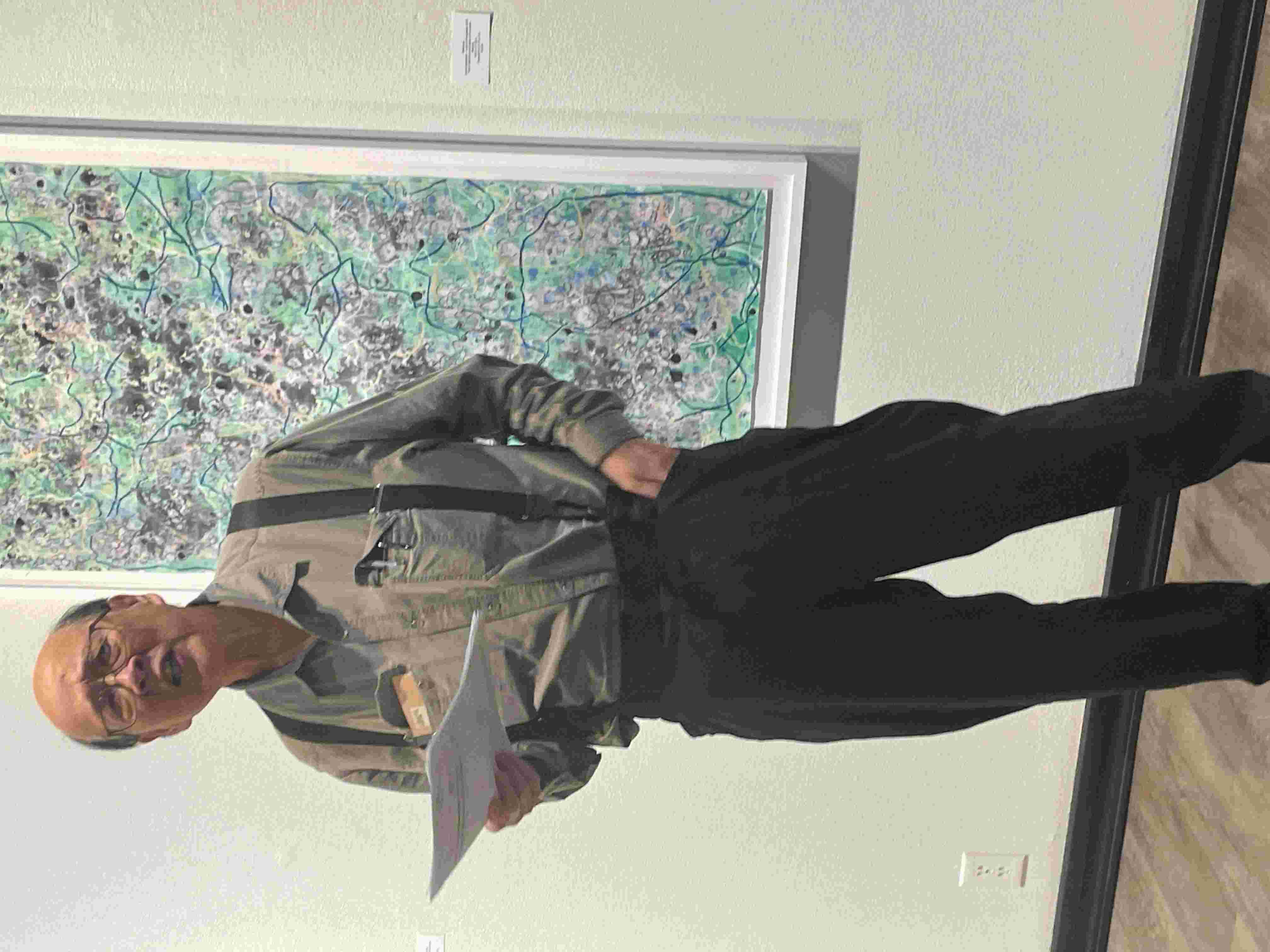
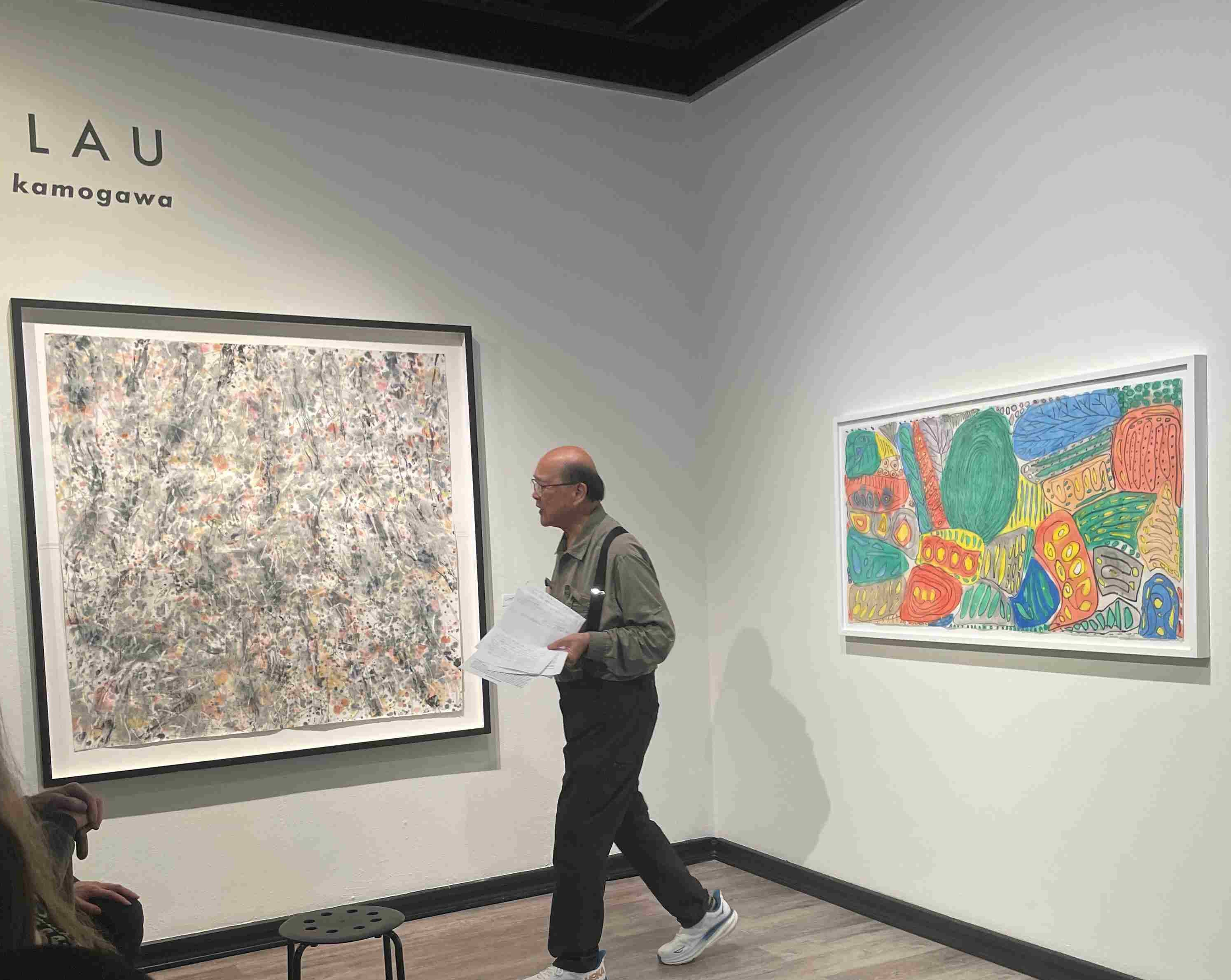
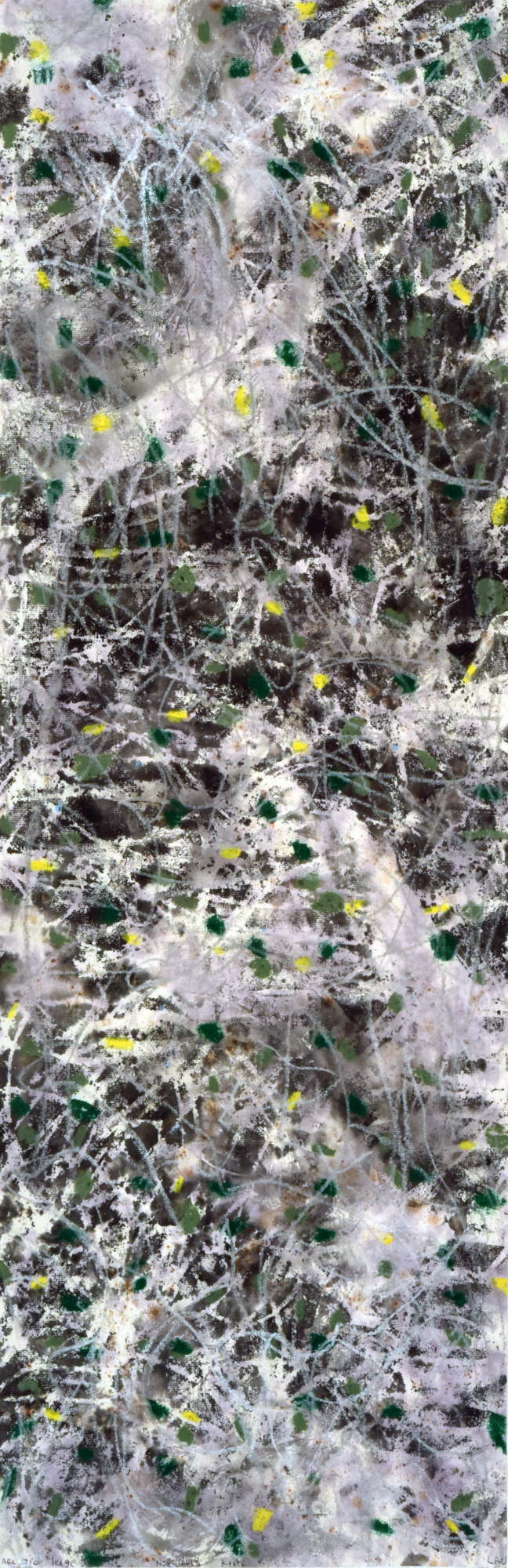
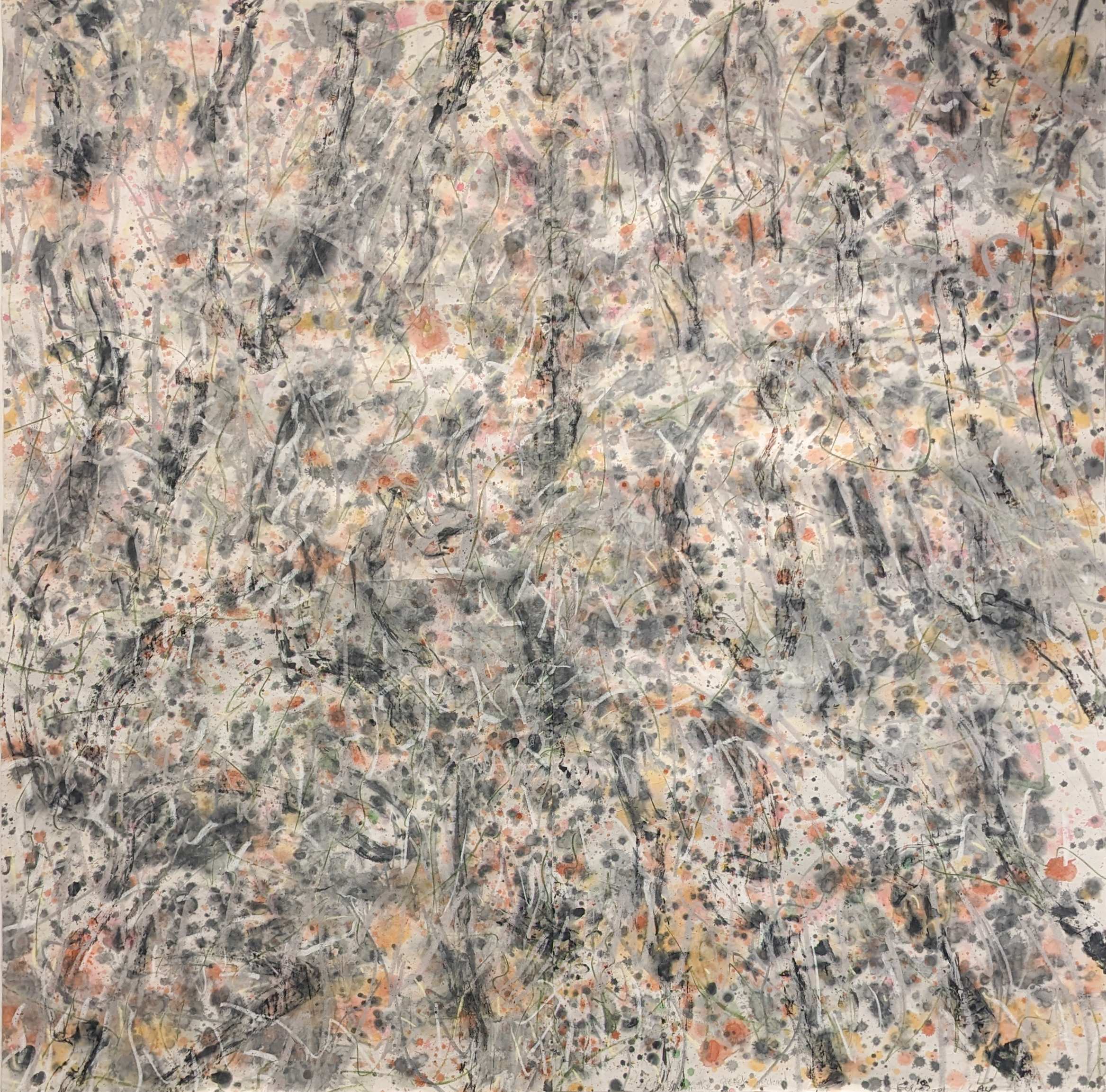
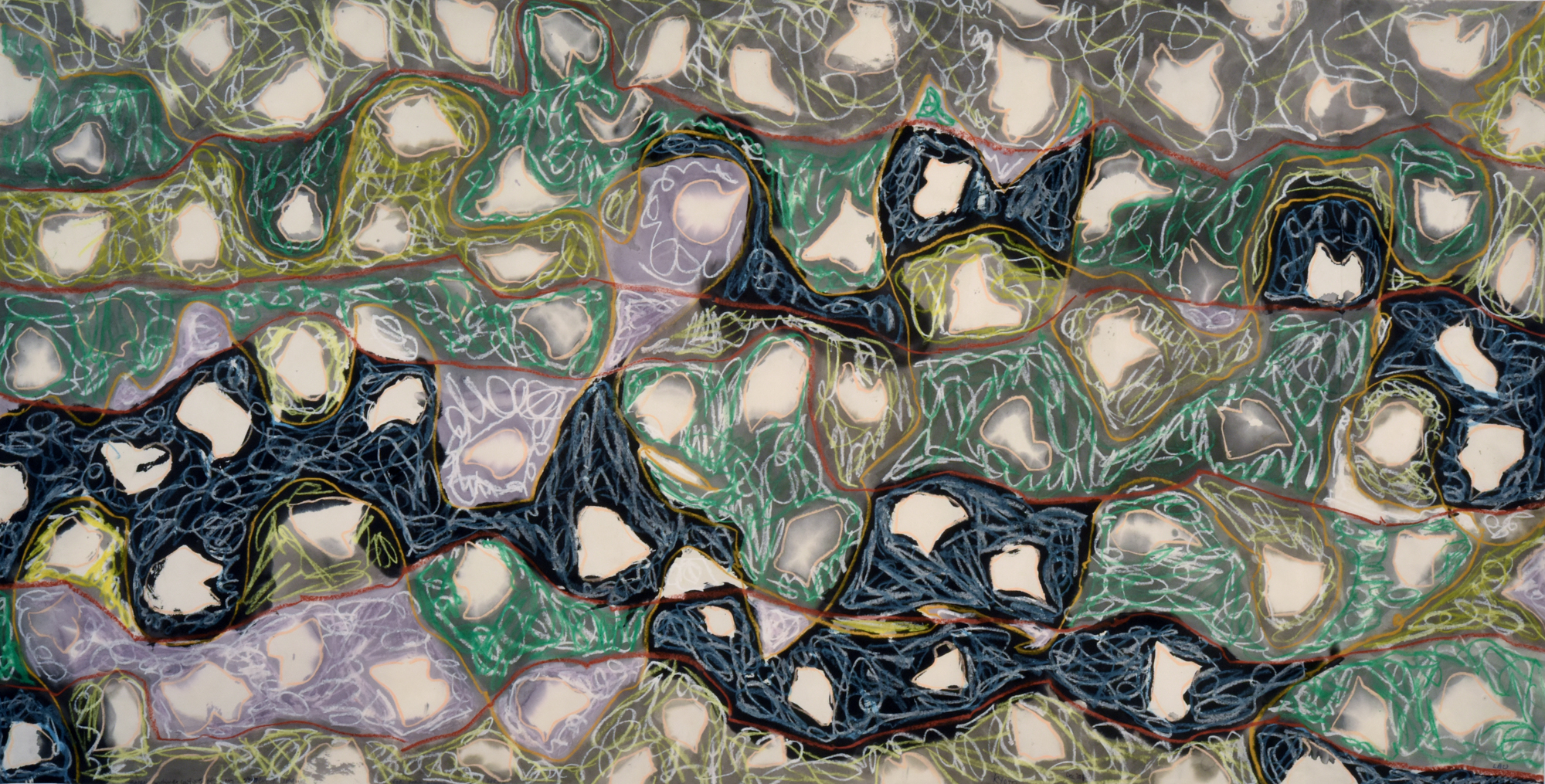
Alan Lau focuses on nature intimately.`“Walks Along the Kamogawa: The Kyoto Series Part I” gives us lyrical paintings in sumi, watercolor and pastel on rice paper that evoke hanging vines and swirling waters, sometimes birds (tracing migration patterns of small birds) and animals (when the zebra lost her spots).
Immerse yourself in this paintng: arctic ledge
It suggests different temperatures in cool grays
or in the peach orchard with soft pinks, much warmer
“trapped within my garden of longing (in memory of peach blossom spring)” is entirely different in stroke, texture and color.
The titles, all written in lower case by the artist, suggest a poetic enchantment in themselves.
We can imagine the artist in Kyoto in his “make shift studio in my in-laws’ house…the only room in the house where the sun filters in. Below I see the tiny garden with a lone persimmon tree with orange bursts of fruit and a spindly Japanese tree blushing with red and yellow leaves.”
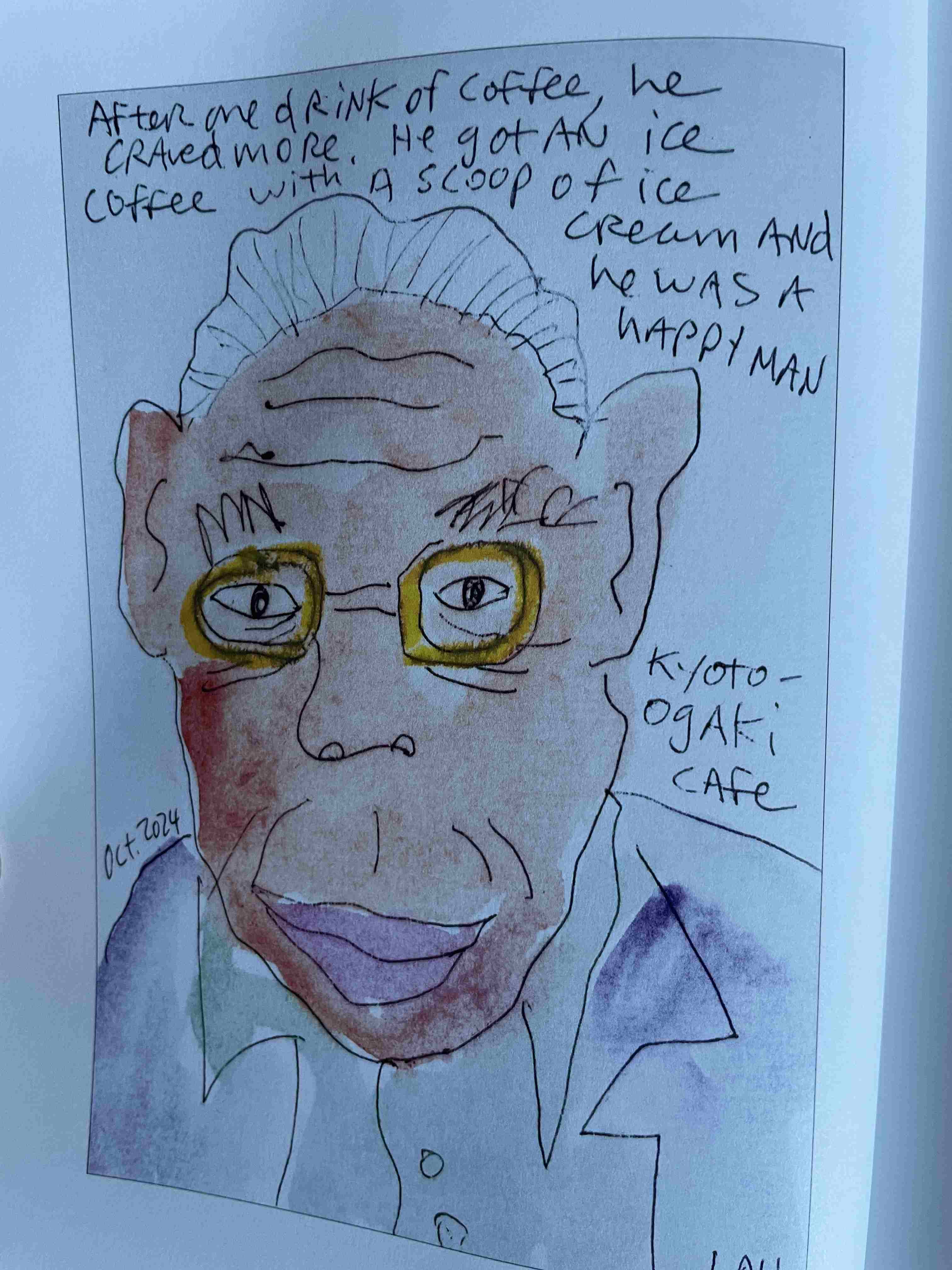
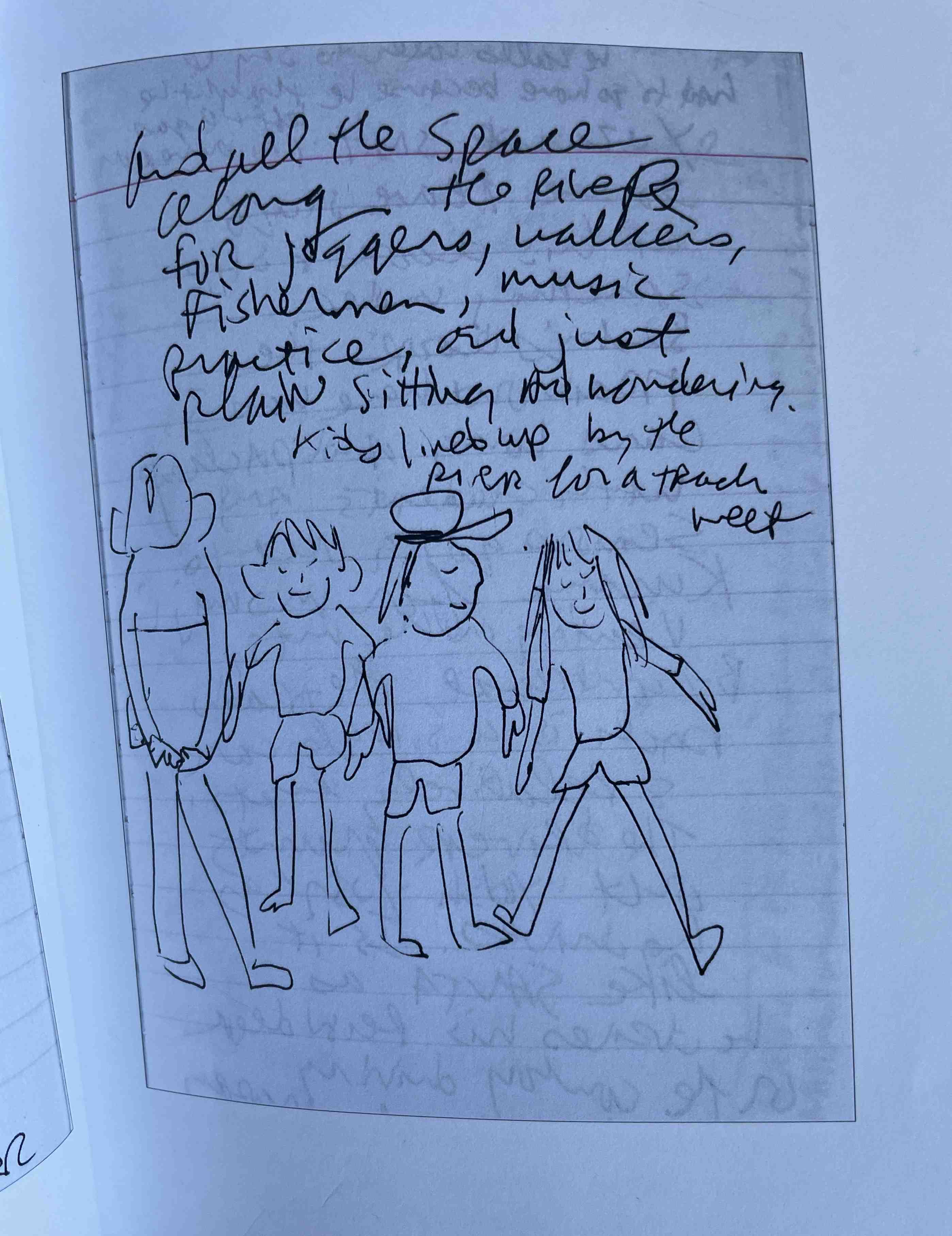
That quote is from his recent book This Single Road. The book is an experimenatl format, with drawings, writing in script and printed narrative, making it into a collage. The book includes his observations along the Kawagama river : along the sidewalks beside it he sees a playground, musicians, seniors doing aerobics , and children in a race. The minuteness of his observations really affected me. I started doing the same thing,looking at a space with careful observations.
This entry was posted on December 30, 2025 and is filed under Uncategorized.
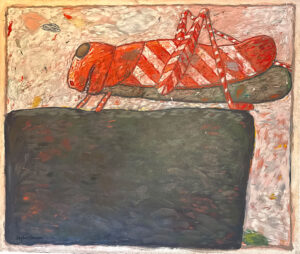
A painting of a giant grasshopper standing on a rock invites us into the Woodside Braseth Gallery for an exhibition of Gaylen Hansen, age 104.
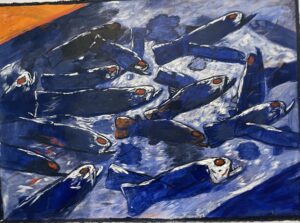
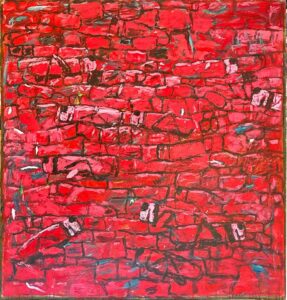
As we enter the gallery we see a swarm of bright blue fish with intense red eyes, mouths open and teeth bared. Turning to the right we see a red wall with irregular bricks and large grasshoppers climbing on it. But the painting is titled “Red Wall Two Ducks.” I asked the gallery owner where the ducks were and he said, “Behind the wall.” Hansen’s sense of humor!
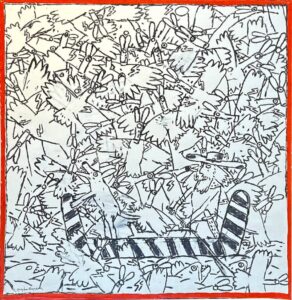
There is one painting with Gaylen’s alter ego Kernal, the only black and white work. A swarm of ducks fill the sky behind the Kernal who is paddling a striped canoe with a dog in the bow. Fish leap up for the birds across the bottom of the painting.
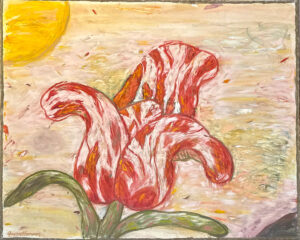
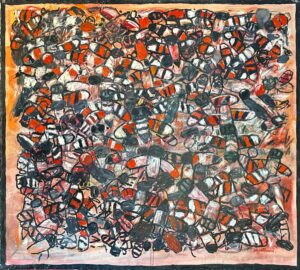
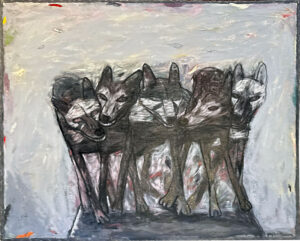
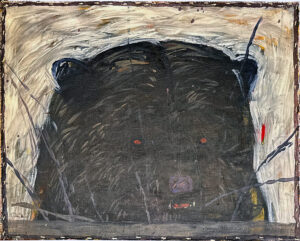
Other topics in the exhibition (and trademarks in much of his earlier work) include huge tulips, a swarm of bees that fills an entire canvas, and a dense pack of wolves. A closeup of a bear’s face peers at us rather agreeably.
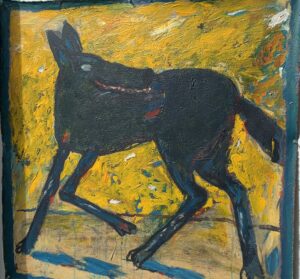
the dog is brilliantly arranged imnto the square canvas with the yellow bacground creating a harsh emotional atmosphere
This pinting titled Red Wall Two Ducks is a joke, as the two ducks do not appear as far as I can tell. When I asked the gallery ownere about them, he said they were behind the wall!
Hansen was a professor at Washington State University for many years. After he retired, he lived in Palouse, a small town nearby. He had plenty of opportunities to experience the scenes that he depicts, but he never settles for “scenery.” The huge scale of the wildlife and small scale of his figure suggests his respect for these creatures as well as his sense of humor.
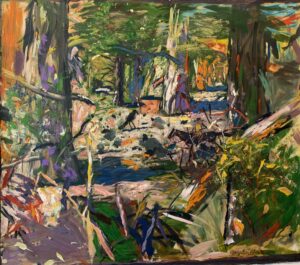
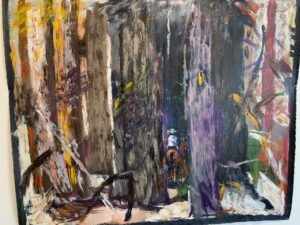
He moved to Whidbey Island in 2014. It was a radical change of environment. The Palouse is a wide-open horizontal landscape while Whidbey Island is filled with tall closely packed trees. A loosely painted image of a bear in the forest from 2021, suggests that bears are still running through his life, but now they are taking second place to the forest.
Hansen grew up on his grandfather’s farm immersed in geese, goats, chickens, cattle, pigs, and ducks many of which are the subject of his paintings. He rode horses and did heavy farm labor from the age of nine. Such a childhood must be the foundation for his incredible longevity.
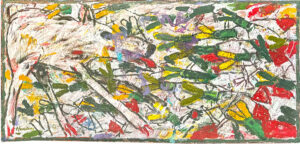
The paintings of the 1980s are characterized by intense confrontations of different species and humans (mostly the Kernal). But in later work like Dog and Many Ducks of 2012 ( above)there is no human present. The dog faces many ducks who seem to all be squawking at him. He is obviously outnumbered and daunted.
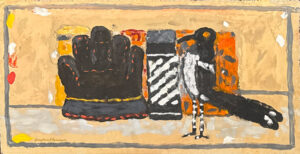
Another format is the still life composition, which juxtaposes, for example, a large glove and a magpie. Hansen loves to experiment with scale and here the glove and magpie are the same size. Another painting is only one large glove. In another, a red fish fills the canvas. We can see here the formal strengths of the artist as he takes a familiar object and transforms it into an imposing shape.
On Whidbey Island the tall trees overwhelm rather than the large creatures
But here we see asmall Kernal riding away from us.
Hansen is a phenomenal painter. His colors, his compositions, his brushstrokes dazzle. Close looking reveals the complexity of his painting. Wandering through these brightly colored paintings of so many creatures, most of them hugely enlarged, immerses us in Hansen’s fantasy world.
New books and an exhibition demonstrate Ruth Asawa’s extraordinary contributions to 20th century sculpture
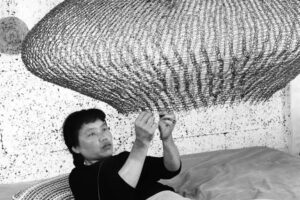
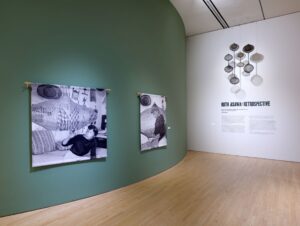
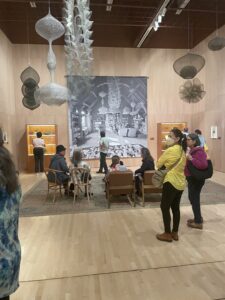
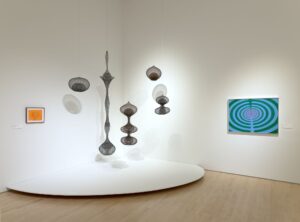
Installation view of Ruth Asawa: Retrospective at the San Francisco Museum of Modern Art, including a photograph of artist’s living room. Photo by Heinrich Kam.
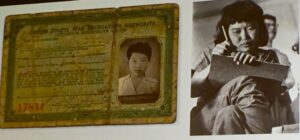
Ruth Asawa had an extraordinary childhood. In her early years she grew up on a farm with her immigrant parents, sharing in the hard work. That ethic of hard work stayed with her throughout her career as an artist. In April 1942, when she was sixteen, her family was sent to a detention camp, first the Santa Anita Assembly Center, then the Rohwer Relocation Camp in Arkansas. At the Santa Anita camp, she had the fortune of learning from three Asian American artists who worked for Walt Disney.
After she graduated from high school in the Rohwer camp in August 1943, Asawa was allowed to leave, provided she stayed away from the West Coast. She attended the Milwaukee State Teachers College and then the Black Mountain College in North Carolina, an experimental interdisciplinary arts school. It changed the course of her life.
These are some of the details with which Marilyn Chase begins her biography of Asawa, Everything She Touched: The Life ofRuth Asawa (2020).
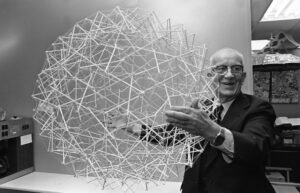
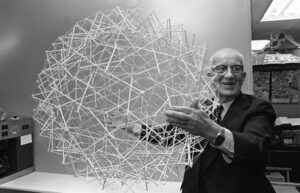
In a Philadelphia office, R. Buckminster Fuller holds up a tensegrity sphere one of his inventions thats inspired a space project April 18, 1979. Dr. Enrest Okress of the Franklin Center envisions the structure, made of rods and cables, as the basis for a Spherical Tensegrity Atmospheric Research Station Stars. A giant tensegrity sphere could be light and strong enough to support a floating space station a mile in diameter. (AP Photo/Bill Ingraham
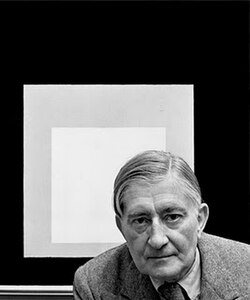
Chase carefully describes Asawa’s unusual education at Black Mountain College, her study with the artist Josef Albers and the architect and philosopher Buckminster Fuller, as well as the courtship between her and the architect Alfred Lanier, her future husband. After completing her education, Asawa moved to San Francisco with Lanier to start her family and her career.
Chase’s book is an easy read. It includes a continuous narrative that focuses on Asawa’s professional activity and her personal life, much of it based on Asawa’s letters.
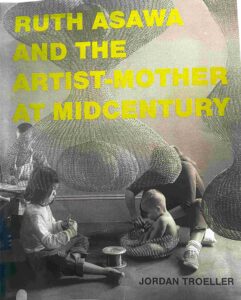
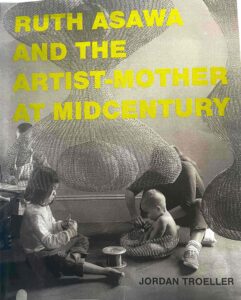
In her recent book Ruth Asawa and The Artist-Mother at Midcentury (2025), Jordan Troeller emphasizes the ways in which Asawa, together with other what she calls “artist-mothers,” managed to produce extraordinary art while they were raising children. Troeller’s method is to examine both motherhood and creativity together (she leads a research group on “The M/Other Project: Creativity, Procreation, and Contemporary Art,”). Asawa raised six children, defying the idea that having children prevents women from making creative art, Troeller argues. Various Asawa techniques such as weaving and knitting connect to female traditions, Troeller suggests, because they enable the artist to start and stop as is necessary to attend to children.
In actuality however, Asawa’s incorporation of her children into her art process might undermine that argument. Asawa’s work ethic and ability to embrace creativity as a generous gift meant that she worked almost nonstop, with her children helping as they grew older. Other chapters in Troeller’s book focus on flowers, folding, or pregnancy, to name only a few themes, integrating them with aspects of Asawa’s work.
Asawa’s best known image of pregnancy is the “Andrea” cast bronze public sculpture in San Francisco. I found Troeller’s book a bit insistent in connecting everything to a feminist analysis. At the same time, it clearly demonstrates a feminist answer to patriarchal tropes and the traditional parameters of making art as a woman.
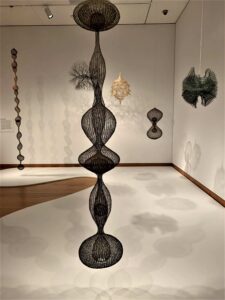
Installation view from Ruth Asawa: Retrospective at the San Francisco Museum of Modern Art Photo by Susan Platt.
As an art historian, I have to say that the large book accompanying Asawa’s major retrospective at the San Francisco Museum of Modern Art (SFMOMA) is comprehensive and invaluable. Edited by Janet Bishop, Ruth Asawa: Retrospective (2025) includes essay after essay on themes such as “From Tool to Ornament, Ruth’s Intricate Refusals,” and “What Cannot Be Produced Alone : Ruth Asawa’s Public Art.”
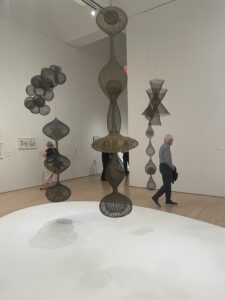
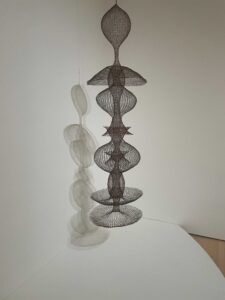
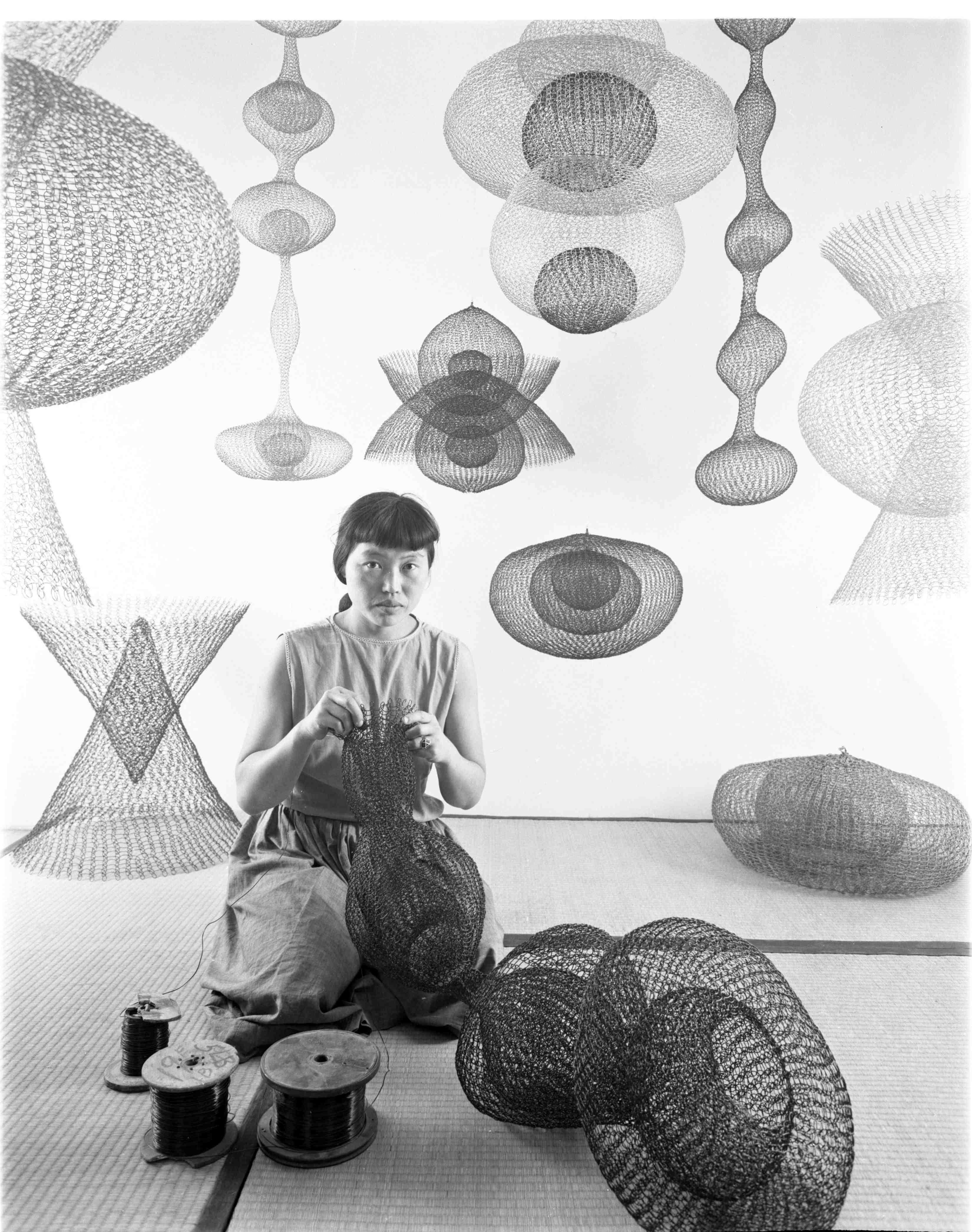
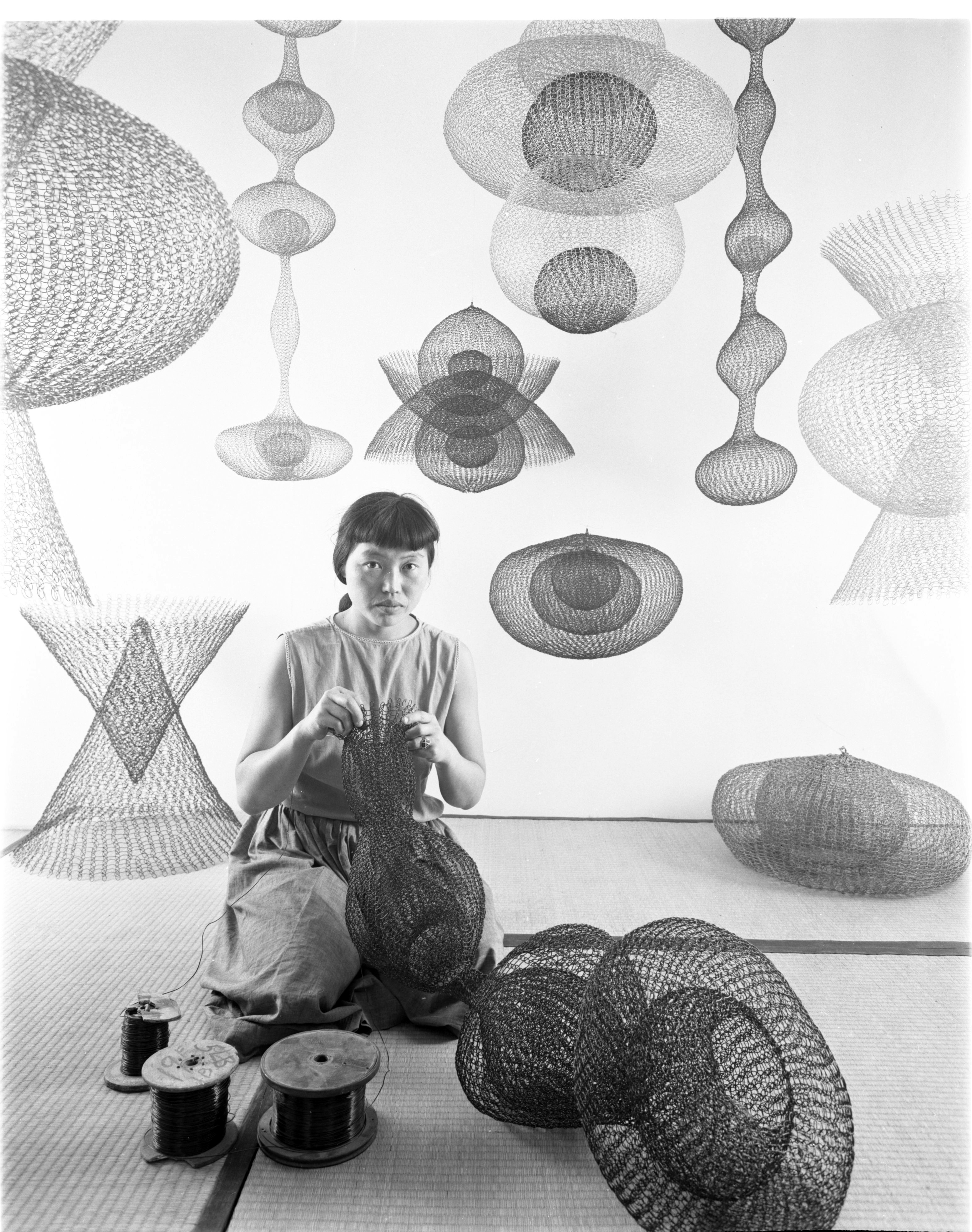
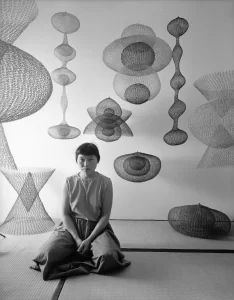
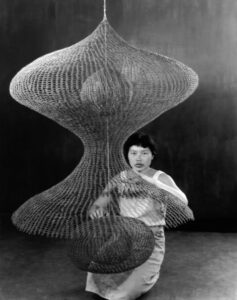
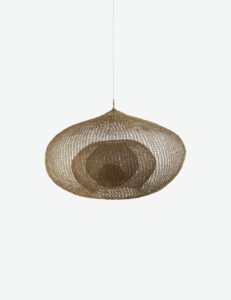
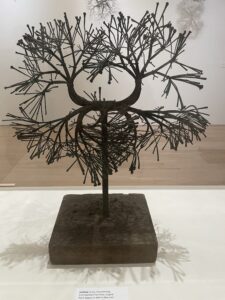
The SFMOMA exhibition itself follows all the stages of Asawa’s artistic career, from single woven-wire baskets to complex hanging sculptures enclosing one orb inside another. Then a new technique of tying wire, electroplating it, and much more. These dazzling hanging works are Asawa’s best known work. The complete discussion of her public art is also represented in the catalog and the exhibition, where we seestudies and photographs. The installation at the SFMOMA even includes a sample from Asawa’s garden.
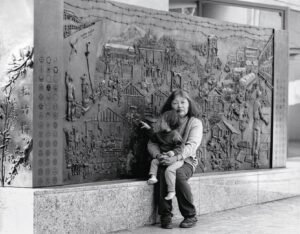
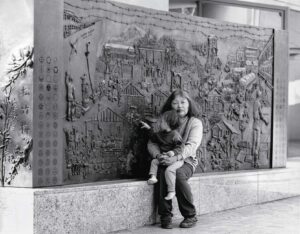
As we learn in this thorough study, Zen Buddhism was part of Asawa’s worldview, as well as nature itself. Her drawings of leaves and plants show her understanding of the intricacies of the natural world. In the chapter on public art, bronze casting is a major departure, as well as the scale of the works she took on, a huge low relief of the Japanese incarceration camps, a wall called San Francisco Fountain, with many small reliefs of life in San Francisco and many more.
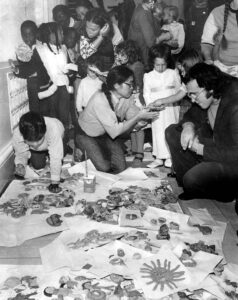
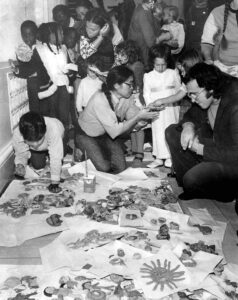
Asawa’s creativity also extended to schoolchildren, teaching them innovative ways to make art with materials such as milk cartons, and “bakers clay” (flour, salt and water). Asawa also engaged in civic affairs, founding an art school, now called the Ruth Asawa School of the Arts, and lobbying for more art education in the public schools.
The magnificent sculptures that Ruth Asawa created hang in space, and surround space. They embrace interior and exterior, the delicate and the strong, the idea of growth and the idea of stasis. It is hard to overstate her contribution: her wire-based art, at first seen as simply decorative, is now understood as major accomplishments of twentieth century sculpture.
This entry was posted on November 18, 2025 and is filed under Uncategorized.
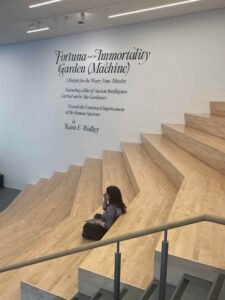
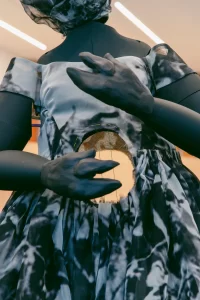
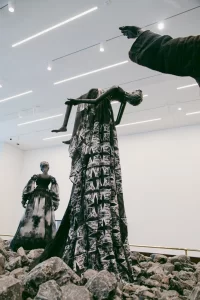
At the San Francisco Museum of Modern Art I saw an intense installation by Kara May Walker with robotic movement and frightening arms and bodies going up and down .
The title is
Fortuna and the Immortality Garden (Machine) A recipe for the Weary Time Traveler Featuring a Rite of Ancient Intelligence carried out by The Gardeners toward the Continued Improvement of the Human Species
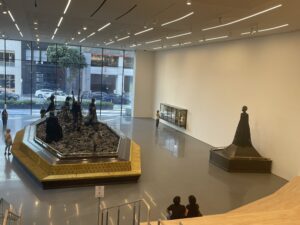
That’s the whole installaton from afar. When it was first created it had eight robots, now some of them no longer move, but the installation is still riveting
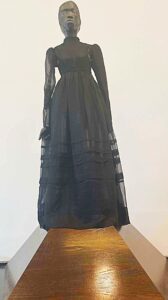
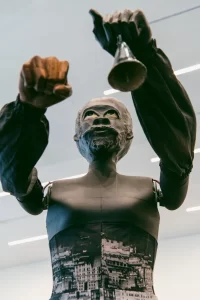
THis is Fortuna herself, a prophetess who orignally spit out fortunes to people.
“The paradox of Being Black is the condition of Not-being,” one read.
“Your last shred of dignity is often your best.”
“Loss is aheady thing our hearts cannot comprehend.”
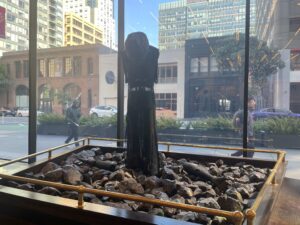
this figure is near the window, invoking a homeless man.
perhaps addicted to fentanyl.-
just ouside my door in Seattle in a park, I see many men and woman hanging in suspended animation like this after they take a dose of fentanyl
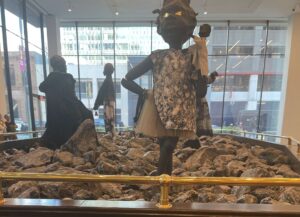
THis child and her puppet gaze around. It echoes Walker’s Covid experience, when she sought out an old doll for comfort.
This amazing work with its moving parts both fascinates and horrifies mre.
Walker speaks of dolls as “I thought about dolls as empathy machines, providing a service, and as some kind of magic object.”
“Fortuna and the Immortality Garden (Machine)” could be seen as a diorama of tomorrow, looking back at Black life in America “from the institution of slavery through the eviction of Black populations from inner cities like San Francisco,”
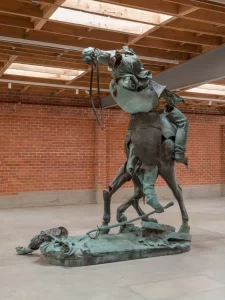
Kara Walker has also co curated the Monuments exhibition in Los Angeles, in which artists repurposeConfederate bronze monuments.Her own piece is here using part of a Stonewall Jackson equestrian monument.
This entry was posted on November 11, 2025 and is filed under Uncategorized.
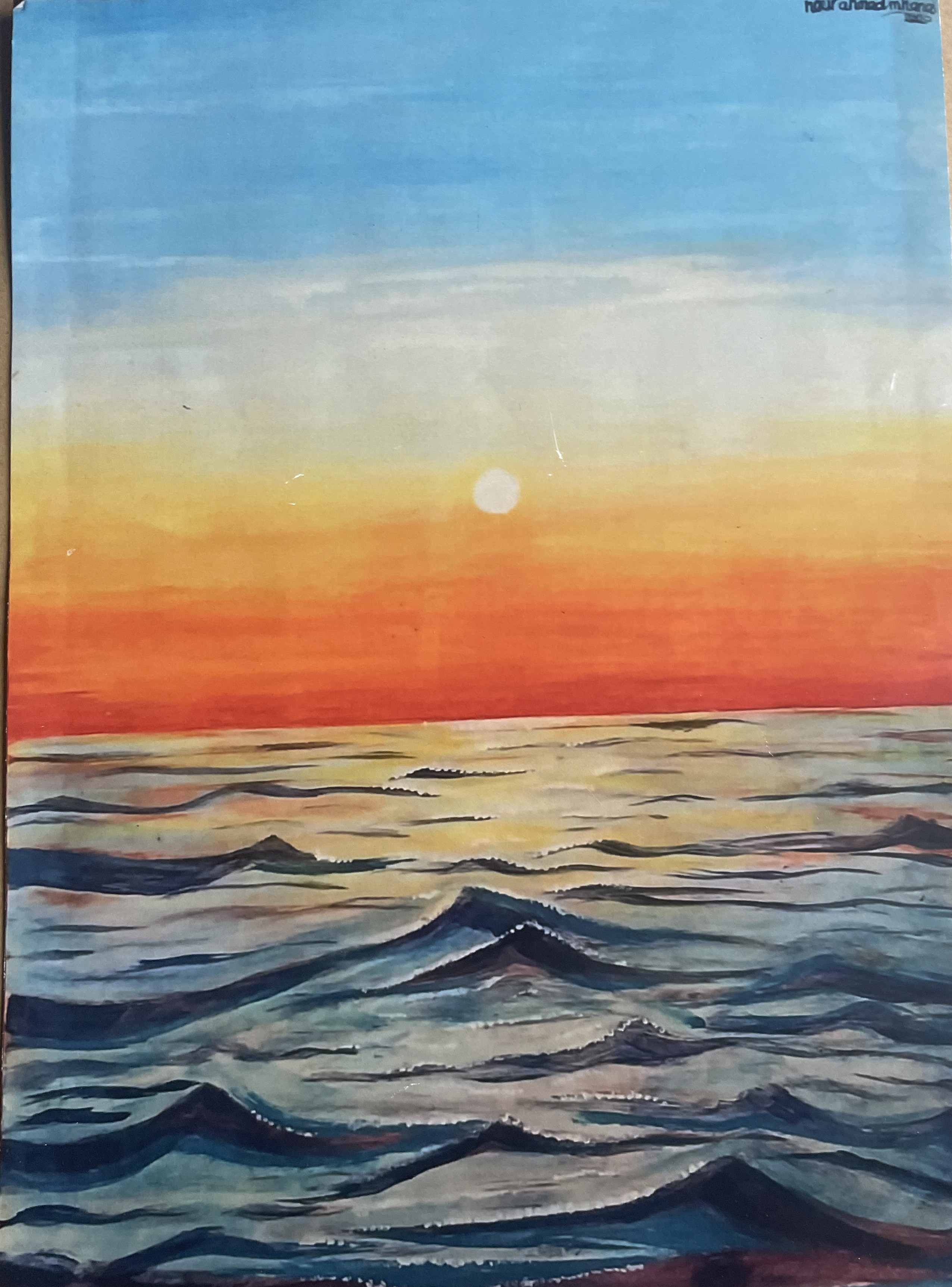
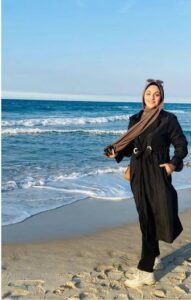
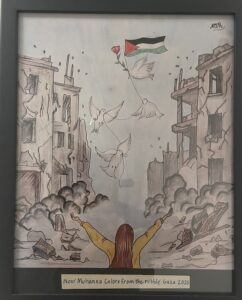
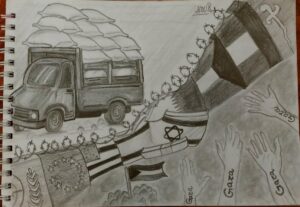
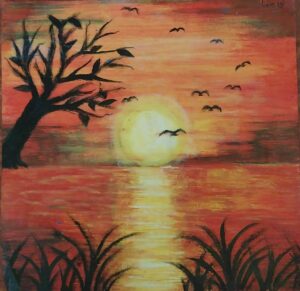
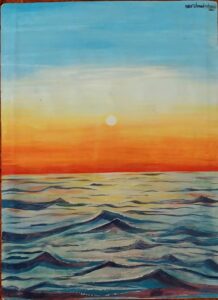
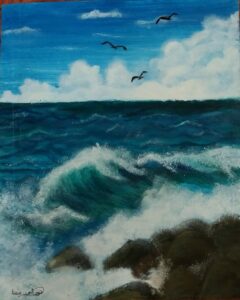
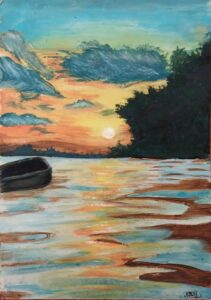
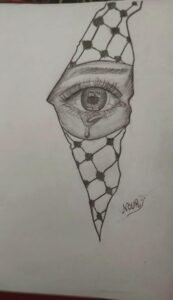
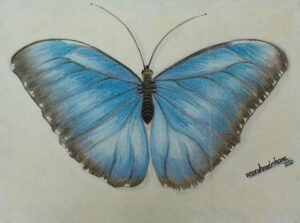
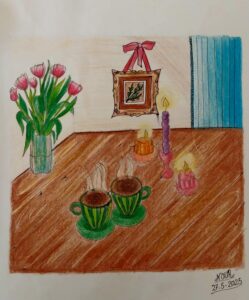
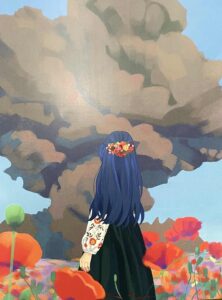
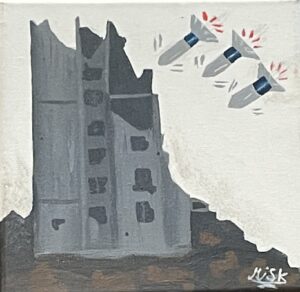
I am Nour Muhanna age 20, an artist and top ranking business student at Gaza university. Every painting carries a story. Since childhood art has been my refuge, a way to express my feelings . With our home now destroyed I have only colors and paper to rebuild my memories I paint nature because it gives me peace and I paint war because it dwells within me with all its pain
As the eldest daughter I carry deep family responsibilities especially during wartime. After losing our home my family now lives in a tent where daily life is a challenge. I help my father cook over fire, my aunt and mother bake bread and I wash clothes by hand.My siblings fetch water and we all support my grandmother who struggles to move in the harsh conditions. We all suffer from famine sand and insect allergies. Despite everything I remain committed to my studies, my ar,t and my hope for a better future. We in Gaza say we dream we create we live despite the challenges but it gets harder every day and still we are here.
This entry was posted on November 4, 2025 and is filed under Uncategorized.
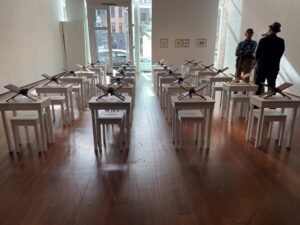
Humaira Abid, a Pakistani artist who lives in Seattle, created an exhibition (seen at Greg Kucera gallery) focusing on children from Gaza17 , Israel 2 and Ukraine 4
who have died in war.
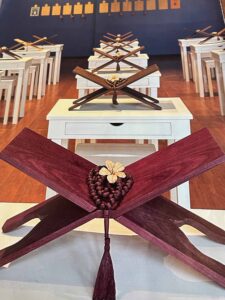
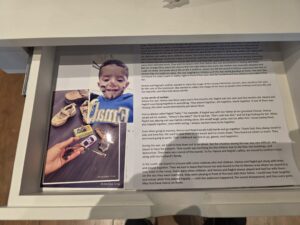
Her installation “The Shape of War” consists of twenty-four children’s desks (she plans on creating many more). On the desk is a “Rehal,” that would hold a Quran.
In this case they have prayer beads and a flower- a primrose symbolizes innocence or a petunia symbolizing hope.
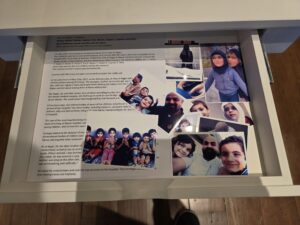
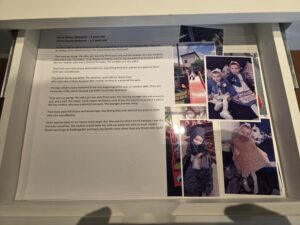
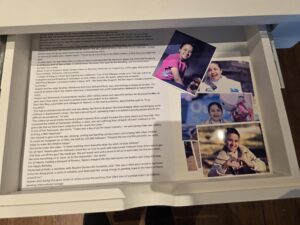
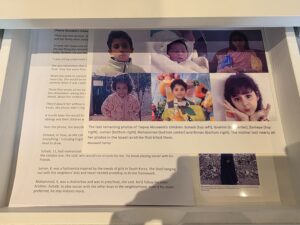
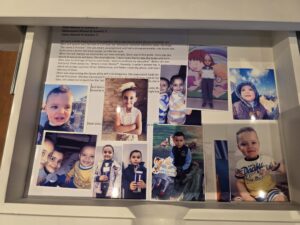
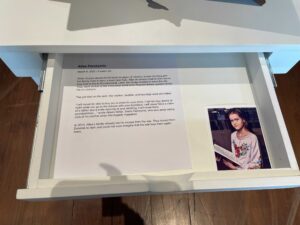
Each desk has a drawer. When you pull it out you see photographs of a child and a text. Each text details stories from the child’s life, how they were killed, and many photos of the child.
Batool
This exhibition is heartbreaking. As we look at the photographs of the happy child with her family, and read the texts, it is almost unbearably sad. I
t is hard to imagine how the artist could create this work. But Humaira has been a socially engaged artist for a long time, so this is only an intensification of her deep commitments. This sense of art for social justice began whem she was an art student in Pakistan and saw the discrimination that female artists faced in Pakistan.
She worked directly with families for their stories
She has 17 from Gaza, 2 from Israel, and 4 from Ukraine
Hamza and Raqid
eight children
Farah and Zaina
Yaqeen
Taqwa Abudeid’s children Suhaib, Ibrahim Juman Mohammed, Riman Juman, Sumaya There was one survivor
Adam Ahmed,Mohammad,Shan Al-Suwelsi
Ukranian 9 year old Alysa Perebyinis
This entry was posted on September 18, 2025 and is filed under Uncategorized.
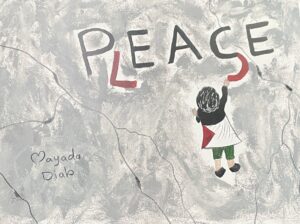
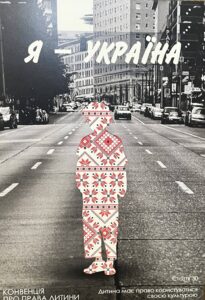
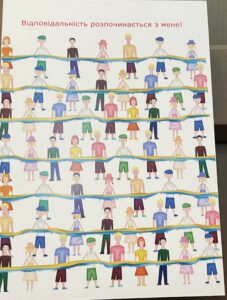
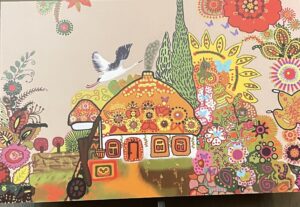
There is less art from Ukraine and I did not have an explanation as to how it arrived in Seattle, but this strong image is on the cover of the brochure as an emblematic image from Ukraine. I include more at the end of the post
Drawings by Children of Gaza
Brought to Seattle by D’vorah Kost Shown at St. Marks Cathedral Seattle
as a series of events called “Sacred Spaces.”
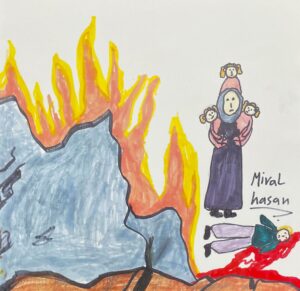
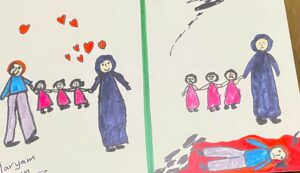
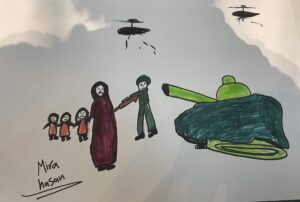
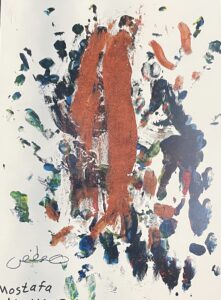
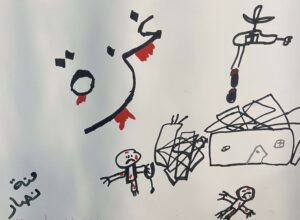
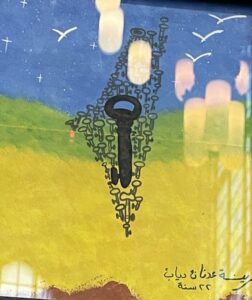
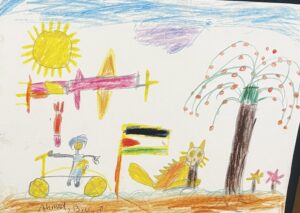
The small drawings were easy to overlook in the corner of the huge cathedral, but once you looked closely, you could not look away.
Wejdan Diab founder of Meera Kindergarten with children
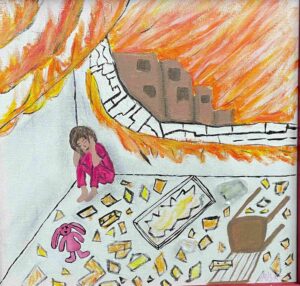
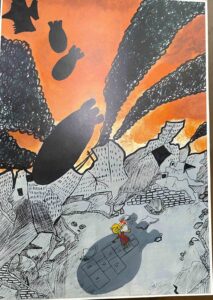
All of these children have experienced what they draw first-hand. Each child has a unique style, but all of them are vividly depicting attacks by Israelis
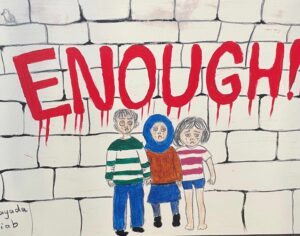
These works are by three triplets, watching their house burn, finding their father dead. and being pursued by a tank
a Home destroyed The We are not numbers book mentioned at the end of this column has esssays by youth writers who describe the constant destruction, and fleeing
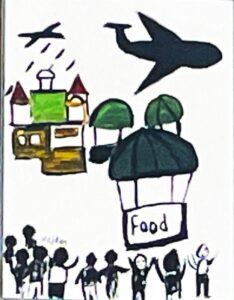
Food Drop
The food drops are chaotic and often turn violent
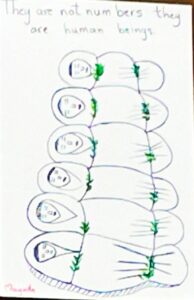
They are not numbers They are Human Beings
One of the few labels
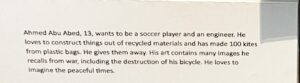
Ahmed Abu Abed. 13, wants to be a soccer player and an engineer. He loves to construct things out of recycled material and has made 100 kites from plastic bags. He gives them away. His art contains many images he recalls from war, including the destruction of his bicycle. He loves to Imagine peaceful times.
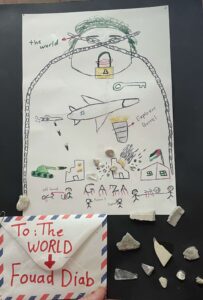
A collage by a Fouab Diad father of the children with actual rocks from Gaza
I highly recommend the book We Are Not Numbers (WANN), The Voices of Gaza Youth. WANN is a group of 385 Palestinian young adults. https://wearenotnumbers.org/. The website has recent posts and a way to buy the book.
The book is a selection of short articles by young adult writers describing their life in Gaza. It spans from 2016 to 2024. Many speak of participating in the Great March of Return that began in 2016. One of going to the beach, another of studying the stars (he is now studying astronomy in Russia), “The Betrayal of Wonder Woman,” “The Donkey Carts of Gaza” and much more. Four of the writers and one mentor/teacher have already been killed.
Some have escaped Gaza with fellowships, and some are helping with the WANN project inside and outside Gaza. Others received fellowships that they couldn’t take because the border is closed.
And of ocurse the situation is worse everyday. The Israelis are systematicly obliterating Gaza and its inhabitants
The book We are Not Numbers is available at Eilliott Bay Bookshops://www.elliottbaybook.com/
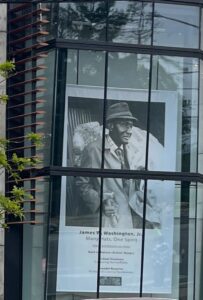
As you walk from the ferry toward the Bainbridge Island Museum of Art, you will see a large photograph of James J. Washington, Jr. holding a chisel in the window. It announces his exhibition “Many Hats, One Spirit” at the museum until Sept 17.
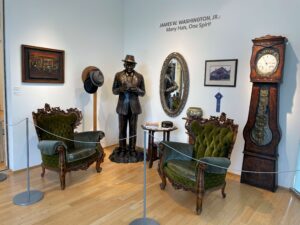
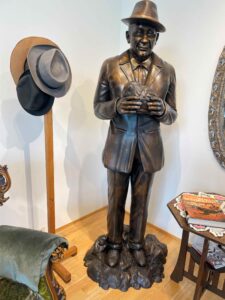
Once inside the museum, climb the staircase, so you first view a life size bronze statue of Washington by Barry Johnson, a replica of the piece at Union and 24th street.
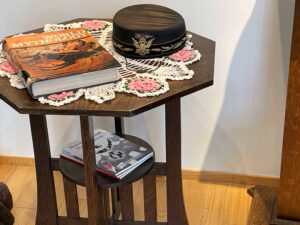
The statue is set in a re-creation of his living room with two enormous chairs and a table with books and a masonic hat .
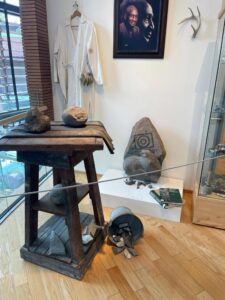
In the same space is an evocation of his studio with tools and stones.
Passing through glass doors, we are immersed in Washington’s works, as well as the contemporary artists whom he inspired. The exhibition is beautifully installed.
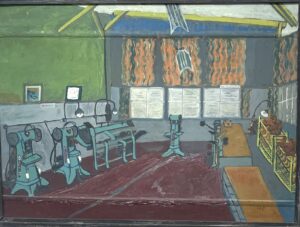
A concentration of Washington’s works in the exhibition include early watercolors of intensely colored images of churches and streets from Mississippi, Arkansas and Seattle (Needless to say even in Seattle, as a Black man, he had to be careful about what and where he painted.)
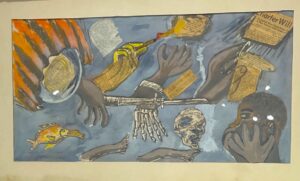
In the earliest carving, a small block of wood with the title The Chaotic Half (1946), a hand reaches out to vote as a hooded character holds him back, ( what has changed since then?) Also from the 1940s (at the other end of the gallery), two paintings comment on the status of African Americans.
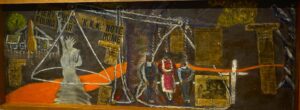
In the Making of the UN Charter (1945 a horrified black man is relegated to the lower right hand corner;
Democracy Lynched (1946), depicts unbalanced scales of Justice with a black family on one side being lynched.
Washington was involved in Civil Rights actions from early in his career, so these two paintings represent important statements in that trajectory. His archives give us a great many documents on Civil rights actions in Little Rock, Arkansas and Seattle.
In 1944 he moved to Seattle to work as an electrician in Bremerton with the civil service. A few years later he moved to Seattle and was permitted to set up a Shoe Repair Shop at Fort Lawton (1950).
At the same time he was also becoming known as an artist among the soon to be famous Northwest artists , especially Mark Tobey. Tobey and Washington shared an interest in spirituality.
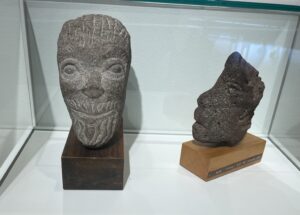
After a trip to Mexico in 1951 when he met Diego Rivera and David Alfaro Siqueiros, he picked up a small lava stone at Teotihuacan that was to lead to a decisive change in his art.
Four years later he sculpted Young Boy From Athens, (on the right) from that rock , leading to his long career of sculpting stone. In the exhibition we see several examples of his bird sculptures, as well as portraits and spiritual symbolism.
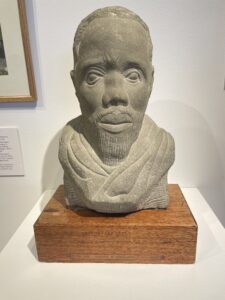
One of the strongest portraits is Jomo Kenyatta(1962), not yet President of Kenya. We see here an inspiration for Charles Parrish’ small bronze portraits Desmond Tutu, and Veteran shown nearby.
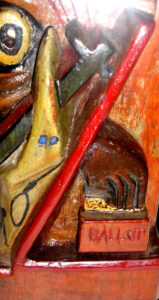
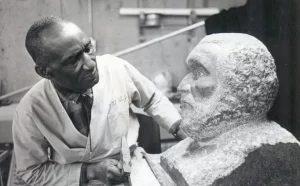
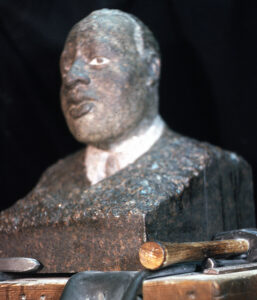
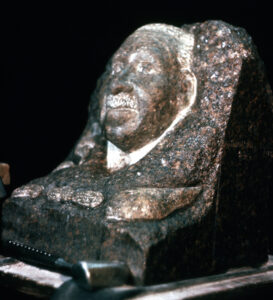
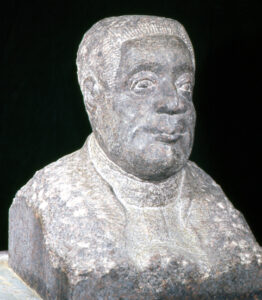
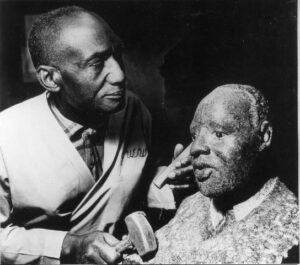
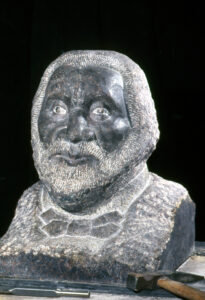
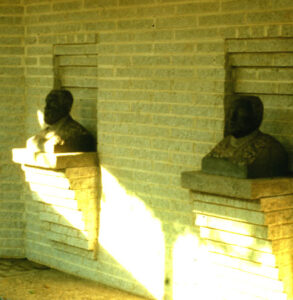
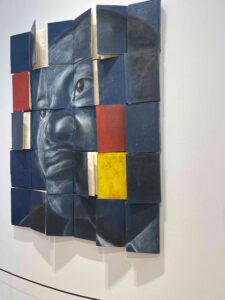
One of Washington’s most important commissions was a set of famous black men created in 1969 Here we see him carving one of them Frederick Douglass
Martin Luther King
George Washington Carver
Crispus Attucks
Frederick Douglass
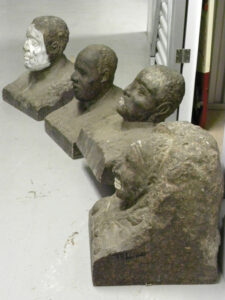
Theu were installed in Philadelphia in a Rotunda of Achievement but they were vandalized the next day and removed. I found them in a storage locker in 2009. It is very sad that they have never been restored.
———————————–
The Artist in Residence Program includes 25 former Artist in Residence .
Carletta Carrington Wilson and Christian French showed work made during the residency.
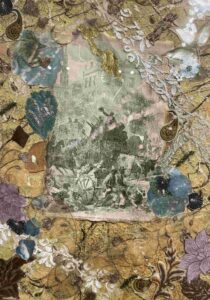
Carletta’s wonderful layers of fabric collage include a page from Harpers Weekly during the Civil War depicting African Americans performing various duties.
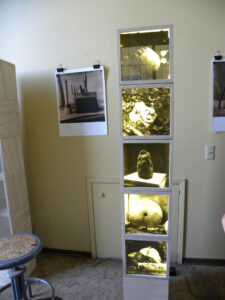
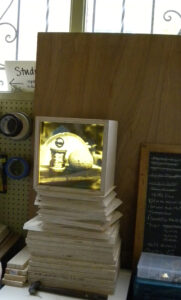
Christian French explained how he created his totem “from Polaroids I took onsite of stones around the studio and yard. Those were then scanned digitally and printed out larger on transparent material for the lightboxes, which I also assembled onsite.”
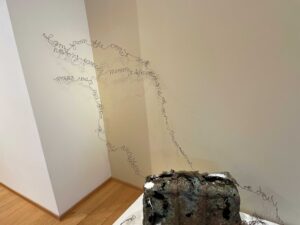
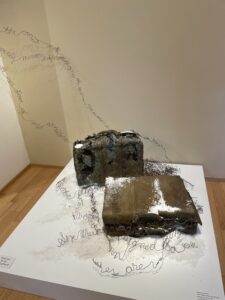
Mary Coss’ salt eroded metal suitcases suggest endless travel. Long dangling wires made words referring to migration and memory and speaking about her own family’s experiences.
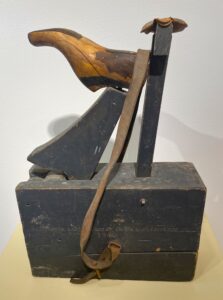
Marita Dingus made shoes on Washington’s sewing machine during the residency, exhibited a small spiritual collage figure Contemplation.
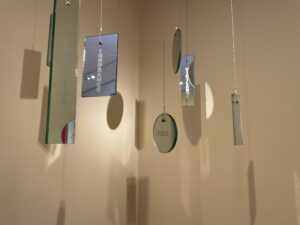
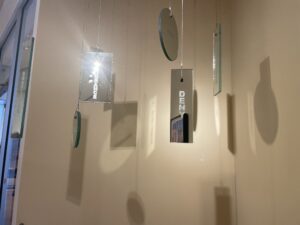
In one corner a group of hanging mirrors called Shaded by Christina Reed had one word on each side: “Unfounded/ Suspicion Deliberate/Ignorance
Fear/Ful, Evade/Truth, Constant/ Vigilance, Deny/Access, Intended/ Disregard.” As they turned on a wire, the message came through gradually.
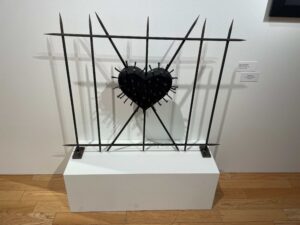
On the Fence, an evocation of love and danger by Ursula Stuart, featured a heart shaped motif studded with nails and hung against a fence. Ursula also created a group of protective amulets, including a witch and a queen. She connects to Washington’s belief in the spirit.
Lift Every Vice and Sing a portrait of King by Christen Meisel was made with hymnals. I found it very moving.
There are many other works to enjoy, but primarily what we experience is Washington’s spirituality. Much of that spirit emanates from the materials used for the art, his own stone sculpture or the artists discovering everything from nails and rounded stones in the garden to a model of a slave ship in his historic home on 26th st in the Central District.
“Many Hats, One Spirit” is a landmark event perfectly curated to provide a provocative dialog between Washington and the Artist Residents.
Ruth Asawa had an extraordinary childhood. In her early years she grew up on a farm with her immigrant parents, sharing in the hard work.
That idea of hard work stayed with her throughout her career as an artist. In April 1942, when she was sixteen her family was sent to a detention camp, first at Sant Anita racetrack, then Rohwer Camp in Arkansas. At the Santa Anita camp she had the fortune of learning from three Asian American artists for Disney.
After she graduated from high school in the Rohwer camp in August 1943, she was allowed to leave as long as she stayed away from the West Coast. She went to Milwaukee State Teachers College,
After learning she could not teach, she had the opportunity to go to Black Mountain College the experimental interdisciplinary arts school. It changed the course of her life.
These are some of the details with which Marilyn Chase begins her book , Everything She Touched, The Life ofRuth Asawa..
Chase carefully describes the artist’s unusual education at Black Mountain College, her study with Josef Albers and Buckminster Fuller, her love affair with Alfred Lanier, and her move to San Francisco to start her family and her career. She was life long friends with Albers and Fuller.
Chase’s book is an easy read and it includes a continuous narrative that focuses on her professional activity and her personal life, much of it based on letters.
Asawa’s woven wire sculpture were embedded in her home. In the current retrospective exhibition at the San Francisco Museum of Modern Art, photograph of her living room in front of a partial recreation of the space. We see her sculpture hanging from the ceiling throughout the huge space.
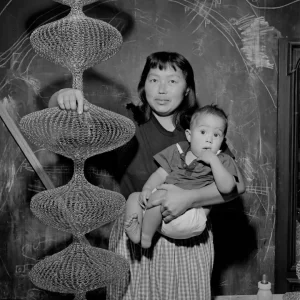
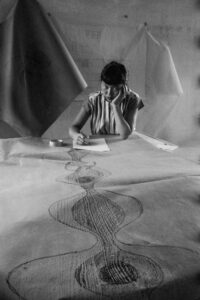
She welcomed her children to be part of the creativity,: a baby sitting in a wire basket as Asawa wove around him, and her other children pursued their own creative endeavors as she worked. Shw was photographed by Imogen Cunningham, her dear friend, many times.
Jordan Troeller Ruth Asawa and The Artist-Mother at Midcentury emphasizes the ways in which Asawa, together with other what she calls “artist-mothers” managed to produce extraordinary art as they were raising children. Troeller’s focus is to combine motherhood and creativity (she leads a research group on “The M/Other Project: Creativity, Procreation, and Contemporary Art,”).
Ruth Asawa raised six children, defying the idea that having children prevents woman from making creative art. Various Asawa techniques such as weaving and knitting, connect to female traditions, Troeller suggests, because they enable the artist to start and stop as is necessary with children. Actually Asawa’s incorporation of her children into her art process defies that logic. Asawa’s work ethic and ability to embrace creativity as a generous gift, meant that she worked almost nonstop, with her children helping as they grew older.
Other chapters in Troeller’s bookfocus on flowers, folding, or
pregnancy, to name only a few, themes, integrating them with aspects of her work.
The best known image of pregnancy is the “Andrea” cast bronze public sculpture in San Francisco. I found the book a bit overboard in connecting everything to a feminist analysis- if she had not been so focused on motherhood, as metaphor and literally, her analysis would have been more useful. It is clearly, though, a feminist answer to patriarchal tropes and the parameters of making art as a woman.
As an art historian, I have to say that the large book accompanying her major retrospective at the San Francisco Museum of Art is comprehensive and invaluable. Janet Bishop, editor, Ruth Asawa: Retrospective, includes essay after essay that clearly follow a theme such as “From Tool to Ornament, Ruth’s Intricate Refusals,” and “What Cannot Be Produced Alone : Ruth Asawa’s Public Art.”
The exhibition follows all the stages of her art career, from single woven wire baskets to complex hanging sculptures enclosing one orb inside another. Then a new technique of tying wire, electroplating it,
and much more. These dazzling hanging works are her best known work.
The complete discussion of her public art is also represented in the catalog and the exhibition, where we saw studies and photographs. The installation at the San Francisco Museum of Modern Art even included a sample of her garden.
For Asawa, as we learn in this thorough study, Zen Buddhism was part of her world view, as well as nature itself. Her drawings of leaves and plants show her understanding of the intricacies of the natural world.
In the chapter on public art, bronze casting is a major departure, as well as the scale of the works she took on, a huge low relief of the Japanese Internments camps, a wall called San Francisco Fountain, with many small reliefs of life in San Franciso, and many more..
Her creativity also extended to schoolchildren, teaching innovative ways to make art with materials such as milk cartons, and “bakers clay” (flour, salt and water.)
Last, Asawa engaged with civic affairs, founding an art school, now called the “Ruth Asawa San Francisco School of the Arts,” and lobbying for more art education in the public schools.
The magnificent sculptures that Ruth Asawa created hang in space, and surround space. They embrace interior and exterior, the delicate and the strong, the idea of growth and the idea of stasis. It is hard to overstate her contribution: her wire-based art, at first seen as simply decorative, is now understood as major accomplishments of twentieth century sculpture

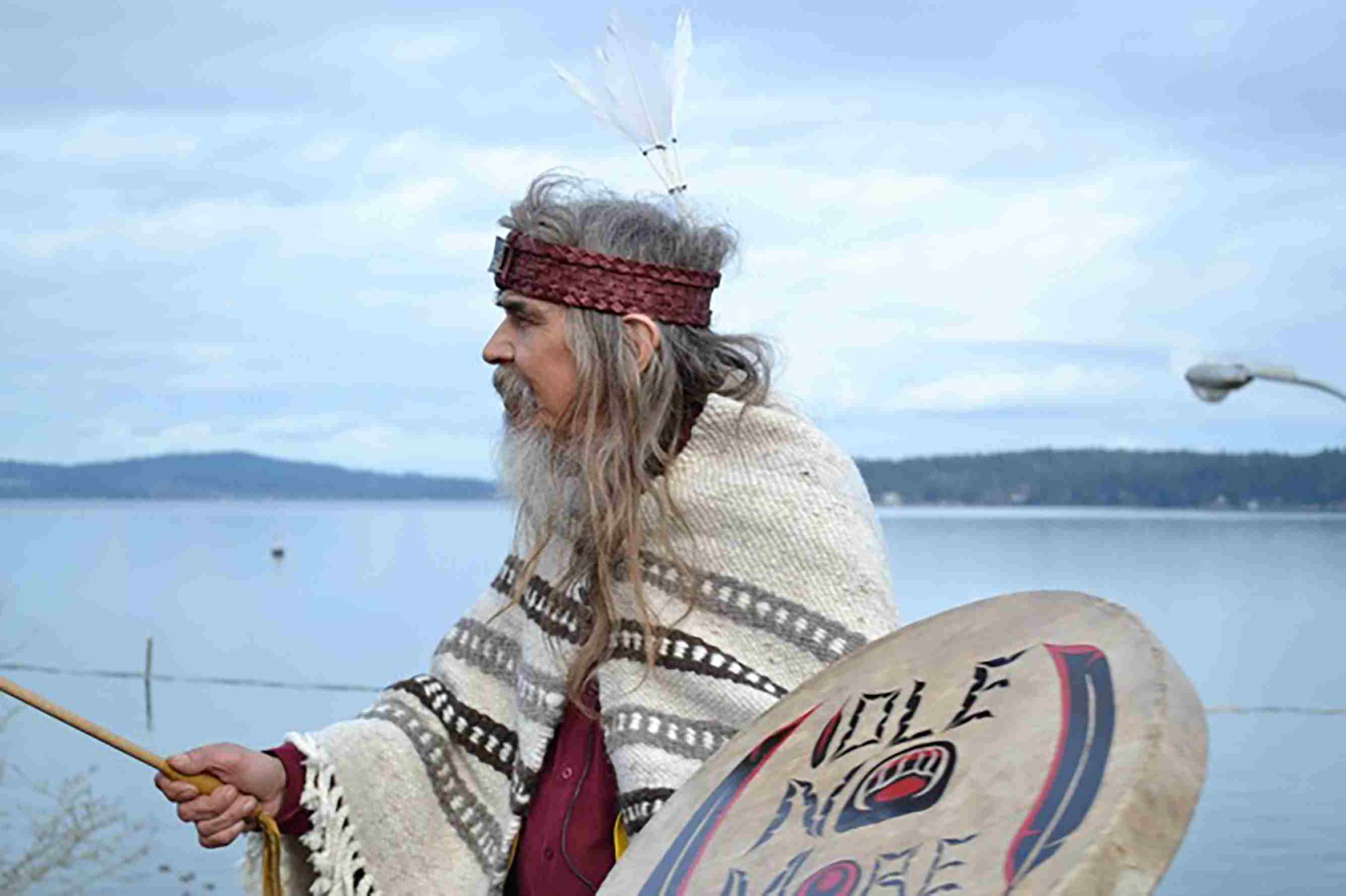 “Beau Dick : Insatiable Beings “ until January 18th Frye Art Museum 704 Terry Ave, Wed- Sun 11-5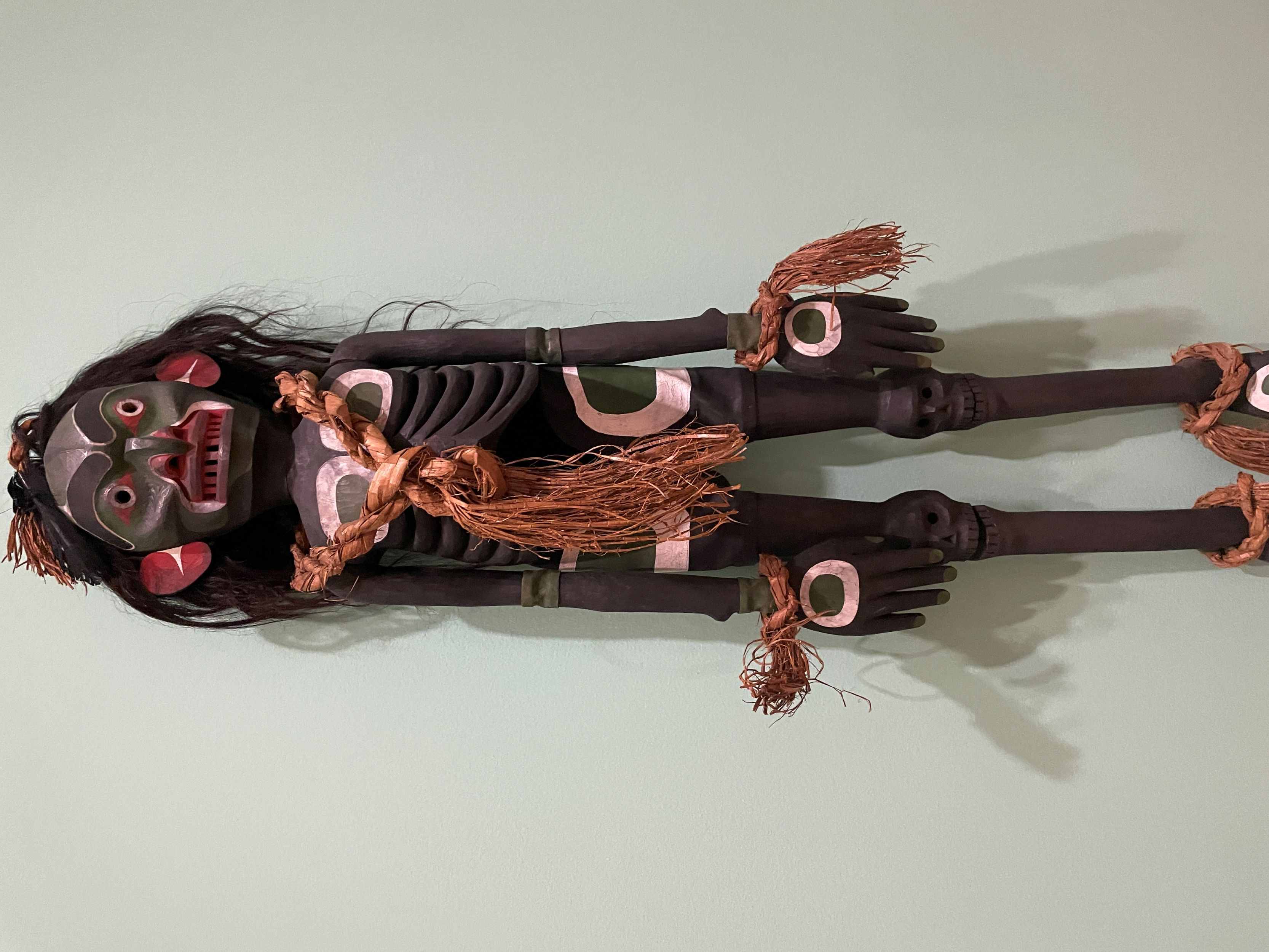
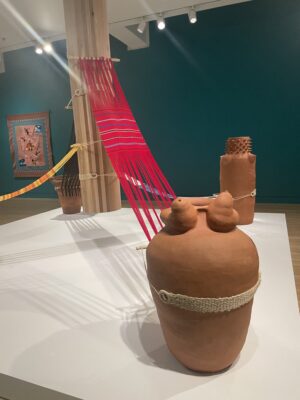 In the center of the exhibition an installation large ceramic vessels suggest women’s torsos. “The four winds gathered around Tree and her threads.” They contain whistles and are connected by backstrap weaving, a long tradition in Mayan culture, to a “tree” representing the Mayan tree of life.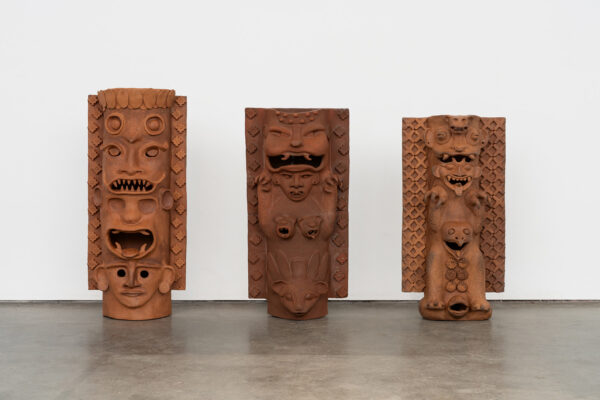











 e Shape of War” consists of twenty-four children’s desks (she plans on creating many more). On the desk is a “Rehal,” that would hold a Quran.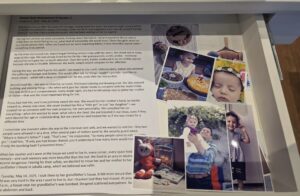



 but they were vandalized the next day and removed. I found them in a storage locker in 2009. It is very sad that they have never been restored.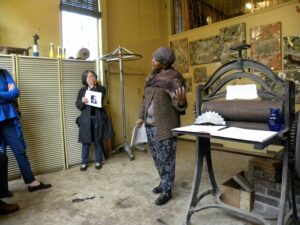
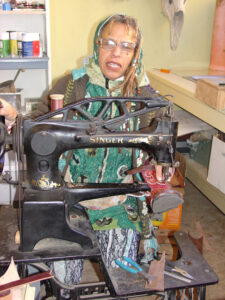
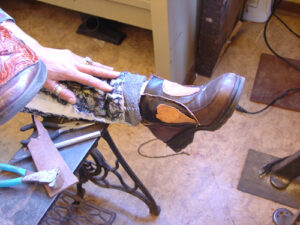 Marita Dingus made shoes on Washington’s sewing machine during the residency, exhibited a small spiritual collage figure Contemplation.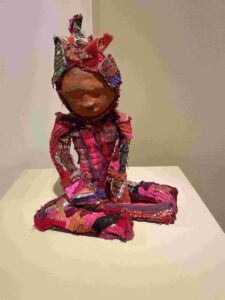

 and much more. These dazzling hanging works are her best known work.