Carletta Carrington Wilson: Object Lessons
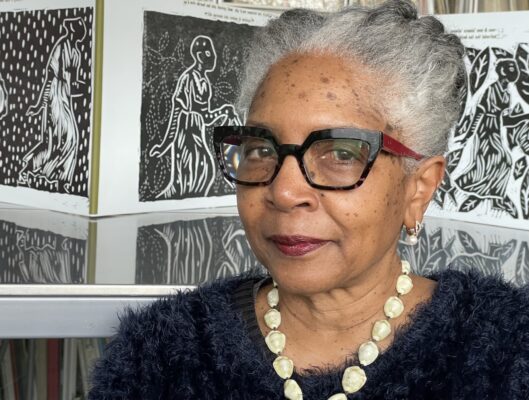
Carletta Carrington Wilson’s large exhibition at the Bainbridge Island Museum of Art. “Carletta Carrington Wilson: Object Lessons” highlights all phases of her career!! It closes on Sept 20. The Museum makes a perfect day trip with a bus to downtown Seattle, a beautiful ferry ride and a short walk to the museum. She will be in the gallery on August 26 11-1
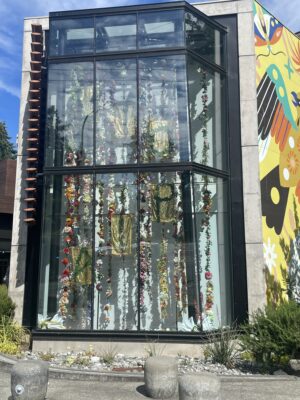
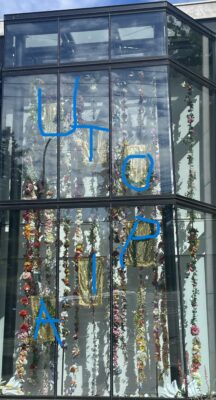
In the large window on the outside of the Bainbridge Museum of Art, Carletta Carington Wilson created a two story installation. If you look closely you can see the word “Utopia” spelled in giant letters ( It is hard to see in this photograph- the golden squares contain the letters. I sketched it in on the right))
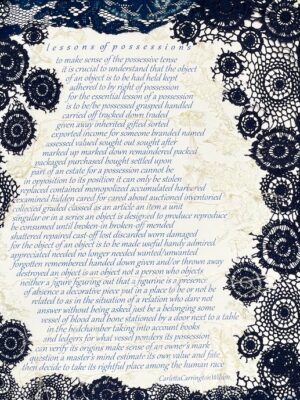
Going upstairs to the Beacon Gallery we are greeted by a poem called “Lessons of Possession” It begins
“To make sense of the possessive tense it is crucial to understand that the object of an object is to be had held kept adhered to by right of possession . . .”. All of it is an ironic but heartfelt statement about slavery.
The Feferman gallery downstairs creates a dazzling effect with multi colored fabrics, but as we approach the individual works we see there is much more at stake than aesthetics.
The works divide into distinct series: “constellation of shadows and leaves” (2006) the “Mingus Series” (2008) the “book of the bound,” (2011) in honor of slaves who could not read, “knot my name haint my house” ( 2015), “kNot free, kNot human,” (2023).
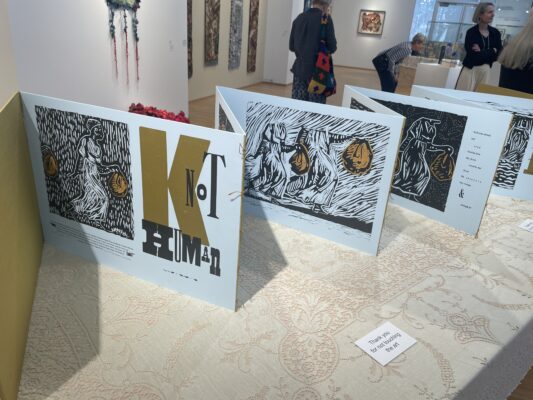
Wilson is a poet as much as a visual artist, and her wonderful sense of the multiple meaning of words flows through all of her art.
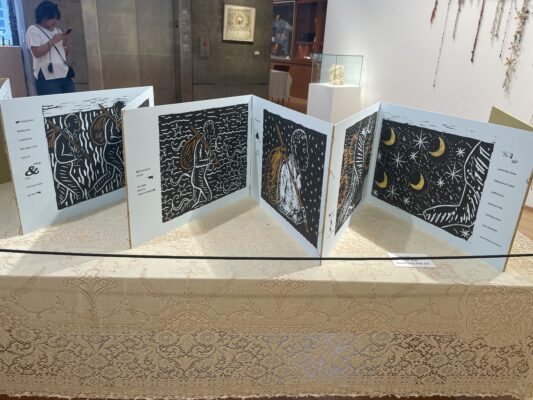
She creates stunning aesthetic objects to educate us to the horrors of slavery. In this case the escape of a female slave
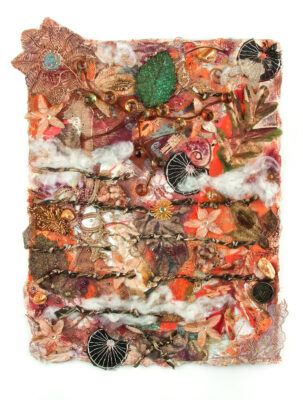
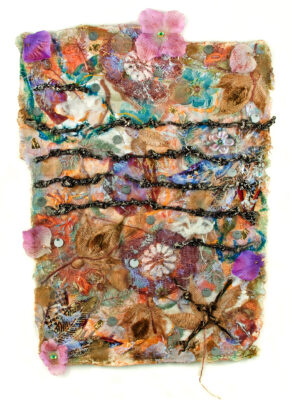
These are two works from the field notes series: “wrap my right hand tight” and “woke fore day”. We see the collage of many fabrics. Twisted and knotted paper lines constitute a unique form of connection between the field notes. Each letter-sized collage’s message is signed with an X, the universal signature of an illiterate person.
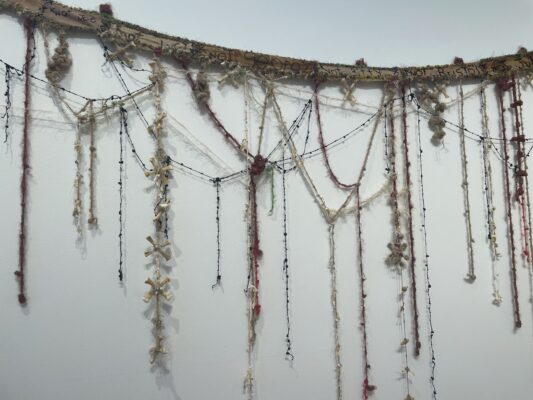
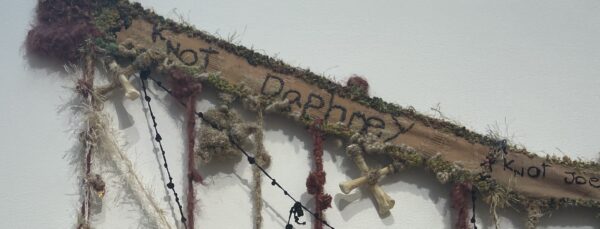
On one wall hangs “the knotted line of cloth cord, thread, bones, wire. The knotted line is a genealogical chart of names of people listed as property from plantation records in the 19th century. Each embroidered name is preceded by the word
k/not.
The lines represent African, European and Native American bloodlines and how they are genetically knotted. These tangled knots speak to the mixture of blood lines among slaves and the impossibility of tracing ancestry
Another pair of hanging works represent a male and female runaway.
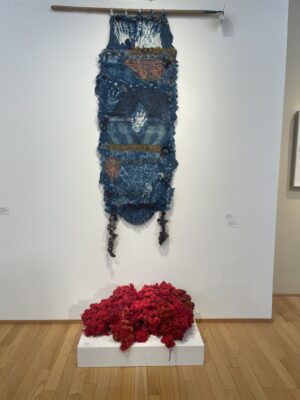
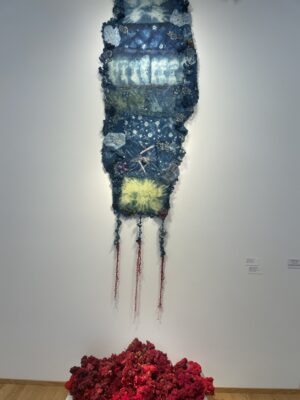
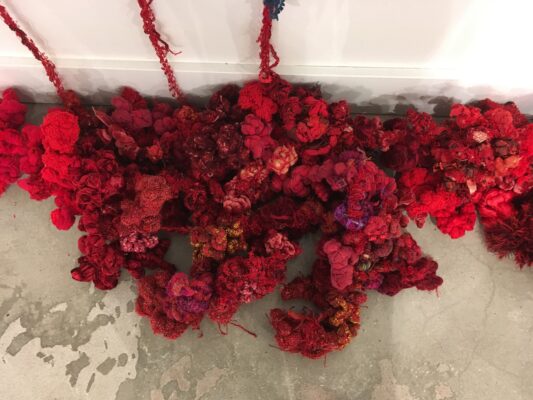
“resist dying” describes
both the technique and the action; below it is a “blood knot,” a tangled rich red colored cloth.
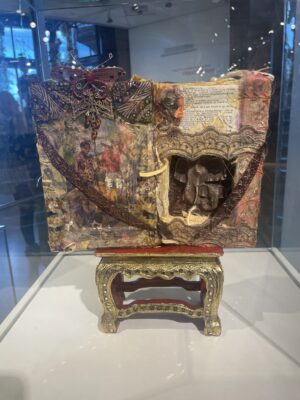
“book of the bound”
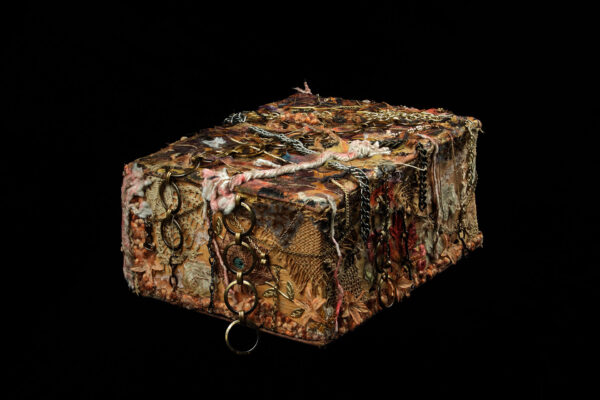
There are six examples from the” book of the bound” series. above is one of the most powerful., actually called “book of the bound,” closed with chains.
One of the covers is made of bones attached with lace called “abduction”
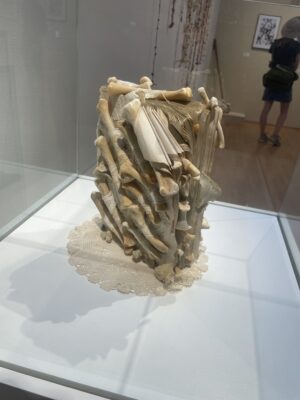
The artist comments “Most of my work is not distressing to the eye. “abduction” is one of the last books
In the “book of the bound series”. I thought about people who died on the way to the coast, died
in the forts, passed away in the ships or jumped into the sea, expired soon after reaching dry
land, were murdered and/or killed themselves. It is a memorial to those who lost their lives.”
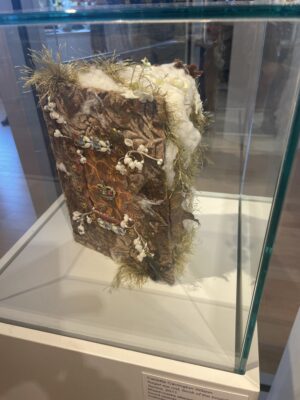
Others emphasize cotton, as above “forget me not”.
Some are covered with beautiful fabrics. Carrington Wilson uses fabric as the means of suggesting the connection of trade, money and the “thread-bare body”: the wealth of the traders was based on the bodies of the slaves.The fabrics throughout the exhibition are decorative but painted with words that speak to the slave trade. Because European slavers often traded fine fabrics like silk and velvet in exchange for bodies, Wilson believes the stories of their bodies remain in the cloth.
Her collaged covers become a song to those who could not fill these books with their stories.
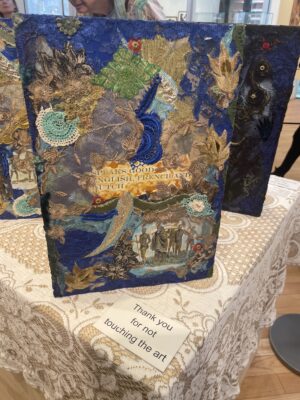
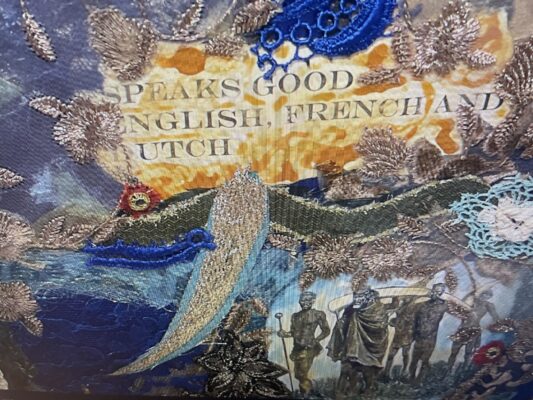
In this example we see an ad saying “speaks good English, French and Dutch” and an illustration of slaves carrying an elephant tusk The artist explains “In the trade the term “black ivory” was used to describe Africans who brought elephant tusks
down from the deep interior to the coast. After they delivered, not only were the tusks sold,
but Africans found themselves sold into the trade.”
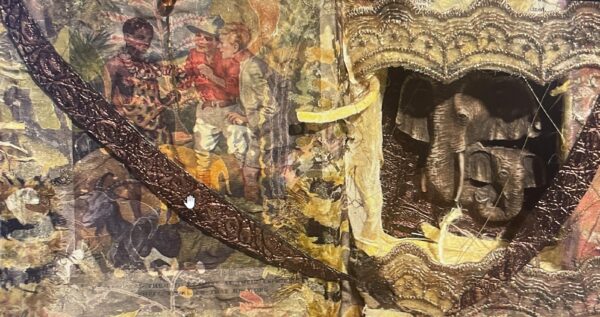
“I am bound to go there” Here you see a mother and baby elephant inserted as well as an image of two white youths inspecting a necklace on an African boy. The artist wants to bring attention to how enslaved African children and English indentured children
are a little recognized part of the transatlantic slave trade.
“letter to a laundress”
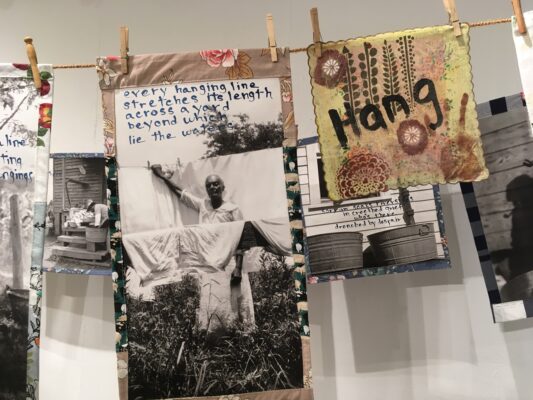
“letter to a laundress,” a letter to her great great grandmother, dominates the exhibition as a poem and a series of 1930s photographs mounted on fabric and hanging from a clothes line .
It has two texts, the large and the small
Here iin small letters it says “mothers of the blue blue waters who hung from those knotted lines” ( you can easily understand the multiple meanings here)
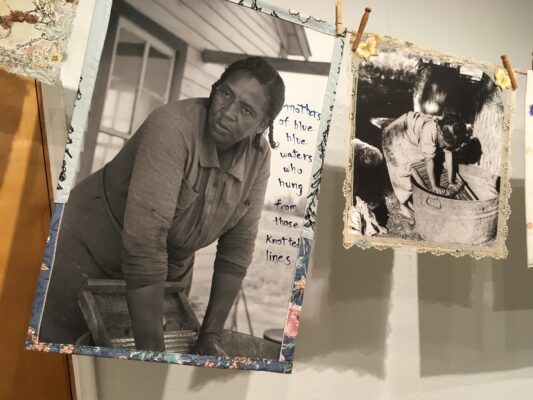
Written on the photograph below is one step in doing laundry: Wash, Soak, Starch, Wring, Boil, Pin, Rub, Scrub, Hang Press.
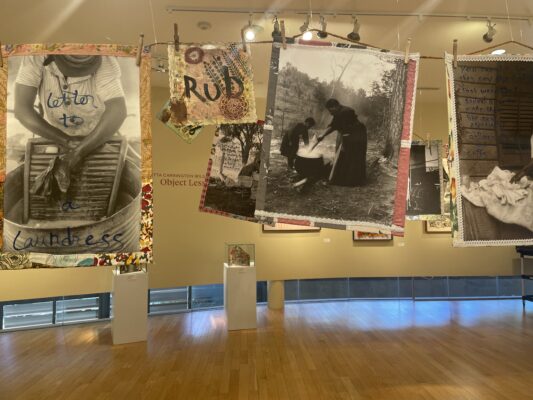
The WPA photographs of laundresses reveal the different background of the women, some are wearing rags, others are in dresses and heels.
As the artist explained
“Each photograph, dating from the late 19th to mid-20th century, reveals a woman frozen by the lens of time who has been, largely, unseen in works of history or photographic essay. In addition to its visual narrative of tools of the trade, architecture, geography, labor and clothing, history, this work reconfigures the figure of the laundress and the washerwoman as witness. It
sheds light on the unique position these women held as a result of their occupational tasks during an era where African Americans were summarily lynched throughout the United States.
letter to a laundress is an immersive installation that mirrors a ubiquitous and familiar form from a bygone era, the clothesline.
“Viewers enter this work, moving through time while, simultaneously, reading lines of a poem whose verses are written upon various
panels of photographs of laundresses and washerwomen”
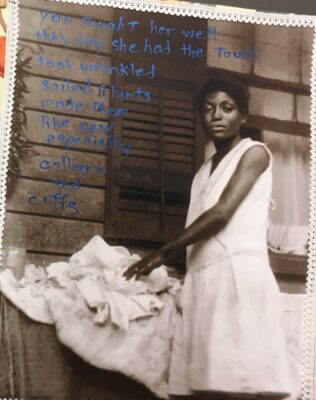
“You taught her well they say she had the touch took wrinkled soiled shirts made them like new especially collars and cuffs”
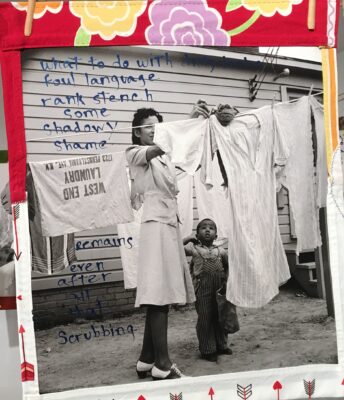
“What to do with foul language, rank stench, some shadowy shame remais even after all that scubbing”
In these two examples you see differences in dress that suggest one woman is better off.
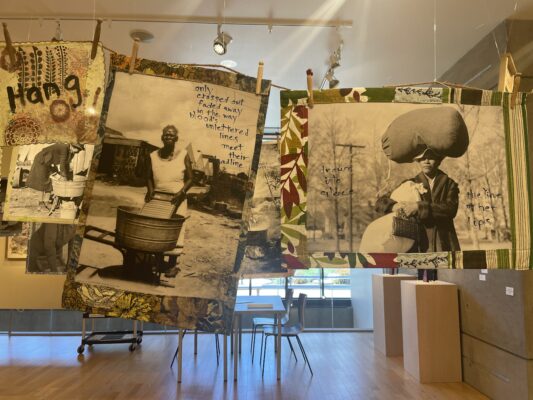
The layers in Carletta Carrington Wilson’s words inscribed and pasted onto these art works give voice to the silent women of the photographs. If you want more discussion of “letter to a Laundress” see my blog post
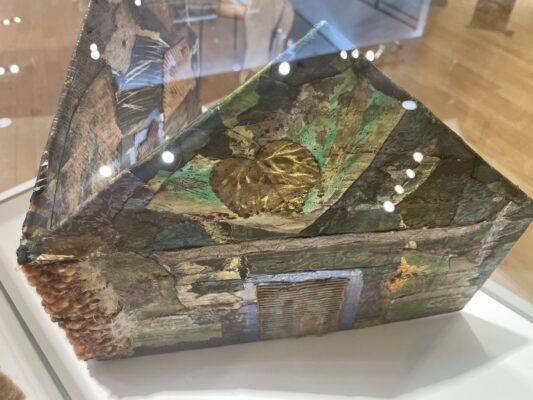
“Joe’s House” from the series “knot my name, haint my house”
We see a simple house evoked with collage on its walls.
In addition the exhibition includes recent work such as No Way Out, 2026. An ironing board covered with black fabric and bearing a vertical row of red x’s’ is paired with two irons painted with red hand marks. And the title of the” letter to a laundress” above
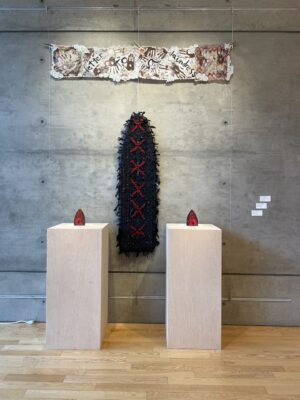
It is a powerful statement . The x’s represent the signature of illiterate people but may also be a reference to writing in blood. The title and shrouded ironing board honors
as the artist put it: “No way out is a memorial symbolic of six lives of unknown individuals lost by lynching.
The ironing board and the irons give testament to the knowledge laundresses and washerwoman carried as they performed their tasks.”
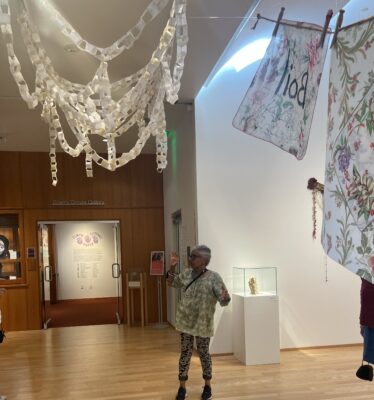
Carletta is standing under a paper garland made by visitors who have written on pieces of paper calling out to the distant slaves
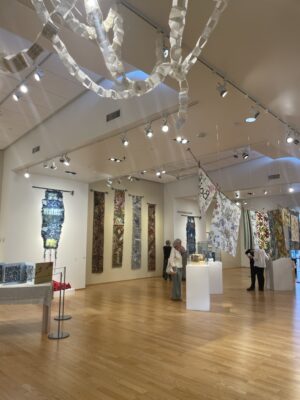
An installation view of the exhibition suggesting its coherence and beauty. The many works come together as a powerful statement about slavery and a testament to Carletta’s strength as both an artist and a poet.
Here is another blog post about Carletta.
This entry was posted on August 16, 2026 and is filed under African American history, Art and Activism, Art and Politics Now, Bllack Art, Carletta Carrington Wilson, Carletta Wilson, Uncategorized, violence against women.